Friday, June 20, 2014

Gabriel Garcia Marquez's Bogotá Years

Gabriel Garcia Marquez's portrait in the exhibition in the National University's library.
In 1942, the teenage Gabriel Garcia Marquez arrived in Bogotá, and found the city dark, rainy and generally depressing. Nevertheless, it would be the place where he would find his leftist ideological formation, enroll in university, publish his first poems and short stories and get his start in journalism.

Publications by and about Marquez
in the Nacho's library.
Unfortunately, however, you won't learn much of that from the sparse exhibition about Marquez on now in the lobby of the National University's main library, which was renamed after the Nobel Prize-winning author after his recent death.

Paradoxically, a lot more information about Marquez was on display recently in an interesting and detailed exhibition that was up only during a brief book fair on the university's Ché Plaza.

The exhibition in the library will interest Marquez fans: there's his university inscription document, as well as editions of books by and about the novelist. But it's embarrassingly sparse for a man of such accomplishment and the university's most famous ex-student.

I wish I knew where the book fair exhibition is stored away. Perhaps somewhere in the university's
Marquez's Universidad Nacional registration paper.
literature department. It's worth seeking out for anyone wanting a fuller picture of Marquez's life.

That exhibition included Marquez's famous (or infamous) description of the Bogotá he encountered in 1942  on arriving from the warm and sunny coast.

"Bogotá was then a remote and sad city, where a drizzle had been falling since the beginning of the century."

But Marquez grew to like - or at least appreciate - the Colombian capital's quirks and characters, including its spark-throwing streetcars and dignified funerals. He also became an habitué of the cafés in the city center, where he debated literature with other intellectuals.

Marquez enrolled in a high school in Zipaquira, north of Bogotá. The school was incorrigibly leftist,
and Marquez later recalled that even his physics professors graded students more on their ideology than their learning.

"I dare to think that most of my professors graded me more on my personality than my tests," Marquez wrote.

But, he added, a professor named Calderon saw talent in one of Marquez's short stories and urged him to continue writing, despite classmates' teasing, "if only for my mental health."

Marquez's first published
story 'The third resignation.'
In 1947, Marquez enrolled in the National University to study law, primarily to please his parents. But his university career cut short by the April 1948 Bogotazo riots, which sent the budding author to Cartagena. His memories of the University are less pleasant: He describes law school as "an alley with not exit" and didn't understand the subject - despite having Alfonso López Michelson, son of a president and later president of Colombia himself, as a professor. Marquez's best memories of university life were his long walks and talks with other leftist intellectuals, including priest Camilo Torres, the university's chaplain, who two decades later would claim his own place in Colombian history by joining the ELN guerrillas and finding martrydom in his first battle.

It was in Bogotá that Marquez read a version of Franz Kafka's 'Metamorphosis' rewritten by Argentine writer Jorge Luis Borges, which revolutionized Marquez's literary mindset. In 1947 and '48 he published his first three stories in El Espectador: 'The third resignation,' 'Eva is inside her cat,' and 'Tubal-Cain forges a star.' The three displayed the influence of Kafka and of the Bible.

 Marquez later recalled how he'd been told to climb to the second floor and hand his manuscript to the
Marquez admired populist politician Jorge Eliecer Gaitan,
whose 1948 assassination sent Marquez to Cartagena.
paper's literary editor. However, terrified, Marquez simply left the pages in reception and ran away. Nevertheless, two weeks later the story was featured with its title in grand letters.

Four years earlier, Marquez's first published work, a poem called 'Song,' (Canción), appeared in El Tiempo's literary supplement.

Marquez later became a reporter for El Espectador. In 1955, the paper's editor asked Marquez whether he had plans for the following Friday. Marquez did not, and the editor assigned him to a two-week trip to cover a political meeting in Geneva, Switzerland. Marquez's reporting trip to Europe would extend to five years, during which, while living in Paris, he wrote his first novels.

In 1955, El Espectador sent Marquez to Europe to
cover a political meeting. He stayed for five years.
Marquez eventually would warm up to the cold city of Bogotá. He later said that he had "5,000 anecdotes about Bogotá, the city where I was formed."

And he even reconciled the Andean city with his coastal roots. Bogotá, he would later write, "is a green and endless beach at 2,600 meters above sea level."

'Insomnia' by Marquez.
Marquez with friends in Bogotá.
Related entries:

Wednesday, June 18, 2014

The Wayuu Way of Peacemaking

A portrait of a Wayuu putchipu'u and goats, a common desert livestock.
The Wayuu people, popularly known as the Guajiras, are native to the desert Guajira peninsula which protrudes into the Caribbean Sea between Colombia and Venezuela, which divide the region.

Wayuu in traditional dress.
The region has a history of contraband and lawlessness, and the Wayuu themselves share that reputation. Historically, pirates, explorers, slave traders, guerrillas and paramilitaries, smugglers of drugs, weapons and gasoline have all criss-crossed the region. And the Wayuu themselves divide themselves into clans, each with its own symbology, which sometimes fight each other.

Symbolic gifts of bead collars are often used to make peace.
It's fortunate, then, that the Wayuu also have traditional peacemakers, called putchipu'u, who work as intermediaries to make peace agreements, often thru the use of symbolic gifts such as bead collars. An exhibition now on in the basement gallery of the Museo de Oro in La Candelaria describes the practice (with English-language texts) as well as Wayuu culture in general. Peacemaking amongst the Wayuu can be particularly challenging, because by tradition they demand payment, usually in livestock, for any blood let - even when the cause was accidental.

The exhibition also touches on other, sometimes contradictory aspects of Wayuu culture. For example, theirs is a matrilineal society, in which relations are traced thru the uterus (that's the real terminology). However, in Wayuu tradition young men are also expected to pay a bride price, usually in livestock, to the woman's family before marriage. Many women interpret this as being purchased.

Yet, from what I've seen of Wayuu culture it is the women who seem to dominate.

The Wayuu are one of the indigenous peoples who have prospered most in western society, sometimes becoming wealthy traders (and smugglers), but have also preserved many of their traditions.

If the ongoing peace negotiations between the Colombian government and leftist guerrilla groups derail, they could do worse than call in a putchipu'u to put things back on track.


Wayuu elders.


Traditional Wayuu bags, and a desert scene.
An intricately carved bird on a walking stick representing authority.

By Mike Ceaser, of Bogotá Bike Tours

Tuesday, June 17, 2014

Futbol in sthe Park


Bogotá has been transmitting the soccer World Cup on big screens in several public parks, including Parque de la Independencia, in these photos. And folks have been turning out to watch - even in the rain.

I also saw a presence of police - or, at least, city crowd minders. That might be a good thing for Colombia's next victory, assuming there is one. After all, during the celebrations over Colombia's 3-0 trampling of Greece on Saturday 10 people were killed.


By Mike Ceaser, of Bogotá Bike Tours

Monday, June 16, 2014

Santos's Second-Term Debts

Pres. Santos looking leftward for his second term.
Pres. Santos won a second term despite his own lackluster campaigning.

He has lots of unlikely allies to thank for his victory - and now he'll be expected to pay them back. As a result, many of Santos's second-term policies are already set, and out of his hands.

FARC Guerrilla fighters wave rifles.
The FARC guerrillas clearly gave Santos the nod by advancing the peace talks during the last weeks of the campaign. (And so did the ELN guerrillas by announcing peace talks just before the second round vote.)

Santos made the peace talks his campaign's central plank, and if a peace deal doesn't happen, then Santos will seem to have betrayed his leftist supporters and his second term will look like a failure.

However, the pressure to reach a peace accord could weaken the government's bargaining hand.

Santos's victory means Petro para rato.
Bogotá Mayor Gustavo Petro, whose ouster from office Santos signed a few months ago (and whom Santos put back into office a month later) sent his top staffers into the streets to campaign for Santos. Bogotá went handily for Santos and helped give him victory.

As a result, don't expect Santos to sign any more ousters of Petro anytime soon.


Polo Democratico/Union Patriotica presidential
candidate Clara Lopez.
The whole political Left will be presenting a bill to Santos for their surprising and surprisingly energetic support.

Clara Lopez, who got 15% of the vote in the first round as candidate for the Polo Democratico and Union Patriotica, even made TV commercials endorsing 'Santos and peace.' She will insist on the peace negotiations continuing. In one of her commercials, Lopez also mentioned free university education. Let's see if that enters Santos's agenda.


Bogotá's big vote helped put Santos over the top.
Bogotá turned out big and helped hand Santos his reelection. Will that now mean more central government infrastructure investment in the city? Even better would be strong policy initiatives. But that could generate conflicts with Mayor Petro, who seems to prefer to do next to nothing.

By Mike Ceaser, of Bogotá Bike Tours

Sunday, June 15, 2014

Santos's Campaign Secret: La Selección?

Pres. Santos and supporters celebrate his reelection victory. (Photo: El Tiempo)
Pres. Santos, it seems to me, ran a remarkably ineffective reelection campaign, despite impressive achievements to run on: The economy is growing at an almost 5% annually, unemployment is dropping, inflation is low, Santos has killed several important guerrilla leaders and the government-FARC peace negotiations are progressing.

Colombia beat Greece 3-0 on Saturday.
Nevertheless, just ten days ago some polls had Santos trailing right-wing candidate Oscár Iván Zuluaga - who until recently was almost unknown to Colombians - by as much as 10% in voters' intentions.

And then, today, Santos won reelection with a comfortable 6% margin.

What changed things? It wasn't the debates, in which Santos seemed to flail and Zuluaga made his arguments with confidence.

Members of Colombia's selección celebrating yesterday.
Pres. Santos had good reason to celebrate, too.
Perhaps continued progress in the peace negotiations helped, as did vigorous support from left-wing political leaders.

But a significant factor may have been Colombia's previous day's victory in the World Cup.

Before you shake your head, read this 2010 study 'Irrelevant events affect voters' evaluations of government performance,' which found that in United States elections, a victory by the local college (American) football team gave an incumbent politician an average 1.61% vote increase. The connection isn't rational, of course. But when a voter feels that things are going well generally, he or she can subconsciously transfer that sentiment to the local incumbent.
'Polls predict a Zuluaga victory in Colombia.'

'Big poll: Zuluaga 49% Santos 41%.'

'Santos 38%, Zuluaga 37%. 'The competition is head-to-head.'
Take that 1.6% number, add in the facts that this was Colombia's first World Cup appearance since 1998 and that the national team seems to represent Colombian patriotism, and it seems to me Santos' World Cup boost might have been 2 or 3%. In addition, a more enthusiastic public would tend to turn out to vote in higher numbers, which generally favors the more leftist candidate.

Arguing against a large football influence is the match's closeness to election date - by the day before the vote, most people have already made up their minds.

Still, it's hard to imagine that Colombia's resounding victory over Greece didn't make a difference of at least a point or two. Such a shift of votes from Zuluaga to Santos would at least have changed the election results from a tiny Santos victory to the minor mandate which he received.

Santos voters? Workers in Paloquemao market celebrate Colombia's World Cup victory.
By Mike Ceaser, of Bogotá Bike Tours

Saturday, June 14, 2014

What's a Victory Good For?

Workers go crazy in Paloquemao market as Colombia scores its second goal. I'm afraid I suffered permanent hearing loss.
A few scenes of celebration - and futbol paraphernalia - in central Bogotá today during and after the Colombia-Greece football game, which Colombia one overwhelmingly.

Today, they're celebrating. Tomorrow, they'll wake up to a country that still has a civil war, lots of poverty, hunger and other troubles. Hopefully, the presidential election will get as much attention as this match did.

Dancing away outside the Universidad Nacional.
Employees of Paloquemao Market.

They're not subtle.


Celebrators from a nearby 'Canadian' language academy cross an overpass above Carrera 45 near the Universidad Nacional.
The academy celebrators near the Universidad Nacional cheer Colombia's victory. However, the sign they're carrying is about emigration to Canada. 
The mural on the Universidad Nacional campus says 'Rebel Football, dignified and popular.'

The girls and the puppy are all dressed in the Colombian uniform.

Selling pirated jerseys on San Victorino Plaza.

Workers in Paloquemao Market watch the big screen. If not for that screen, would they have come to work?


By Mike Ceaser, of Bogotá Bike Tours

Friday, June 13, 2014

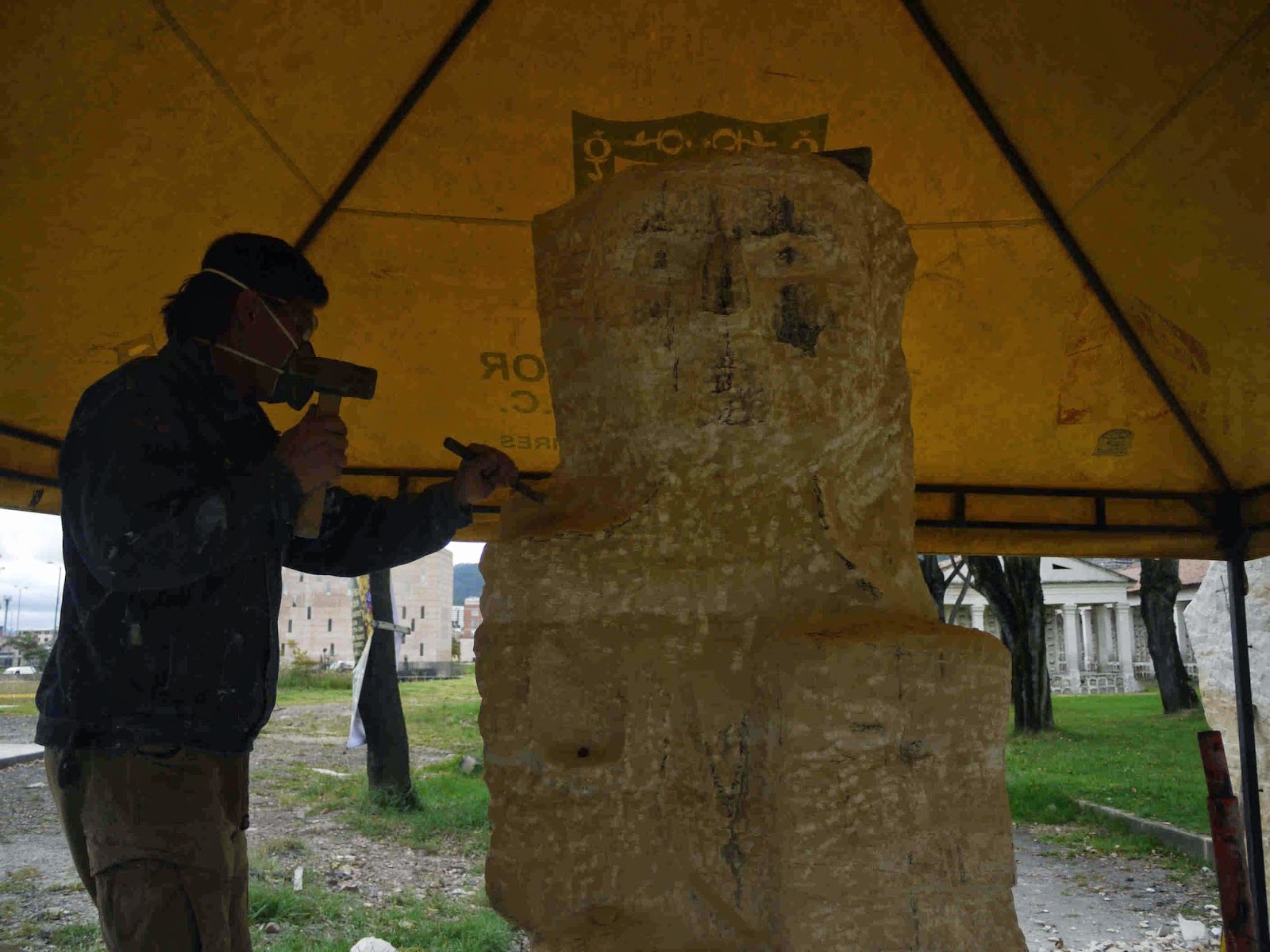
Sculpting Memory in Los Martires


A group of Los Martires residents have been sculpting these monuments in the field beside the Centro Memoria during the past several weeks. The sculptures, which are meant to represent themes of human rights, history and the culture of Los Martires, are to be finished by the end of the month, I was told.


By Mike Ceaser, of Bogotá Bike Tours