Showing posts with label Human rights. Show all posts

Thursday, December 13, 2018

Doris Salcedo's Empty Rooms


During the exhibition's inauguration, the artsy wait in line to visit empty rooms.
The floor is the work of art.
Appreciate it!
When I visited Doris Salcedo's memorial to victims of Colombia's conflict, I walked eagerly onto the property on Carrera 5 a block south of the Casa de Nariño. Salcedo created her tribute to the victims, particularly women who suffered sexual violence, out of tons of weapons the FARC guerrillas turned over as part of their peace agreement with the government, and which were melted down into brute metal.

For the memorial site, organizers found a centuries-old house whose adobe walls and columns have
slowly crumbled away in the rain and wind. Interestingly, they preserved the ancient house's remains, which itself seems like a haunting reflection on Colombia's long tragedy.

Melting down FARC weapons.
I walked into the building's hall, which led to what seemed to be an exhibition room. But the room was completely empty, except for a few other visitors standing around chatting. Confused, I headed up to the second floor, only to find that except for some first aid supplies, this room was empty too.

Feeling cheated - even tho entrance is free - I asked other visitors why Salcedo's promised artwork memorializing the victims was not to be found. They looked down: "The artwork is the floor," one told me.

In fact, Salcedo had used the tons of metal from the melted guns and other weapons to make the exhibition hall's floor. Her idea was to create a 'counter-monument,' an exhibition guide told me. A 'counter-monument' does not project the sorts of preconceptions which a regular monument would, she explained.

That's all well and good. And it's also true that making the weapons into a floor carries symbolisms -
The old building's eroding adobe
makes an interesting backdrop.

the emptiness of the rooms could represent the losses from violence; with each step in the exhibition, we're trampling on those weapons. Even the old adobe building's decaying state might symbolize the peace agreement's only partial success. Etc.

But I suspect that an unsophisticated peasant from Santander, El Chocó or Putumayo whose relatives had been tortured, disappeared and driven from their homes by armed groups, and who herself had been violated, might not appreciate these lofty, abstract artistic sentiments. She'd look for a concrete representation of Colombia's tragedy.

Colombia, it seems to me, needs something like Washington D.C.'s low, haunting, Vietnam Memorial, or Berlin's headstones commemorating the victims of the Nazi Holocaust.

But maybe not yet. After all, Colombia's conflict is still unresolved. A substantial proportion of the FARC's fighters refused to demobilize and are considered 'dissidents.' And the ELN and myriad narco-gangs and other groups remain out there causing havoc and violence.

Colombia's violence, sadly, is far from over.

The FARC's weapons and the United States:

Notably, some of the FARC's newest and most potent weapons had been purchased in the United States - the same nation which has spent billions of dollars trying to defeat Colombia's leftist insurgencies. Similar to Colombia's illegal drug industry, which the U.S. both combats and finances, the U.S. is on both sides of the guerrillas weapons-wise: it pays the Colombian government to battle the guerrillas, while supplying those same guerrillas with weapons to fight the government and terrorize civilians.

By Mike Ceaser, of Bogotá Bike Tours

Monday, April 9, 2018

Day of the Victims 2018

A memorial artwork in front of the San Francisco Church.
April 9, the anniversary of the 1948 assassination of leftist presidential candidate Jorge Eliecer Gaitán, is also the 'Day of the Victims.' The commemoration had a special significance this year because of the signing of the peace agreement between the government and FARC guerrillas, the ongoing murders of social leaders and the 70th anniversary of Gaitán's assassination.

Events included memorials at the site of Gaitán's assassination, at his house, on Plaza Bolivar, and also a march by indigenous people.

A crowd of 'Gaitanistas' gathered by the spot where he was assassinated.

How about a Gaitán video?

A memorial beside the National Museum. Interestingly, soldiers participated in the memorial, altho the military itself has been accused of many rights violations.
'Long live the Embera women.'


Demanding reloation of the Wounaan people.
Dancing in the treet.
A memorial artwork by the San Francisco Church.
Carrying caskets down Carrera Septima.
On Plaza Bolivar, denouncing the killng of social leaders.

On Plaza Bolivar.

By Mike Ceaser, of Bogotá Bike Tours

Monday, December 4, 2017

When is a Massacre Not a Massacre?

A newspaper announces deaths and injuries in labor conflicts
in the banana region. (Photo: Radio Nacional)
The 1928 massacre of workers of the United Fruit Company was one of the signal events in Colombian history, retold in song, painting and in Gabriel García Marquéz's most famous novel, and the event which launched politician Jorge Eliecer Gaitán to fame - and tragedy.

However, bizzarely, nobody's sure exactly what happened in Ciénaga, Magdalena on that 5 and 6 of
Banana workers of the era.
December 1928.

The event burst into the news recently when conservative Senator María Fernanda Cabal claimed that it was the workers who attacked the soldiers that day.

"The confrontation did happen," she said on W Radio. "But what turned into a myth is the idea that the massacre was committed by the Army against unarmed workers. That's a lie: The workers were armed by the International Socialists, and they attacked by security forces."

"During that massacre, more soldiers than workers died," she added to the El Espectador newspaper.

That's exactly the reverse of the story I have learned, in which the striking banana workers had gathered in the town's plaza. Unbeknownst to them, the army had machine guns set up on the plaza's corners, from which they poured a murderous fire upon the strikers.

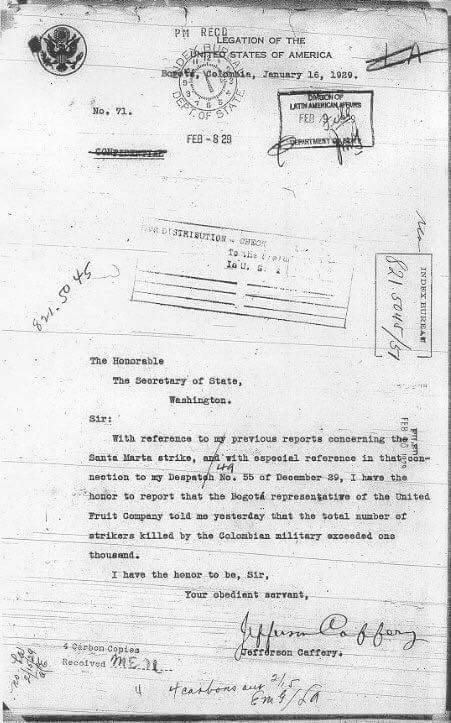
February 1929 letter by the U.S.
ambassador citing a fruit company
 executive's statement that
1,000 banana workers were
killed by soldiers.
Cabal's comments were met with an avalanche of ridicule and criticism, including a statement by 76 political science graduates from the University of Los Andes, of which she is an alumni.

The statement said that Cabal "discredits the profession" and "offends not only the dignity of the victims, but also the nation's historical memory."

Cabal is correct that the events of that day are unclear - but her accusations against the workers - based on a vision of great communist conspiracy - appear groundless.

Cabal first aims her criticism at novelist Marquéz, who made the masssacre a key event in 'One Hundred Years of Solitude,' the novel which earned him the Nobel Prize.

In that novel, the soldiers kill 3,000 workers. But Marquéz was always clear that he had written fiction, and exaggerated the number of dead to fit the dramatic proportions of his novel. He said that before writing he had first researched the event, but could not determine how many died.

"To say that all of that (drama) took place for just 3, 7 or 17 deaths...So I decided that they were 3,000 deaths, because was what was required for the proportions of the book I was writing," he said later.

But fiction became fact. The 3,000-deaths number was even repeated in Colombia's Congress - to Marquézes' objections.

In support of her argument, Senator Cabal also cited a book by Eduardo Mackenzie called 'Las FARC, Fracaso de un Terrorismo.' However, the pages which Cabal posted on Facebook argued only that no thorough investigation of the events was done, but did not support her argument that the workers massacred soldiers.

Perhaps the most concrete number came from the U.S. ambassador in Colombia, who sent a telegram to the U.S. State Department saying that a United Fruit Company official had told him that 1,000 workers were killed in the massacre. It's a suspiciously round number, but it doesn't seem likely that the either the company or the embassy would exaggerate the number of dead when they themselves were implicated in the killings.

We'll never be certain exactly what happened in Cienaga on that warm day in 1928. However, it is undisputed that the banana workers were badly exploited, at least by today's standards, by the fruit company. For example, they had to work Sundays, did not receive compensation for injuries, were paid not with tokens instead of money, and could only spend the tokens at the company's high-priced stores. And, with low banana prices, conditions had worsened, triggering the strike.


By Mike Ceaser, of Bogotá Bike Tours

Saturday, August 19, 2017

Colombia's Own 'Confederate' Problem

Gonzalo Jimenez de Quesada stands in all his glory on the Plaza Rosario. Thief, mass-murderer, committer of cultural genocide...and hero.
In the United States, they're removing monuments to Confederate 'heroes' because they fought to defend slavery - generating, in many cases, controversy and even violent riots.

Bogotá, in contrast, just renovated a statue of conquistador and founder of Bogotá Jimenez de
A heroic Quesada painting hangs
in the presidential palace.
Quesada. We live in an era of supposed respect for indigenous cultures and human rights. But Quesada conquered indigenous peoples, undoubtedly enslaving and committing massacres in the name of the Spanish crown and Catholicism. In what is today Bogotá, he decimated the Muisca people, stole their treasures and executed their rulers.

We try to respect human rights. Quesada hung his own soldiers, because, to avoid starvation, they killed and ate horses.

Today, Colombia venerates indigenous artworks in museums and cultural sites. Quesada stole indigenous peoples' gold and emerald treasures and sent them to Europe.

Not satisfied with his treasures, in 1568 Quesada set off on yet another conquering expedition, this time to Los Llanos, in search of gold. He started off with an army of 1,500 Indians and 400 Spaniards, of whom only 4 Indians and 64 Spaniards returned home.

Quesada doesn't seem to deserve much admiration. But there he is glorified on the plaza Rosario and in the presidential palace. And I haven't heard anybody, including even indigenous people, question the situation.

And why even mention the idolizing of liberator Simon Bolivar, who unquestionably accomplished an immense amount: He freed about 6 nations from the Spanish empire and liberated his own slaves (which is more than George Washington can say). But the war involved massacres and other grevious human rights violations on all sides, including the revolutionaries'. And at the end of his rule, Bolivar, the supposed democrat, tried to make himself dictator for life.

Go figger.

By Mike Ceaser, of Bogotá Bike Tours

Friday, October 30, 2015

Might the Corporations Pay Victims?

U.S. corporations which have escaped charges of responsibility for human rights violations in Colombia because the alleged events happened in Colombia might feel a bit more nervous now, thanks to a recent ruling by a U.S. judge.

Multiple U.S. companies, including Coca Cola, the Drummond coal company, Chiquita banana and others have been accused in U.S. courts of financing illegal Colombian organizations, particularly right-wing paramilitaries, which committed severe human rights abuses, including assassinations, massacres and forced displacements.

But U.S. courts have consistently ruled that the alleged victims of those atrocities and their relatives could not sue in the U.S. because the relevant events took place in Colombia. The courts don't even examine the crimes themselves or the U.S. corporations' relationships with criminal groups.

Hernán Giraldo Serna, ex-paramilitary
leader on trial in the U.S.
However, the other week a federal appeals court in Washington ruled that victims of one Colombian paramilitary extradited to the U.S. on narcotrafficking charges can pursue charges against him there. The one-time paramilitary leader, Hernán Giraldo Serna. ex-leader of the Tayron Block of the so-called self-defense forces, was extradited to the U.S. in 2008 on narcotrafficking charges. However, the family of a social activist and ex-member of the M-19 guerrillas named Julio Henríquez, who was murdered on Giraldo Serna's orders in 2001 joined the case.

A district court ruled that the family did not have standing to participate in the case, but a Washington appeals court reversed that ruling and ordered Henríquez's killing be included in the case, according to El Tiempo.

I'm no lawyer and my understanding of these issues is superficial. And this paramilitary has admitted ordering Henríquez's killing, whereas the corporations are generally only accused of financing outlaw groups which committed crimes, perhaps without even the companies' previous knowledge.

Nevertheless, Henríquez's ability to sue in the U.S. for a crime committed in Colombia seems to offer at least a glimmer of hope for other victims.

The most notorious case is probably Chiquita banana company, which in 2005 confessed to the U.S.
Chiquita, worried?
government that between 1997 and 2004 it had paid millions of dollars in what it called 'protection money' to Colombian paramilitary abuses. During the same years, the paramilitaries were committing severe atrocities, including massacres and forced displacement. Chiquita claims it had no choice but to make the payments in order to protect the lives of its workers, altho the company could have sold its operations and withdrawn from Colombia. Chiquita paid a $25 million dollar fine to the U.S. government, but nothing to the paramilitaries' victims.

Victims of Colombian paramilitaries and their families filed numerous lawsuits against Chiquita in U.S. courts under the Alien Tort Statute, but the cases were dismissed because the relevant events had taken place in Colombia.

Might this latest ruling make a difference?


By Mike Ceaser, of Bogotá Bike Tours

Saturday, June 27, 2015

A Half-Remembered Hero


Antonio Nariño, by Acevedo Bernal.
Antonio Nariño was one of the heroes of Colombia's revolution, but lives on mostly as a surname, immortalized primarily in the Colombian department named after him and the presidential palace, La Casa de Nariño.

But Nariño (1765 - 1823), who is being memorialized these days in an exhibition in the Archivo de Bogotá, deserves to be remembered as much more than another heroic portrait. In conflict after conflict, with both pen and sword, he battled for freedom - and paid with his own liberty.

A child of a wealthy Bogotá family, Nariño suffered lifelong health problems for which he moved to the warmer climate of Cartagena, where he became a successful exporter. He also imported the first privately-owned printing press in La Nueva Granada, ending the royal government's monopoly on the press.

In 1794, Nariño used that printing press to publish La Nueva Granada's first copies of 'The Rights of Man and the Citizen,' the fundamental document of the French Revolution and a furious challenge to the absolutist Spanish monarchy. After distributing only a few copies, Nariño got cold feet and burned the rest. But the virrey had already discovered the publication, and Nariño was arrested and condemned to ten years' exile in a Spanish colony in Africa.

Nariño, however, managed to escape and return to Colombia, where he was again arrested and imprisoned until 1803. In 1808, with the winds of revolution blowing, the royal government rounded up dissidents, including Nariño, who was imprisoned until freed by the rebels in 1810.

Back in Bogotá, Nariño founded what was probably Colombia's first opposition newspaper, La Bagatela, with which he helped drive out of office Jorge Tadeo Lozano, the first president of the then-independent Estado de Cundinamarca. Nariño then became Cundinamarca's second president.

The La Bagatela newspaper, in the Archivo de Bogotá.
Nariño also led troops in the independence wars, but was captured once again by the royal forces and carried to prison in Spain, and managed to return only in 1821, after independence had been won. Back in La Gran Colombia, Nariño returned to politics, but was accused of corruption and treason. In his final battle, he was absolved in court.

Suffering health problems, Nariño moved from Bogotá to a warmer climate, where he died two years later.

How might Colombia's history have been different if it had had such a fighter during each generation?

As for La Casa de Nariño, the presidential palace, it is located on the site of Nariño's birthplace.

By Mike Ceaser, of Bogotá Bike Tours

Monday, June 15, 2015

Thank The Magna Carta

King John signs the Magna Carta in this mistaken portraya. In fact, he sealed the document.
Article VII - No man can be accused, arrested nor detained but in the cases determined by the law, and according to the forms which it has prescribed. 
Article IX - Any man being presumed innocent until he is declared culpable...
Article XVII - Property being an inviolable and sacred right, no one can be deprived of private usage...
Article XIV - Each citizen has the right to ascertain, by himself or through his representatives, the need for a public tax, to consent to it freely,
 - Declaration of the Rights of Man and the Citizen, Paris, 1789.

Those basic citizens' rights and others are inscribed on the wall of the Universidad de America's Casa
The Rights of Man and the Citizen, just off of Calle 10.
de los Derechos del Hombre, sadly hidden away on Calle 10, just above the Plaza Bolivar.

That resounding list of rights, issued by the French Revolutionaries in 1789, was secretly brought to Colombia in 1794, translated and secretly distributed by Antonio Nariño. The Spanish royal government, which held that the king ruled with divine right and could do whatever he pleased, confiscated and destroyed the documents and sentenced Nariño to 10 years imprisonment. Nariño escaped royal arrest twice and returned to Bogotá to help lead the revolution in La Gran Colombia, becoming one of Colombia's most important but less remembered heroes.

As imperfectly as those principles have been honored, they still provide a basis for rule of law in Colombia today.

The Right of Man are hidden back there.
And those principles emanate from an even older document: The Magna Carta, sealed by the lousy English King John and the barons exactly 800 years ago on June 15, 1215 in the field of Runnymede, outside of London.

The Magna Carta, or Great Charter, was nearly stillborn: King John soon repudiated it, and the Pope ordered him not to obey it. Rule by divine right and rejection of citizens' rights would continue. Yet, successive kings reissued the Great Charter, it helped inspire the Declaration of the Rights of Man, the United States Constitution and the United Nations' Charter of Human Rights, not to mention the laws of innumerable other nations.

Antonio Nariño brought
over the rights.
You might not have a chance to visit Runnymede this week, but it's worth passing by the hidden
Plazoleta on Calle 10 and taking a look at the principles which enable you to demand a trial before punishment, to defend your property from arbitrary confiscation and to have a say in how you are taxed - at least in theory.

The Magna Carta, not a very impressive-looking document.
By Mike Ceaser, of Bogotá Bike Tours

Wednesday, May 6, 2015

Nicolas Neira, Martyr

Nicolas Neira, 1989 - 2005
Today, his anarchist companions, memorialized killed activist Nicolas Neira on the tenth anniversary of his death. Neira, a 15-year-old student, was killed in May 2005 after participating in May Day a protest on Carrera Septima just south of Calle 19, converting him into a martyr for other anti-state activists.

A candle for Nicolas Neira.
Neira, who had asthma, was reportedly overcome by tear gas and hit by riot police. He collapsed on the pavement, where he was trampled by the crowd. Neira was carried to a hospital, where he died May 6 from his internal injuries. The riot police did not aid Neira, forcing other protesters to find a taxi to transport him to a clinic. Police have alleged that Neira's injuries resulted from the protesters' own violence.

The individual police who allegedly hit Neira were never identified, but two police officials were banned from public posts for their responsibility in Neira's death. A judge ordered the Colombian government to pay Neira's family 160 million-pesos in compensation. That has not satisfied Neira's parents, but criminal charges against the police officials have not advanced and the family has taken the case to the Inter-American Commission on Human Rights. The tragedy also converted Neira's father, Yuri Neira, previously an insurance company executive, into an activist for victims of state violence.
Another plaque for Nicolas Neira.

At this evening's memorial, the anarchist crowd called the state 'criminal' and 'murderer.' "Death to the state," they chanted, "long live anarchism."

Yet, altho state security forces clearly carry responsibility for Neiras death, that same state did issue a judgment against itself and order itself to pay damages to its victims.

Perhaps the state is not really pure evil after all.


The memorial's location, on the Carrera Septima shopping strip, did not smack of anarchism and anti-capitalism.

The other day, an anarchist 'colectivo' painted this portrait of Nicolas Neira on Calle 26 west of the Central Cemetery.
By Mike Ceaser, of Bogotá Bike Tours

Thursday, April 9, 2015

Human Rights Under Killers' Gaze

'Where are my children?'
She cried out that the killers had come to her town, taking away the people and burning homes.

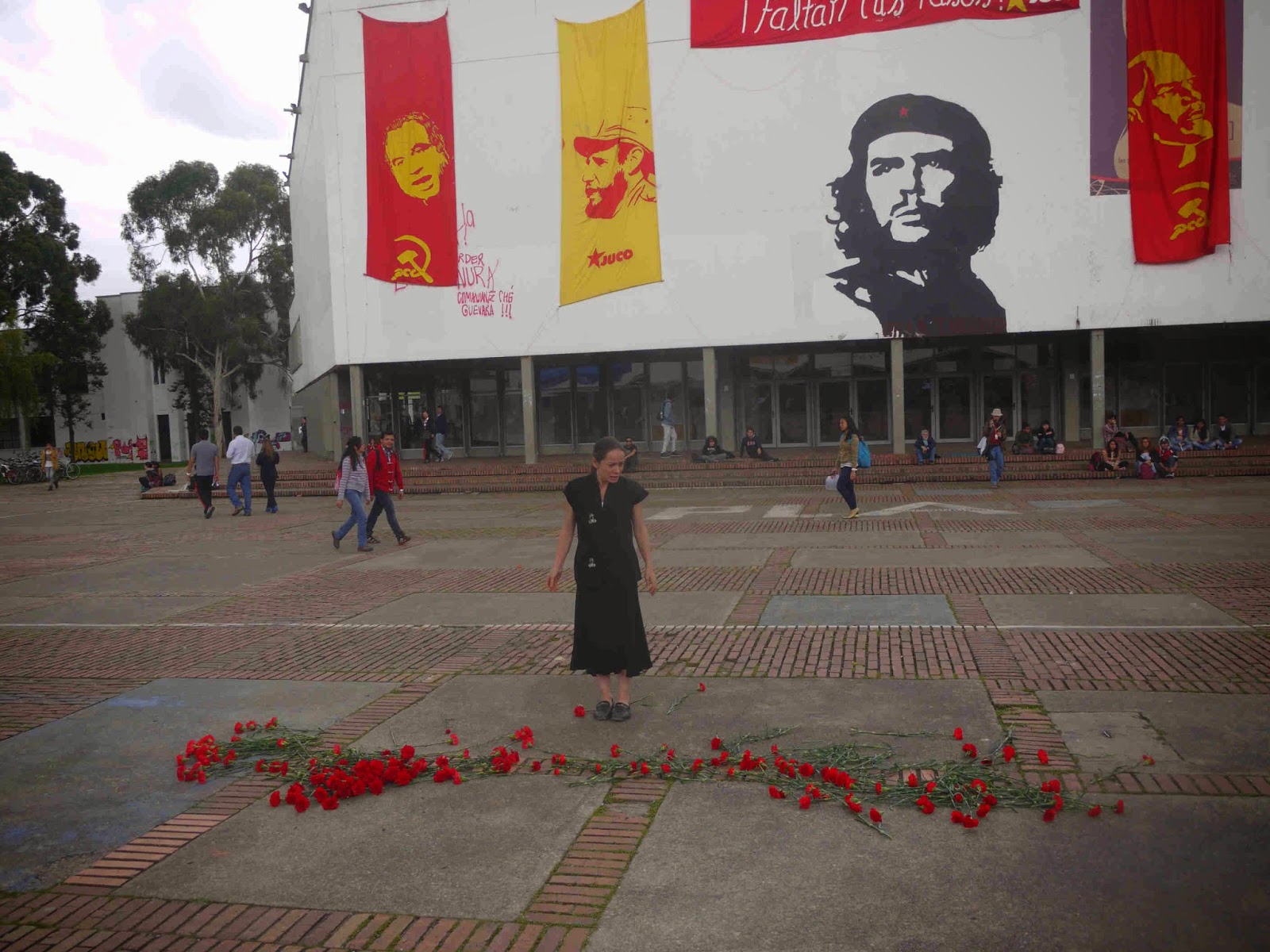
It was a theatre piece on the Plaza del Ché on the campus of the Universidad Nacional, but the story was one which has been repeated again and again during Colombia's long armed conflict. Altho such atrocities were committed by all sides, this play was undoubtedly aimed at the right-wing paramilitaries, who for many years did the regular military's dirty work.

But the far left also produced millions of victims, both in Colombia and abroad. So, it was a bit ironic watching this play under the gazes of Marx, Lenin, Che Guevara and Fidel Castro, whose various regimes themselves committed wholesale human rights abuses.

The performance was part of the Summit for Art and Culture for Peace.


By Mike Ceaser, of Bogotá Bike Tours