 |
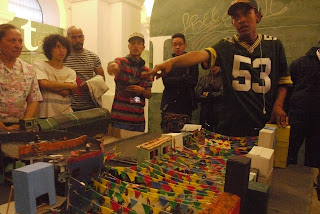
| Chiri, left, and Juan Carlos point to a detail of their model of El Bronx. |
 |
Looking out of the window of
a Bronx rented room. |
For most Bogotanos, the name 'El Bronx' represents misery, addiction, depravement and addiction. But, for three young men who lived years there as criminals and addicts, the place also represents joys, friendship and pleasure.
The three young men recounted their experiences recently in Bogotá's Museo Nacional, where they also displayed a scale reproduction of the three streets which for nearly 15 years were home for thousands of thieves, drug dealers, crack addicts, prostitutes and myriad other criminals, just a few blocks from City Hall and the Presidential Palace.
 |
| Drugs for sale. |
The model was complete with a stabbing, lots of bags of drugs and the streets' many other criminal activities, but also normal activities such as a woman preparing food and children playing with a dog.
Juan Carlos, 19, who lived in the Bronx for six years and Chiri, 22, who lived there for a decade, were both addicted to basuco, a cheap, dirty form of crack cocaine, and supported themselves by robbery. Chiri recounted how he belonged to a gang which stole car parts on the neighboring Carrera 10.
"I'd ask the driver for a handout," he said, "and then bang! the rear-view mirror's gone!" He made a motion of ripping the mirror off of the car.
But El Bronx, which was ruled by several criminal kingpins, each of whom controlled a sector of the
 |
| A Bronx corner. |
streets, had its own organization and rules. For example, thievery was prohibited inside - except when the prize was big and one had permission from one of the kingpins.
"You could come and go safely," one of the young men told me. "Fresco."
"Nobody stole just a few hundred thousand pesos. It had to be millions."
The neighboring small businesses, which sell bedwear and hardware were safe, the men explained, because they paid protection money. In fact, El Bronx's bosses prohibited stealing within a several block radius, as Chiri learned when he stole a bicycle on the neighboring Los Martires Plaza. The bike's owner chased him into El Bronx, where one of the bosses learned of Chiri's misdeed and sentenced him to being hit 25 times with a wooden board. Chiri took it in stride.
 |
| A stabbing in the street. |
"I just said 'let's get it over with,' Chiri recalled. "I wanted someone who would do it fast."
But he'd gotten off easy. When Mayor Enrique Peñalosa sent in thousands of police to clear out El Bronx a bit more than a year ago, they found cemeteries and torture chambers, used to punish those who didn't pay their drug debts. I asked the young men about the stories that the penalty for failing to pay was death and they shrugged their shoulders.
"Isn't it that way everywhere?" they asked me. "How about your country?"
I told them that this was beyond my personal experience.
Another unpardonable sin in El Bronx was spying - or even giving the appearance of doing so. For
example, outsiders came in to buy drugs or stolen items, but couldn't dilly dally. If they didn't come, buy and leave, they were suspect and could be punished.
"The Bronx wasn't a shopping mall," Juan Carlos said.
Both boys entered El Bronx because of their drug habits. "It's just a short step from (doing drugs on) the corner, to living in the street," they said, and added, "There are no social classes in El Bronx. Everybody's the same, everybody's an addict."
In contrast, young girls and women addicts ended up trading sex for drugs in El Bronx - and many became prisoners. After months of witnessing the Bronx's crimes, the kingpins would not let them leave for fear they'd rat on them.
 |
| Children play with a dog, lower left, near scavenged materials to be sold. |
Bazuco, or crack, was the ubiquitous drug there, but marijuana, heroin, psychedelics and alchohol were also popular. Juan Carlos recalled multi-day alchohol and heroin binges. "Boy, I was flying," he said.
 |
| The entrance to the old Bronx. |
Not all the Bronx residents were criminals and addicts. There were also working families, they said, who lived there because it was cheap: a room cost as little as $5,000 pesos per night, and you could pay in cash by the night.
But, amidst the horrors, the boys also experienced solidarity, when other Bronx residents shared food and loaned money to each other.
 |
| Quiet and empty: El Bronx today. |
Now, they are living in a rehabilitation center, working with other addicts, and have started a hip hop band called 'Free Soul.'
El Bronx replaced the nearby El Cartucho neighborhood, which was bulldozed and replaced by the Tercel Milenio Park in the early 2000s. The ex-Bronx residents agreed that the problems of addiction and crime won't go away, but urged more support for addicts. That wasn't the case with the thousands who had inhabited El Bronx, many of whom ended up on the street. Juan Carlos and Chiri said there are about 150 recovering addicts in their rehabilitation residence.
The young men made one other point: To its residents, their home was not 'El Bronx,' but 'La L,' named for the L shape made by the two original streets invaded by addicts and criminals driven out of El Cartucho. "El Bronx is a place in New York," they pointed out.
Evidently, they think the original Bronx's reputation reflects badly on them. (Little do they know that New York's Bronx is being gentrified.)
As for Bogotá's Bronx, the city has plans to turn the neighborhood into an arts and education district. We'll see whether that ever happens. So far, it's still vacant.
I asked Juan Carlos whether he regretted his years living in El Bronx.
"No," he replied, "if I hadn't been there, then I wouldn't be here today."
This was the last week the event and exhibition were to be held in the Museo Nacional, but it will move on to the Centro de Memoria and IDArtes.
It's worth seeing, even if your Spanish is less than perfect, like mine. I probably understood less than half of what was said, but I comprehended enough to appreciate the tragedy, suffering and humanity of El Bronx, and why it's a good thing that it's gone - until another one appears.
Related:
By Mike Ceaser, of
Bogotá Bike Tours

 It was called a 'living hell,' with drug addicts of all ages, child prostitutes, torture chambers and illicit cemeteries, located just a few blocks from City Hall and the Presidential Palace, until in May 2016 the city sent in thousands of police and cleared it out, scattering the criminals and addicts all over the city.




 Posts
Posts