Showing posts with label global warming. Show all posts

Sunday, September 21, 2014

Bogotá's March for the Climate


Anti-climate change marchers on the Ciclovia today.
Bogotanos participated in the global 'March for the Climate' today, supposed to combat global warming. Bogotá Mayor Gustavo Petro has made fighting climate change a centerpiece of his discourse - but not of his policies, unfortunately.

Petro has implemented some limited pro-cycling policies, but under his watch the number of private cars - and particularly motorcycles - has boomed. That's not exactly Petro's fault, but he has not advanced policies, such as a vehicle congestion charge or real solid waste reduction laws, which could reduce the city's global warming gas production.

'Help the planet? Don't eat meat!'
That said, Bogotá and Colombia in general still do produce relatively small amounts of global warming gases per capita. That's because Colombia's a developing nation in which car ownership is still lower than its neighbors and because almost all the country's electricity is generated by hydropower.

However, car ownership is growing fast, the country is losing it forests at a dramatic rate and it's a significant and growing exporter of hydrocarbons, particularly coal, the dirtiest fossil fuel. And Colombia recently approved the use of fracking, meaning it hopes to accelerate still more its fossil fuel production.

As in Colombia, climate change gases are booming across the developing world. According to a report released today, the planet set a new record in greenhouse gas emissions, driven particularly by China and the United States.

Consciousness-raising marches may be a good first step. But it'll take real lifestyle changes for the planet's wealthy if we want to halt climate change before it becomes too late.


Communist marchers denounce capitalism as the cause of environmental destruction. That's true enough, but communism, which can brought us Chernobyl and other disasters, didn't do any better.
Greenpeace - despite its idealism - or because of it - opposes nuclear energy, which is the only low-carbon energy source that can realistically replace fossil fuels in the medium term.
Factories 'Guilty of Causing Sicknesses.'


'Protect Our Wetlands.'


Soon after passing the climate change march, I spotted this pollution-belching bus, a half-block from the Ministry of the Environment.  
While global warming gases and traditional air pollution are different things, 'rolling chimneys' like this one are an indication of the government's lack of seriousness in environmental matters.


The city government has permitted projects like this one, a private university's massive parking garage being built on Bogotá's hills. 
Projects like this one contribute to climate change (and damage quality of life) in multiple ways, by promoting private car use and deforesting the hillside.

By Mike Ceaser, of Bogotá Bike Tours

Tuesday, September 2, 2014

Colombia Fracked?

U.K. activists protest against fracking.
(Photo: Popular Resistance)
Colombia will proceed with the controversial petroleum and natural gas production method called hydraulic fracturing or fracking.

There are lots of worries about fracking, including consumption of water, triggering of earthquakes and possible pollution of groundwater. But Colombia seems determined to ignore those concerns in its eagerness to pump up its fossil fuel production. And the announcement about fracking comes at a particularly sensitive time, as several regions of Colombia suffer a severe drought. A single fracked well consumes millions of U.S. gallons of water, which is forever lost to the water cycle.

But, like so many things, fracking's biggest harms come from very obvious causes which aren't hidden.

Fracking will deepen Colombia's dependence on raw material exports, which have produced economic growth, but few jobs and lots of environmental damage. Fracking will also make Colombia an even bigger contributor to global warming.

And the announcement comes just in time for the annual March Against Climate Change, to be held Sept. 21 in Bogotá in the Parque Nacional.

Sadly, like so many decisions here, I heard of no public hearings or other opportunities for public input on this one. Most likely, in the best style of Dick Cheney, they consulted only with the hydrocarbon producers.

By Mike Ceaser, of Bogotá Bike Tours

Monday, April 22, 2013

Few Reasons to Celebrate Earth Day


Deforestation rages in Colombia.
(Photo from Flickr.)
A TransMilenio bus on its way up the 'Environmental Axis'
celebrates Earth Day by blasting out smoke.
A few years ago TM won an award for reducing
greenhouse gas emissions.
Today was Earth Day, but it went by pretty much unnoticed except for some talk on the radio about recycling and a ride by naked cyclists painted green.

Meanwhile, deforestation rages on: El Tiempo reports that, the way things are going, the Amazon
jungle will be nearly gone in 40 years. That will not only accelerate climate change, but also destroy the lives of millions of people and drive countless plants and animals to extinction.

The number of cars and other vehicles in Colombia is booming, Colombia has huge areas of biodiverse jungle and mountains mapped out for oil and mining development, and it's looking at the possibility of building a huge oil pipeline from the Venezuelan border across the country to the Pacific coast to ship Venezuelan crude to China.

I'm afraid that prospects for stopping global warming and saving Colombia's biodiversity could hardly be worse.

The Amazon covers 40% of Colombia's territory and is why Colombia is considered a megadiverse nation.

By Mike Ceaser, of Bogotá Bike Tours

Saturday, February 9, 2013

Colombia's Real Coal Crisis

A crane dumps coal into Colombian coastal waters.
(Photo: NTN24)
As everybody who follows the news knows, environmental authorities have revoked Drummond Corp.'s export license, after it reportedly dumped tons of coal into a bay. And Colombia's largest mine, El Cerrejon, has suspended operations because of a strike, while a third mine is also not operating because of pay disputes. Altogether, about 85% of Colombia's coal production is shut down. The production stoppages in Colombia, the world's fourth-largest coal producer, have hiked world coal prices.


But, while Drummond and El Cerrejon will eventually restart operations, their troubles are symptoms of profounder problems in an industry which Pres. Juan Manuel Santos has called one of the 'locomotives' of the economy. Cheap natural gas produced thru fracking has reduced coal's share of the market, slumping its price and generating employer-union tensions. And, if the world someday gets serious about addressing global warming, coal, the dirtiest fossil fuel, is certain to suffer.

Coal also damages the environment on a smaller scale. El Cerrejon, for example, has expansion plans which include rerouting La Guajira's only river.

Rail cars carrying coal. In many areas, residents complain that
these coal shipments cover communities with coal dust.
And, like many of Colombia's big resource industries, the coal industry has become entangled by accusations of human rights violations. Drummond, in particular, is fighting lawsuits alleging that the company had links to right-wing paramilitary groups, which assassinated union leaders. The company denies the accusations. Last year, a one-time Colombian paramilitary leader testified that Drummond had paid the paramilitaries millions of dollars to assassinate union leaders, according to news reports.

Coal, along with oil and natural gas production, is also distorting Colombia's economy, according to a recent OECD report. That could continue over-valuing the Colombian peso, suffocating the manufacturing sector. And, in a longer view, by continuing to produce fossil fuels, Colombia is contributing to global warming, which may very well devastate the country's environment and economy in future decades.

Is Colombia's dependence on coal and other fossil fuels inherently disfunctional or something which the country can exploit constructively?

Perhaps only time - and Colombian authorities - will tell.

By Mike Ceaser, of Bogotá Bike Tours

Thursday, November 15, 2012

Talking About Climate Change


Talking, and talking, about climate change.
By accident today I attended a panel discussion about climate change in the Universidad Central (I was looking for a bicycle week event). The panel talk was a preliminary to the upcoming international conference 'Cities and Climate Change' organized by Bogotá's City Hall, the French Embassy and others.

'Are we really facing Climate Change?'
A question I thot was answered long ago.
At today's event, I was surprised by the lack of consensus from the experts that humans are causing climate change. It's my understanding, after all, that there's an overwhelming consensus amongst scientists (at least those not on the oil and coal companies' payroll) that human-generated carbon dioxide, methane and other gases are changing the planet's climate.

Colombia, of course, is already feeling the impacts of climate change, with the melting of its glaciers and shifting weather patterns. And sea level rise could devastate Colombia's Caribbean islands and coastal cities.

Sure, Colombians per capita generate much less global warming emissions than do residents of the United States and many other developed countries - and even much less than neighbor Venezuela.

At last year's climate summit in Durban, South Africa, Pres. Santos said "We are one of the nations which do not emit carbon" (a dubious claim) "but we are one of the most vulnerable to climate change."

Bogotanos contributing to climate change.
But the wealthiest Colombians, who drive big cars and vacation in Florida and Europe, are doing their best to gobble just as many natural resources and pump out as much pollution as do citizens of rich-nations.

And, with increasing car ownership and consumerism in general, Colombia is going in the wrong direction.
Even more important, probably, is Colombia's role as a producer of fossil fuels, such as oil and coal, which now compose most of the country's exports.

The frustrating aspect of all of this is that the solutions are obvious: reduce greenhouse gas emissions. But implementing real measures, such as carbon taxes - requires a political will which few countries have. In fact, the public discussion here is about how to lower the price of gasoline, which will only mean more consumption and pollution.


By Mike Ceaser, of Bogotá Bike Tours

Saturday, December 10, 2011

Colombia: Climate Victim, Offender, or Both?

Bogotá-area residents evacuate their home, while protesters at the South Africa climate talks demand action. 
While negotiators in Durban, South Africa haggle over another climate change treaty which will be weak,  and probably ignored, anyway (despite all we know, last year saw the largest increase ever in world CO2 production). Meanwhile, Colombia has suffered a second year of horrendous flooding, which may very well be caused by climate change.

But, while Colombia has generated little of the world's global warming gas, it is no innocent bystander in either its domestic tragedy or the growing global climate tragedy.

Deforestation, cause of climate change  and climate victims.
Domestically, Colombia's terrible deforestation rate of 238,000 hectares per year - or even double that, according to National University Prof. Jesus Rangel - caused by agricultural expansion, illegal drug crops, deforestation and cattle ranching, worsens flooding and erosion and desertification because forests normally soak up water like sponges and their roots keep soil from sliding into rivers.

Deforestation also contributes to global warming by taking carbon out of trees and pumping it into the atmosphere, where it causes the greenhouse effect.

Pres. Juan Manuel Santos also vowed that Colombia would "demand concrete actions" from the "big countries."

"I've given very concrete instructions," Santos said, while visiting a town whose flooding the government blames on global warming. Our representative to the climate talks "has to demand that the big countries which today don't want to make their contribution, don't want to make committments, commit themselves. This (flooding) is affecting too many people."

Out of the ground and into the
atmosphere: Coal mining in Colombia.
But Colombia doesn't want to make sacrifices either - for the same reasons that those 'big countries' don't. While denouncing climate change and its impacts, Colombia very happily sells those countries more and more fossil fuels to combust into global warming carbon dioxide. Colombia's coal production, for example, is supposed to double in the next decade.

Colombians are also burning more and more fossil fuels domestically, driven by record automobile sales - which will only accelerate when new free trade agreements with the U.S. and Korea take effect.
Up, up, and away: Colombian coal production. (Source: Simco.gov.co)


By Mike Ceaser, of Bogotá Bike Tours

Saturday, October 15, 2011

Chocolate Meltdown?

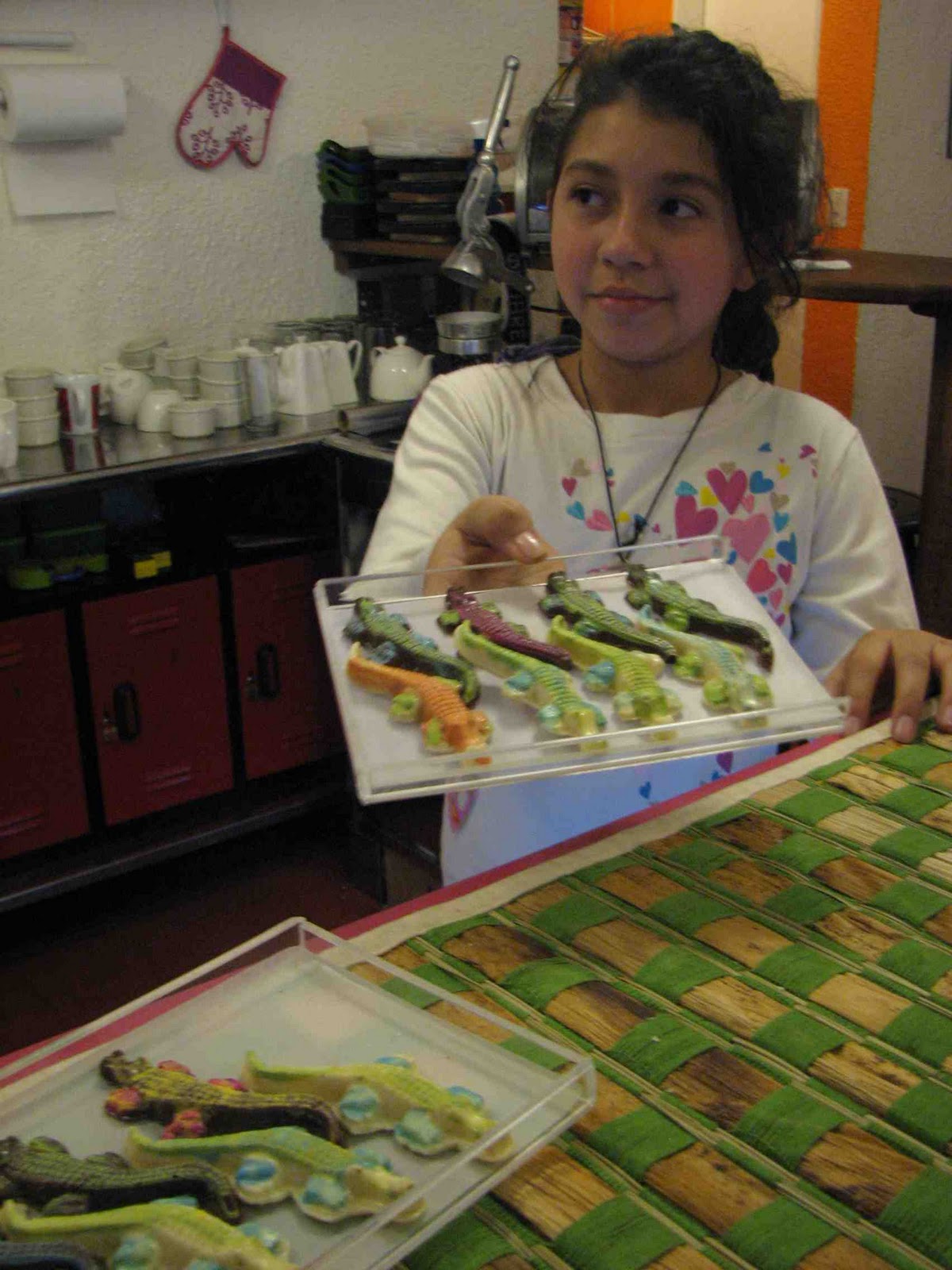
A girl shows off chocolate insects in La Chocolatera in Bogotá's La  Macarena neighborhood. 
This is Chocolate Week, an industry-invented event if I've ever seen one. And Colombia grows and produces chocolate, altho Colombians also consume so much chocolate that the country doesn't export it.

A sack of 'green' dried but unroasted cocoa
beans in Cafe de la Fonda coffee factory. 
This delicious treat is native to the Americas, where the Aztecs called it the cocoa bean 'xoco latl' - which Europeans deformed into the world 'chocolate.' For centuries after the Spanish imported cocoa to Europe, chocolate was considered a medicine and aphrodisiac, until a series of inventions produced the modern treat. Chocolate's history is not all sweetness, however. For centuries the treat was produced using slave labor, both in the Americas, and, until the early 1900s, in Africa.

Today, Africa produces much more chocolate than the Americas do - but researchers at the International Center for Tropical Agriculture in Cali, Colombia, say that global warming could meltdown Africa's cocoa industry within a few years. The might be good for Colombia - but it'd be a disaster for African farmers and for the world's chocolate lovers.


Coffee beans, cocoa beans and the cocoa fruit, which contains the beans. 

Dumping out roasted cocoa beans. 
 
A handful of cocoa beans. 

Cocoa beans mixed with sugar cane sugar make a sweet treat.

Chocolate treats.

By Mike Ceaser, of Bogotá Bike Tours

Wednesday, August 24, 2011

Coal to Newcastle, and Coffee to Colombia

Sacks of coffee waiting to be roasted - some of them imported.

Back when I was growing up, my mother used the phrase 'coal to Newcastle' whenever something got shipped to a place that was supposed to be producing it. (The UK town of Newcastle was known for coal production - until a strike shut down the mines and forced it to import coal.)

Bags of coffee beans, some imported, some Colombian.

Now that's happening to Colombia and coffee.

Today a coffee factory owner displayed bags of green coffee beans imported from Ecuador, Venezuela and even as far away as Vietnam, which he's going to roast and grind to make Colombia's best-known beverage.

To be sure, Colombia still exports high-quality coffee. The imported bags contained miscolored, mostly low-quality beans of the low-priced robusto variety, mostly to be consumed domestically as 'tinto.' Most of Colombia's high-quality arabico beans, which are grown in the mountains, are exported under the brand name 'Cafe de Colombia.'
The large bean is Colombian,
the two right ones from Vietnam. 

Several factors have contributed to reducing Colombia's coffee production: last year's torrential rains  devastated lots of agricultural areas (and this year's upcoming rains are supposed to be even worse). Related to that, global warming has reduced the coffee harvests in many areas. And, the factory owner said, displacement of peasants by Colombia's seemingly endless armed conflict has driven many peasants off of their farms, leaving the lands unproductive.

A cup of Colombian coffee.

By Mike Ceaser, of Bogotá Bike Tours

Friday, July 29, 2011

Grey to Black: Colombia's Urban Environmental Prospects

A landslide this year near Medellin. More of this coming?
Fifty years from now, Bogotá will be several degrees warmer, rainier and yet suffer more water shortages, say experts.

During three days this week, environmental experts from around the world discussed the environmental prospects for Colombia's cities - and the predictions aren't encouraging.

The conference, hosted by the Chamber of Commerce, took place from the 26th to the 28th of this week.

More rain? Flooding in Bogotá.
Raising the average temperature a few degrees might sound good for chilly Bogotá. But it will be accompanied with more traumatic changes, such as torrential rains, landslides and monumental traffic jams. Meanwhile, Colombia's coastal cities will be invaded by rising seas.

Increased and more erratic rainfall, combined with environmental damage from deforestation, the destruction of wetlands and pressure to build on unstable lands will mean more environmental disasters, the experts said.

Deforestion in Colombia
According to recent studies, Colombia loses more than 3,000 square kilometers of forest each year, worsening soil erosion and landslides and pumping global warming gases into the atmosphere. One of the biggest causes of deforestation is illegal drug crop production, according to the government.

Gridlock near central Bogotá. 
Bogotá and other cities will also overwhelm their infrastructures. Bogotá alone is expected to add another million residents by 2020, and, even more importantly, car ownership is growing rapidly, bringing the city to one huge gridlock - unless the city finds ways to limit car use.

By Mike Ceaser, of Bogotá Bike Tours

Thursday, March 17, 2011

Al Gore in Bogotá: Do as I Say, Not as I Do!

Al Gore in Bogotá
Al Gore, the former U.S. VP and campaigner against climate change, spoke in Bogotá yesterday at an environmental forum organized by the El Espectador newspaper. (See it here.)

The environmental problems "we've seen are nothing compared to what will happen if we don't stop using the atmosphere as an open-air landfill." - Al Gore in Bogotá.

After reading about the event, however, I felt like asking: 'Are these people really serious?'

Don't get me wrong: Al Gore is right, and has done a whole lot to gain attention for global warming, which has to be the world's most dire mid-term crisis. Gore is sincere, dedicated and deserves tremendous credit. And, in a few decades, as rising seas flood coastal cities, deserts spread and storms intensify, people all over the world will be crying 'Why didn't we listen to him?'


Al Gore's house - green?
However, Al Gore lives in an huge, energy-gobbling house and flies around the globe in pollution-spewing jet planes. Gore says he buys electricity from renewable sources and compensates for all of this environmental impact by financing anti-warming projects, such as tree planting, and I believe him. (Although many of these projects are questionable.) But, the larger point is that if he and other celebrity leaders of the environmental movement really want ordinary people to live more sustainably by driving less and wasting less, those leaders need to change their ways. That's particularly true for the middle class of developing nations like Colombia, who aspire to adopting Americans' exorbinant, wasteful lifestyles.

Bogotanos enthusiastically pump CO2 in the air. 
The statements by others at Gore's talks made me feel even worse. Bogotá Mayor Samuel Moreno, for example, promised that a planned subway would reduce global warming emissions.


Sorry, Mr. Mayor. Subways are great for moving lots of people around quickly and efficiently. But they do little or nothing to reduce driving. For proof of that, just look at cities like Medellin (Colombia), Caracas (Venezuela), Santiago (Chile), Mexico City and many others with efficient subways and tremendous traffic congestion. Moreno's scheme to build a network of urban freeways will only generate more automobile traffic.

In fact, the only way to reduce automobile use is to raise the cost of driving. Colombia has done that to some degree by raising fuel prices. But private car ownership continues booming in Bogotá, with March expected to show record car sales. Bogotá needs a London-style congestion charge, but neither the mayor nor any other Colombian is courageous enough to advocate one.

A Colombian coal mine. Carbon out of the ground, into the air.
Pres. Juan Manuel Santos also participated in the event, and expressed support for alternative energy and  Gore's idea of a carbon tax. A global carbon tax is a great, if political inviable, idea. But Santos' administration has worked hard to increase Colombia's coal, oil and natural gas production, while doing little to expand renewable energy.

This hypocrisy issue also applies to people like myself and my business, Bogotá Bike Tours. Bicycle tours are pretty 'green,' but our customers often arrive at our shop in taxis and almost always fly to Colombia in carbon spewing jet planes. Sustainable tourism is an oxymoron. Sustainable tourism means vacationing at or close to home. How many people fly to Colombia, whereas they could have had a great time in the mountains near home?

By Mike Ceaser, of Bogotá Bike Tours