Showing posts with label budget. Show all posts

Saturday, August 26, 2017

Slashing Science

A researcher protesting on Plaza Bolivar this week displays
a sign claiming he needs a microscope to see his science budget.
Colombian Pres. Santos has not, like U.S. Pres. Trump, denied basic science - but he is acting that way.

'Did you know that the government plans to cut 40%
of the science and technology budget?
The other day, across Colombia scientists protested against the government's proposed slashing of the science budget from 380 to 220 million pesos - a drop of 41%. The cuts include reductions in Colciencia's budget and the shifting of royalty money from science to road infrastructure.

Science isn't the only area scheduled to suffer: The environmental budget is also on the chopping block. That makes no sense in a country suffering a horrific deforestation rate, and in which the guerrilla demobilization has created new environmental challenges.

The big winner? Defense - which makes no sense, since the FARC, Colombia's biggest and oldest guerrilla group, just signed a peace treaty, gave up its weapons and demobilized.

Running with full tanks: Pick-up trucks carry soldiers thru La Candelaria.
An El Tiempo graphic showing the government's 2018 budget proposal.
The environment and science lost. The military won.
By Mike Ceaser, of Bogotá Bike Tours

Monday, July 24, 2017

The Unkindest Cuts

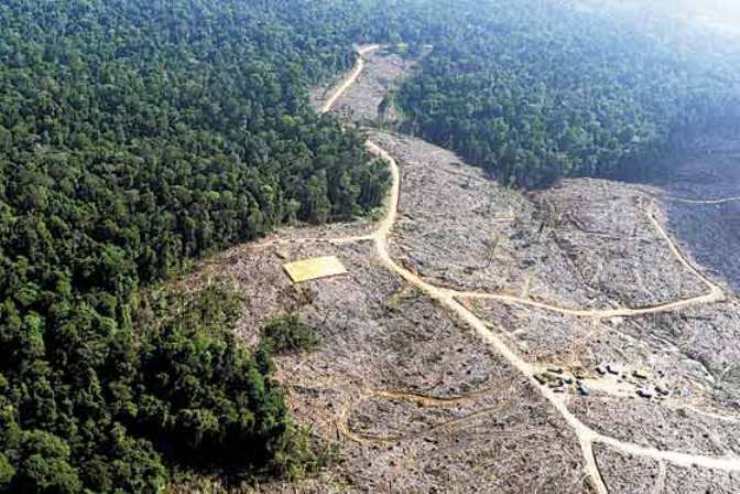
Deforestation in Colombia is set to accelerate with planned budget cuts.
Nobody can dispute that Colombia has huge environmental challenges: Deforestation has accelerated by 44% over the last few years, to 20 hectares erased every hour; illegal drug crops are invading national parks; and the peace agreement with the FARC guerrillas commits the government to stop the advance of the agricultural frontier.

So, what's the government's response?

From Semana magazine: 'The cuts which the environmental
sector will be subjected to in 2018.'
To slash the budgets of an array of environmental entities, including the Instituto Humboldt, the Institute of Hydrology, Meteorology and Environmental Studies (Ideam) and even the National Parks, from 632 billion pesos to 232 billion, or by 63%. That's according to a preliminary budget seen by Semana magazine. Such cuts make Donald Trump's war on the environment appear downright gentle. (I'm not clear on the relationship of these budgets to that of the environmental ministry.)

Incredibly, Minister of the Environment Luis Gilberto Murillo doesn't seem troubled by this financial massacre. "The budget isn't the only indicator of the environmental sector's resources," he said. "Resources are being mobilized like never before."

If only he'd explain where those resources are coming from.

The drastic budget cut - and the lack of an outcry over it - reflects the low priority environmental causes receive here. Minister Murillo may be sharp, capable and sincere, but before this job he had no discernable environmental experience. One suspects he's there in order to have an Afro-Colombian face in the cabinet. His predecessor had been a toy company executive.

By Mike Ceaser, of Bogotá Bike Tours

Thursday, May 3, 2012

Busting Bogotá's Budget?

Old Tranvia rails on Ave. Septima. A sign of things to come?
Mayor Petro's proposed city budget is extraordinary in several ways: it would build three new transit systems and several expansions all at once, while also giving a big slice of the pie to social programs.

Indigenous people beg on a downtown sidewalk.
Petro's budget plan would also invest a lot
in social services.
The proposed new transit systems: a metro, light rail on Seventh Ave. and Medellin-style cable cars up to poor hillside neighborhoods in south Bogotá, together with two new TransMilenio corridors, would undoubtedly transform Bogotá for the better - if they're ever built.

The plan would cost 61.1 trillion pesos according to El Espectador - compared with 38 and 33 trillion peso budgets by the previous mayors. And that would put Bogotá into debt.

But a glance at Bogotá's clogged and chaotic streets any rush hour shows that, unless the city makes dramatic moves soon, the onslaught of new vehicles will turn Bogotá into one big gridlock. Transit plays a huge role in every aspect of city life. Traffic jams steal productive hours from recreation, work and studies. Traffic's pollution damages our health. And the noise and frustration of traffic jams raises everybody's stress levels.

Nowhere to roll: Cars stuck in a traffic
jam in downtown Bogotá.
Efficient mass transit can transform a city - at least for those who use it. But the experiences of many other cities has proven that good transit doesn't eliminate traffic jams. To do that, Bogotá needs to take strong measures to phase out those old and highly polluting buses with infest our avenues and to discourage the use of the private car, which is the least efficient transport method invented by mankind.

That's why Petro's idea of a London-style congestion charge is so vital to Bogotá's future, and why talk of lowering the price of gasoline is so destructive.

Petro's budget - if it's approved - is a huge gamble. If it works, it could mean sustainable economic growth for a long time to come. But if it fails, it could leave Bogotá still dysfunctional but saddled with a huge debt to boot.

By Mike Ceaser, of Bogotá Bike Tours

Saturday, March 26, 2011

Changes and Challenges for the Public Universities

A casket in the National University's student-named
'Lenin Plaza,' warning about the U's supposed fate.
The Colombian government has proposed fundamental reforms for the country's public universities. Government officials say it's crucial to bring more financing and expand access to the universities, but some students and officials fear that the changes will lead to privatization of the public university system. 

The proposed reforms include quality control systems, cuts in drop-out rates, the acceptance of private financing and the creation of for-profit public schools.

All of that sounds great. But in Colombia the public universities have a special status as bastions of leftist politics and protests again the establishment, ranging from university reforms like these to the existence of capitalism and the state itself. (Take a look at the graffiti on the National University campus in Bogotá, and you'll see for yourself.) Still, the public universities provide good educations.

A new Ché Guevara mural in La Nacho. 
More concretely, the public universities are heavily subsidized for low-income students, providing many Colombians of modest means with their only opportunity for higher education. For students from the poorest families, a university education can cost as little as $50 or $100 per semester, compared to the several thousand dollars which a private education at a high-status private university can cost. However, there aren't enough places for the all of those who want to study. And university officials complain that they've expanded enrollment and services greatly over the last decade, but haven't received budget increases to match.

Government officials also believe that universities play an important role in occupying young people who might otherwise join one of the illegal guerrilla or paramilitary organizations. (Of course, a look at the pro-guerrilla graffiti in the National University in Bogotá suggests that higher education can convert some students into guerrillas.)

In the United States, where many public universities accept money for research projects, sports financing and other purposes, the policy has been controversial. Private universities can influence the type of research that is done, and whether or not the results are published.

Privatize this! A communal meal being prepared in La Nacho's Ché Plaza. 
See also: Students march against Ley 30.

By Mike Ceaser, of Bogotá Bike Tours