Showing posts with label bullfighting stadium. Show all posts

Friday, August 24, 2018

Bullfighting's Back for Good (or Bad)

Bogotá's Santamaria Bullfighting Stadium: Empty and lonely.
The plaza in its usual condition:
empty and unused.
In the latest round in the battle over bullfighting, the Constitutional Court has ruled that cities cannot ban bullfighting where it's traditional. That means that bullfighting will go on in Bogotá's Santamaria Plaza - for a while anyway. (Even if the bullfighters win in court, anybody who takes a look at bullfighting's aging audience can see that in another generation or two its fan base will check out permanently.)

Meanwhile, bullfighting's opponents are trying another strategy: calling on Bogotá's city government, which owns the Santamaria Bullfighting Plaza, not to rent it to the bullfighters.

Anti-bullfighting protesters.

Bicycle tourists outside the stadium.
That might be legally dubious, and it would also be a real pity. The bullfights would simply be shifted elsewhere, as they were while the Santamaria was being renovated a few years ago. Meanwhile, the handsome, Moorish stadium, would be even more abandoned than it is already.
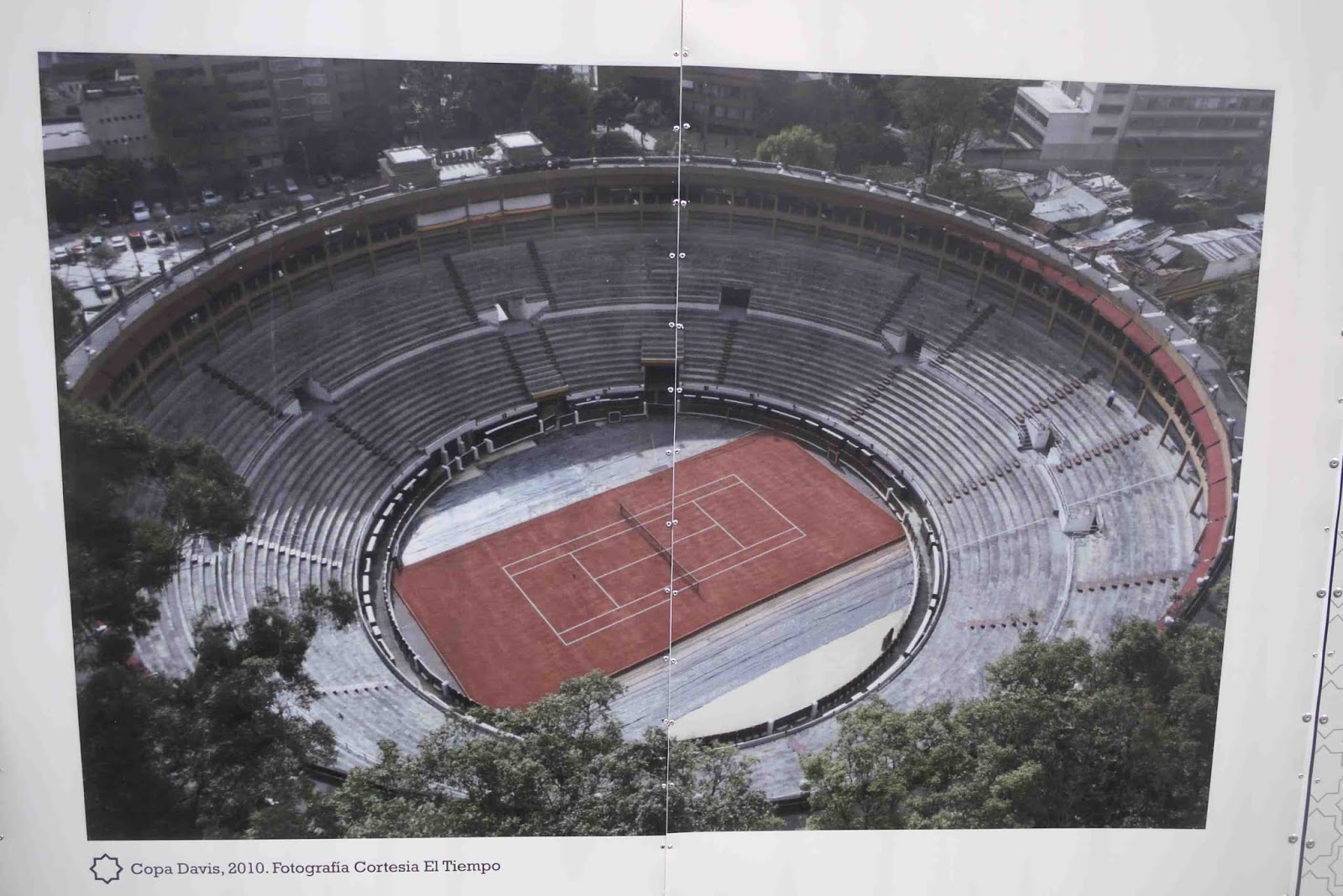
One of the few uses, a tennis match.
The Santamaria stadium, built in 1931, centrally located and recently renovated, is, incomprehensibly, almost never used for events except for bullfights. If the bullfights move out, then this Bogotá landmark will be even more completely vacant than it is already.

The Santamaria would be great for cultural and musical events. Imagine afternoon jazz festivals, weekend theatre, children's sports...the possibilities are endless. The lack of activities is incomprehensible.

If the city puts the Santamaria to other uses, as it should, then by all means ban bullfighting there. But until that happens, let this Bogotá landmark at least be used for something.

The plaza's only visitors. tourists.
Anybody who reads this blog knows that I have a bit of cynical view toward the bullfighting protesters. Sure, bullfighting is cruel and seems like a holdover from the Dark Ages. However, other thngs, such as cockfighting and factory farming, are much crueler and affect many more animals. Why does only bullfighting get protested?

By Mike Ceaser, of Bogotá Bike Tours

Saturday, January 27, 2018

Bogotá's Final Bullfighting Season?


Anti-bullfighting protesters march in Bogotá last Sunday.
Workers preparing the plaza for bullfighting recently.
Bogotá's sometimes-annual bullfighting season started last weekend. But, no matter how many ears and tales the fighters are awarded and how many bulls they kill, the real story story is the fate of bullfighting in Bogotá and the rest of Colombia.

Bullfighting has been under siege here since Mayor Gustavo Petro managed to block the activity
during most of his mayoralty. However, a 2016 court ruling obligated the city to allow the fights because they are a tradition here, even tho current Mayor Enrique Peñalosa (perhaps after having observed that the anti-bullfighting crowds are far larger and more motivated than are the bullfighting fans), says he wants to ban bullfighting as well. It also seems as tho bullfighting is getting aged out, since today's young people have other interests, such as videos, football and Pokemon Go.

Men buying tickets to a bullfights. Bullfighting reportedly is
losing popularity, and its fans are aging.
City officials have talked about holding a referendum to let Bogotanos vote on whether or not they want bullfighting to continue, but it's not clear what legal weight such a vote would carry. A senator has also introduced legislation to ban bullfighting nationally. Yet, while only a tiny minority of people seem to like this blood sport, they tend to be economically and politically powerful, giving them a good shot at blocking any anti-bullfighting laws.

A billboard advertises
Bogotá's 2018
bullfighting season.
No matter that the bulls live good lives before they are brought to the Plaza de Toros, where the fight lasts only a quarter of an hour. And no matter that much, much worse practices, such as cockfighting and industrial farming, which affect many more animals, are ignored by protesters: It still is a fact that killing an animal for sport and
entertainment is a cruel spectacle which harkens back to centuries ago.

But if bullfighting ends, will the historic, Moorish-influenced stadium find another life? The panels the city put on its front call it the 'Plaza of a Thousand Uses,' but it receives almost no use at all outside of bullfighting season and a few tourist visits. A rare exception this year was the Davis
Cup Tennis Tournament, held in the stadium. (Colombia lost Croacia.)

Bicycle tourists outside the bullfighting stadium.
A sport with a future? Advertising a bullfighting school.


A rare alternative use for the stadium: An art festivale.


Women's volleyball in the bullfighting plaza.

Big time wrestling inside the bullfighting plaza.
By Mike Ceaser, of Bogotá Bike Tours 

Sunday, October 12, 2014

A Strange Sort of Hunger Strike

A man stands today near a sign announcing that the young bullfighters have been hunger striking for 69 days.
On March 1, 1981, in Maze Prison in Northern Ireland, Catholic Republican inmate Bobby Sands refused to eat. 66 days later, Sands died of starvation, making him likely the world's most famous hunger striker. Nine more men followed him to their deaths. The longest survivor withstood 73 days of starvation, while another man died after not eating for 46 days.

Hunger strike supporters outside of the Santamaria Plaza.
In early August, In front of Bogotá's Santamaria Bullfighting Plaza, a group of young bullfighters called novilleros started a hunger strike demanding that the plaza, be reopened to bullfighting, against the wishes of Mayor Gustavo Petro. Today, 69 days later, they're still there- and going strong. In fact, some of them plan to bullfight early next month in Choachí, a town outside of Bogotá. By then, they'll have been 'hunger striking' for about 90 days - far longer than any of the Northern Irelanders survived. That's pretty good, for a bunch of guys who by all rights should be near death.

In fact, from what I'm told, the 'hunger-strikers' are receiving nutrition via intravenous fluids.This is not meant to question the strikers' dedication - several have been hospitalized during the 'hunger strike' - after which they taking nutrition intravenously.- and at least one had to withdraw after developing stomach ulcers. hospitalized, before they started taking nutrition intravenously.

So, call what they're doing a sit-in, not a hunger strike. Give up the lie you guys, and eat an apple.

The bullfighters look likely to win their battle - altho not because of their dubious hunger strike. A court recently ruled that Mayor Petro lacked the authority to prohibit bullfighting in the historic stadium. The mayor is appealing the ruling. The mayor is also asserting that the 83-year-old stadium requires structural reinforcement. Some suspect that the problems were invented by Petro as an excuse not to allow bullfighting. But even if the work goes ahead, the city would have to provide another site for bullfights, the court said.

By Mike Ceaser, of Bogotá Bike Tours

Thursday, September 4, 2014

Bullfighting Back in Bogotá?

The empty Santamaria bullring might see corridas again soon.
Bullfighting's coming back? Altho a court has ruled that Mayor Petro did not have the authority to break the city's contract to put on bullfighting, you can bet that Petro will do his best to defend one of his few - and perhaps his most signature - accomplishment.

Christ-as-bullfighter.
The court ruled that bullfighting enjoys legal protection because it is a piece of cultural tradition. Petro has not permitted bullfights in the stadium for the last two years, and recently said he'd retire before allowing bulls to return there. But after the court ruled, the mayor said he'd respect the decision. At the same time, Petro also claims that sections of the 83-year-old plaza are in danger of collapse and that the building needs a major remodeling.

The bullfighters suspect the mayor of inventing that supposed danger as an excuse to not allow bullfights, and that in remodeling the stadium the city would make it unusable for bullfighting. Whatever the truth, Petro may now insist that holding major events in the plaza would be hazardous and that the building needs an expensive multi-year workover.

The court also seemed to give Petro a way out by allowing him six months to allow bullfighting in the plaza. Six months from now is early March 2015, and Bogotá's annual bullfighting season is in January and February. So Petro could possibly delay bullfighting until at least 2016 without violating the court ruling.

The Moorish-style Santamaria stadium was built in 1931.
It's understandable that Petro will do all he can to block bullfighting for reasons besides his concerns about animal welfare and the celebration of violence. The anti-bullfighting activists have been a small but vociferous part of Petro's coalition.

And Petro has few other accomplishments to point to. Courts have ruled against two of his other signature accomplishments: his city-wide land-use plan and his reorganization of the city's garbage collection scheme. Meanwhile, hopes that Petro would boost the city's recycling rate and find a new formula to reduce traffic jams have been disappointed.

Bullfighting advocates certainly continue to be dubious about Petro's intentions. A group of young bullfighters called novilleros have been hunger striking in front of the plaza for more than a month demanding the return of bullfights. After the court's ruling, they vowed to continue until a bullfight is actually held in the stadium.
Young bullfighters have been hunger striking in front of the stadium for more than a month. They now vow to continue until the first bullfight is held there.
Bullfighters train in front of the Santamaria Plaza.
By Mike Ceaser, of Bogotá Bike Tours

Tuesday, August 12, 2014

Hungering for Bullfighting

Andrés Castillo stands in front of the bullfighters' protest stand.
Andrés Castillo has a single dream: He wants to be a bullfighter. And not just any bullfighter, but una figura - one of the big names of the fiesta brava, who displays his art in the great plazas of Spain.

Hunger strikers. 'We don't want food.
We're hungry for bulls.'
But Castillo, who is 18 and still working towards becoming a full-fledged bullfighter, sees his dream in peril. For the past two years Bogotá Mayor Gustavo Petro has not allowed bullfighting in the city's venerable Santamaria bullring. And now the mayor plans a multi-million remodeling of the 83-year-old structure, which the bullfighters fear will make it unusable for bullfighting. For more than a week, Castillo and other novilleros have been staging a hunger strike in front of the stadium demanding the right to practice bullfighting.

"My greatest dream is to fight in Bogotá," he says.

Hunger strikes several days ago.
Petro and other opponents of bullfighting charge that the practice involves cruelty and glorifies violence. While they may be correct, it is perhaps a strange argument for a mayor who made his name as a leader of the M-19 guerrilla group, which was not above employing violence. But the anti-bullfighters' arguments hold no weight for Castillo, for whom bullfighting is passion, art and his reason for being.

"I dream about bulls; I live with bulls; for me, bulls are everything," he says.
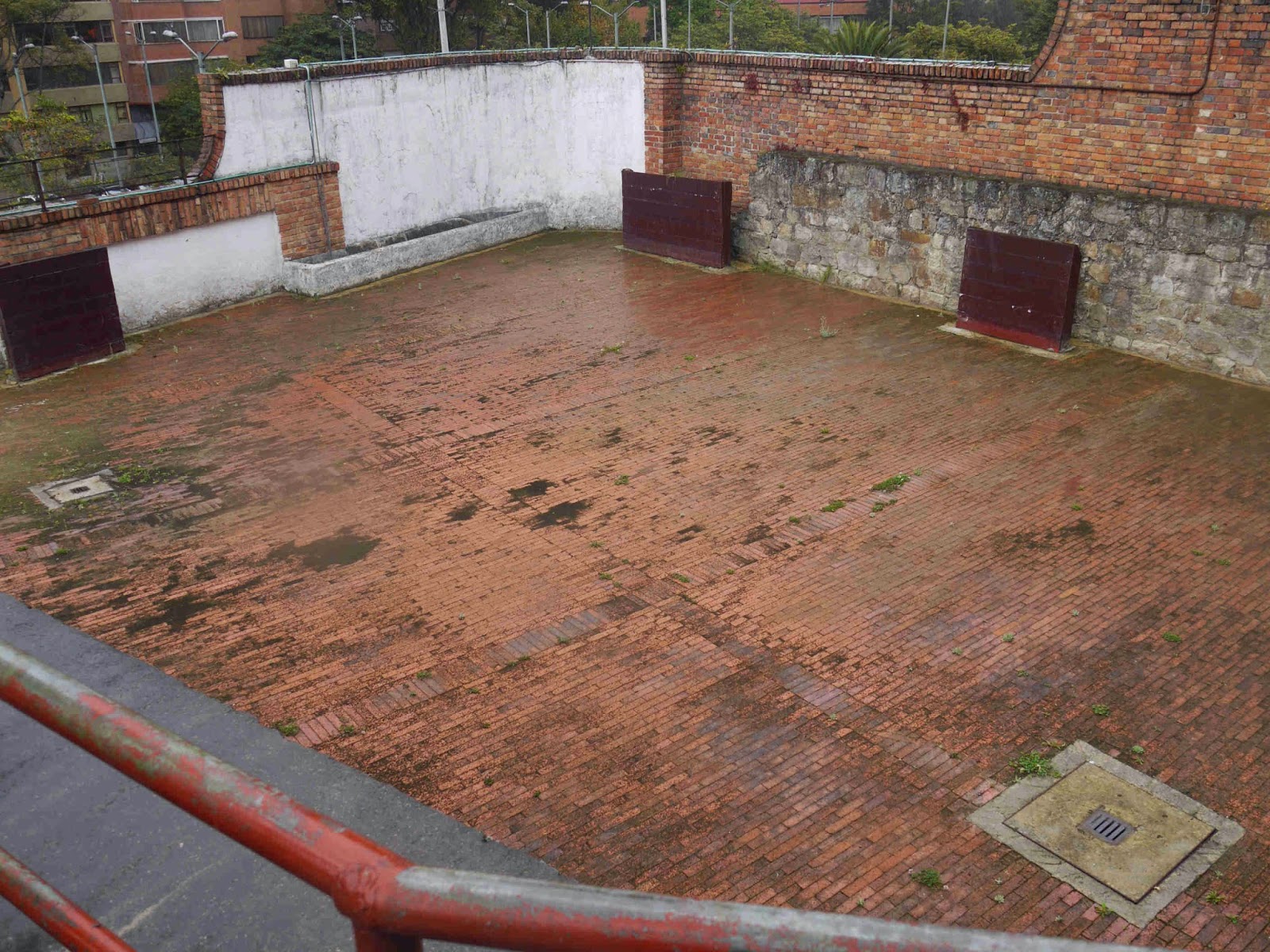
An empty corral: Destined for cars?
Castillo's father is a fan of bullfighting, and even tried it once - but gave up after being scared by his first bull. He is now repairs washing machines. Ironically - or perhaps appropriately - Castillo says that his father is now the family member who least supports his bullfighting.

But Castillo caught the bug, despite suffering a mild goring from a calf in his first fight in 2012. He blames that, the first of many such gorings, on the fact that he'd trained for only two days.

"I got back up and kept going," he remembers proudly.
Andrés on Aug. 19 with his mother, Lorena. The night before, he had been hospitalized and given serum. 'He's in the hands of God,' Lorena said.
Since then, Castillo has fought dozens of bulls, most of them in small-town bullrings where he filled in after the regular matador got injured. He's fought ten bulls on his own.

Bullfighting is undeniably in decline, both because of pressure from animal welfare advocates and because the futbol. Colombia is the world's third most important country for bullfighting, after Spain and Mexico. Except for Bogotá, all of Colombia's major cities and many small towns have bullfights. There is also some bullfighting in Peru, Ecuador and Venezuela.

The bullfighting crowd also seems to be aging out. Young people in Colombia and other countries are into

His profession's decline worries Castillo, but doesn't dissuade him.

"When I think about bullfighting, I think of victory, not defeat," he says. "I don't know whether I'll achieve it, but I'm going to give all I can. There's nothing else that I like."

Transforming the Bogotá's Plaza de Toros into a Plaza de Todos (Plaza for Everybody) was one of Petro's headline promises during his mayoral campaign. For the first year or so of his mayoralty the handsome moorish-style stadium was used for cultural events and concerts. However, for the last 12 months the building has sat vacant, except for tourist visits and toreros practicing in the morning. The mayor's planned remodeling could be the death knell for bullfighting in the arena if the building's stables are transformed into a parking area.

Colombian bullfighters see the Santamaria Plaza as fundamental to their career prospects because it's where they have their best chance of being recognized and offered contracts to fight overseas.

Protesting bullfighters display their craft.
"Fighting here opens many doors," Castillo says.

The bullfighters have filed lawsuits demanding the return of bullfighting. They are backed by laws declaring bullfighting part of the city's patrimony. According to El Tiempo a court is likely to rule in the bullfighters' favor. But they can expect Petro to oppose bullfighting's return with every resource he has. After all, stopping the fiesta brava is about the only transformation the ex-revolutionary has accomplished. More than two years into his term the city is as polluted and congested as ever, and trash still piles up on streetcorners.

Slaughtered pigs and cows for sale in Paloquemao Market.
Does anybody care how these animals lived and died?
Animal rights activists have also been loud and conspicuous supporters of Petro. But, strangely, they have directed their ire almost solely against bullfighting. Nobody protests against cockfighting, nor have I seen any effort to improve conditions for the innumerable animals which are slaughtered every day for Bogotanos to eat. Bullfighting bulls, which are bred specially to be large, strong and aggressive, live free in the fields and live years longer than do animals raised for meat. Castillo points out that, if not for bullfighting, the bullfighting breed would not exist at all.

In his eight days of fasting, Castillo's weight has lost ten of his 64 kilos. But he says he has no doubts about continuing on until the plaza is reopened for bullfighting.

"I've risked my life with bulls," he says. "So, why not here, to defend 83 years of tradition."


By Mike Ceaser, of Bogotá Bike Tours

Tuesday, August 5, 2014

The Bullfighters Have Their Say

'We gave you our vote and you left us without work.' (I don't believe that they voted for Petro.)
Hunger-striking bullfighters
There have been lots of protests against bullfighting, but this was the first one I've seen in favor of la fiesta brava. Mayor Gustavo Petro hasn't allowed bullfighting in Bogotá's historic Santamaria Plaza for the last two years. Now, the city plans to spend millions remodeling the plaza, which has the bullfighting community worried that the mayor's real goal is to make the stadium unusable for bullfighting.

The bullfighters claim that, because the plaza is a designated historical landmark, remodeling is illegal. They also say that the remodeling plan includes transforming the plaza's stables into a parking lot, which would seem to make bullfights impractical. It's also a strange plan for a mayor who keeps promising to discourage use of the private automobile.

Even on hunger strike, bullfighters show their moves.

Hunger striking for bullfightig.


Welcome to the bullfighting university.
By Mike Ceaser, of Bogotá Bike Tours

Thursday, January 3, 2013

Slippin' and Slidin' in the Bullfighting Stadium


Bogotá's Plaza de Toros, La Santamaria, is experiencing an uncharacteristic kind of display these days. Instead of sand, there's ice. And instead of bullfighters facing off against bulls, there are young people slipping and sliding. The performers may be less graceful, but they look like they're having lots more fun.

Normally, January and February are Bogotá's bullfighting season. But Mayor Gustavo Petro announced an end to bullfighting in the Santamaria. The bullfighters went to court and won when a judge ruled last year that cities could not ban bullfighting where it's traditional. Petro responded that he's not banning bullfighting, but just not renting out the plaza, which belongs to the city.

Many suspect that Petro arranged the ice skating as an excuse not to allow bullfighting. In other years, they put an ice skating rink in Plaza Bolivar, where it looked strange between Congress, the Cathedral and the Supreme Court.
A few minutes' observation makes clear that this is Bogotá, not Quebec or Holland. Few of the Bogotanos slippin' and slidin' around have ice skated before.

Try, try again.
Oops!


By Mike Ceaser, of Bogotá Bike Tours

Monday, December 3, 2012

Julian, Boy Bullfighter


Many young boys aspire to be football stars, famous musicians, even presidents...but to be a bullfighter? It sounds like something out of a long-past era. And job prospects for bullfighters are dimming - the sport (or art) is being restricted in the few countries where it's still practiced, including in Colombia. Early this year, Bogotá Mayor Gustavo Petro prohibited bullfighting in La Plaza Santamaria, altho bullfighters then sued and won a court ruling that municipal governments could not bann bullfighting where it is traditional. The battle over bullfighting will continue.

Meanwhile, most mornings in the Plaza Santamaria, young men practice their passes and kills, dreaming of one day carrying out their moves with real bulls in front of thousands of spectators. At nine, Julian is one of the youngest. But he, and his father, Jose Ignacio, 29 and a bullfighter himself, are confident that Julian has the skills - and the backing.

That's why they believe that Julian can make it in a profession that's perhaps in its twilight.

"There are powerful people behind him," says the father.

But Julian, like all bullfighters, will have to overcome the profession's dangers. He's already been gored once, by a small cow. Is he scared? I ask him.

"Sometimes," he admits.

"They call me the Colombian Juli," adds Julian, who is not strong on humility. El Juli, a Spaniard, is one of the current stars of the bullfighting world.

Jose Ignacio, who's been injured multiple times bullfighting, tho never seriously, says he and Julian's mother are proud of the boy, but that they'll support him in whatever profession he chooses.

Bullfighting appears to have a genetic component - at least, many bullfighters are sons and grandsons of bullfighters. But Jose Ignacio says he's the first bullfighter in his family, altho his parents were great bullfighting fans.

Both Julian and his father know well that their profession is under siege. Animal rights activists regularly protest bullfighting (but never cockfighting or industrial farming, which seem to me to be much crueler). Jose Ignacio accuses animal rights activists of distorting bullfighting. Julian cites "an anti-bullfighting scientist" who Julian says demonstrated that bulls feel little pain in the heat of battle. That makes sense, since a person too shrugs off pain while charged with adrenalin.

But that doesn't address the making a spectacle out of killing and violence.

But if he doesn't make it, and bullfighting ends in Bogotá, Julian may have another professional option - guiding tourists thru the Santamaria Plaza, which he does with lots of enthusiasm and passion.

Jose Ignacio's T-shirt says 'Bullfighting is ar and culture.'


By Mike Ceaser, of Bogotá Bike Tours