Showing posts with label military. Show all posts

Thursday, August 23, 2018

Scientology in the Armed Forces?

A retired Colombian general pins an award recently
on Scientology leader David Miscavige
Revelations that the Church of Scientology, whose history is filled with bizarre beliefs and accusations of cultism and abuses, has worked closely with Colombian military personell have generated justified concerns.

There are many people - including some Hollywood celebrities - who are dedicated followers of Scientology, and appear to believe that they have obtained great benefits from it.

But the belief system - does it deserve the respect of being labeled a 'religion'? - includes some truly bizarre ideas about faraway planets and ancient volcanoes filled with hydrogen bombs and has been repeatedly accused of abusing its followers and engaging in exploitative cultlike behaviors.

A Colombian military man at a
Scientology event.
That's why it's worrisome when such an organization has an institutional influence over members of an armed forces. In case of conflict, where would these soldiers loyalties lie? Whose orders would they obey? What sort of values would they apply?

In particular, it's frightening and contradictory for an organization accused of imprisoning members
and forcing women to have abortions to be allowed to teach human rights to Colombian troops.

And Scientology's grandiose, even bizarre, claims about itself just make one shake one's head and wonder whether the organization has its head on straight. A 2015 Scientology press release about the inauguration of its new Bogotá building boasted about the legal and military high officials attending the ceremony, and called the event 'one of the greatest things ever to happen to Colombia.' Scientology has even credited itself with slashing Colombia's crime rate, boosting its tourism and reducing human rights violations.

That said, Scientology is clearly on the offensive in Colombia, with its expensive new headquarters in the city's north.

Interfering with others' religious beliefs is always sensitive. But when it comes to Scientology, both the government and potential followers should exercise lots of caution.


By Mike Ceaser, of Bogotá Bike Tours

Sunday, November 13, 2016

Gorgona Island: Natural Wonder or Military Outpost?

Gorgona Island from above. 
Gorgona Island, located 35 kms off of Colombia's Pacific Coast, is a natural wonderland. In the past, however, the place was a nightmare. When Spanish conquistador Francisco Pizarro took refuge there in 1527, so many of his men died from snake bites that he named it after a monstrous goddess from Greek mythology who had serpents growing from her head.

From 1960 to '84, the island contained a much-feared prison, where prisoners died from snake bites, tropical diseases and beatings from sadistic guards and vicious fellow inmates. Finally, the prison was shut down under pressure from human rights defenders and prisoner advocates.

Today, the island is a national park, boasting sloths, monkeys, sea lions and, of course, snakes. It has
Isla Gorgona, (E), off of
Colombia's Pacific Coast.
41 species of reptiles, 155 species of birds and 13 of bats. In the surrounding waters, swim sharks, dolphins and humpback whales.

But environmentalists now charge that this natural paradise is threatened. The Navy plans to buid a communications base on top of the island's tallest hill. Naturally, the military moved ahead with the plan to alter this national treasure without any public hearings.

Unquestionably, the island is strategically located to monitor drug trafficking and illegal fishing in the region. The military points out that its project - consisting of a telecommunication tower and support facilitie - will be built on already-disturbed land, an old prison football field.

A sloth on Gorgona Island.

A lizard on Gorgona Island.
But that's not the point. The base will inevitably require road building, loud, heavy machinery and the arrival of outside workers, who many not be environmentally sensitive. The base will also house about 28 soldiers.

Those young men will be bored and restless. And young military conscripts don't have the best reputation for environmental sensitivity. Will officials be able to prevent them from hunting, building campfires, smuggling animals onto or off the island, riding around on dirt bikes, and all kinds of other destructive misbehavior which bored young men are inclined to? Remember that Gorgona used to be a prison, where men suffered from heat, insects and snakes. For tourists, the island may be a natural paradise. But for someone stuck there involuntarily for months, the place could be a living hell.

Whatever the military ultimately decides to do on Gorgona Island, the decision should be taken with public input, rather than behind closed doors, as the Colombian government unfortunately is wont to operate.

By Mike Ceaser, of Bogotá Bike Tours

Tuesday, August 5, 2014

A Cannon in Parque Tercer Milenio


A cannon in Parque Tercer Milenio.
This afternoon these soldiers had set up this revolutionary-era cannon in Parque Tercer Milenio.

BOOM!
They were rehearsing for the celebration of the revolutionary victory in 1819 at the Puente de Boyacá.

BOOM!
The firing recalled, inevitably, the three pipe bombs which were fired from this same area during Pres. Alvaro Uribe's inauguration in 2002. Back then, this was the notorious El Cartucho neighborhood. According to the government, the bombs were fired by the FARC guerrillas. All three missed, and two landed in poor neighborhoods, killing and injuring residents.
BOOM!

Meanwhile, this rainbow appeared above Bogotá's Eastern Hills.


Near the Casa de Nariño, the presidential band was marching.


By Mike Ceaser, of Bogotá Bike Tours

Saturday, August 2, 2014

Final Scene of 'La Guaca Millonaria'?

Soldiers on trial for keeping guerrilla money they'd found. (Photo: El Espectador)

When, on April 14, 2003, soldiers hunting for kidnapped U.S. contractors happened to dig up a package of money, the soldiers believed the fortune would change their lives. They were right, but not the way they expected.

The soldiers were marching thru a mountainous region of Caqueta Department, searching for three United States military contractors who had been captured and kidnapped by FARC guerrillas. The soldiers had occupied a deserted FARC camp and proceeded to search for weapons the guerrillas might have buried nearby. Instead, they found packages of money wrapped in black plastic.

'Dreaming doesn't cost anything.'
The soldiers proceeded to dig up some two dozen packages containing Colombian pesos or U.S. dollars. Altogether, the cache may have totaled some 40 billion pesos - close to 20 million U.S. dollars by today's exchange rate.

Naturally, as soon as the soldiers returned to the city of Popayán, they asked for leave and went wild. Some bought expensive cars, others houses. And, according to one soldier's account, the city's brothels shut their doors to everybody except for the free-spending soldiers.

Naturally, the episode couldn't be kept secret, and the 147 soldiers - or at least those who could be found - were arrested and eventually put on trial. But prosecution was tricky. After all, nobody was sure to whom the money rightfully belonged, since the guerrillas had probably obtained it thru narcotrafficking or extortion. The soldiers were first absolved of any crime, and then, in 2013, given sentences of up to 10 years. Yesterday, a military tribunal reduced the sentences to 4 years plus fines.

But only 84 of the original men were present for sentencing. The rest were either dead or had fled.

During the past decade, some of the soldiers involved have been murdered. Others have had relatives kidnapped for ransom. In the end, authorities recovered only a small fraction of the money originally found.

But at least one of the soldiers got something lasting out of the money. He had a sex-change operation, became Lilliana and opened a spa in a secret location, according to El Tiempo.

Along the way, the episode had produced books, a TV series and a film, 'Soñar no cuesta nada' ('Dreaming doesn't cost anything'), issued in English as 'A ton of luck.'

Guacas, or buried treasures, have been something of a theme in Colombian history ever since Colonial times. And they keep appearing. After his killing in 1993, cocaine king Pablo Escobar's mansion was sacked, its floors dug up and its walls bashed in by neighbors who believed riches were stashed there. If anybody found anything, they didn't talk about it. In 2003 in the town of Tulua, a drifter lived high for weeks on a cache of money he'd discovered inside the abandoned house of an arrested drug dealer. Three weeks after the discovery, the drifter was found dead, with signs of torture. And a few months ago, a street vendor told me to go visit a certain military post, where they were selling dollars at half the market rate. The soldiers there had found a guaca and were laundering the money.

I didn't see anything morally wrong with helping some humble, long-suffering soldiers make a buck from dirty money they'd found. But it could also mean trouble, so I didn't go.

By Mike Ceaser, of Bogotá Bike Tours

Thursday, June 26, 2014

No More 'Off to the Army Now'?

'Let's see those papers!' Soldiers review a young man's documents to see whether he's done the obligatory military service.
The batida has long been a disturbing and controversial institution in Colombian cities.

A young man is walking across a plaza or down a street, when he is stopped by soldiers who demand his papers. If the youth cannot demonstrate that he did the obligatory military service by displaying his libreta militar, he's detained and loaded onto a truck headed to a military base. Suddenly, he's in the Army now.
Some of these soldiers appear to have more
than recruitment on their minds.
Colombia has obligatory military or police service of one to two years for all young men - in theory. In practice, it's legal to pay to get out of the military service - referred to as 'purchasing the libreta militar.' As a result, wealthy Colombians generally pay their way out of the service, while the poor who end up trudging thru the jungle amidst mosquitoes, marshes and guerrillas.

The military service law does have exceptions: for only sons, conscientious objectors and those with physical disabilities.

Some rights activists argue that the public batidas are illegal - an issue which has been fought over in court.

You're in the Army now! A truckload of young men
caught in redadas are driven off to camp.
Of course, military service can be a positive experience. I've known parents who wanted their sons to join the Army in order to learn skills, discipline and to improve their future job prospects - as well as to get them out of the house and out from underfoot.

During his successful reelection campaign, Pres. Santos, who had been minister of defense, and whose son did perform military service, promised that if the government reaches a peace treaty with the FARC guerrillas, Colombia's military draft would be ended.

Perhaps sometime soon, young men will breathe a bit easier when they go out for that walk.

By Mike Ceaser, of Bogotá Bike Tours

Tuesday, June 24, 2014

New Name, Same School of the Americas?

For decades, the School of the Americas played a controversial role in Latin American politics.
Founded in 1946 in the United States-controlled Panama Canal Zone, the school trained tens of thousands of military and police officials from Latin American countries.

Some of the school's alumni notoriously went on to commit severe human rights violations and even become military dictators, giving the school a sinister image among the left.

In 1984, the school was relocated to Georgia, and in 2001 renamed the Western Hemisphere Institute for Security Cooperation (Whinsec).

Through the school's first decades, when it concentrated on anti-communist training, as well as during its recent incarnation as a anti-narcotrafficking academy, many of the school's students have come from Colombia, according to the 2004 book 'The School of the Americas: Military Training and Political Violence in the Americas' by Lesley Gill. Between 2001 and 2003, 21 of the school's 88 Latin American instructors came from Colombia - more than from any other nation.

Under its new name, the school was supposed to place emphasis on protecting human rights, Pres. Bill Clinton said at the time.

However, a recent study by John Lindsay-­Poland of the Fellowship of Reconciliation found that a number of the school's Colombian ex-students were later implicated in or convicted of human rights violations.

For example, Mauricio Ordoñez Galindo taught a leadership course at the school in 2001-2. Back in Colombia, he commanded an anti-kidnapping unit. In 2009 he was charged with participating in the killing of four civilians and is now serving a 46-year prison term.

Maj. Alvaro Quijano Becerra and Capt. Wilmere Manuel Mora Daza taught courses about democracy in the school in 2003-4. Back in Colombia, they were charged a few years later with collaborating with outlawed paramilitary groups by leaking them military information.

Others have commanded troops allegedly responsible for murdering civilians, according to Lindsay-Poland's report.

Jaime Lasprilla Villamizar taught the General Staff and Command course at the school in the early 2000s. Back in Colombia, Lasprilla commanded the Ninth Brigade near Huila, which committed nearly 60 extrajudicial killings, according to Gill. Lasprilla was never charged in the killings and in 2009 was promoted to brigadier general.

The report lists some 14 of the school's alumni associated or convicted of human rights violations or other crimes. I have no idea what proportion of the school's ex-students that constitutes. But if the school is supposed to educate its students in human rights, then any participation in abuses seems to be too much.

By Mike Ceaser, of Bogotá Bike Tours

Sunday, May 4, 2014

Demanding Justice for a Murdered Son


In late September 2006, Raul Antonio Carvajal, a 29-year-old army corporal, called his father and told him that his superior officers had ordered him to kill innocent people and turn their bodies over as supposed guerrillas. Carvajal disobeyed the command, his father, also named Raul Carvajal, said, and 18 days later, on October 8, he was murdered himself, his father said.
Raul Carvajal, right, tells a passer-by
the story of his murdered son.

The elder Carvajal has been protesting the last several days with his truck covered with billboards denouncing the Alvaro Uribe administration parked in front of the San Francisco Church at the intersection of Carrera Septima and Ave. Jimenez.

Carvajal says that the courts and government have ignored his demands for justice. He believes that is because of the continuing influence of ex-Pres. Alvaro Uribe, who was recently elected to the Senate, and of current Pres. Santos, who was Uribe's minister of defense. In what became known as the False Positives scandal, thousands of young men, mostly peasants, were murdered by military units and labeled as guerrillas in order to earn bonuses and time off. In the investigations and prosecutions which followed, neither Santos nor Uribe was directly implicated in the crimes. According to United States diplomatic cables released by Wikileaks, Santos wanted the killings investigated at the time.

Carvajal believes that his son was murdered by other members of the military for either refusing to participate in the killings or trying to report them.

"I want the world to know about these killings," Carvajal says. "I want justice done."


By Mike Ceaser, of Bogotá Bike Tours

Thursday, October 10, 2013

Kevin Scott's Great Adventure

Kevin Scott, in the Colombian Amazon,
shortly before wandering off into FARC's hands.
(Photo: El Tiempo)
Kevin Scott, apparently, does not read Wikipedia. If he had, he might have learned that San José del Guaviare, a town deep in Colombia's Amazon, is the historical base of the FARC Guerrillas and not a reccomended tourist destination - particularly for an ex- military man from the United States.

But Scott, a 27-year-old ex-Marine, got it into his head to walk from San José del Guaviare across the Amazon jungle to Brazil, armed only with a machete. It promised to be a great adventure, and turned into an even greater one when the FARC seized Scott on June 18 and began providing him free food and lodging (as well as Marxist ideology) for the duration.

When they initially kidnapped him, the guerrillas accused Scott of being a 'mercenary.' But they seem to have warmed up to him. Recently on their web page the guerrillas called Scott "a good gringo, naive and a daydreamer." That's probably not the way an ex-Marine likes to be described. But his family must be comforted to hear that Scott is alive, and apparently well, if a bit confused.

The guerrillas also described Scott as a hippy, who seems to have added a new dimension to couch surfing. After finishing his tour in Afghanistan, the FARC say, Scott "turned into a folkloric gringo, a gum chewer and marijuana smoker, who with a pack on his back, bluejeans and a few dollars in his pocket, set out to travel and get to know the world, with a very unique conception of life."

The FARC seem to have found in Scott an opportunity to wax poetic. They also hope he will get them some of the attention and legitimacy they perpetually craave. When U.S. civil rights leader Jesse Jackson visited Colombia recently, the FARC seemed willing to release Scott - as long as Jackson showed up for a photo opp at the release.

The Colombian government refused to cooperate. Now, Scott may have to wait until the next media star visits.

Scott, however, may not be impatient to live the jungle and guerrilla hospitality. On their website, the FARC quote Scott as saying that, before he leaves the jungle, he wants to see a tiger.

By Mike Ceaser, of Bogotá Bike Tours

Saturday, September 7, 2013

Soldiers for Peace


A soldier lights a candle for peace. 
This evening, a group of  residents of Chapinero organized this candle lighting ceremony on the Plaza de Lourdes, in Chapinero. One told me that the candles, which spelled out 'PAZ', were a protest against violence during recent marches and demonstrations in support of farmers protesting low prices for their products. Some of the protests in Bogotá turned violent, in great part because of hooded rioters called encapuchados.

Such a perspective on recent events is perhaps not surprising for residents of middle class Chapinero. Others would probably find the violence in deeper, root causes, such as economic exploitation of farmers.

I was struck by the participation of soldiers in the ceremony. But I probably should not have been. After all, they suffer most from Colombia's violent armed conflict. On the other hand, tho, peace would deprive them of work.

The candles on Plaza Lourdes spelled PAZ - PEACE.


By Mike Ceaser, of Bogotá Bike Tours

Saturday, August 24, 2013

Marching for Conscientious Objection


'I'm an artist and I prefer painting the world with brushes and oils instead of painting Colombia with innocent blood and arms.
These young people protested today against a Colombian institution - Obligatory Military Service - which may be on the way out for several reasons. In theory, military or police service is obligatory for all young men - but not in practice, since it's legal to pay not to do it. As a result, the wealthy pay their way out while the poor do time and risk their lives in remote jungle camps. There are also many other exceptions, including for only children, students and those with disabilities.
'No al fuero militar.' The fuero militar is a military
jurisdiction law protecting soldiers from
charges for rights absues.

In principle, it's also possible to plead conscientious objection - but many young recruits don't know about that right. And, reportedly, it's hard to use in practice. 

At today's rally, speakers protested against the practice of police and military stopping young men in public and demanding proof of having done military service. If they don't have it, it's off to the army. Speakers also portrayed military service as a practice of 'killing innocent campesinos and defending multinational corporations.' 

The military certainly has committed abuses, most notoriously the False Positives killings. But advances by the military against guerrillas have also brought peace calm to parts of the countryside, enabling farmers to return to their land. 

And, some poor families see military service as a positive opportunity for employment, character building and a small income - at the very least, the family has one less mouth to feed. 

'I object.' 
Today's protesters also forgot about the guerrillas' own 'recruitment' practices. The groups are notorious for turning children into guerrilla fighters, sometimes against their will or under fals pretenses, and holding them for decades under threat of death if they try to flee. In the guerrilla ranks, young men are sometimes used as cannon fodder and girls become lovers of senior guerrilla leaders - and are forced to abort when they become pregnant. 

If the ongoing talks between the FARC guerrillas and Colombian government are successfull, the need for a miltary draft may end. That would be the best outcome of all.

And today's small protest march was striking for the quantity of riot police called out - to protect against an inherently anti-violence organization. It's a common response to protests by Bogotá authorities, whether from an excess of caution or a wish to intimidate.


The crowd on Plaza Bolivar.

By Mike Ceaser of Bogotá Bike Tours

Monday, August 5, 2013

What Can an F-16 Buy?


F-16s parked at a Colombia air base.
El Tiempo reports that Colombia is shopping for e-16 fighter jets, altho the government quickly denied it.

Still, the newspaper's account of meetings in Colombia and the United States sounded convincing.

Colombia's existing warplanes, made in Israel and Brazil, are aging. But does Colombia really need new warplanes?

Peace negotiations between the government and FARC guerrillas appear to be advancing. With a peace agreement potentially near, it seems that at a minimum the government should wait before making a big arms deal.
An F-16 in flight. 

And there are no prospects of war with any of Colombia's neighbors. A few years ago, when the Venezuelans were making war noises, their tanks broke down on the way to the border. Colombia didn't take even Venezuela seriously enough to mobilize its own military, and analysts predicted that Colombia would come out ahead in any conflict.

The real point here is what Colombia would have to give up to buy these warplanes. The news reports don't specify how many planes Colombia might buy. And, F-16s vary in price from a few million dollars for used ones, to $80 million when training and additional equipment is included. And, a warplane of course requires a crew, fuel, maintenance and someplace to park, meaning that purchase is only the beginning of its costs.

Placing a round, somewhat arbitrary number on the rumored deal, I'll price it at $150 million, which might buy between four and six planes. That's roughly 300 billion (300 thousand million) Colombian pesos (talking U.S. billions, which are equivalent to one thousand million).

To put that in context, the city of Bogotá's most recent budget alloted only 5,000 million pesos for the environment and half that for the sports and recreation. Arts received 2,500 million pesos.

Military weapons, of course, can be useful. With all of its human rights violations, Pres. Alvaro Uribe's offensive did weaken the FARC guerrillas enough to force them to enter the ongoing peace negotiations with the Colombian government.

But today, with the country's armed conflict perhaps near its end, might it not be better to invest the F-16 money in schools, hospitals, environmental protection and economic development? You could even argue that more work and classrooms for young people is a good military strategy, since it keeps them out of the guerrillas and other outlaw organizations. 

But the military boys must have their toys, and I suspect that Colombia's brass will get their airplanes.
By Mike Ceaser, of Bogotá Bike Tours

Sunday, June 16, 2013

The Changing of the Guards


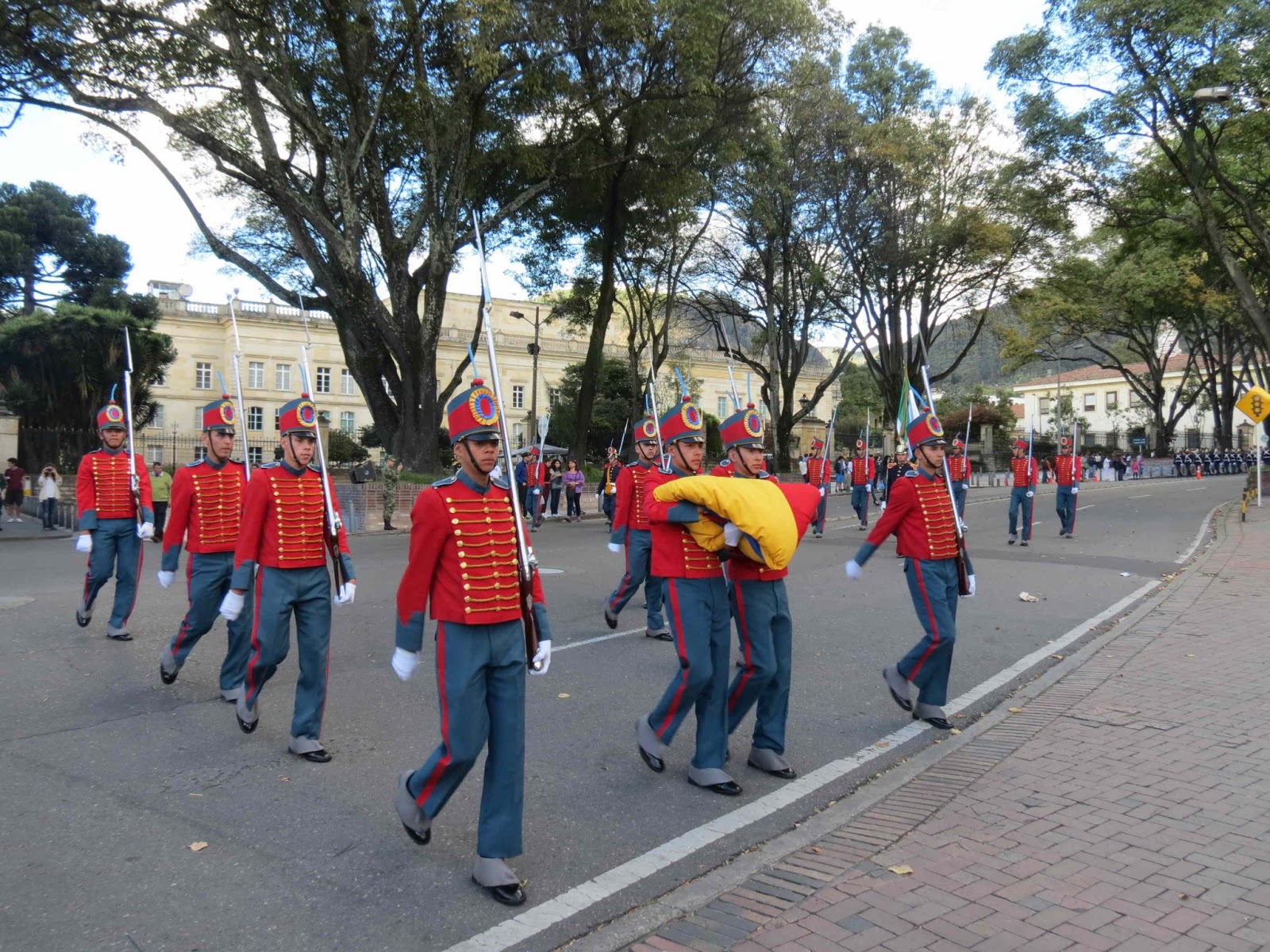
Today I happened to come upon the changing of the guards by the Presidential Palace, La Casa de Nariño, just as it was winding up. It was the first time I'd seen it.

It's nice, I suppose, to see the military in peacable performance. I was also struck by the soldiers'  (mostly female) fan club, as well as the way that the young men celebrated the end of their peformance, which must represent lots of time and training for them.


A photographer in close pursuit. 

The soldiers cheer as they near their cuartel.
The soldiers' feminine fan club follows close behind. 

And cheer more...


By Mike Ceaser, of Bogotá Bike Tours