Showing posts with label armed conflict. Show all posts

Monday, December 10, 2018

Scenes From The Armed Conflict


A girl and her father, driven from their
homes by violence, carry away
their few belongings.
Jesús Abad Colorado is Colombia's most distinguished documentary photographer, particularly of the country's armed conflict. And it seems to me that his work lives up to the term 'documentation,' because he documents all parts of the conflict's tragedy and anguish.

Leftist guerrillas; right-wing paramilitaries; the regular military - all have committed terrible crimes, which Colorado documents impartially. Perhaps this characteristic is in his blood, as his family story carries scars dealt from all sides.

During Colombia's La Violencia period paramilitaries murdered his grandfather and a child. Colorado's grandmother stopped eating out of sadness and died a few months afterwards. In more recent times, one of his cousins was disappeared by the military, another cousin was kidnapped and murdered by the FARC guerrillas, and the guerrillas have kidnapped Colorado himself - twice.

An exhibition of Colorado's work, called Testigos, is on now in the Claustro de San Agustin in La Candelaria.

If you go by bike, however, be forewarned: Even tho the Claustro is part of the Universidad Nacional, whose campus is full of bicycles, the Claustro has no bike parking. You'll have to leave it in one of the commercial lots on Carrera 9.


Comedian and journalist Jaime Garzon, who was assassinated by right-wing groups working with the government.
The Convivir were legal organizations of rural residents which often turned into paramilitary organizations.
A crematorium with which the paramilitaries burned their victims.

A woman cries in her devastated town.

Investigators retrieve the remains of conflict victims.

Indigenous people displaced by violence.

A girl holds a photo of her murdered father.

A girl and her mother flee with the girl's beloved chicken.

A happy fighter. 

The interior of the San Augustin cloister.

Mourning a murdered relative.

Visitors in the Claustro San Augustin.


Excavating a mass grave.

A river polluted with oil from a pipeline bombed by guerrillas.

A displaced girl and a soldier.
By Mike Ceaser, of Bogotá Bike Tours

Friday, December 1, 2017

Sexual Violence as a Weapon in Colombia's Conflict

Sexual abuses have been in the news not only because of the endless parade of headline-making sex crimes, often targeting children, but also because of revelations of wholesale sexual attacks being used as a weapon of war by Colombia's various armed groups. 

A recent report by the Centro de Memoria titled 'The War Written on the Body' counted more than 15,000 sexual attacks amidst Colombia's armed conflict, committed by armed groups of all types, including the official military. That number, of course was surely a huge undercount, since most such crimes are never reported.

The report included testimonies by women and girls recounting attacks by armed groups, often as punishment for supposed disobedience. One woman, for example, had helped her children escape from being recruited as FARC fighters, for which misdeed the guerrillas gang raped her. Other women were targeted with attacks as warnings to or punishment against their husbands, for example for not paying protection money to the armed groups. 

One FARC leader, Raul Reyes, who was killed in 2008 by a Colombian military bombing of his camp in Ecuador, kept an escort of female guerrillas, some as young as 10 or 11, whom he sexually abused.

A graph shows numbers of reported cases of sexual abuse
related to Colombia's armed conflict. Cases
peaked in 2002 and 2014.
A young girl recruited by the guerrillas described in the Centro Memoria's report how the guerrillas arranged newly arrived girls up in two rows: the virgins on one side, the rest on the other. The virgins were given to the guerrilla commanders for their recreation, while lower-echelon guerrillas had to make do with the others.

Female guerrillas who became pregnant were usually forced to have abortions or had their newborns taken from them.

A conservative politician calls for
life sentences for child abusers.
Sex crimes are also in the news because some conservative politicians are advocating for capital punishment or life in prison for child rapists. That has many asking why the demobilized guerrillas - many of whom committed sex crimes, as well as murder, kidnapping and forced displacement - should get off with little more than a symbolic punishment, and even be allowed to hold political office.

And I also wonder why the wave of accusations (almost all of them certainly true) of sexual misbehavior against prominent men in the U.S. has not spread to other places, particularly Latin America. After all, in a nation like Colombia where many men feel entitled to make sexual comments to women on the street, and where machismo culture is strong, is it credible that much worse things don't happen in the privacy of offices and studios?

By Mike Ceaser, of Bogotá Bike Tours

Saturday, November 11, 2017

The War We Have Not Seen

Massacre victims.
A paramilitary commander kidnaps a woman on suspicion of guerrilla sympathies, holds and rapes her, and then murders her to keep her quiet.

A teenage FARC guerrilla, eight months pregnant, wants to have her baby. But the guerrilla leaders
Massacring civilians.
force a doctor to abort her pregnancy. When the doctor and the baby's father both object, the guerrilla leaders order them murdered, too.

A child soldier flees a paramilitary unit, but is recaptured. The paramilitary commander gathers together the students from the local school to watch the execution, as a warning.

A guerrilla unit commander, ordered to blow up a military vehicle, becomes bored with waiting, and decides to bomb a car carrying a civilian family instead.

FARC guerrillas, suspicous that a local schoolteacher is reporting on them when she leaves town, capture and hang her.

A funeral.
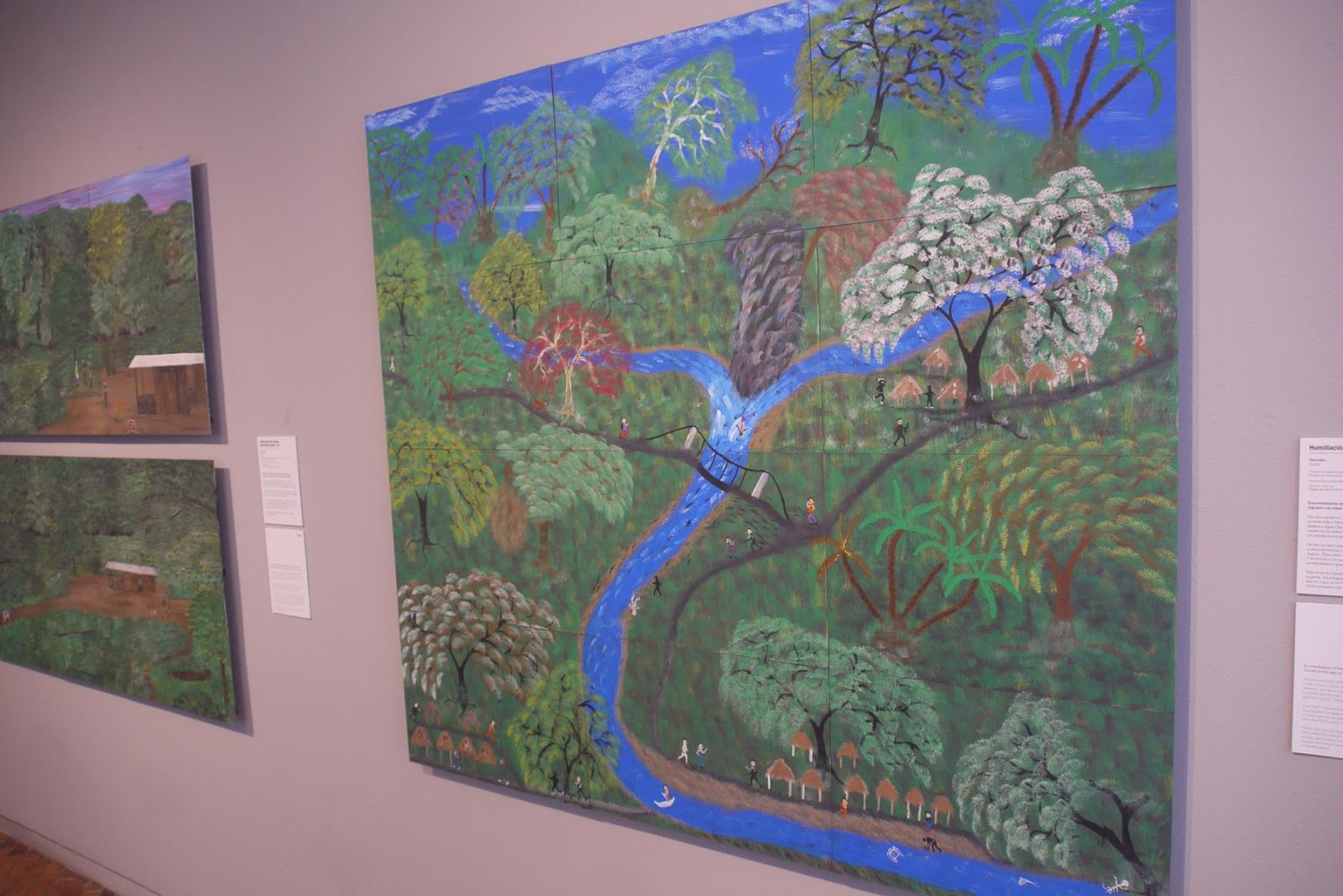
Such horrors became almost routine during Colombia's long and senseless conflict. And such accounts, told by ex-combatants, many of them only children when they joined up, are on display now in Bogotá's Museum of Modern Art, illustrated by childlike paintings.

The project is called 'The War We Have Not Seen', by the Points of Encounter Foundation, and captures a few of the conflict's innumerable horrors, horrors which would have made headlines in any normal country, but, if not for this project, would have gone unnoticed here.

The museum has, incidentally, done a good job of becoming bilingual.
A hanging.


A river of death.


Killing a woman.


Kidnap victims.

A massacre.

A paramilitary officer. In the background, a woman he raped and then murdered.


By Mike Ceaser, of Bogotá Bike Tours

Boards of Memory

When Juan Manuel Echavarría traveled thru the Montes de Maria region in 2010, in a community depopulated by Colombia's conflict, he came upon a schoolhouse abandoned by the fleeing residents. Inside, he entered a classroom - and found the teacher's final lesson still on the blackboard.

That haunting experience started Echavarría  and a friend on an oddysey across the remote region, where they visited more than 100 abandoned schoolhouses, photographing more than 200 classrooms as memorials to disappeared schoolchildren, families and whole communities.

According to Verdad Abierta, from the late 1980s to the early 2000s, nearly 50 massacres took place in this bucolic hill country just a few hours outside of Cartagena, mostly committed by right-wing paramilitary groups against landless campesinos.

Echavarría's work, named Rios y Silencio, preserving a history Colombia hopes not to repeat, is on now  thru Jan. 7 at Bogotá's Museum of Modern Art.

The museum has, incidentally, done a good job of becoming bilingual.

A mule outside of a school, apparently waiting for a child who long ago went away.
An abandoned chalkboard in a deserted school conserves its final lesson.

Photos of abandoned schools in the Museum of Modern Art.


By Mike Ceaser, of Bogotá Bike Tours