Showing posts with label cars. Show all posts

Friday, February 2, 2018

Car-Free Day

The street behind the Paloquemao market, normally congested and chaotic.
Yesterday's car-free day was a success - if you measure it by the number of cars removed from city streets. Many streets and avenues were bereft of private cars, enabling traffic to flow faster, and reducing pollution.

Calle 26, usually a perpetual traffic jam, was given over to cyclists.

bicyclists abounded.
This year's car-free day was dedicated to pedestrians.

City workers show off information on the benefits of walking.
Still, the day was far from pollution-free. Here was the view from the upper end of La Candelaria at 8:30 a.m.
At 8:30 a.m. a grey haze blanketed the city, as seen from La Candelaria.
And, if cars were restricted, 'rolling chimneys' like this bus still abounded.
One of the car-free day's goals is to motivate car-aholics to try car-free ways of commuting. However, many workplaces make that goal mute by shutting down for the day.

Lots of places just shut down. The Ministry of Technology had its workers telecommute yesterday.

And Paloquemao Market was nearly deserted.

Paloquemao market's usually-crowded parking lot.

By Mike Ceaser, of Bogotá Bike Tours

Tuesday, November 28, 2017

The Carification of La Candelaria

An apartment building goiing up with a parking garage.
A new kind of apartment building is popping up in La Candelaria: Ones with car parking incorporated. 

That might sound nice and convenient, but it means worse traffic congestion, more pollution and even worse health for the neighborhood. 

Until now, the minority who owned cars parked them in commercial lots and paid for the privilege.
A new apartment complex with parking garage:
Makes an ugly contrast with the neighborhood's
historic homes.
But incorporated parking changes the dynamics and economics. Now, by acquiring an apartment, you're paying for a parking space whether you want it or not. That means that those who don't own cars, subsidize those who do (as happens with all 'free' parking.) It also sends a signal: 'You should own a car, and use it for transport.'
The convenience of having a car at hand means that many residents will use them, even to go two blocks to buy some beers. That means even worse traffic jams, and less exercise for residents. It also hurts the local economy, since residents with cars are more likely to go across town to shop in some supermarket, rather than supporting a local shop. 

And, of course, more driving means less exercise and all the harm that causes. 


By Mike Ceaser, of Bogotá Bike Tours

Friday, October 27, 2017

When Numbers Lie

Perhaps - but probably not - you saw this brief article in El Tiempo recently:


Under the headline 'Ecological Vehicles Improve their Position,' the article boasts that the registration of electric and hybrid vehicles shot up in September by 26.3%. The writer doesn't seem to know basic math, since the previous months fewer than half such vehicles were registered, meaning that September actually saw a registration leap of way over 200%.

Potential relief for our lungs from Bogotá's polluted air? Don't be so hopeful.
'October started badly for car sales.'

Translated into absolute numbers, in September only 24 'green' vehicles were registered, and 9 and 11 in July and August. Those numbers are so measly as to be insignificant.

After all, in the first half of October, 7,260 new vehicles were registered in Colombia, a number which the national retailers federation, Fenalco, called 'disappointing.'

At that rate, in a good month for 'ecological' vehicles and a 'bad' one for sales of conventional, smog-belching ones, the so-called 'green' vehicles accounted for only a little more than one tenth of one percent of all car sales.

(It's also worth recalling that, depending on the materials used to build them, particularly the battery, electrical vehicles can produce lots of environmental impact.)

Incomprehensibly, the government has even placed quotas on the number of ecological vehicles which can be imported each year, at about 5,000 annually thru 2027. I doubt they limit imports of conventional gas guzzlers. Of course, at the rate they're going, the imports will never come close to that number. E-vehicles are more expensive than conventional ones (altho less expensive to operate), environmental values here don't seem very strong, and Bogotá has few vehicle charging stations - and in fact removed some of them recently.

A Renault Twizy electric car in north Bogota, alongside a truly ecological vehicle.
Colombia provides some tax and import-duty benefits for importers and buyers of electric vehicles, but they obviously are not enough. And until the government gets serious, mostly by raising the price of gasoline, don't expect any real change.

By Mike Ceaser, of Bogotá Bike Tours

Saturday, June 3, 2017

Colombia's Climate Contradictions

Congested cars on Calle 26 pump carbon dioxide into the air. Colombians buy more than 20,000 new cars per month.
Donald Trump has taken a wrecking ball to international cooperation, to the United States' image and to the planet's future by withdrawing the U.S. from the Paris climate accord.

However, judging by the climate policies of the rest of the world, including Colombia, which is supposedly sticking with the accord, the agreement is headed for failure, anyway.

Colombia seems like a good example of this:

The country signed the Paris agreement, but has proceeded to enthusiastically dig as many fossil fuels
Colombian oil production, in red, and consumption, in black.
(Chart: Wikipedia.)
out of the ground as possible. Colombia's production of coal, the dirtiest fossil fuel, is still growing fast, and oil production may level off only because they can't find more of it.

Ecopetrol's Reficar Cartagena refinery complex,
recently expanded.
The country also made a major long-term investment in the fossil fuels industry by modernizing Ecopetrol's Reficar refinery in Cartagena, a project which went $6 billion over budget, spurring corruption investigations.

Meanwhile, Colombian car ownership is booming, and deforestation rages on.

Still, Colombia is doing well compared to many other oil producers, particularly its neighbors Ecuador and Venezuela, both of which subsidize the price of gasoline and other energy forms, essentially paying people to waste energy. Venezuelan car owners pay only about one U.S. penny per liter to fill their tanks, but that hasn't stopped Caracas from signing the Paris agreement or lecturing developed countries about their environmental policies. Nor do other oil producers, such as Saudi Arabia, Kuwait and Iran, see any contradiction between signing the Paris agreement and producing oil and subsidizing its consumption.

Colombia also subsidizes its gasoline, though much less than does Venezuela.

Colombia is also said to be one of the world's most vulnerable nations to climate change.

World car sales are rising, and almost all of them burn fossil fuels.
(Chart: Andemos)
Needless to say, the world would be better off in many ways, besides in climate change terms, if it cut back on fossil fuel consumption: the air would be cleaner, cities would be quieter and more liveable, and people would likely get more exercise, from walking and bicycling. And fewer forests would be cleared.

Trump has squandered the U.S.'s leadership and moral standing as well as the planet's environmental future in return for a few votes and donations from fossil fuel producers. But at least give him credit for honesty. Trump withdrew from the climate agreement, instead of leaving the U.S. on the list while pursuing environmentally poisonous policies.

However, the danger now is that the rest of the world will use Trump as a convenient whipping boy, and an excuse not to act themselves.

Higher and higher: Colombian coal production. Coal is the dirtiest fossil fuel,
and Colobmia is producing more and more of it.
(Chart: Wikipedia)


By Mike Ceaser, of Bogotá Bike Tours

Tuesday, May 2, 2017

How to Kill a Neighborhood


When the city slashed a four-lane avenue through the hardscrabble Egipto neighborhood above La Candelaria last year, it may have eased the commutes of some wealthy Bogotanos, but it cut the heart out of this already-troubled neighborhood.

A mother and daughter walk past a spot where small
businesses were demolished to widen the avenue.
Construction not only razed small businesses and homes along the avenue route, it also divided the neighborhood in two and has residents risking life and limb to cross what had been a narrow street.

Few residents of the impoverished and high-crime Egipto neighborhood own cars, but they suffer the expanded avenue's dangers, pollution and ugliness.

Planners seem to have forgotten about pedestrians: Street lights are far apart. Here, two women climb over the dividing rail. 
Pedestrians then must wait for a chance to cross the avenue.
The avenue benefits wealthier outsiders. Few Egipto residents own cars. 

By Mike Ceaser, of Bogotá Bike Tours

Friday, August 21, 2015

Painted Into a Box

Gridlocked cars block Ave. Caracas
Recently, some city transit official with great faith in human nature decided that painting the intersection of Ave. Caracas and Calle 13, which suffers chronic, daily gridlock, would make the traffic chaos magically disappear.

Of course, drivers ignore it. Look at the results.

Has anybody thot of fining drivers who stop inside intersections? Thjs practice, which seems easy enough to discourage, costs Bogotanos immeasurable frustration and countless hours of lost time.

The result.
By Mike Ceaser, of Bogotá Bike Tours

Wednesday, April 22, 2015

'Vehiculos' Self-Defeating Vision

A good, gridlocked highway on the left, a bad, functioning roadway on the right, during Car-Free Day. 
In honor of its hated Car-Free Day, El Tiempo's car.-boosting Vehiculos section published this cover spread entitled 'Cars Are Winning The Battle Against Car-Free Day.'

If so, theirs is a bizarre kind of victory, judging from the photos. On the left, is Vehiculos' preferred vision: a gridlocked highway, and on the right, a mostly vacant roadway during Car-Free Day, on which traffic actually flows.

Be careful what you wish for, you Vehiculos editors, or else someone might notice that cars are killing this city.

By Mike Ceaser, of Bogotá Bike Tours

Car-Free Day: More Symbolism Than Substance?

NQS avenue this afternoon.
The same stretch of the NQS Avenue on a normal day.
Bogotá pioneered the annual Car-Free Day during the Peñalosa administration as a way to show car-dependent residents that there are other ways to get around.

Palo Quemao's Market's empty parking lot.
It's a great concept. But unfortunately, it may do just the opposite: Rather than going to school or work by bus, bicycle or foot, many car owners simply stay home on car-free days, reinforcing their own beliefs that the only way to get around is inside a huge, polluting machine.

That seemed to be the case today, during Mayor Petro's new, extra Car-Free Day, when much of the city seemed somewhat ghostly.

Don't get me wrong: I believe that cars are a scourge on cities and the planet, and I wish that every city was car-free every single day. However, Bogotá's car-free days seem mostly to generate resentment against such top-down sustainable transit measures, while changing the behavior of few people.

Petro has proposed creating monthly Car-Free Days. That will only add an additional day off or work-at-home day for many people. Better, but even less politically possible, would be to create a Car-Free Week, which would obligate drivers to find a more sustainable way to get around.

At this point, I can't help recalling an anecdote from the time car-choked Caracas, Venezuela
A normal, grid-locked day in La Candelaria.
involuntarily went car-free. In 2002, engineers and tanker captains working for the country's key petroleum industry went on strike in an effort to paralyze the country's economy and force Pres. Hugo Chavez out of office. They failed, but for weeks gasoline, normally abundant and nearly free, was unavailable. I interviewed people waiting in line - irrationally - for days at dry gas stations, even tho they could have long since gotten to their destinations by bus or bicycle.

I knew a woman there who normally drove alone in her car from the city's outskirts to her office job in central Caracas, a miserable three-hour ordeal off traffic jams. During the petroleum strike she could not get gasoline and was forced - god forbid - to take the bus - and three separate buses, in fact. But despite that multi-bus odyssey, with the roads clear, my acquaintance got to work faster by bus than she had driving her car.

I'm sure that many people had similar experiences. Nevertheless, once the oil started flowing again, the immense traffic jams returned.

Should Bogotá shut down its gas stations? It could be a good thing, but not likely. Better for the city to triple the price of gasoline, or do what Petro said he would upon being elected: Create a London-style congestion charge.

That could really reduce the driving habit.


According to El Tiempo, bicycle - or, bike parking lot - use rose 9.2%, SITP bus use rose 19% and pollution dropped 15%.

By Mike Ceaser, of Bogotá Bike Tours

Thursday, April 16, 2015

´Do As We Say, Not As We Sell´


'Get On the Bus', editorializes El Tiempo. But buy one of our advertisers' cars, first.
One of the huge, daily traffic jams on Calle 26.
El Tiempo, Colombia's largest newspaper, has long been part of the chorus calling for people to use mass transit instead of private cars. And I can't doubt their sincerity. After all, the evidence is there for all to see in the city's immense and ever-growing traffic jams.

But, while El Tiempo wants you on the bus, they clearly also want you to buy a car, whose propaganda constitutes much of the newspaper's advertising, including two weekly pull-out car magazines. (The editorial, in any case, is mealy-mouthed and consists mostly of cliches, while neglecting the only policy demonstrated to reducing car use - a congestion charge.)

El Tiempo's hypocrisy in calling for less car use while doing all it can to promote car sales, is an example of the contradictions in many of us, not least of all Bogotá's city government, which claims to want to reduce private car use. Until the government and others actually make their policies match their rhetoric, the traffic crisis will only get worse.
A lone cyclist weaves thru traffic near the National University.
One of the huge, daily traffic jams in La Candelaria.
By Mike Ceaser, of Bogotá Bike Tours

Friday, January 9, 2015

Early Return of the Traffic Jams


One of the daily traffic jams in La Candelaria.
Millions of Bogotanos are still far away, on their Christmas vacations, but the city's traffic jams already back.

Waiting and waiting,,. 
And things will only get worse. Last year, Colombians bought a record 326,000 new cars, about hoalf of which will clog Bogotá's streets...unless the government takes real measures - which doesn't mean more twiddling with the failed Pico y Placa law. Instead, drivers should pay for their impacts on the city, in noise, congestion, space used and pollution, thru a London-style congestion charge, charging for parking and raising the price of gasoline.

'Fear of the dollar provokes record car sales,' reports El Tiempo.
By Mike Ceaser, of Bogotá Bike Tours

Wednesday, January 7, 2015

A Tire Mountain Grows in Bogotá

Dozens, or hundreds, of discarded tires piled on a Caracas Ave. median in central Bogotá.
This mountain of used tires magically appeared, reportedly this morning, on the median strip of Caracas Ave. by Calle 17. Where they came from is a mystery, even tho they look like motorcycle tires, and a block away is one of the city's motorcycle districts, where tires are sold and changed. But that's no reason to think there's any connection.

Still, the tires are there, and will undoubtedly remain while more arrive, until someone sets fire to them, or our tax money pays for them to be hauled to a probably unregulated dump, where they'll breed mosquitoes until they eventually catch fire. In the 'best case', they'll end up in the city's Doña Juana landfill, which is almost full, despite Mayor Petro's ineffective 'Zero Garbage' program.

As we all can see, Bogotá's sidewalks, parks and streetcorners are becoming inundated with discarded car and motorcycle tires, while city officials look on passively, and fantasize that recycling programs are functioning.

What Bogotá needs to do is charge the tire industry for the disposal of its products. Each tire purchase would include a deposit, part of which would be returned when the tire is correctly disposed of. The rest of the deposit would pay for some recycling process, such as shredding the tires and incorporating the material into asphalt.

But will the supposedly environmentalist and sustainability-minded Mayor Petro put into action such a policy? Don't count on it, especially in an election year.


Scenes from the neighboring motorcycle district. Is it possible that the tires are coming from here?

Sleep tight, you motorcycles, in those comfortable pijamas.
Across Ave. Caracas, yet another tire pile, altho these look like car tires.
Near motorcycle alley, more tires pile up on a sidewalk.
According to El Tiempo, some 2.5 million used tires are generated annually by the city of Bogotá, of which 750,000 are discarded illegally.

As a public service, I've come up with some ideas about how to use those 2.5 million waste tires:

As footrests.
As bumpers.
For urban gardening.
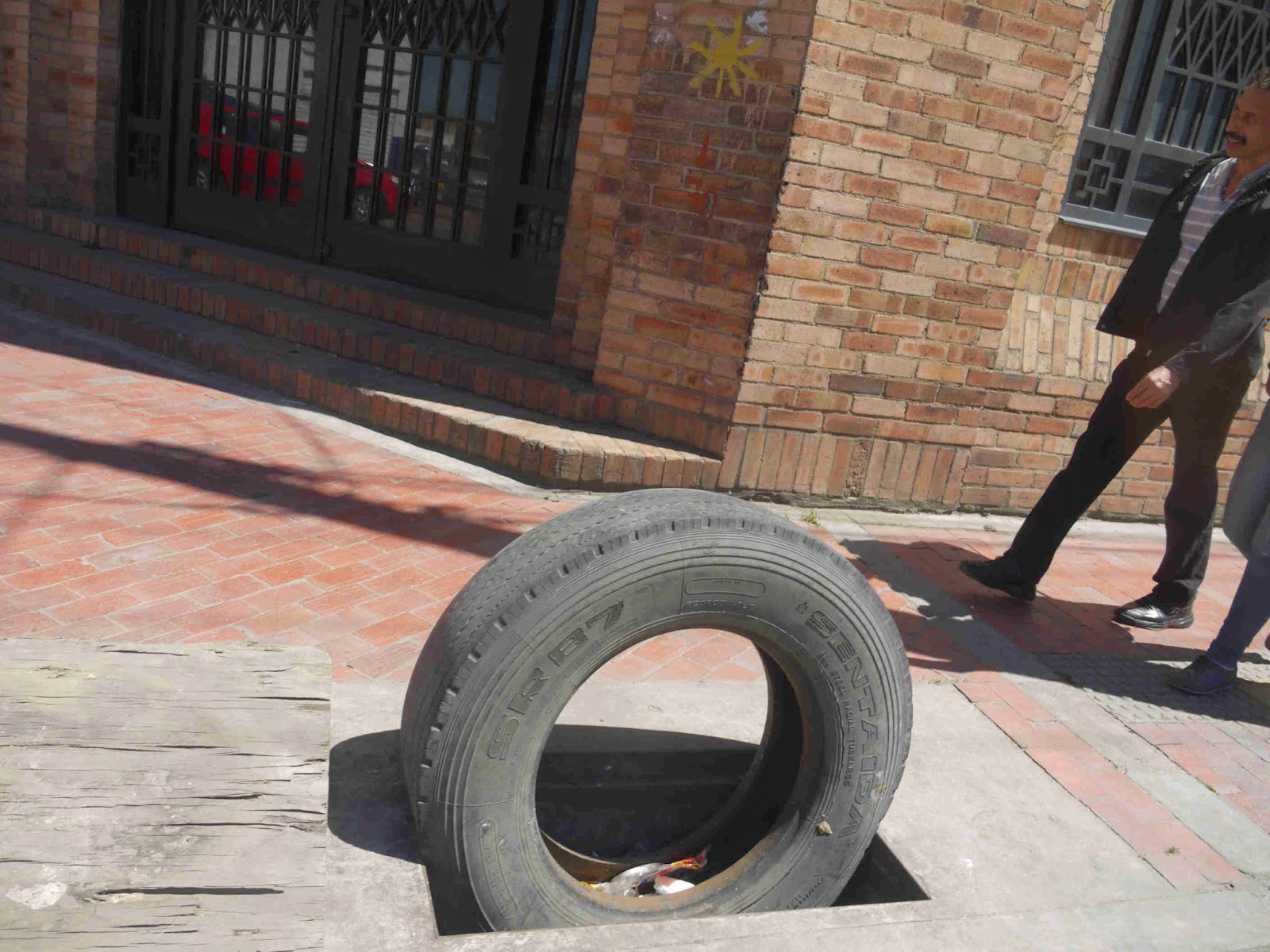
To mark holes in streets and sidewalks, where covers have been stolen, so that people don't fall in.
As sidewalk sculptures.
As taller sidewalk sculptures.
As advertising, to sell more tires, which will end up on sidewalks.
To protect fire hydrants.
Great, now only 1,999,978 more tires to find uses for (not counting the ones discarded today).

By Mike Ceaser, of Bogotá Bike Tours