Showing posts with label writers. Show all posts

Friday, July 26, 2013

Short Stories From (But Not About) Chapinero

Authors from Authors, a short story collection.
I'll start this post by discrediting my taste in literature. I do read - a lot - but with little appreciation for quality literature - or even much ability to recognize it. For example, I've tried and failed three times to make it thru 'One Hundred Years of Solitude.' The Nobel-prize-winning novel confuses me and the significance of all of those strange episodes goes right past me. And I just read 'El Ruido de las Cosas al Caer,' a recent Colombian novel which has won important literary awards in Spain and Italy. Its author, Juan Gabriel Vasquez, is probably the most admired of Colombia's youngish generation of writers. I enjoyed the book, mostly because of its descriptions of the Bogotá of the Pablo Escobar era. But parts bored me and left me wondering why they were in the story at all.

And don't even ask me about tackling literary giants like Thomas Mann...

On the other hand, I just read and loved a book of pirate adventure stories.

So, I'm no judge of literature.

The creative writing group at Authors bookstore. 
With that in mind, here's my appraisal of Authors from Authors, a slim book containing 12 short stories by a group of Colombians and foreigners participants in a creative writing workshop that meets at Authors English-language bookstore in Chapinero. I greatly respect them, as I do anybody with the guts, discipline and willpower to create fiction - which is more than I've ever done.

That said, I thot this collection could have been better. In the first place, only a few of the stories are set in Colombia. That's not relevant to the stories' quality, but Colombian content would have made them more interesting and immediate to a local audience. And, as we Colombian residents know, this country is boiling over with interesting and exciting raw material for fiction and for non-fiction).

Of the stories I read (I skipped the science fiction and fantasy), three are set in Colombia. These are interesting, but lack some basic plot elements, it seems to me.

The unsubtly titled 'False Positives', by Clara Irene Reyes, tells the story a killings by the same sort. (The False Positives was a Pres. Uribe-era scandal in which military units kidnapped and murdered thousands of young men and disguised them as guerrillas in order to receive bonuses and vacation time.) Reyes's fictional story is a heartfelt (and maybe overwrought: 'Rosalia, I have just realized what they're going to do to us. I'm scared, so scared.') account of such a killing told from the perspectives of the victim, his lover and his killer - who also happens to be one of his lover's exes. But for me the story lacked a tension to carry the reader to the not-very-subtle ending: 'As blood seeped from the wound, I understood: The government always lies.'

Routine Glances, by Juan Manuel Rodríguez, set in Bogotá, is one of the few to aim for that good, ol' fashioned excitement, including sex, violence and betrayal. In order not to spoil it, I'll say only that it involves a young man who falls for a murderess who beguiles him on a bus. So far, so good. But the trouble is that what happens next is precisely what the characters predict and the reader expects to happen. A piece of irony, a plot twist would have made this story fun rather than flat. Also, several of the story's details struck me as unrealistic, including when the police arrest the protagonist and tell him 'If you can't afford an attorney, one will be provided for you.' Do Bogotá police really say that? (Perhaps only when they arrest gringos?)

Also, I might have felt more sympathy for the protagonist if he had displayed a bit more originality, instead of issuing lines like: 'Damn, somebody is in need of a little love! I will happily be the provider.' Certainly, it can't be easy creating characters, developing a plot and wrapping up a story in eight pages. But this particular character might sill have had some interests above his waistline.

A third Colombia story 'Life from a different point of view,' by Lucia Cristina Loazana, about a woman with a physical deformity, offers the lesson 'Accept people just the way they are.' That's nice, but doesn't make for a story for me.

The only story which really drew me in and left me caring for the characters was 'Pristine,' by Peter Dale. It's apparently set in Britain and describes, with interesting psychological dynamics, the consequences of a family which stmbles    discovery of someone's sexual escapade. The style is understated, embedded with small, realistic details, and the author allowed himself to suggest things and let the reader draw conclusions. The story isn't exciting, but is natural and believable, and made me relate to the characters' moral and psychological quandries. The atmosphere of sport, suburbia, sexual yearnings and family suspicions added ealism.

I also have some general suggestions for the book. Its last few pages contain photos and a paragraph or two about each writer, mostly their interests and what lively, enthusiastic people they are. But only a few included the writer's nationality or their experience - important background it seems to me to put their work into context.

Another detail: I'm sure that lots of time and dedication went into this book. However, the 35,000 peso price for a 144-page softcover might limit the readership to housemates and close relatives. (On the other hand, while in Authors I registered for a raffle for one of the sample books the store receives but isn't allowed to sell - and I won, providing me with a good value after all.)

All that said, more power to this group for their work. It's a wonderful endeavor. And since Colombia contains so much rich material for fiction,let's hope that more writers, whether Colombians or foreigners, bring it to life.

But my views are completely subjective and I'm unqualified to judge, anyway. So, support creativity made in Colombia, buy Authors from Authors and judge for yourself.

By Mike Ceaser, of Bogotá Bike Tours

Friday, May 11, 2012

Rafael Pombo - Not Just Kids' Stuff

Children play on a wooden iguana in Pombo's childhood home. 
One hundred years (and a few odd days) ago, Colombian poet, translator and diplomat Rafael Pombo died at age 79.

Pombo is remembered as a children's writer - which he certainly was - and you can visit his childhood home, now the Rafael Pombo Foundation on 10th St. in La Candelaria, beside the Teatro Colon. The house, built in 1833, does workshops for groups of schoolchildren and is full of colorful characters from Pombo's stories, which include Rinrin el Renecuajo (Rinrin the Tadpole), La Pobre Viejecita (The Poor Old Woman) and Simon el Bobito (Simon the Fool)

Pombo is less remembered for his work as diplomat in New York, where he lived for 17 years and translated and adapted Anglo Saxon stories into Spanish, or that back in Bogotá he founded two newspapers and even wrote opera.

Pombo's home, in the foreground,
and the Teatro Colon beyond it. 
Rinrin the Tadpole tells the story of a tadpole - actually a frog - who goes partying with his friend the mouse. But, because they didn't listen to momma frog's admonitions, they end up being eaten by a cat and a duck. So, let that be a lesson to you, young people! (But it's a lesson lost, judging by young Colombians' partying habits.)

Characters from Pombo's stories now populate his home. 
A doorway and garden in Pombo's home. 
The Poor Old Woman 'who had nothing to eat, except for meats, fruits, sweets, cakes, bread, eggs and fish' and had noplace to live 'except for a big house with garden and garden.' And so it goes, ending with a plea to God to 'let us enjoy the poverty of this poor woman and die from the same afflliction.'

Witty and entertaining, The Poor Old Woman could also be seen as a lesson for Colombia - a suffering, afflicted nation with tremendous riches.

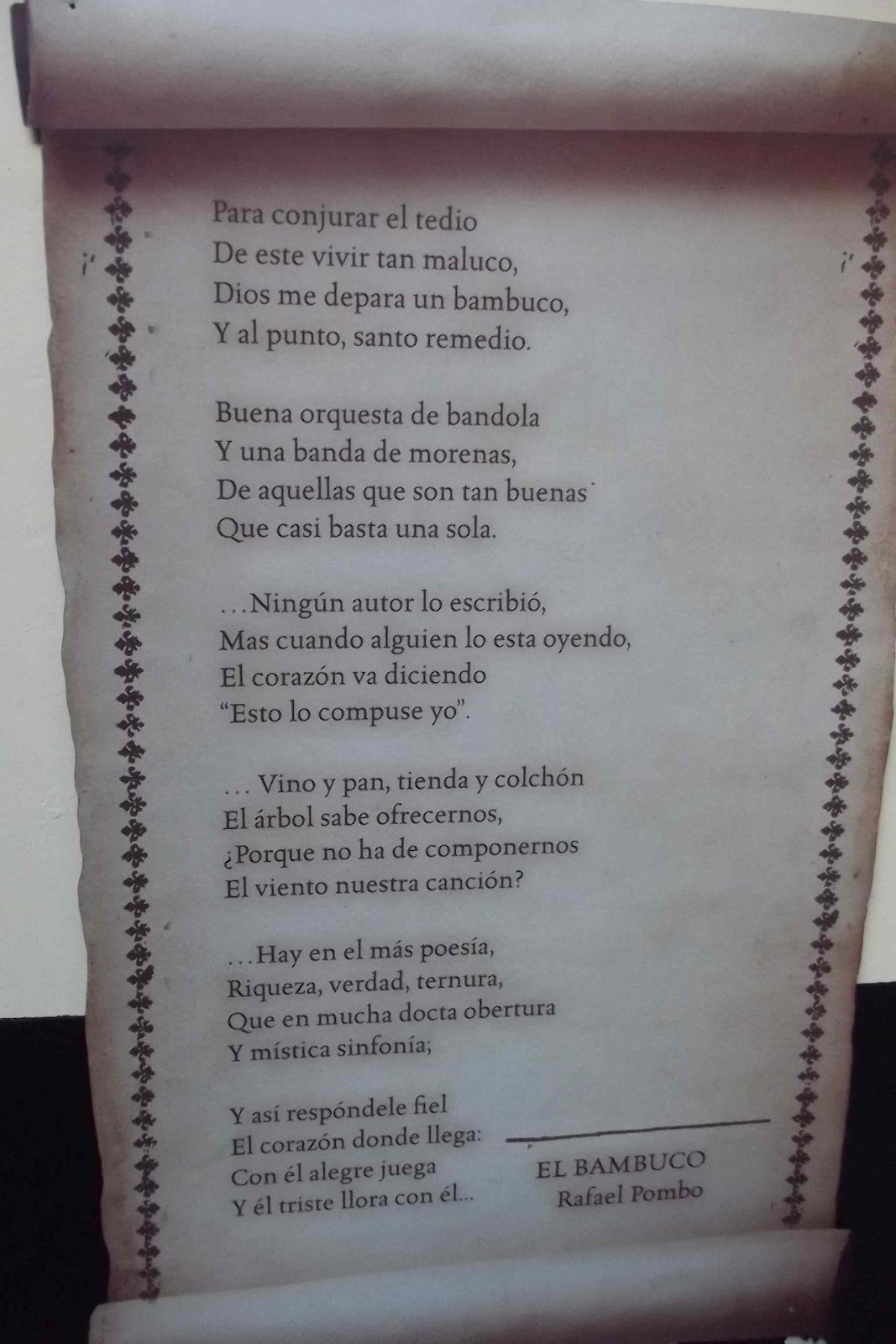
But it is Pombo's darker and even anguished passages which I find more interesting. He gives a hint of existential despair in El Bambuco, which begins with an appeal to 'excorcise the tedium of this miserable life' which God responded by 'providing a bambuco', or traditional Colombian dance related to the European waltz. Pombo ends the poem by saying that his greatest ambition would be to have composed el bambuco.

That poem's happy ending contrasts with his most famous existentialist piece, La Hora de Tinieblas (The Hour of Darkness), in which life is worse than a burden: 'Why was I born? Who forces me to suffer? Who created this terrible law of being and suffering?'

Predictably, that loss of faith got Pombo in trouble with the church. But it doesn't appear to have cast a shadow over the children having fun in his old home in La Candelaria.

Find 18 of Pombo's most famous poems here.


Rafael Pombo's portrait in the National Museum in Bogotá.


El Bambuco


Calle 10 is one of La Candelaria's most historic and best-preserved streets. 


Playing with a giraffe. 


By Mike Ceaser, of Bogotá Bike Tourswhich also has La Candelaria's largest collection of used books in English, French, German, Dutch and other languages for sale and exchange.

Thursday, May 3, 2012

Rufino José Cuervo


Some of Cuervo's books, which he donated to the Biblioteca Nacional. 
Cuervo beer.

Rufino José Cuervo (1844-1911), who is on exhibit for a few more days in the National Museum, was probably Colombia's most accomplished linguist and chronicler of Colombian Spanish - and has lots of influence on those of us learning to speak Colombiano, whether we know it or not. His most famous works were 'Critical Notes About the Language of Bogotá' and the Dictionary of the Construction and Regime of the Castilian Language.'

But be glad that you never had this guy for a Spanish teacher. His overarching concern was that Spanish might splinter into regional tongues the way that Latin fragmented into Spanish, French, Portuguese and others. And so he probably wouldn't have approved of modern Colombia's rich slang vocabulary such as 'parce' and 'veci' and 'marica.'

The Language of Bogotá, which has
changed lots since Cuervo's time. 
The man studied and spoke dozens of languages, ranging from Portuguese, French and Latin, to Hebrew, Sanskrit and Lithuanian. But his life wasn't all dry. Cuervo's family brewed Bogotá's first beer, Cerveza de Cuervo, in their home on Calle 10 below Carrera 4 in La Candelaria. That building is now the Caro y Cuervo Foundation, which studies language, surprise, surprise.


Cuervo's death mask. 

A view of the exhibition in the Museo Nacional, which was originally built to be a prison. 
Beermaking back then. 

Poet Rafael Pombo, Cuervo's good friend. 
The Instituto Caro y Cuervo, on Calle 10 in Bogotá's La Candelaria neighborhood. 
Rufino Cuervo's tomb in Bogotá's Central Cemetery. 
By Mike Ceaser, of Bogotá Bike Tours , which also has La Candelaria's largest collection of used books in English, French, German, Dutch and other languages for sale and exchange.