Showing posts with label zorreros. Show all posts

Wednesday, January 8, 2014

Last of the Zorreros


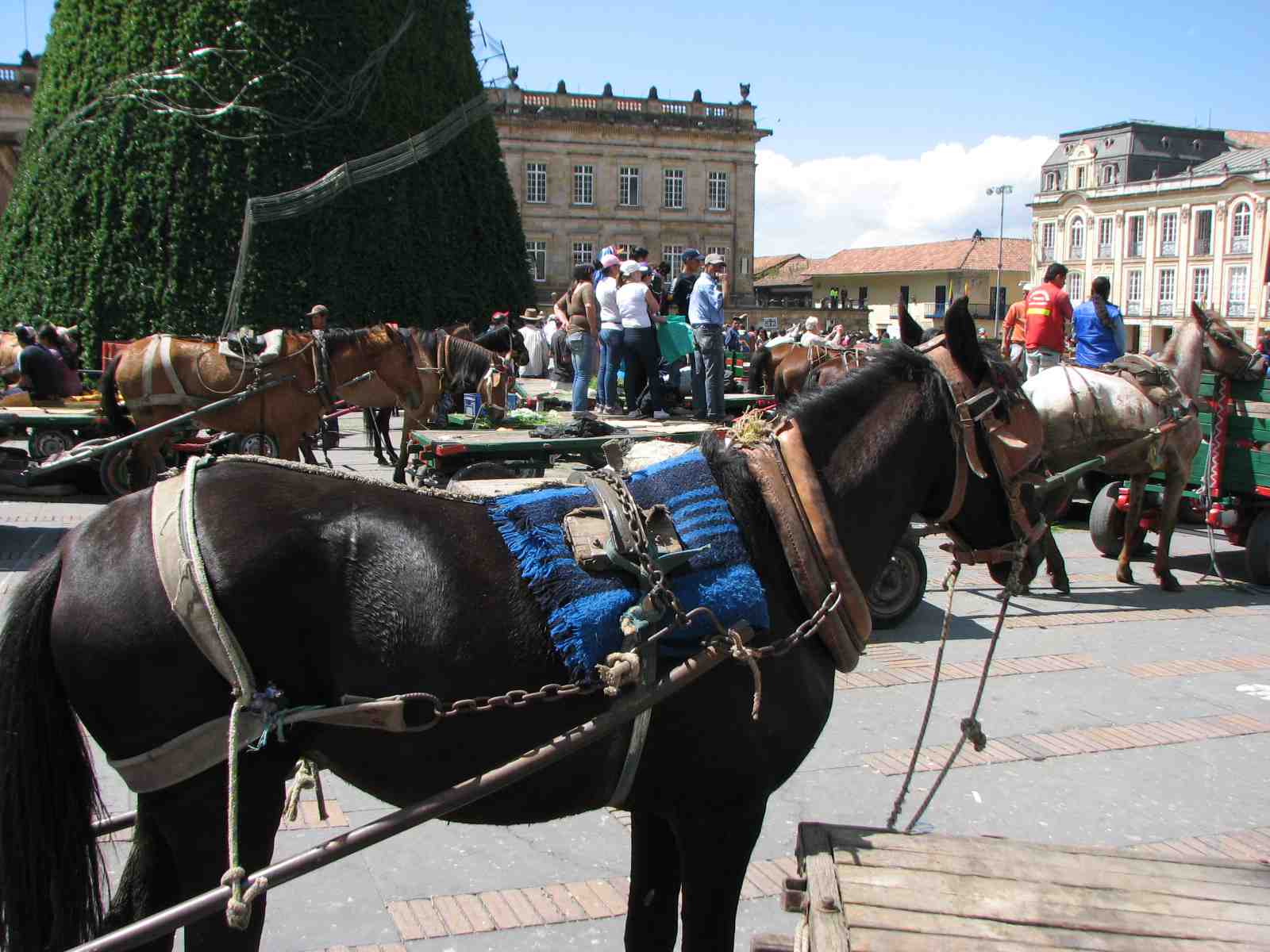
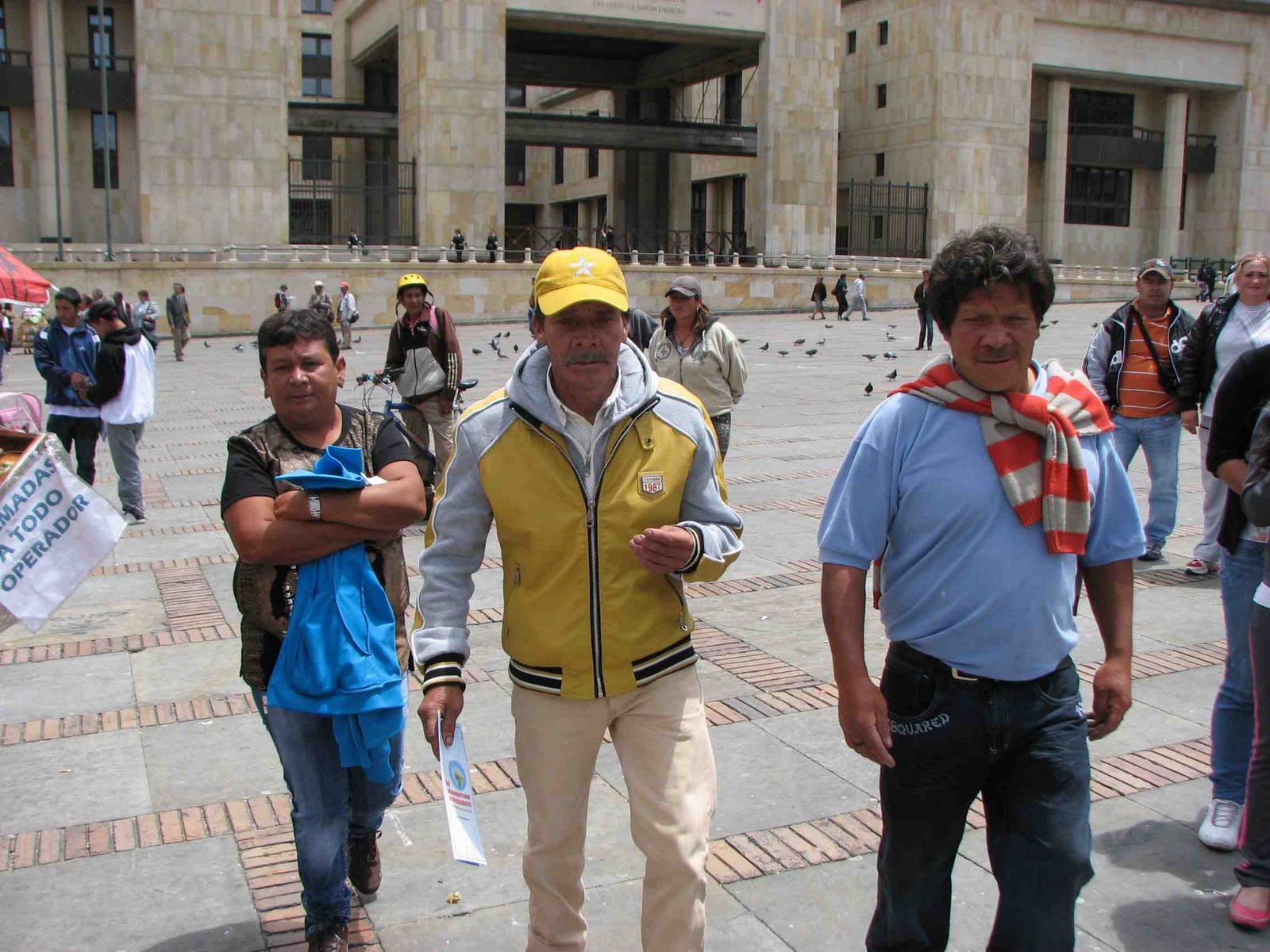
Zorreros, or horsecart families, listen to a speech today on Plaza Bolivar. 
The last of Bogotá's zorreros, or horsecart drivers, demonstrated today on Plaza Bolivar. The city has retired the thousands of horsecarts which used to clop along the city's streets and avenues, transporting loads and scavenging stuff for sale and reuse. The horsecart owners are supposed to receive compensation, including in some cases motorized carts to replace the horsecarts.

But the people protesting today say they were left off of the lists and did not receive their payments.

Brothers Luis and Andres told me that they weren't included in a 2010 census of horsecarts. As a result, they have not been offered compensation for their carts, which they are afraid to use because of the threat of confistication. "Our horses are going hungy and getting sick from being shut in," they told me. 

Children of horsecart families on the stage, in front of the Cathedral de Bogotá, on Plaza Bolivar. 
An artist makes a sketch at today's rally.  


By Mike Ceaser, of Bogotá Bike Tours

Tuesday, November 19, 2013

Bogotá's Zorreros: Trotting Off Into History?

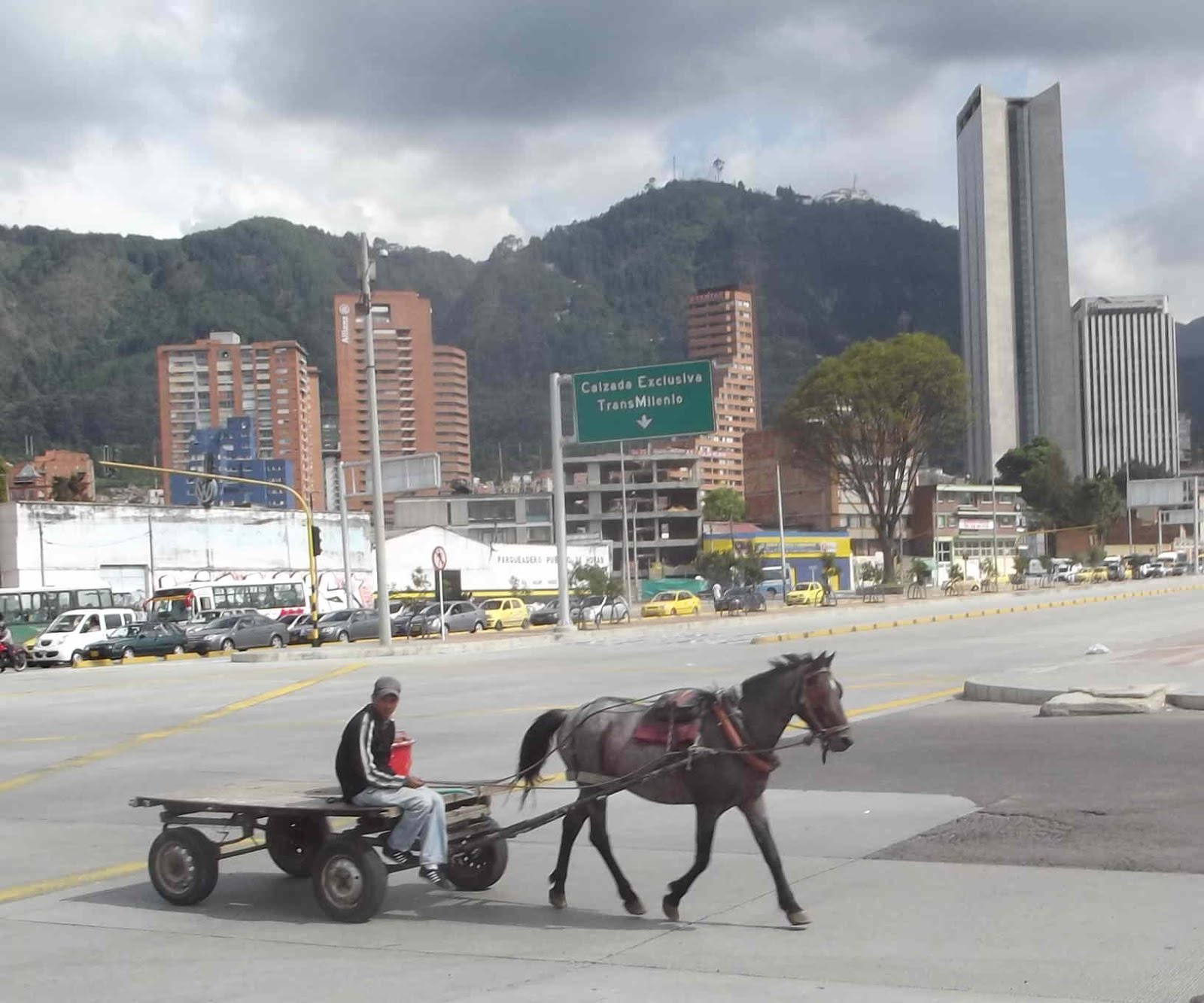
A horse cart trots thru Bogotá's Santa Fe neighborhood on a recent afternoon.
Bogotá's horsecarts, long a surprising sight on the capital's streets, were supposed to be gone by now. But hundreds or more remain, trotting about, vending things or carrying loads to dispose of or recycle.

Animal rights activists led the campaign to ban the carts, which were supposed to be gone by Oct. 1. By early August only about 1,000 of the 4,000 or so horses had been turned in. And a brief visit a poor, industrial neighborhood such as Los Martyres shows that many zorreros are still holding out.

The cart drivers, known as zorreros, are supposed to turn in their horses in return for a compensation intended to allow them to buy a small truck or open a small business. But many of the zorreros, who are overhwhelmingly uneducated and unsophisticated, may not be able to handle that wealth.

"We believe that many of the horsecart people won't have those trucks after a few weeks," a leader of Bogotá's recyclers told me.

The payments are so generous that Bogotá authorities even suspect that people from outside the city have brought in horses to trade for the compensation.

A horsecart and bike tourists near Bogotá's Paloquemao market.
It certainly is true that many of the cart drivers abuse, underfed and overwork their animals. In fact, many of the horses turned in to the city suffer from intestinal parasites and other ills which require veterinary attention. (Animal welfare groups are recruiting adoptive families for the animal retirees.) But other horsecart drivers value and love their animals.

And those cart drivers, who often have few skills, will struggle to survive without those animals. One leader of Bogotá's recyclers recently said that some have been forced into prostitution to feed their families.

And, for me, the horsecarts give Bogotá a different atmosphere, saying 'this isn't just another big city.'

Their disappearance - if it happens - will remove a piece of Bogotá's uniqueness and character.

And, does Bogotá really need more gas guzzling, polluting vehicles?

A horsecart amidst motor traffic. 
A group of mares, some of them retired zorrero horses, are rehabilitated on the campus of the National University while awaiting adoption.
By Mike Ceaser, of Bogotá Bike Tours

Thursday, January 17, 2013

Bogotá's Horsecarts: Still Rolling Along

A horse and cart await the return of their owner,
who's inside the recyclers' association's office in La Candelaria. 
A horsecart waits patienly in the evening in La Candelaria. 
Yes another deadline is about to pass by with Bogotá's horsecarts still on the streets. The city government had vowed they'd be gone by Feb. 1, and replaced by motorized tricycles or something similar. Now, City Hall promises they'll absolutely, definitely be gone by September - except that the new deadline will get pushed back, too.

I'm not crying about it. The horsecarts add a sort of bucolic touch to Bogotá. And they also demonstrate that you can get around without an internal combustion engine, altho. few car drivers are likely to trade in their vehicles for horsecarts.

Of course, many of these urban horses are abused and underfect,, altho other zorreros cart owners really love their animals.

The city evidently doesn't have the budget to give the horsecat families the motorized scooter's they've promised them. Neither are there enough willing families to adopt the retired animals.

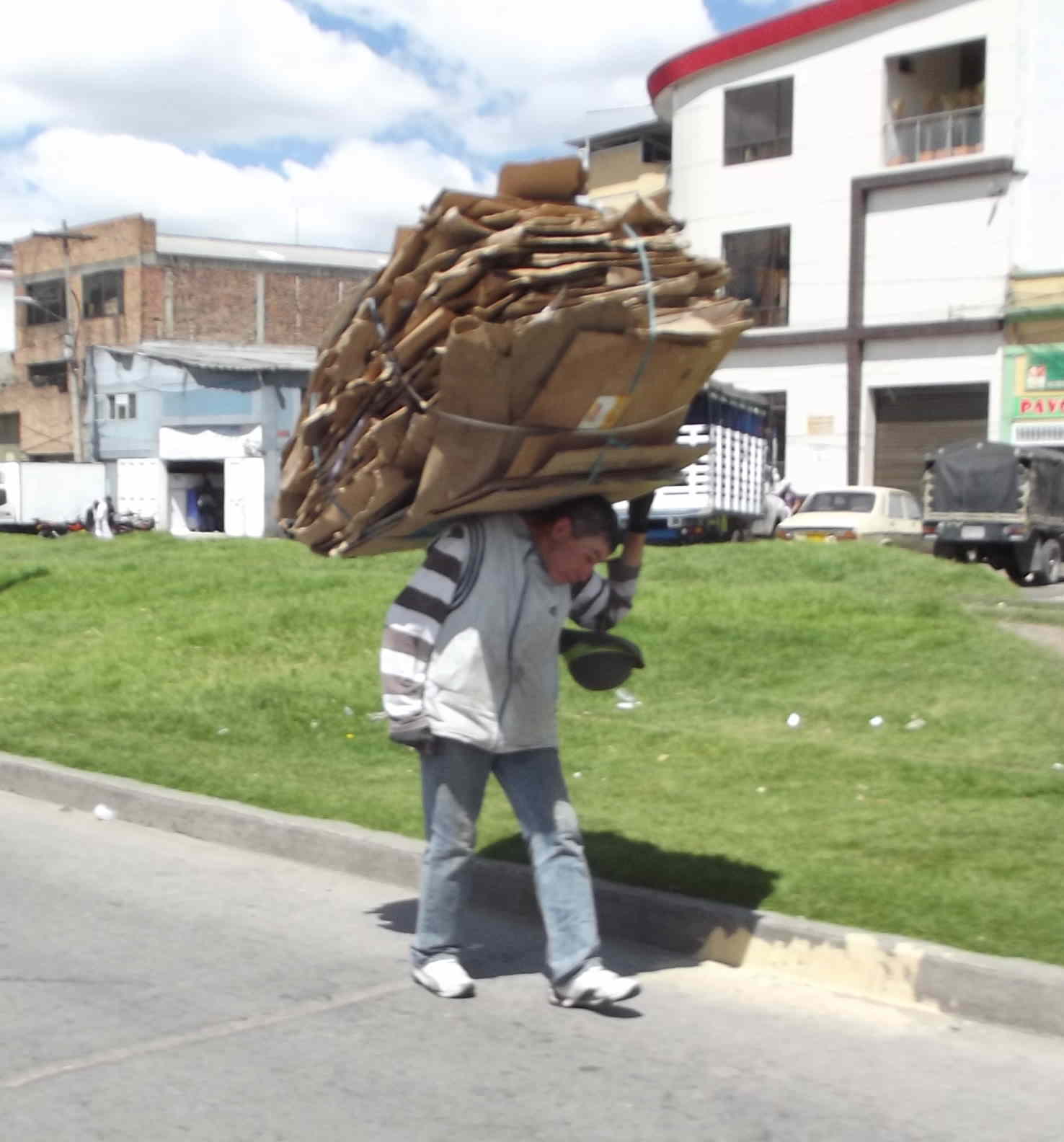
A scavenger carrying a load of carboard
could use a good horse. 
The survival of the horsecarts, called zorreros, might be good for reasons other than the fact that they add an interesting element to the city. They're also a way of life for their owners, who are humble families who survive by scavenging and selling things or by hawking items from the carts.


A horsecart waits for its driver to have lunch in the red light district.

A horsecart near the Central Cemetery with downtown Bogotá and the Eastern Hills in the background.

By Mike Ceaser, of Bogotá Bike Tours

Monday, January 16, 2012

Bogotá's Horsecarts: Urban Eyesores, or a Way of Life?

Horsecarts and their drivers invaded Plaza Bolivar. 
This morning, Plaza Bolivar looked like a scene from a century ago, with hundreds of horsecarts crowded onto it. 

But these horsecarts, known as zorreros, were rallying for their right to be a part of Bogotá's present and future. Bogotá has thousands of horsecarts - used by poor people who scavange and resell stuff, vend from the carts or make deliveries.

The city has repeatedly tried to ban the horsecarts, and the latest deadline is coming at the end of this month. However, the city hasn't advanced at all with a plan to give the horsecart users motorized tricycles to replace the carts. The plan would probably never work, anyway. For these families, the horsecarts are not only a way of making a living, but also a way of life, and they won't easily change - nor can they likely afford to buy gasoline, when the horses are fed virtually for free.

And does Bogotá really need more polluting motor vehicles?

Poor, workikng people: a zorrero family.
The zorreros also fullfill important social and environmental functions, recycling, taking away junk, and thus reducing landfill use. I often see zorreros trotting thru La Candelaria crying out for people to bring out their pieces of junk, which the horsecart people either sell or find a use for.


It sure seems contradictory that at the same time that Bogotá is trying to kick off a recycling program, it's considering banning the vehicles which the cities' principal recyclers use.


Animal rights defenders say that many of the horses are abused, underfed and overworked, which is undoubtedly true. Some have also made the absurd argument that the horsecarts are bad for traffic congestion - when a glance at Bogotá's traffic jams makes obvious that they're there because there are way too many cars, not horsecarts. City officials' real reason for wanting to ban the carts, one suspects, is a desire to create an image of a sanitized, modern city. But close to half of Bogotanos live in poverty, and the city's wealthy deserve to be reminded of that.

If the city does ban the horsecarts, then the impoverished families with little education who depend on them would be pushed even deeper into poverty and some will undoubtedly turn to crime.


The real solution is for the city to produce more jobs. But that will take a long time, if it ever happens. Until then, the zorreros are supporting their families and fulfilling an important social, economic and environmental function.

I'd suggest that the wealthy in their polluting SUVs, purchased by burning coal or marketing useless gimmicks, who feel so embarassed and annoyed by the zorreros' mere existence, contribute much less for their city.


Related Posts: End of the road for Bogotá's horsecarts?

The zorreros fight for their way of life.

While their drivers have lunch, these horses do too in the Santa Fe Neighborhood. 

Overloaded? A horsecart trots up Calle 13.


By Mike Ceaser, of Bogotá Bike Tours

Monday, October 3, 2011

The Zorreros Fight for their Way of Life

Out of place and out of time?
A zorrero trots up Carrera 13. 


'Members of the Constitutional Court,
we demand the right to work. '
Families who make their living with horsecarts protested today against plans to prohibit their way of life.

Bogotá's thousands of horsecart drivers, known as zorreros, mostly make their living by scavenging or vending things from the carts. You can't miss them as they drive up and down streets crying out for people to bring out their junk, which the zorreros will sift thru for anything they can sell, including scrap metal.

The zorreros have been broadly demonized by many Bogotanos. In recent weeks, I've seen two demonstrations, including one yesterday, at least partly directed against them, and a city law would prohibit them as of February 2012: supposedly, they are thieves, they are dirty, they abuse their horses and they mess up traffic.

This cart appears to be terribly overloaded. 

There's undoubtedly some truth to some of these accusations, altho I have seen no evidence that the horsecart people commit any more crimes than any other group of poor people. And, if they lose their horses and livelihoods, desperation would undoubtedly turn many working zorreros into criminals. The accusation that they cause traffic jams is even more preposterous, as a glance at any Bogotá traffic jam will show: Bogotá's traffic jams are caused by too many cars - not too many horsecarts. 

Horses and carts wait along Calle 13.
Yes, some of these urban horses are overworked, underfed and abused by their owners. But other zorreros seem to dearly love their horses and care for them like family members. In the past, animal protection organizations tried to enforce standards for protecting the animals, including regular veterinary check-ups. I think the results were mixed. But maybe the right mixture of funding and sanctions could actually protect these horses. For society, I'm sure, that would be lots cheaper in the end than turning working people into criminals, alcoholics and beggars, which is where the zorreros would most likely end up. After all, these people lack the education or skills to do anything else.
The zorreros, or horsecart drivers, are mostly poor,
unosphisticated people with little education. 

The most humane solution for the horsecart families would be to educate their children, opening up other options for them. Then, the horsecarts might disappear into the past, not because internal combustion vehicles are better than animal-drawn ones, but because Bogotá will have produced more good jobs and educated people to fill them. (By then, lets hope, cars will be gone from Bogotá's streets as well.)

A horse gallops up Calle 13. 
I'm convinced that the zorreros' greatest sin is being unsophisticated and seemingly anachronistic in a city that wants to appear slick and modern. All of this, as well as social isolation, compounds the zorreros' vulnerability.
 Today, they waved signs (most likely written by more literate supporters) and blew into horns. Google 'zorreros Bogota' and you'll find Facebook groups and You Tube videos condemning them - but almost nothing in their defense. In contrast, Google those expensive diesel vehicles which are flooding the city and you'll find lots of propaganda glorifying them - even tho they are responsible for poisoning our air and clogging our avenues.

But, money and sophistication talk these days - and the zorreros lack both of them.


By Mike Ceaser, of Bogotá Bike Tours