Showing posts with label afrocolombians. Show all posts

Sunday, May 21, 2017

Afro-Colombians Demand to be Heard


Afro-Colombian march down Ave. Septima.
'We support the strike in the El Chocó' region.
 Afro-Colombians, often said to be forgotten Colombians, are demanding attention and resources from the national government. Recently, Afro-Colombian communities on the Pacific coast region have held protests and work stoppages demanding government investment in infrastructure and that the government fulfill commitments made in previous agreements.

The Pacific coast, distant from Colombia's major cities, is an impoverished region wracked by violence from guerrillas, right-wing paramilitaries and narcotrafficking groups which fight over valuable drug trafficking routes and illegal mines. This weekend, riots and looting took place in the port city of Buenaventura.


Such hair!

Afro heroes.

'The Afro-Colombian people demand that the government fulfill its promises.'

'We demand the law of equal opportunities and no racial discrimination.'


By Mike Ceaser, of Bogotá Bike Tours

Saturday, May 23, 2015

Dancing for Delia


The Fundación Delia Zapata is one of the little-known jewels of La Candelaria. Named in honor of
Delia Zapata Olivella
Delia Zapata Olivella, who dedicated her life to researching and popularizing the music and dance of Afro-Colombian peoples of Colombia's coastal regions. Later in life, she traveled to Africa to find the roots of AfroColombian melodies.

The foundation, housed in a grand old building on the south side of Calle 10 between Carreras 2 and 3, offers dance classes and musical events.

Delia Zapata was born in 1926 in Cordoba and died exactly 14 years ago on May 24, 2001. Ironically, she was killed by a disease she contracted during a research trip in Africa.


Delia Zapata and friends.
The Delia Zapata Foundation on Calle 10.

Delia Zapata at rest.


By Mike Ceaser, of Bogotá Bike Tours

Thursday, March 13, 2014

Can an Election Turn White People Black?

Afro-Colombians? Moisés Orozco and María del Socorro Bustamante, elected to represent Colombia's AfroColombians. (Photo: Semana)
About 20% of Colombia's 47 million citizens are of African descent. So, many people - particularly AfroColombians - found it strange that in Sunday's vote the two people elected to the two seats reserved for the AfroColombian community look very white.

Afro-Colombian protesters carry a banner denouncing the
white holders of the Afro parliament seats.
In addition to appearing quite white, Moisés Orozco and María del Socorro Bustamante, have some dubious connections and episodes in their pasts.

After the vote, AfroColombian leaders who really are Afro, questioned whether these two white people really had the experience and knowledge to represent Colombia's black population.

"(Those two) don't represent the spirit of the Afro-descendent community," Zulia Mena, mayor of Quibdó, Chocó, who once held one of the seats, told El Tiempo. "They don't have a legislative agenda for the reality lived by Colombia's black population. They don't know the situation."

Neither of the new congressmembers has made many comments to the media. Socorro Bustamante reportedly 'declared herself a member of the AfroColombian community,' while Orozco claims to have a distant relative who was black. Perhaps both are seizing onto the old 'one drop rule' in the Southern United States, in which anybody with a single black ancestor was considered black. Or, perhaps they're relying on the fact that, since humanity evolved in Africa millions of years ago, all of us are ultimately of African descent.

Afro-Colombian participants in a recent
protest march in Bogotá.
Socorro Bustamante's election was challenged before the National Electoral Commission (CNE), which confirmed her victory.

The election of the Afro representatives had been somewhat polemical from the start. Strikingly, some 70 candidates had competed for the two seats. The great interest may come from the fact that the organization on whose ticket the two were elected, Fundación Ébano de Colombia (Funeco), holds numerous contracts with local governments in Sucre Department, according to Semana magazine.

Both Orozco and Socorro Bustamante also have questionable pasts and connections. Orozco, an attorney, has defended alleged narcotraffickers. In 2010, two politicians accused Orozco of making death threats. One of the accusers was later murdered, a crime which has never been solved, reports Semana.

For her part, Socorro Bustamente has links to Enilse López, known as 'La Gata,' a political business and political power player from Colombia's Caribbean coast linked to corruption and now in prison for murder.

Both Orozco and Socorro also have political links to a regional political boss in Sucre Department, who himself reportedly has links to outlawed paramilitary groups.

But electoral authorities appear to believe that both politicians were elected fairly by the AfroColombian community, and that they hold their seats legitimately.

By Mike Ceaser, of Bogotá Bike Tours

Sunday, December 1, 2013

A Sensuous Celebration for a Sexy Sculpture


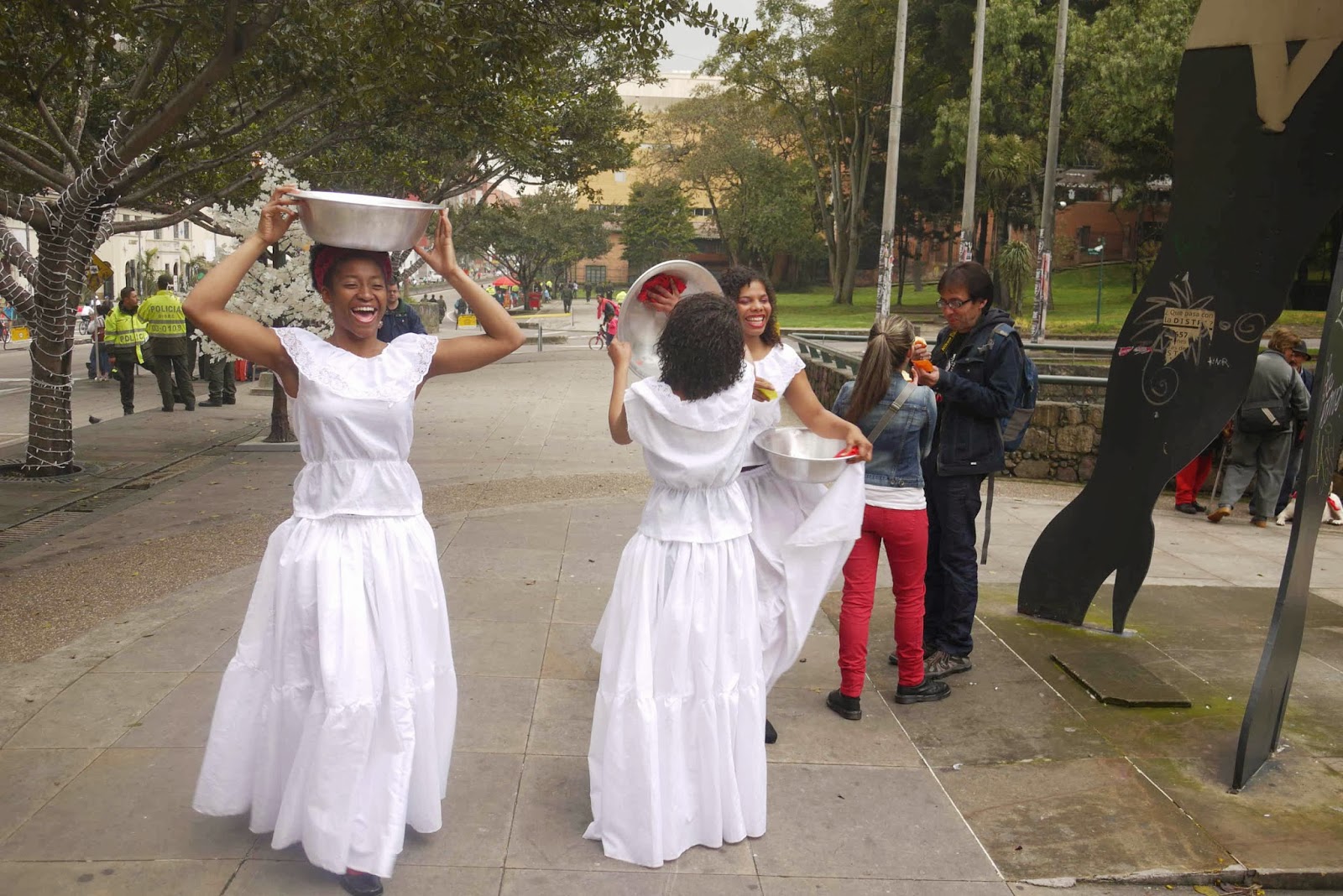
The bowls are carried by AfroColombian street vendors on Colombia's coasts, where they use them to carry fruits on their heads.
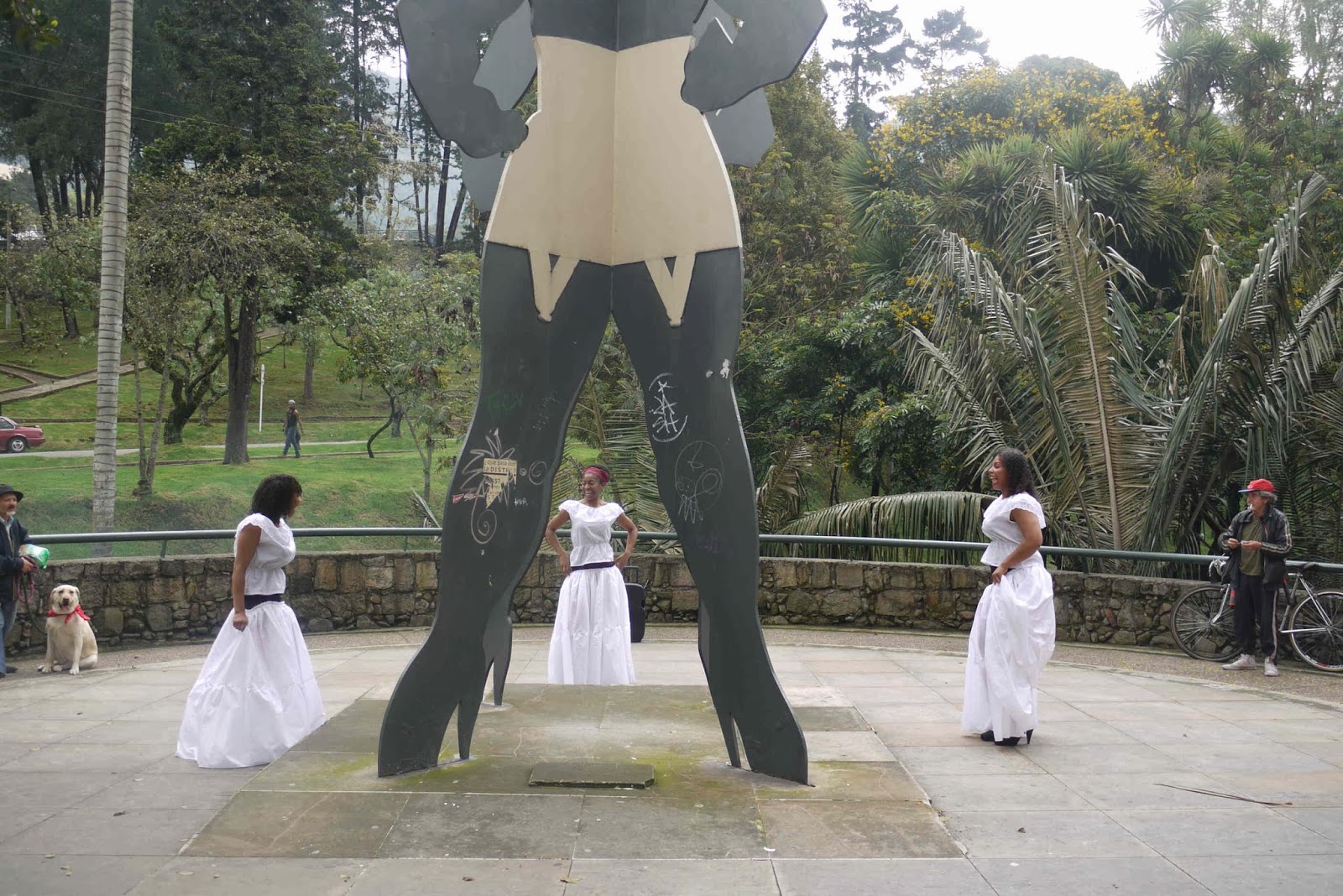
 During a bike tour today, we came upon this small troupe of erotic AfroColombian women dancers around the Enrique Grau sculpture of scantily dressed woman in front of the National Park. The location and them were appropriate, since Grau's work, named 'Rita 5:30 p.m., represents a prostitute.

The dancers certainly seemed to be enjoying themselves, as the dance became more erotic. A recording playing in the background talked of the eroticism of AfroColombian women.

The erotic dance was financed by the District's Institute of Patrimony, which is evidently pretty broad-minded. (Bad pun unintended). One of the event's organizers told me that the event's purpose was to encourage the public to respect city monuments and not graffiti them. Events are planned for other monuments, she said.

The dancers evidently were enjoying themselves, as was the audience and - hopefully - Rita as well.


Write something sex on my legs, baby.


Can you read my leg, baby?


By Mike Ceaser, of Bogotá Bike Tours

Sunday, October 27, 2013

The Fall of an Idol?

Raul Cuero. (Photo; El Espectador)
It was a wonderful, inspiring life story: An AfroColombian child of Buenaventura, one of Colombia's poorest cities, overcame innumerable obstacles to become a star researcher and inventor in the United States, even working for NASA.

Unfortunately, the story seems to be untrue, or at least inflated.

Raul Cuero was the son of illiterate parents. From an early age he showed an interest in research, and his botany work moved a foreign visitor to help Cuero travel overseas to study. Today, at age 65, he teaches in a small United States agricultural university, works on inventions and does contract research. He's published research papers and has several U.S. patents to his name.

Cuero's life story is unquestionably impressive. But being good was evidently not good enough for him: he wanted to be great. And the Colombian media played along. Colombian newspapers, magazines and television celebrated Cuero as a great inventor and award-winning NASA researcher.

El Tiempo columnist Maria Isabel Rueda recently even asked Cuero whether he dreamed of winning the Nobel Prize. (To his credit, Cuero said that awards weren't important.)

But Rodrigo Bernal, an ex-professor of agricultural engineering of the National University, decided to dig deeper into Cuero's story. It turned out, as Bernal wrote in a cover story in El Espectador, that Cuero's dozens of 'scientific papers' were mostly news reports about himself, that the NASA awards were rather routine recognitions and that Bernal had only two minor patents to his name. Bernal added many other details which Cuero appeared to have exaggerated or distorted to add to his own legend. Cuero has worked for NASA, for example, but only as a contractor.

One of Cuero's recent books even describes him as 'One of the world's most important scientists.'

In his response, Cuero did not directly deny Bernal's affirmations. 'I'm not an orthodox scientist," he wrote. "In essence, I'm an inventor...I'm an inventor and my purpose is to create things which serve humanity and create economic impact.'

Give Cuero credit for accepting the criticisms gracefully. In fact, Cuero is a very impressive guy. How many of us have even one invention or scientific article to our names? How many of us overcame a dirt-poor background and racial discrimination to become university professors and do work for NASA?

Cuero is rightly an inspiration for many poor youth. But he inflated his impressive life history into a legend, and paid the price when the exaggerations were inevitably uncovered. Sadly, those distortions will leave a lasting stain on his exceptional accomplishments.

By Mike Ceaser, of Bogotá Bike Tours

Thursday, October 17, 2013

Racism in El Tiempo?

AfroColombians can be journalists and student activists,
but are rarely portrayed as such by the media.
A few key phrases from El Tiempo's recent article about Bogotá's AfroColombian neighborhoods:

"I don't enter the (city) blocks full of blacks ever since I saw how they planned to mug a girl who'd just gotten off of a bus..." said a man who requested anonymity.

'Fear and frustration rule in the the 10 neighborhoods where most Afros are concentrated.'

In the black neighborhoods "One has to walk carefully because they (Afros) will force you against
the wall and attack you; they'll steal all you have."

Residents of black neighbhorhoods are also generally dishonest, adds a taxi driver: "They like to fight; they don't pay for the ride, and even end up breaking the (car) windows or pulling out a knife."

Those are just some of the quotes and commentaries from an article the other day in El Tiempo, which
Afro-Colombian girls on their way to or from school.
in the past has seemed to have a sensitive attitude toward the situations of ethnic minorities. But this article consisted primarily of voices describing black neighborhoods - and their residents - as violent criminals who should best be avoided. The article included little balance and few voices examining the history of poverty and social discrimination which have contributed to making those Afro neighborhoods poor and socially troubled.

The story also neglected to mention that, of the many poor and dangerous Bogotá neighborhoods, only a few are predominantly Afro. For example, the dangerous and violent central Bogotá neighborhoods like Egipto, Las Cruces y San Bernardino are overwhelmingly by white and mestizo.

An AfroColombian univesity student
doing a presentation about a Bogotá business.
I know some young AfroColombians who live in an impoverished area called Altos de Cazuca, in the far south of Bogotá, where many residents are displaced people driven from their land and into the city by Colombia's armed conflict. Altos de Cazuca IS dangerous - residents fear returning home after dark. And criminal groups force local businesses, including street vendors, to make extortion payments - on the threat of death. But most of the victims here are the neighborhood's own AfroColombian residents. The residents also suffer severe types of discrimination: Because different illegal groups dominate neighborhoods, and different neighborhoods are predominantly black, white or mestizo, my friends tell me that if they cross into non-Afro neighborhoods they run the risk of being labeled as members of a hostile gang and attacked. These AfroColombians are victims of violence and discrimination, not generators of it, as the El Tiempo story portrays.

El Tiempo's story also perpetuates stereotypes by portraying AfroColombians as examples of poverty and crime. Even when the media portray black Colombians positively, it often still means stereotypes: as dancers, musicians or athletes. But AfroColombians also study, start businesses and hold down 'normal' jobs. But because such images don't play into established stereotypes, they're more difficult to portray.

By Mike Ceaser, of Bogotá Bike Tours

Saturday, June 15, 2013

Afrocolombian and Indigenous Festival in La Candelaria


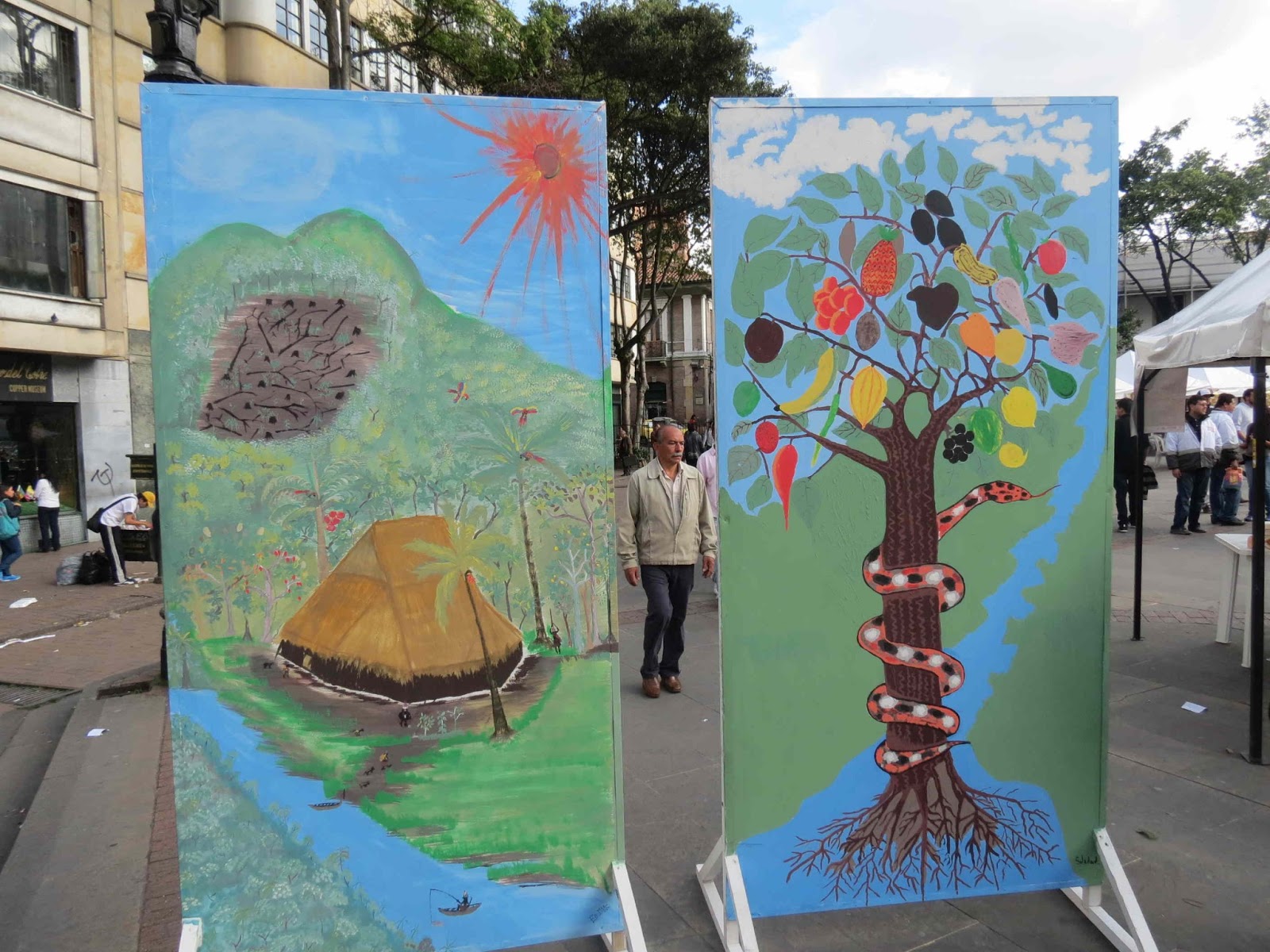
 La Candelaria held an Afrocolombian/indigenous festival this week. It was one of the few times I've seen indigenous people from Amazonia in central Bogotá.
Coca leaf products from the Amazon.
Spicy mashed ants on the left. 


Indigenous men in traditional dress seated on Plaza del Rosario.

Indigenous women from Amazonia.


By Mike Ceaser, of Bogotá Bike Tours

Thursday, May 2, 2013

Eleven Years After Bojayá


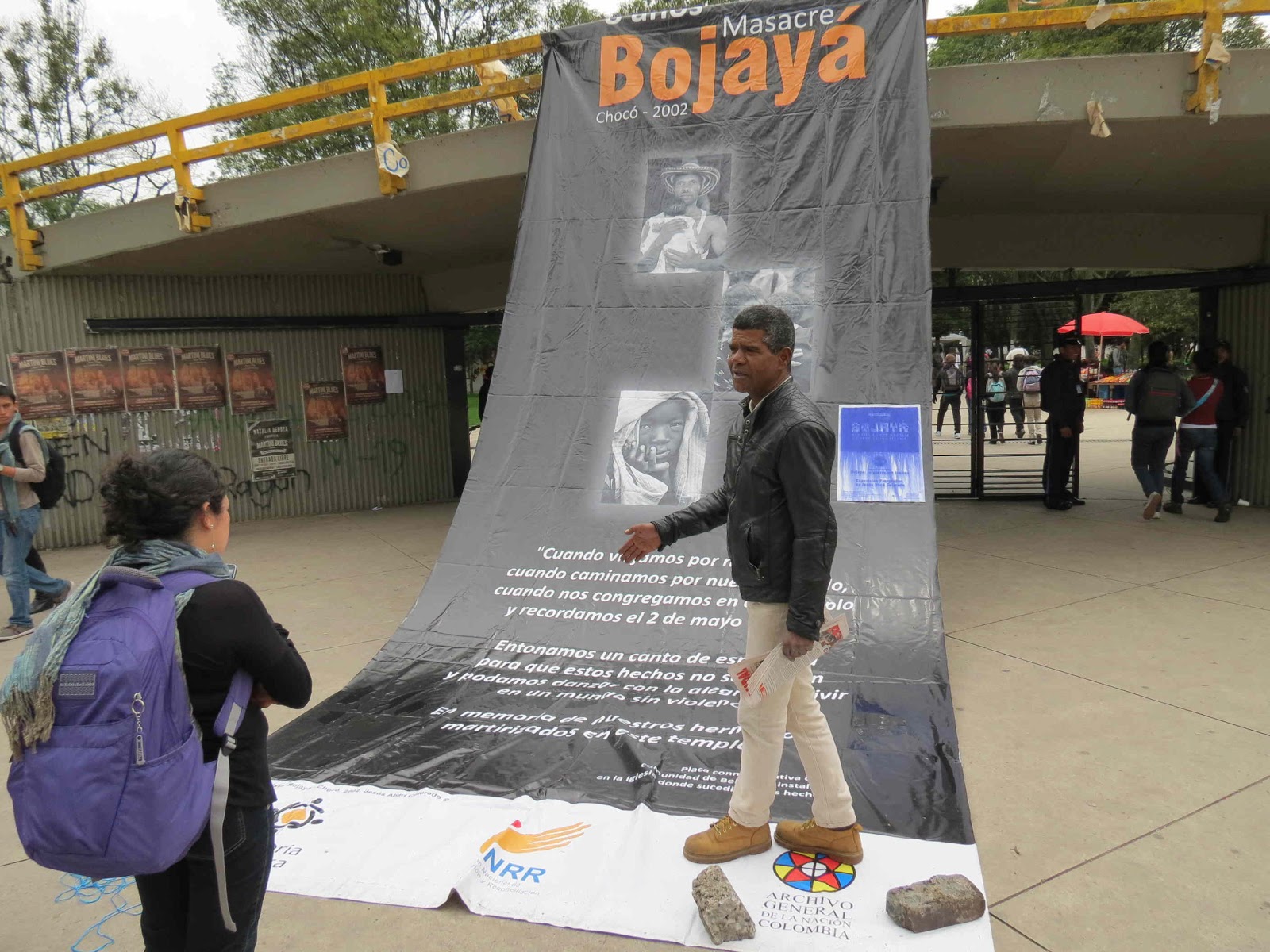
Today, this man at the entrance to the National University was using this banner to commemorate the 11th anniversary of the terrible massacre of Bojayá.

On May 2, 2002 FARC guerrillas and right-wing paramilitaries were fighting over the poor, AfroColombian town. The paramilitaries had positioned themselves around the town's church - despite the fact that about 500 civilians had taken refuge inside and near the church. A guerrilla cylinder bomb smashed thru the church's roof and exploded on the altar, killing about 100 people, many of them children, and injuring about 100 more.

While the guerrillas carry the principle responsibility for the massacre, the paramilitaries were also considered responsible for endangering the civilian population, as were also the Colombian government and mlitary for not taking measures to prevent the violence.

Ruins of Bojayá's church, where about
100 civilians were killed. (Photo: El Espectador)
As with so many other tragedies in Colombia's armed conflict, this one forces us ask how the perpetrators are to be dealt with in any FARC-government peace treaty. Would it be tolerable for the guilty to go unpunished, or - even more unthinkable - go into politics?


By Mike Ceaser, of Bogotá Bike Tours