Showing posts with label jorge eliecer gaitan. Show all posts

Monday, April 16, 2018

Gaitán Revisionism

Gaitán supporters at the site of his assassination during the 70th anniversary, April 9 last week.
Gaitán DVDs on sale
on the anniversary of his
assassination last week.
Seventy years ago last week, on April 9, 1948 on Carrera 7's sidewalk Juan Roa Sierra gunned down a leftist, firebrand politician, Jorge Eliecer Gaitán, triggering the Bogotazo riots and creating a popular saint. With all the attention given to the martyr Gaitán around his asssassination's 70th anniversary, it's worth taking a closer look at the man - and his imperfections.

I'm not disputing Gaitan's passion and sincerity. And there's no questioning the courage with which as
congressman he denounced the 1928 massacre, by Colombian soldiers backed by the United States, of banana workers employed by the United Fruit Company.

However, if Gaitán was sincere in his motives, some of his methods and actions can be questioned. And that makes one wonder what he would have done if he'd been elected president.

A monument to Gaitán on Calle 26 near the Central Cemetery.
Gaitán had, after all, already served as senator, minister of labor and of education and mayor of Bogotá. His term as mayor had been most polemical, as he tried to impose draconian - some would say almost fascist - policies, such as dictating to residents what colors to paint their houses, requiring shoeshiners and taxidrivers to wear uniforms - and, most notoriously of all, prohibiting the ruana from the streets of Bogotá. The ruana, a sort of overcoat, is used by Colombia's poor, particularly country people, so banning it was tantamount to expelling the poor from Bogotá. The measures were intended to 'cleanse' and 'beautify' the city for its anniversary, but they got Gaitán ousted prematurely from office.

Just imagine if a right-wing politician like Alvaro Uribe were to try something like that. We'd never hear the end of it. But because it was Gaitán who did it, the episode gets forgotten.

It's perhaps not surprising that Gaitán had fascist tendencies. After all, he studied law in Rome in the 1920s, under Mussolini. Gaitán's populist, angry speaking style was undoubtedly also influenced by Mussolini. So, it's perhaps significant that, as far as I've heard, Gaitán never denounced the European fascists' hatemongering, mass murder and warmaking.

Gaitán was a succesful lawyer. But evidently not a crusading, moralistic one. After all, the very day he was assassinated Gaitán and his friends were celebrating the previous night's court victory - the freeing of a military officer who had murdered a journalist.

If Gaitán was unprincipled enough to defend a journalist's killer, what could the nation have expected
Gaitán's old house, now a museum, in the Teusaquillo
neighborhood. During his life, Gaitán was criticized
for his expensive lifestyle while rallying the poor
against the wealthy.
from him as president, in terms of rule of law? Of respect for a free press? Of civilian control of the military? Some speculate that a president Gaitán would have refused to relinquish power and become yet another Latin American strongman.

Part of the idolization and martyrization of Gaitán is the belief that if he had survived he would surely have been elected president. But that itself is far from certain. Gaitán was on the left edge of the Liberal Party, which was badly divided internally. And Gaitán was a very polarizing candidate, loved by many and hated by many. He might not have won the Liberals' nomination, or might have lost to a Conservative candidate. (A Conservative in fact was elected Colombia's next president.)

A strong parallel can be made to Robert F. Kennedy, assassinated in 1968 while campaigning for the Democratic Party's nomination for U.S. president. Like Colombia's Liberals, the Democratic Party was badly divided at the time, particularly over the war in Vietnam and ultimately lost the presidency to Richard Nixon.

Another aspect of Gaitán's matyrization are the conspiracy theories around his assassination: some claim that he was killed by the Conservative Party, by the Russians, by the Cubans, or - most of all - by the CIA.

These are interesting theories, but they all lack evidence. Yes, Gaitán had lots of enemies inside and outside of Colombia, many of whom would have loved to see him dead. But I've read a lot about Gaitán's assassination and never found a single piece of concrete evidence of a conspiracy.

Gaitán's apparent assassin, Juan Roa Sierra, was seized and lynched by a furious crowd immediately after the shooting, making it impossible to be definitively prove that he was the assassin or to know whether there was a conspiracy behind him. (Gaitán's killing triggered the horrific riots remembered as the Bogotazo, and the following low-grade civil war known as La Violencia.) But the crowd must have had a reason for attacking Roa. And, afterwards, Colombia hired Scotland Yard to investigate the assassination, who also concluded that Roa had done it.

And if the CIA had been behind Gaitán's killing, we'd know about it. After all, the CIA backed coups in Chile, Guatemala, Iran and other places, all of which is well documented from released CIA files. And the CIA tried many times to assassinate Cuban revolutionary leader Fidel Castro, and that is also well-documented. (Castro, coincidentally, was in Bogotá at the time of Gaitán's assassination and had a meeting scheduled with Gaitán that very afternoon.) If the CIA were behind Gaitán's killing, we'd know it by now.

We don't want to hear about the imperfections and failings of the 'great man' many believe Gaitan to have been. And that's amplified when the man is martyred. But John F. Kennedy and his brother Robert were cold warriors, and Robert worked for red-baiter and hatemonger Joseph McCarthy. Abraham Lincoln was racist and made a fortune as a lawyer by representing railroad companies when he might have been defending escaped slaves who being hunted down by southerners who claimed to own them.. The Rev. Martin Luther King was a womanizer. Winston Churchill was an unabashed imperialist and held backwards, racist beliefs which would make him a pariah by today's progressive standards. After the Cuban revolution, Che Guevara managed a prison where inmates, including young boys, were executed without trial just for having been part of the old regime.

None of these defects prevent these men from being 'great' because they stood for or accomplished important things - even if they had big flaws.

It is uncomfortable to think that a 'great man' who changed history, or might have, was killed by a maladjusted nobody. But that seems to have been the case over and over again. It's much more interesting and satisfying to believe in a conspiracy or great dark forces. But, to do that, one needs proof.

Who knows why Gaitán chose to represent a murderous military man - particularly when the military was murdering Liberals? Were the rest of his cases more idealistic, or similar?

By Mike Ceaser, of Bogotá Bike Tours

Monday, April 9, 2018

Day of the Victims 2018

A memorial artwork in front of the San Francisco Church.
April 9, the anniversary of the 1948 assassination of leftist presidential candidate Jorge Eliecer Gaitán, is also the 'Day of the Victims.' The commemoration had a special significance this year because of the signing of the peace agreement between the government and FARC guerrillas, the ongoing murders of social leaders and the 70th anniversary of Gaitán's assassination.

Events included memorials at the site of Gaitán's assassination, at his house, on Plaza Bolivar, and also a march by indigenous people.

A crowd of 'Gaitanistas' gathered by the spot where he was assassinated.

How about a Gaitán video?

A memorial beside the National Museum. Interestingly, soldiers participated in the memorial, altho the military itself has been accused of many rights violations.
'Long live the Embera women.'


Demanding reloation of the Wounaan people.
Dancing in the treet.
A memorial artwork by the San Francisco Church.
Carrying caskets down Carrera Septima.
On Plaza Bolivar, denouncing the killng of social leaders.

On Plaza Bolivar.

By Mike Ceaser, of Bogotá Bike Tours

Friday, April 10, 2015

Where the Victims Lie?


El Parque del Renacimiento may have ended a mystery with this unimpressive monument to the thousands of people killed during the 1948 Bogotazo, who are supposedly buried underneath the park, whose name means 'Rebirth.'

The monument didn't seem to include any evidence for the remains' presence below the park, which was once the Children's Cemetery. But the remains' presence here would be logical, since I've seen photos of hundreds of corpses laid out in the nearby Cementerio Central.

If true, tho, maybe it explains why the park is so often vacant.

The park's monument.
An image of a newspaper headline reporting Gaitan's assassination 'by an agent of the government.' In fact, Gaitán was apparently assassinated by a mentally unstable man who had an obsession with the political leader.


Gaitán speaks in the Santamaria Bullfighting Stadium.
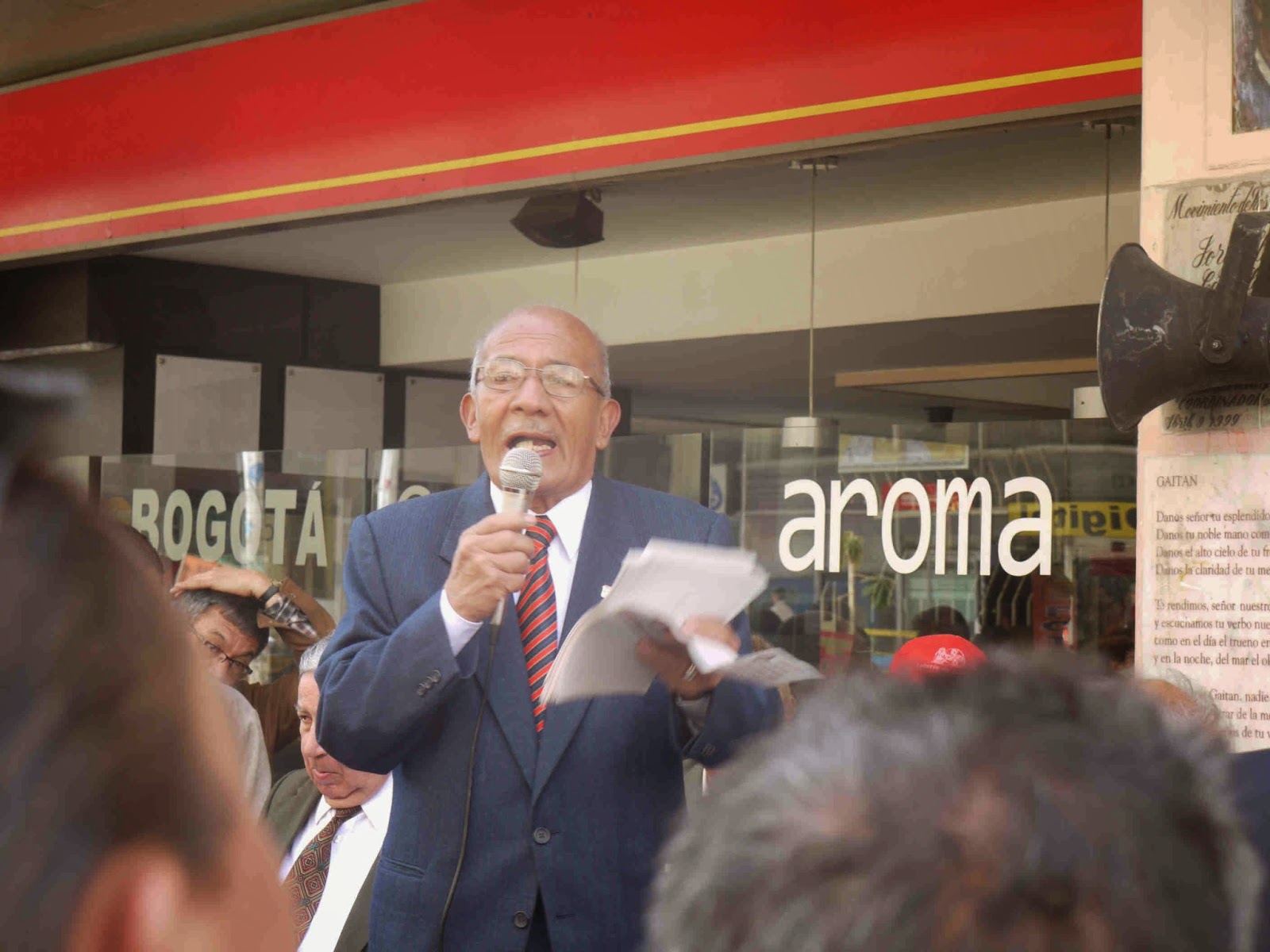
Yesterday, passionate followers of Gaitán held this rally by the spot on Ave. 7 and Jimenez Ave.

A Gaitanista makes an angry speech calling for Latin American unity.
An image of a smiling Gaitán.
A man sells DVDs of Colombian history.


By Mike Ceaser, of Bogotá Bike Tours

Sunday, November 16, 2014

The Banana Massacre on Stage in the Parque Nacional


The 1928 banana workers massacre became a landmark event in Colombian history after Gabriel Garcia Marquez made it a key episode in his Nobel prize-winning novel 'One Hundred Years of Solitude'. 

This theater troupe, performing around mid-day in the Parque Nacional, didn't employ much subtlety in portraying the hardships of the banana workers, employed by the United Fruit Company (now Chiquita). Banana prices had declined, causing a drop in pay and benefits. Workers went on strike and the military arrived to back the U.S. company. With union leaders gathered in the plaza of the town of Ciénaga, near Santa Marta, in Magdalena Department, the soldiers started firing machine guns placed on roofs of buildings on all four corners of the plaza. Estimates of the number killed range from a few hundred to thousands of unionists. Afterwards, the corpses were loaded onto the trains used to ship fruit to the coast and dumped into the ocean. 

Some believe that the Colombian military acted because they feared that if they did not, then U.S. Navy ships waiting off the coast would invade. The U.S. Embassy at the time knew about the massacre, and reported it to Washington, but kept quiet publicly.  

The massacre brought fame to then-Senator Jorge Eliecer Gaitán, who made fiery speeches in Congress demanding punishment for the killers. But that didn't happen.

Today's performance portrayed the hungry workers with empty milk cans and starving infants. Death, with a skull head, pursued the workers and even chased Gaitán. Actors waved black and red flags, suggesting anarchism. Workers and Gaitán waved flags and yelled in protest. But a businessman denounced the workers as troublemakers who deserved repression.

For liberty! - if Death does not catch Gaitán.
Our poor starving babies!
The businessman, in grey on left, denounces the protesting workers as troublemakers who deserved what happened to them. 

Death victorious!


Shining shoes.
Forward!


Who will fill our empty milk cans?


On a different note, a homage to the disappeared.
By Mike Ceaser, of Bogotá Bike Tours