Showing posts with label john f. kennedy. Show all posts

Friday, November 22, 2013

Colombia's Many Martyrs

Supporters with the corpse of leftist politician Jorge Eliecer Gaitan, assassinated in central Bogotá on April 9, 1948. 
The 50th anniversary of the assassination of John F. Kennedy seems like an appropriate time to recall Colombia's many, many political martyrs.

Colombia's most famous martyr was undoubtedly leftist, populist politician Jorge Eliecer Gaitan, whose slaying in downtown Bogotá in 1948 triggered the Bogotazó riots and generated almost as many conspiracy theories as did Kennedy's assassination. The shooting has some parallels to JFK's: after Gaitan was gunned down on a sidewalk, the apparent assassin, a mentally ill man named Juan Roa Sierra, was killed by the furious crowd. As a result, some still dispute that Sierra was the real killer, and conspiracy theories abound about political enemies or foreign powers having planned the killing.

The tomb of Gaitan, by his house in Bogotá's Teusaquillo neighborhood.

A portrait of guerrilla priest Camilo Torres on the Plaza del Che in the National University in Bogotá.
Camilo Torres, chaplain of the National University in Bogotá, was an idealistic leftist who in 1966 gave up on the system, joined the ELN guerrillas and was killed in his first battle. He remains an enduring symbol of protest for many young Colombians.

The monument to revolutionary martyrs executed by imperial Spain on Los Martires Plaza in central Bogotá.

The tomb of Liberal Pres. Candidate Luis Carlos Galan, assassinated on orders of drug cartel kingpin Pablo Escobar while campaigning for president in 1989 in south Bogotá. Galan's assassination is still being investigated. Apparently, authorities cooperated with the assassins by changing Galan's bodyguards before the killing. 

The Justice Palace on Plaza Bolivar in Bogotá. In 1985, the M-19 Guerrillas attacked the building and took the Supreme Court magistrates hostage. The episode ended with about 100 deaths, and is still under investigation.
A list of those killed following the M-19 guerrilla attack on the Justice Palace. The victims included guerrillas, palace employees and 11 of the 12 Supreme Court judges. Some were murdered extrajudicially by the military.
The tomb of AfroColombian union leader Jose Mercado, in Bogotá's Central Cemetery. Mercado was kidnapped and murdered by the M-19 guerrillas. 
The tomb of M-19 presidential candidate Carlos Pizarro in Bogotá's Central Cemetery. Pizarro was assassinated on an airplane in 1990 by a youth hired by right-wing paramilitary leader Carlos Castaño.
More than 3,000 leaders of the far-left Union Patriotica political party were killed during the 1980s and '90s. Recently, the party was revived and now has a candidate for president. 
A mural in central Bogotá memorializes the Union Patriotica political party, thousands of whose leaders were assassinated by right-wing groups in the late '80s and early '90s, including its two presidential candidates Jaime Pardo Leal and Bernardo Jaramillo.
A mural on 26th Street memorializes comedian Jaime Garzon, assassinted nearby in 1999. The killing, apparently by right-wing forces, is still being investigated.
El Tiempo put JFK on its cover today. 
A mural on the National University's campus with portraits of leftists allegedly killed by the government or right-wing groups and the words 'Neither Pardon nor Forgetting.'
A section of Colombia's memorial to police adn soldiers killed in battle. 


By Mike Ceaser, of Bogotá Bike Tours

Wednesday, November 20, 2013

Kennedy and Colombia

Kennedy and Colombian Pres. Albeto Lleras inaugurate housing for the poor in south Bogotá.
The 50th anniversary of JFK's assassination is as good a time as any to take a look at the storied president's relationship to Colombia.

Kennedy visited Colombia once, in December 1961, only the second U.S. president to do so, following Franklin Delano Roosevelt.

JFK in Bogotá.
(Photo: JFK library.)
The purpose of Kennedy's visit was ostensibly to inaugurate a south Bogotá housing project funded by United States aid money. But the Kennedy administration's broader purpose was to line up regional governments behind U.S. Cold War policy - in particular, opposition to Fidel Castro's communist government in Cuba. Eight months before, the U.S. had launched the disastrous Bay of Pigs invasion, which Kennedy had inherited from his predecessor, the Eisenhower administration.

Kennedy had lots going for him in Latin America: he was young, handsome, charismatic, apparently vigorous (he in fact had severe medical problems), and, most of all, Catholic.

In March '61, his administration had created the Alliance for progress, supposed to help development of Latin America.

But the United States faced widespread distrust across Latin America, as expressed by Colombian an ingratiating letter a few months before Kennedy's visit. Lleras said that Colombia had "no doubts" about the U.S.'s commitment to send development aid to Latin America, but that many other countries thought that Washington's demands weren't balanced. Washington's aid pledge to the region "lacks precision," Lleras wrote, "while at the same time the United States requires from (Latin nations) in very precise form radical transformations that they cannot undertake without external aid from the United States."

In other words, if Latin American nations were to follow Washington's economic and ideological blueprints, they expected to be paid for it.

A cartoon shows Kennedy and Fidel
Castro confronting each other.
(JFK Library)
Pat M. Holt, a journalist, book author and staff member of the Senate Committee on Foreign Relations, also believed that Washington had more persuading to do: "Some - I am afraid many - Latin Americans are not yet convinced that the Soviet presence in Cuba is by intervention and not by invitation," he wrote, adding that, because of Castro's apparent popularity, "Latins are assailed by doubts that (Organization of American States (OAS)) to end Soviet intervention in Cuba would interfere with the right of the Cuban people to self determination. This argument may be silly, but that doesn't keep some people from believing it."

On the following page, Holt quoted a clause in the OAS charter stating that "No State or group of States has the right to intervene, directly or indirectly, for any reason whatever in the internal or external affairs of any other State."

For its part, Lleras assured Kennedy that Bogotá was on the same page as Washington in its "desire to sek proper solutions to the serious danges which have been created for the hemisphere by the imminence of the Soviet menace..."

A few days before Kennedy visited Bogotá, Colombia broke diplomatic relations with Cuba. In January 1962, the OAS expelled Cuba, which is still not a member.

In Nov. 1963 Kennedy was assassinated in Dallas, Texas. Some conspiracy theories hold that Castro was behind the killing. The south Bogotá neighborhood which Kennedy visited was renamed Barrio Kennedy.


By Mike Ceaser, of Bogotá Bike Tours

Saturday, December 17, 2011

Kennedy in Colombia


Today is the 50th anniversary of U.S. Pres. John F. Kennedy's 1961 visit to Bogotá. Kennedy came ostensibly to promote the Alliance for Progress, a Washington-backed development effort. But his visit was more about the ongoing Cold War and Washington's desire to keep Bogotá firmly within its orbit.

The South Bogotá site where U.S. support would build the El Techo housing project.
At the time, Fidel Castro's Cuban revolution was seeking regional allies. Kennedy's speech to Liberal Colombian Pres. Alberto Lleras Camargo mixed Kennedy's characteristic idealism...

"Today we face our greatest challenge to the vitality of our American revolution. Millions of our people -- scattered across a vast and rich continent -- endure lives of misery. We must prove to them that free institutions can best answer their implacable demand for social justice, for food, more material welfare and above all, for a new hope - for themselves and for their children."
John F. Kennedy sets the first brick at El Techo. 

...with apologies....

"We in the United States have made many mistakes in our relations with Latin America. We have not always understood the magnitude of your problems or accepted our responsibility for the welfare of the hemisphere."

...a warning against communism....

"They promise free elections, and free speech and freedom of religion. But once power is achieved, elections are eliminated, speech is stifled and the worship of God is prohibited."

A cartoon makes fun of Pres. Alberto Lleras' closeness to Uncle Sam. 
...and one outright lie: "We deny the right of any nation to impose its will on any other."

Just eight months before, the Kennedy administration would back the failed invasion of Cuba at the Bay of Pigs.

That same day, Kennedy had visited a south Bogotá neighborhood where the U.S. was financing a housing project for the poor called 'El Techo.'

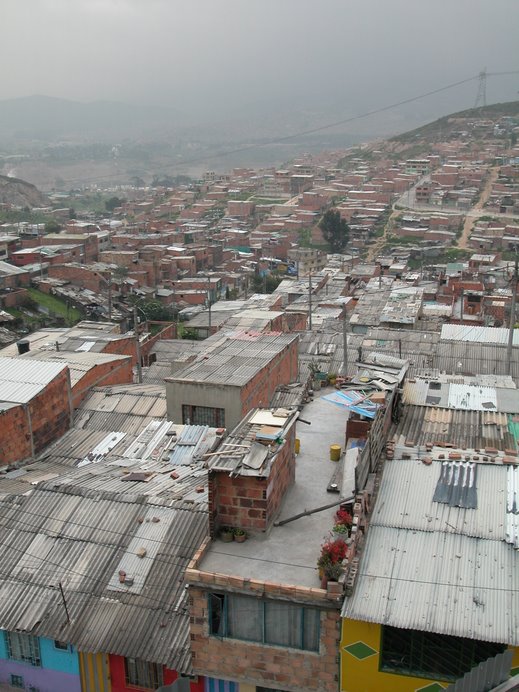
South Bogotá's Ciudad Kennedy today. (Photo: The Tall Gringo)
Kennedy was popular throughout much of Latin America, both for his idealism and for being the U.S.'s first Catholic president. (He was the second U.S. president to visit Colombia, after Franklin Delano Roosevelt in 1934.) But his goals, for all their good intentions, were not to be fulfilled.

Two years later, Kennedy would be assassinated in Dallas. Colombia named a south Bogotá neighborhood in his honor, but today it remains a poor and troubled part of the city.

With the presidency of Lyndon Johnson, the U.S. turned inward, preoccupied with Civil Rights and domestic poverty, and soon after became obsessed with the failing war in Vietnam.

Today, Latin America continues to be burdened by poverty and inequality. Cuba remains a thorn in Washington's side, and socialist rhetoric - if not reality - has received new life from a new generation of leftist leaders in Venezuela, Ecuador and Bolivia.

By Mike Ceaser, of Bogotá Bike Tours