Showing posts with label drunk driving. Show all posts

Saturday, December 13, 2014

Relax Americans: You're Safe

James Watson,
murdered DEA agent.
Members of the taxi-driver gang which murdered a U.S. DEA agent in north Bogotá in June of last year during a mugging-gone-awry are being sentenced in a court in Virginia, and you can be certain that these guys regret their crime.

"If I could go back in time, I would," taxi driver Andrés Álvaro Oviedo, who was sentenced to 20 years in prison, was quoted in El Tiempo. "I made a mistake and know I'm going to pay for it. I never wanted to hurt anybody."

(The five men were extradited to the U.S. on the shaky justification that the smart phone which they stole contained classified DEA information - even tho the gang sold the phone without bothering to check its data.)

Whether someone who 'never wanted to hurt anybody' had any business joining a band of muggers is more than debatable. But so is Oviedo's sentence: 20 years in prison - even tho he didn't actually participate in the crime, because his taxi broke down on his way to the scene. Colombian paramilitary leaders, some guilty of hundreds or thousands of murders as well as other crimes, are getting out of prison this year after doing just 8-year terms.

Two of Oviedo's associates in the robbery-murder received prison sentences of 25 and 27 years, while the principal actors in the crime are expected to receive terms of 40 and 60 years.

These guys may very well deserve to spend the rest of their lives in prison for a crime which the judge called "grave and brutal." That's particularly true since they undoubtedly had committed previous robberies and perhaps even murders which went unpunished (and perhaps the fact that those victims were Colombians had something to do with that).

The harsh sentences may be intended to "send a message to the world that whoever attacks a U.S. citizen will pay a high price," wrote El Tiempo.

If that was the goal, they picked an effective way to accomplish it. As a result, we U.S. expatriates can relax. Any mugger who suspects a potential victim may be a gringo will surely turn around and assault someone else.

But if the goal of the justice system, either in the U.S, or Colombia, is to deter potential future
Ernesto Manzanera killed five in a car crash
and fled the scene, but is at home resting.
criminals, then perhaps they should apply similar harsh punishments to other killers, such as Avianca co-pilot Ernesto Manzanera, who while driving at 180 kilometers per hour in the early morning smashed into another car and killed its four occupants. A judge gave Manzanera home detention, and so he's resting comfortably awaiting his court date. Manzanera could be subject to 18 years in prison, but if his case follows the pattern of previous drunk driver killers, he'll receive a few years of home confinement of dubious enforcement.

One might argue that, in contrast to the cabbie gang, Manzanera did not intend to kill. But his extreme recklessness and irresponsibility come close to the same level of moral culpability. And after the accident Manzanera fled the scene and turned himself into police only 15 hours later, when any evidence of alcohol or drugs would have been flushed from his system. When Manzanera fled, at least one of his victims was still alive, compounding Manzanera's responsibility for her death.

That not all crimes or criminals are punished equally is a cliché. But occasions like this offer the opportunity to examine why that is and how the system of 'justice' could actually be true to its name.

By Mike Ceaser, of Bogotá Bike Tours

Monday, December 8, 2014

Maim, Kill and Go Home to Rest

Police examine cars after crash which killed four. The driver of the other vehicle was sent to his home today by a judge.
(Photo: El Tiempo)
The peace negotiations with the FARC guerrillas are generating controversy because of the impunity sure to be given to guerrillas and soldiers guilty of murder, displacement and other severe human rights violations.

But impunity's critics could look right here in Bogotá, where killers routinely go home to rest: just because they killed using cars and while drunk.

A drunk driver in a Venezuelan embassy car left this disaster
scene in early November. A judge sent him to his home,
and I've heard nohing more about the case.
(Photo: El Tiempo)
The latest example is that of 24-year-old Ernesto Manzanera, who, in the early morning of Dec. 2, while speeding along the Autopista Norte, smashed into a car containing four members of the Moreno family, killing them all. Manzanera fled the scene, and only turned himself in to police 15 hours later, at which time an alcohol test came out negative.

This morning, in a closed hearing, Manzanera, who is a co-pilot for Avianca, was charged with 'culpable homicide,' which in the United States would roughly translate to involuntary murder. Despite protests of the victims' relatives, the judge sent Manzanera to his home to await trial. Manzanera's father, Ernesto Manzanera Jiménez, now apparently retired, was a prominent politician in Cundinamarca.

In the first days of November, Aníbal Enrique Tapia, drunk and driving a luxury BMW with injured 11 people and killed one in north Bogotá. A judge charged him with homicide and sent him home to rest. The Venezuelan Embassy said in a statement that Tapia was a Colombian citizen and had used the car without permission. It did not explain why an irresponsible person with an alcohol problem had access to an embassy vehicle. I've searched the Internet and found no more recent information abut Tapia's case.
The posters, critical of the peace
negotiations, say 'Colombia without impunity.'
diplomatic license plates from the Venezuelan embassy,

Altho these killers go home after their first audience, one would hope that they would eventually be tried, convicted and imprisoned.

However, that doesn't seem to happen, either.

Recent prominent include one in which the scion of a wealthy Cali family killed three members of a motorcycle club on the outskirts of Bogotá and another in which a young man rear-ended a taxi, killing its two passengers and leaving the driver paralyzed. The second driver, Fabio Salamanca, was initially sent to rest in a hospital because of the stress he suffered from the accident he caused. Salamanca did spend a short time in prison before a judge sent him to his comfortable home to pay his debt to society.

In both those cases, as will likely happen in the more recent ones, the drunk drivers apparently paid
Fabio Salamanca killed two and left third paralyzed
and is serving out his sentence at home. (Photo: El Espectador)
off the victims' families to drop charges. Such a 'punishment' may bring some compensation to the families, but it does little for the rest of us, who continue to be at the mercy of drunks, who know that they can kill and go home, just as long as they have money in their pockets.

In a dramatic piece of evidence of this, Hollman Cangrejo, the taxi driver who was left quadriplegic, bought another taxi with the compensation money he received from Salamanca. This may, that taxi, with someone else at the wheel, was hit by a drunk driver who fled the scene. Fortunately, this drunk was chased down and caught by other taxi drives. No word on whether or not he went to prison.

By Mike Ceaser, of Bogotá Bike Tours

Wednesday, February 26, 2014

The New Drunk Driving Law Hits Home

On his way home: Killer Salamanca smiles
as he's led out of court.
Colombia's strict new drunk driving law, intended to crack down on drunks - for whom driving and even killing others had been a forgiveable offense - has finally hit home, unfortunately.

Fabio Salamanca, the rich, spoiled kid who slammed into the back of a taxi, killing its two women passengers and leaving the driver a quadriplegic while driving drunk last July, has received five years of 'house arrest.'

Salamanca's story is just the most recent legal travesty involving a drunk driver. In Salamanca's case, the judge reduced the charge from 'intentional homicide' to 'culpable homicide.' A sentence of only five years made him eligible for home detention under the new legal code. But, paradoxically, the judge didn't apply the new drunk driving law, which would have required Salamanca to do his time in prison.

House arrest doesn't have the most secure reputation in Colombia. And Salamanca's house is likely to be very comfortable, even after his family paid some 800 million pesos to the victims and their survivors.

That others should be so fortunate. An acquaintance of mine was caught last year transporting seven kilos of
'Fabio Salamanca, convicted and sent home,'
reports El Espectador.
marijuana, which he was going to use (mostly) for making health and hygiene products such as soaps. (Ironically, some public health experts believe that wider use of marijuana makes the roads safer because smoking and driving is less dangerous than drinking and driving. And, if not for the availability of pot, some of those high drivers would have been on the road drunk.

Roberto Bastidas, father of one of the women victims, told El Espectador "The justice system favored this young man because he had money....I lost my daughter, and no amount of money will bring her back to me."

For his part, the paralyzed taxi driver said that he'd gladly trade places with Salamanca, who smiled as he was escorted out of the courtroom.

The new, stricter drunk driving law has had at least one impact, however. Bavaria, Colombia's dominant beer company, told Bloomberg Business Week that Colombians are drinking less.

Colombia's didn't celebrate last Christmas with their normal binge drinking, Bavaria President Grant Harries told Bloomberg.

Normally, drinking “starts straight after they get their (Christmas) payout, and then it really takes off," Harries said. "But it didn’t take off, and this was the impact that we were feeling.”

Pity those folks at Bavaria. But Harries said that Colombian beer drinking is picking up again - and with it, perhaps, drunken driving, as well.

By Mike Ceaser, of Bogotá Bike Tours

Saturday, December 14, 2013

Drunk Driving Out of Prison

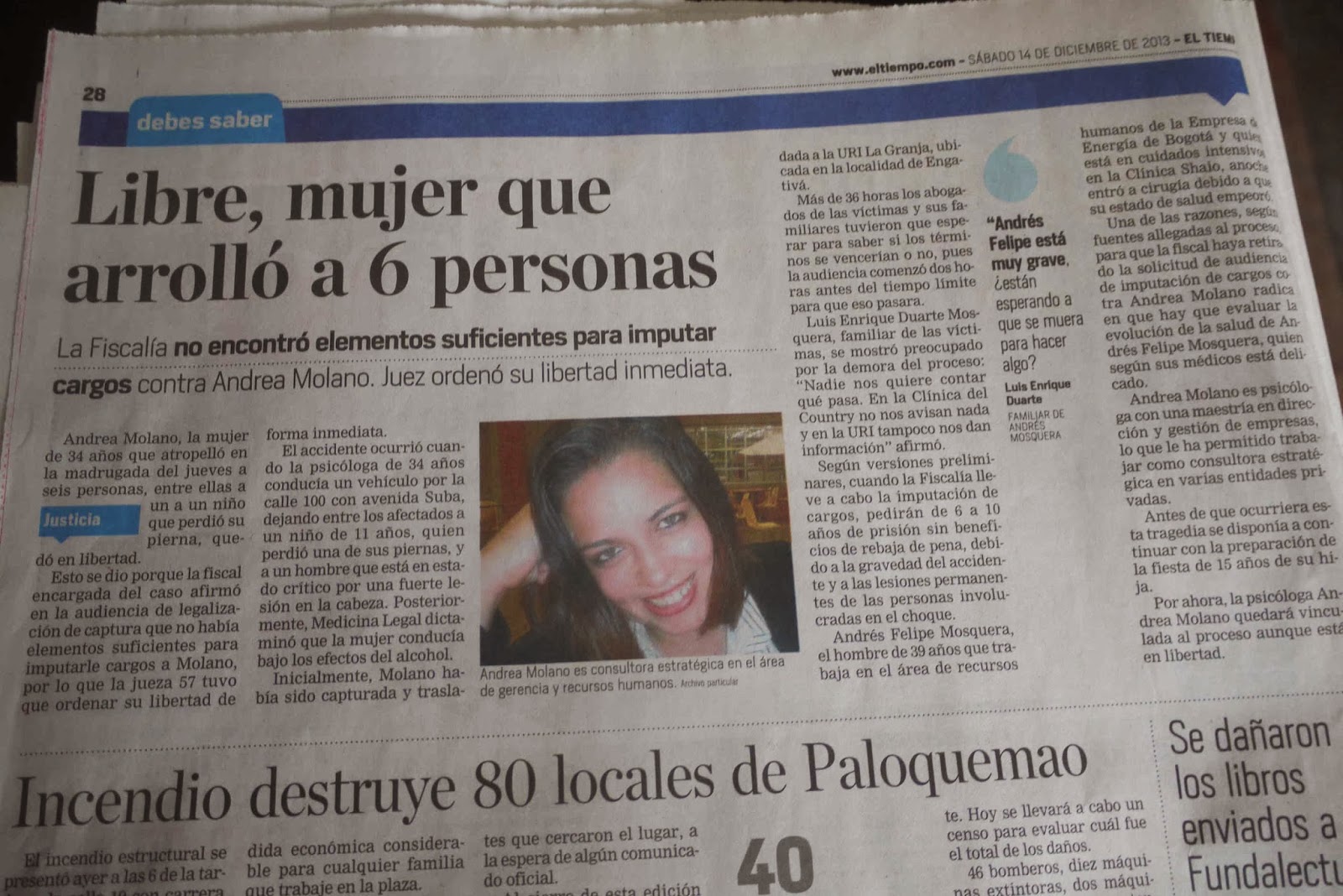
http://www.eltiempo.com/colombia/bogota/legalizan-captura-de-conductora-que-atropello-a-seis-personas_13286102-4
Today's El Tiempo reports that a judge freed a woman who hit six people while driving drunk.

It's like a broken record. Someone gets drunk, hits and maybe kills people. The victims go to the hospital, the driver goes home to relax and recover.

In the most recent case, a woman hit a group of children and adults waiting for a bus to take them to the last day of school. One victim is in critical condition with head injuries, and an 11-year-old boy had to have his leg amputated.

But the driver, a 34-year-old psychologist, was freed and allowed to go home - altho it appears likely that she will ultimately be charged.

It's latest the latest travesty involving a drunk driver.

Fabio Salamanca, a wealthy young man, rear ended a taxi July 12, killing its two women passengers and leaving the taxi driver paralyzed. According to news reports, in late November Salamanca's charges were reduced, opening the possibility of home detention, after his family paid 'compensation' to the victims' families.

Last year, Juan Carlos Varela Bellini. heir to a wealthy Cali family, was drunk driving his Mercedes Benz in La Calera last year and ran over four motorcyclists, killing three and severely injuring a fourth. Varela's family paid the victims and the 27-year-old is serving his sentence in his family mansion.

Altho the victims, who are usually from humble backgrouinds, apparently agreed to these soft sentences, they did so for financial motives, not for justice. Such sentences offer terrible examples and weaken the fear of punishment for those considering getting behind the wheel after a few drinks.

For me, these cases also create an absurd contrast with what happened to an acquaintance who made products like soaps out of marijuana. (I'm sure he smoked the stuff, two.) Riding the bus back to Bogotá after a purchasing trip, police discovered he was carrying several kilos of marijuana. The guy is now serving a seven year prison sentence. (And no home detention for him.)

The case is particularly ironic to me, since marijuana use may actually reduce highway fatalities. That's because driving, while high on pot is certainly dangerous, it's less dangerous than driving after drinking alchohol. And, where pot is easily available, some consumers apparently shift from highly dangerous alcohol to less-dangerous marijuana, making the roads safer.

By Mike Ceaser, of Bogotá Bike Tours

Friday, July 19, 2013

Crime and (Little) Punishment

United States authorities are finding new legal arguments to extradite a group of taxi drivers and accomplices who allegedly robbed a murdered a DEA agent in Bogotá's ritzy Parque de la 93 neighborhood a few weeks ago. Now, the U.S. is accusing them of kidnapping for their attempted paseo millonario robbery-gone wrong.

An alleged drunk driver, now de-stressing in hospital,
and the results of his fatal work. (Foto: ElEspectador.com)
When the taxi drivers thot they'd spotted another wealthy, vulnerable gringo leave a bar with a few drinks in him that night, they surely never imagined that soon U.S. Attorney General Eric Holder would be vowing harsh punishments for them.

People who commit robbery and murder deserve no pity, and I won't be sorry if they spend decades in prison. After all, these guys had criminal histories, almost surely had robbed and perhaps murdered previously, and would undoubtedly still be at it today if they hadn't grabbed the wrong gringo.

Still, it's impossible to ignore the huge contrast between this case, which has made international news and triggered plans to reform Bogotá's taxi policies, and other killings.

During the aftermath to the DEA agent's murder, a drunk driver in an Audi slammed into a taxi, killing its two female passengers and leaving the taxi driver partially paralized. El Tiempo reports that the man's initial medical examination found no stress problem at all.
Not a punishable crime? (ElEspectador.org)

The drunk driver is now in a hospital, where the poor guy is being treated for 'severe stress' he supposedly experienced from killing two innocents and injuring a third.

Most likely, this drunk driver, like so many others, will escape with a slap on the wrist. Once his comfortable hospital stay ends, he'll likely receive a few years of home detention - of questionable enforcement - and then be driving again.

(In fact, at the drunk driver's July 30 court hearing the judge sent him home, saying he wasn't a flight risk. The victims' relatives expressed anger. Strangely, another drunk driver, who killed one person, was sent to jail the other day. The judge sounded like she was on the driver's side, saying that he was 'innocent until proven guilty - even tho he'd confessed - and asserting that, since he was from a wealthy family he wouldn't flee. (So only the poor deserve prison.) Finally, she congratulated the driver for 'resisting media and social pressures.'

Clearly, for her honor, the victim here is the killer drunk driver.

 It all makes one wonder whether something incorrect happened between this wealthy family and the judge.)

Citizen groups and some parliamentarians have made repeated attempts to give drunk drivers real punishment. But other members of Congress - some of whom have been known to drive drunk themselves - don't seem interested in making the laws stricter. At the same time, social and economic factors allow drunks, who often pay off victims or seem to have connections with judges and authorities, to get off lightly.

It's impossible not to read an economic lesson into these two crimes: Taxi drivers, who are usually lower middle class, get the book thrown at them for assaulting a wealthy foreigner, while drunk drivers, who are often wealthy, get off easy.

Check out this dramatic video of a wrong-way drunk driver hitting a man carrying his daughter to school on Thursday in south Bogotá. The driver, who'd had previous drunk driving charges, then allegedly tried to bribe and threaten the victim and attacked police.


By Mike Ceaser, of Bogotá Bike Tours

Monday, October 22, 2012

Drunk Driver Who Killed Three "Is not a Criminal."


Motorcycles lined up outside Bogotá's Central Cemetery
during the motorcyclists' funeral.
In another in Colombia's long series of cases of fatal drunk driving being considered a forgiveable act, the wealthy Caleño businessman who mowed down three motorcyclists and injured one more with his Mercedes Benzoutside of Bogotá while apparently drunk, will now get out of jail.

The driver "was transferred from La Modelo Prison to a site of special detention," attorney Iván Cancino told reporters the other day. 'Special detention' apparently means 'home sweet home'.

A motorcycle club was returning from an outing in La Calera the night of July 7, when Juan Carlos Varela Bellini smashed into them. Immediately after the accident, some witnesses said, Varela Bellini offered witnesses bribes and tried to pretend that he hadn't been driving. Varela Bellini also attempted to flee the scene of the accident and evade the drunkeness test, a judge said. Now, Varela Bellini has agreed to pay the survivors 1,400 million pesos, or a little over one million dollars, in return for dropping charges. That seems like mighty little for three lives, and makes you wonder if anything else was behind it. (The agreement was approved by prosecutors and a judge, Varela Bellini's lawyer said.)

"The important thing is for the world to know that Juan Carlos Varela Bellini is not a delincuent," the accused's lawyer said.

Motorcycle club members at their companion's funeral.
Varela Bellini, 25, belongs to one of the wealthiest and most elite families of the city of Cali, as you can read in this sympathetic story about his misfortunes in Jet Set magazine. How sad it would be for this young man's future to be ruined just because he killed three people. But, it may not be. By paying what is a small fortune for the victims' families, but not much for Varela Bellini's clan, he likely will go on in comfort.

Sure, the survivors will be better off with their pockets full. But those of us on the road in front of drunk drivers feeling confident that they'll get off lightly for any accident, are worse off. That's why drunk driving is a crime against both the individual victims and society in general. By letting drunks off easy the legal system sends a loud and clear message that driving drunk is no big deal, so go ahead and risk it.

And that drunk driver just might be Varela Bellini again. I haven't heard that they've taken away his driver's license or his Mercedes.

If I carry a gun or a knife or a hammer, get drunk and injure someone with those things, aren't I a criminal? Is a car, which is much bigger and potentially more deadly, any different? As I understand it, in other nations' legal systems, when you get drunk and lose control of your behavior, the law makes you responsible for your actions.

But, that's apparently not true in Colombia - at least not when you're rich and behind the wheel.

Related:


The Motorcyclists' Tragedy


Motorcyclists Rev Up Against Drunk Driving


By Mike Ceaser, of Bogotá Bike Tours

Tuesday, July 24, 2012

Motorcyclists Rev Up Against Drunk Driving


A group of motorcyclists rallied on Plaza Bolivar today demanding harsher punishments for drunk drivers - somewhat contradictory, perhaps, considering some motorcyclists' rep for doing just that.

However, the group was responding to a recent tragedy, when a car killed three members of a motorcyclist club on an outing and injured a fourth. The prosecutor initially gave the driver house arrest, altho he did send him to jail following public outcry.


By Mike Ceaser, of Bogotá Bike Tours

Wednesday, July 11, 2012

The Motorcyclists' Tragedy

Motorcycle club members grieve their lost companions this afternoon. 

This afternoon, members of a motorcyclist club laid to rest three of their members, who were killed Saturday night by an apparent drunk driver, whose release caused national outrage.
Motorcycles parked behind Bogotá's Central Cemetery.
About 100 motorcyclists were headed to dinner in the town of La Calera outside of Bogotá when a couple driving a 2012 Mercedes Benz plowed into the group, killing three people and seriously injuring a fourth. The young man driving the car refused to take a breathalyzer alcohol test, but later failed a test of coordination meant to test drunkeness. 
Q'Hubo newspaper quoted the son of one of those killed, also a participant in the VTM Custom motorcycle club, as saying that the car driver offered to pay him not to press charges. Later, a prosecutor released the car driver, telling him to appear the following week for a court hearing. The ensuing public furor has spurred a judge to order the driver's arrest.

This was only the most recent case of an a drinking and driving case in which the killer was treated with kid gloves. Unfortunately, money counts, and car drivers may be able to corrupt the legal system. In addition, getting drunk is still often seen as just good, clean fun, and the drinkers as not responsible for whatever damage they may cause. 

 Related Posts:

Drunk Drivers: Still Almost Invulnerable


By Mike Ceaser, of Bogotá Bike Tours

Wednesday, May 23, 2012

Drunk Drivers: Still Almost Invulnerable

The accounts of drunk drivers hitting and even killing people and getting off without jail sentences have become common.

Last week, the issue hit the news again when police pulled over Senator Eduardo Carlos Merlano for apparently driving drunk. 

"Do you know who I am?" the senator demanded of the police officers, and then refused to take the alcohol blood level test.

The scandal was later compounded by a leaked recording in which a police commander criticized the police officer for trying to test the senator. "Out of millions of Colombians, we've selected just a hundred to write out laws," the commander pointed out.

And, apparently, some of those 100 politicians consider themselves above the law. Merlano - who it turned out was also driving without a license - afterwards asserted that he hadn't been drunk and had a right to refuse to take the alcohol test.

Coincidentally, just yesterday a bill which would have required jail time for drunk drivers died in Congress. The bill failed to pass by a single vote. More than 70 senators failed to appear to vote at all, perhaps taking a long lunch lubricated by aguardiente.

Every year,  drunk drivers kill more than 5,000 people in Colombia. 

Poor Sen. Merlano, meanwhile, has been told by his doctor to take a couple of days off of work to relax from all the stress he's suffered.

At last word, Sen. Merlano hadn't expressed an opinion about the anti-drunk driving legislation.

By Mike Ceaser, of Bogotá Bike Tours
Monday, January 30, 2012

Pick the Prison-Worthy Crime

On the left: Men throw dice on Plaza San Victorino, near a 'Chance' shop.
On the right: a traffic accident on 26th St. 
Which crime deserves harsher punishment? Small-time gambling, or drunk driving and killing someone?

In Bogotá, apparently the former.

Today's El Tiempo reports that, despite officials' vows to crack down on drunk drivers, motorists who kill others while drunk continue receiving short prison sentences or are even allowed to do their 'prison time' at home. 

'Three illegal Chance
sellers sentenced to
four years in prison.''
In contrast, I saw this photocopy today warning that several vendors of illegal 'Chance' tickets had received four-year prison sentences. Those are people who sell either counterfeit tickets from the city's official Chance numbers game or tickets for their own, unofficial and illegal numbers games. Numbers games are bad bets and mostly take money from poor people, who can least afford to lose their money. Bogotá's official Chance game is supposed to finance health care, and the government estimates it loses close to 1.5 billion pesos - or $800,000 dollars - per month because of fraud and illegal games.

Financing health care:
an official 'Chance' ticket shop.
But selling fraudulent tickets can't compare to the immorality or damage from getting drunk, driving a car and killing someone. But, El Tiempo reports, judges continue to consider drunk driving deaths 'unintentional,' and so deserving lighter punishment than a deliberate killing. In contrast, many other nations hold people responsible for their actions while under the influence. Otherwise, inebriation becomes a license to kill, as happens here.

El Tiempo also reports that drunk drivers often pay off their victims' families to drop charges against them.

As so often happens, 'justice' obeys economic power. And in Colombia car drivers are by nature people with money, if only because they own cars.

By Mike Ceaser, of Bogotá Bike Tours

Monday, April 11, 2011

I didn't mean to do it - but you're dead anyway!

Alcohol or just plain old recklessness? A car-motorcycle crash near Tadeo University. 
Here's a useful piece of criminal advice: if you want to commit murder, just get drunk and get behind the wheel before you do it. Colombia's parliament again last week voted down a bill to impose jail terms for drunk driving. And, injuring or killing someone while driving drunk is considered 'negligence' or 'accidental,' and punishable only by house arrest.

I suppose that nowhere in that chain of acts of getting drunk, getting behind the wheel and then injuring or killing someone is there any intentionality.

"I'm sorry, but it was all an honest mistake which could have happened to anybody."

Anybody who is drunk and irresponsible, that is.

Here's a news article about a drunk driver who killed a woman and injered her friend, who said the pair were standing on the sidewalk, and then fled the scene. The incident only made the news because the driver was sentenced to prison. He claimed that the woman had thrown herself in front of his vehicle.

Sure, it's usually the pedestrians' fault for getting themselves killed by cars.


By Mike Ceaser, of Bogotá Bike Tours

Sunday, August 29, 2010

Colombia's Abortion Issue

An illicit abortion clinic in central Bogotá advertises itself as a women's health clinic.
In 2006 Colombia's supreme court legalized abortion in cases of rape, incest, danger to the woman's life and when the fetus has some severe deformation, making Colombia's one of the most progressive abortion laws in Latin America.

Since then, 649 legal abortions have been carried out, 61 percent based on fetal deformation, 20 percent on danger to the woman's life and 19 percent because the pregnancy resulted from rape or incest.

After three years, 650 legal abortions is an absurdly tiny number in a nation of 45 million people, where gender violence is relatively common and maternal mortality is high.

Nevertheless, for the procuradora general that number is apparently too high. In any case, she's been asking why the percentage of legal abortions justified by fetal deformity is so high. Is this disguised eugenics? Abortion for convenience? Neither of those explanations is likely, since even when they have a legal justification to abort, girls and women encounter many obstacles, in particular from doctors and hospitals who profess Catholic values. Rather, those looking for abortions of convenience will simply go to the many ilicit abortion mills which continue doing lively business across Colombia.

In contrast to the apparent crackdown on legal abortion is the Colombian legal system's great tolerance of drunk drivers - even including those who kill people. In recent years, with few exceptions, many drunks who injured and even killed people have been given house arrest - sending the message that drinking is all good, innocent fun, that it's not really their fault and that it's no big deal, anyway. Is there a pattern here? Perhaps it is that it's women who get pregnant, so why not make them responsible, while it's generally men who drunk and drive, who we'll laugh it off.

This blog written by Mike Ceaser, of Bogota Bike Tours