|
| An employee works in a warehouse amongst mountains of paper to be recycled. |

If you thot you'd seen the last of that trash you threw out last week, think again. Fortunately, if almost secretly, a lot of it gets sorted, collected and made into something else in a west-central neighborhood with the surprising name of Pensilvania.
To this industrial neighborhood of steel and concrete, trucks, horsecarts and human-pulled carts arrive loaded with metal, paper and other scrap, which is stored in huge warehouses, where it's sorted and then shipped out again to factories which transform the material into products which you might buy again.
 |
| A truck carrying scrap metal pulls into a warehouse. |
It's a crucial activity for this city. Bogotá's conspicuous trash crisis has overshadowed the unseen crisis of the city's almost full landfill. The landfill is expected to fill up this year, and Bogotá has no ready alternative. That's why recycling the city's waste - and reducing the amoung of material we consume - are crucial for the city's future.
The recycling industry developed in Pensilvania (I couldn't learn the origin of the neighborhood's name) because of the many industries located here, many of which produce chemicals.
 |
| A sign advertises cardboard boxes. |
Recycling is done mostly by individuals and small organizations, which are just now being formalized. The
recicladores, who have been living off of our trash for generations, are just now being integrated into the municipal trash collecting/recycling scheme, altho any Bogotá resident will tell you that the shift hasn't gone smoothly. Starting soon, recicladores are to be paid for each kilogram of material they bring to one of the warehouses, in addition to selling whatever's valuable.
 |
| Trucks lined up on a Pensilvania street. |
Bogotá's
recicladores, known formally and politicaly correctly as trash pickers, have been recognized globally for their organization. But that has involved lawsuits and conflicts with industrial recyclers. The best-known of those conflicts was with the sons of ex-Pres. Alvaro Uribe, who had established an industrial scale recycling enterprise, which threatened to take away the independent
recicladores' livelihoods.
 |
| Men walk past a lot piled high with scrap metal. |

 |
| A lottery salesman offers his tickets. |
 |
| The neighborhood has almost no green space, and this metal tree doesn't make up for that. |
 |
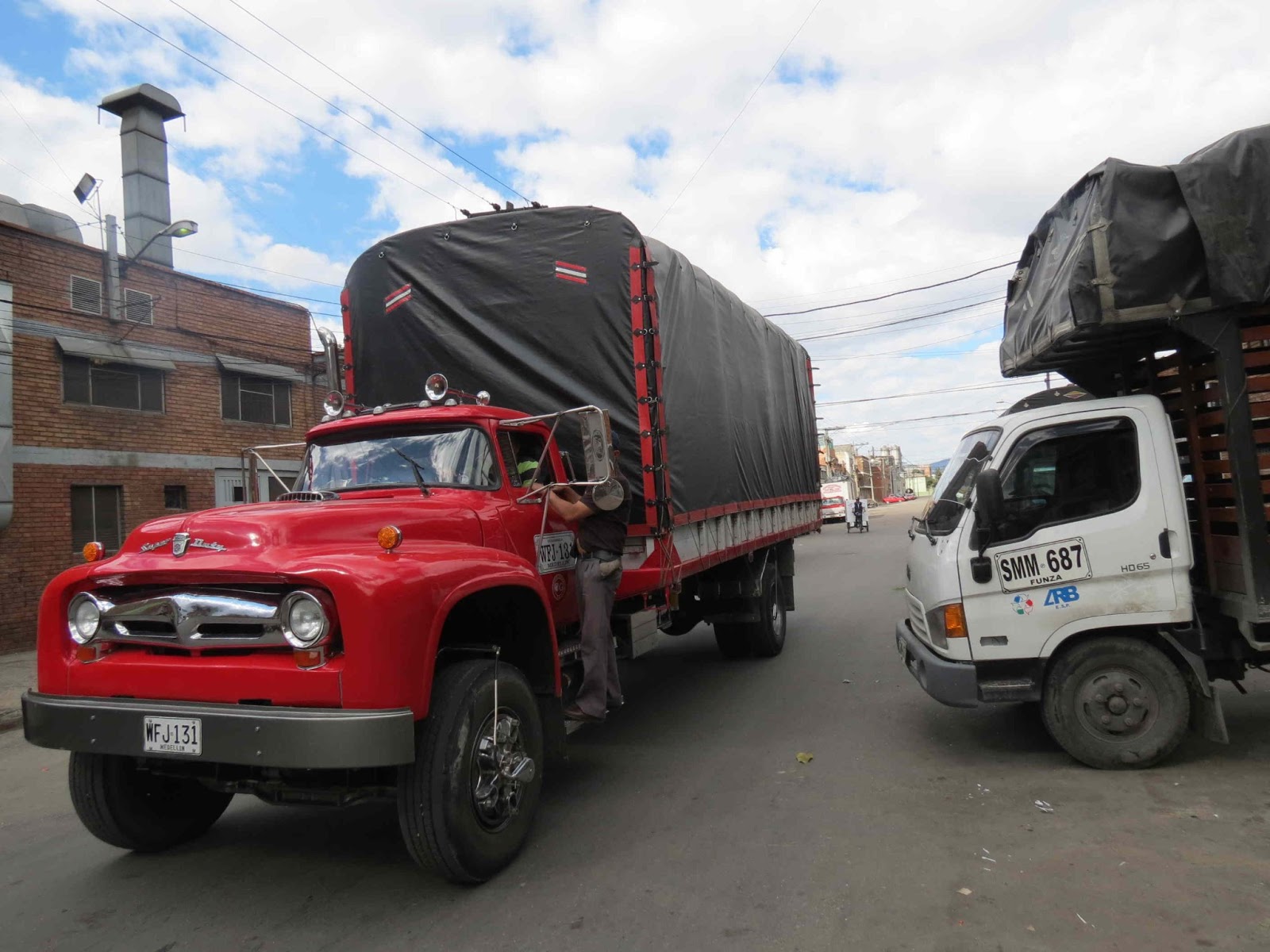
| An old truck - part of the reason why Puente Aranda's air is so polluted. |
 |
| A horsecart passes thru Pensilvania. The horse-drawn vehicles are supposed to be phased out this year. |
 |
| A nearby plant. |
 |
| The old slaughterhouse, located nearby. It's being converted into a library (I believe). |
 |
| Factory workers play football in the street. The neighborhood has almost no green areas or public space. |
 |
| Near the San Andresitos shops a few blocks away vendors hang colorful sports jerseys for sale on a chemical factory wall. |
Puente Aranda, the district which includes Pensilvania, has some of the city's worst air quality - because of the industries and many heavy diesel vehicles. While there Saturday afternoon I saw several factory chimneys spouting smoke, but this one was quite extraordinary. The tiny factory is located on Carrera 42, a major avenue, within sight of everybody. A man apparently employed in the factory wasn't concerned at all by my photographing their plume of smoke, and very kindly explained that the place was a
rectificadora and made an ingredient for soap.
 |
| A policeman passes the belching smokestack and observes nothing wrong. |
(See more horrific photos of Bogotá's uncontrolled air pollution on my
air pollution blog)
By Mike Ceaser, of
Bogotá Bike Tours

 If you thot you'd seen the last of that trash you threw out last week, think again. Fortunately, if almost secretly, a lot of it gets sorted, collected and made into something else in a west-central neighborhood with the surprising name of Pensilvania.






 Posts
Posts