Showing posts with label social equality. Show all posts

Wednesday, August 15, 2012

Land Reform: A Dream That Failed

Awoman receives a land title from the INCOR.
A proud peasant couple show off their land title.
Colombia has tried several times to redistribute lands to satisfy the demands of the poor, hungry and landless, but never really succeeded. The tragic results are demonstrated by the country's ongoing armed conflict, whose historical roots, and probably a large part of its ongoing fuel, lie in Colombia's terrible inequity in land ownership. After all, many of the young people who join illegal groups out of desperation and poverty might choose not to if they had access to land to work and live off of. 

Pres. Santos is now attempting yet another land reform effort and in its success may lie Colombia's future peace. 

The saddest of these photos reminded me of the 1930s WPA photos, which captured the tragedy of the US's Dust Bowl. Others are happier, but very possibly were followed by disappointment. Still others portray idealized, heroic campesinos - fictional figures created to sell the program. 

A boy works a field with a hoe as big as he is. 
These photos were taken by journalist Efraín Garcia between 1960 and 1972, of participants in the government's INCORA agrarian reform program, and are exhibited in the Museo Nacional in Bogotá thru November. The program was seen as a failure by many observers because the land recipients often weren't prepared for land ownership, and because the imbalances of power and the violence in the countryside were not addressed. 


A photo reminiscent of the ones from the US's 1930s Dust Bowl.


Indigenous people demand 'radical' agrarian reform. 

A farmer works furrows extending almost to the horizon.  

An idealized campesino farmer looks heroically toward the future. 

Pretty campesinas in another idealized portrayal.


Indigenous women receive vaccinations. 

Welcome!


By Mike Ceaser, of Bogotá Bike Tours

Monday, March 12, 2012

Getting Hosed at the Pump! (It's Good for You)

Sure, gasoline is cheap in Venezuela and Nigeria. But would you rather live there or in Western Europe, where you'll pay at the pump, but enjoy a healthy society?

Some honorable members of Congress called on car drivers to go on strike today against high gasoline prices. 

Buying expensive fuel in an Esso station in Bogotá. 
That's a sure way to get votes - even from the great majority of Colombians who'd be harmed by lower gasoline prices.

While cheap gasoline may sound nice, I've blogged before about the many costs to the economy, quality of life and the environment and even our health, including less export revenue, worse traffic jams and pollution, more global warming and more sedentarism and obesity from increased dependance on cars.

El Tiempo newspaper also points out that the gasoline taxes pay for things like the search for more oil reserves - which presumably will benefit the country in the future - and fighting poverty. And, that, even with Colombia's relatively high fuel prices, the government's gasoline price stabilization fund is running in the red. And, that the country continues, insanely, to subsidize diesel, which is the dirtiest, most harmful of fuels.

Cars wait on Jimenez Ave.
Does Bogotá really need more traffic jams?
Also, in Colombia, where the monied minority own the cars, fuel subsidies go predominantly to the wealthy.

And, I'll point out, it's been widely documented that almost nowhere outside of Singapore do the costs paid by drivers actually compensate for the resources cars consume and their huge impacts on society in roadway maintenance, air, noise and water pollution, traffic fatalities, dealing with junked vehicles...it goes on and on.

But, for a long time I've wanted an excuse to make a chart like the one above linking quality of life (and governance) to gasoline prices. No, it's not scientific, and you could find exceptions. But, in general, nations with costly gasoline tend to function better and provide better lives for their people. Why might this be?

Want to save on fuel? By a bicycle. (You'll probably move faster, too.)

These nations:

 - Have the political will and wisdom to design economics for the long term, by taxing fuel and investing in infrastructure, health, education, the environment, etc.

- Have healthier democracies which can withstand demands for short-term, facile answers.

- Have more societal solidarity, which translates into a belief that taxes paid will return benefits.

I also can't ignore these nations' relatively stable and healthy economies and low levels of violence. I won't try to argue that raising gasoline prices reduces homicides (altho I could try). But, both high gasoline prices and low violence rates are symptoms of a healthy, well-functioning society.

In short, where does Colombian want to be categorized? with cheap-fuel nations like Nigeria, Venezuela and Saudi Arabia or with the expensive-fuel nations of Western Europe and Japan?

I think the answer's pretty obvious.

Related post: Why Expensive Car Fuel is Good for Colombia

(Fuel price info from CNN.COM)

By Mike Ceaser, of Bogotá Bike Tours

Monday, January 16, 2012

Bogotá's Traffic Jams Return From Vacation


Nothing moving: Third Ave. in La Candelaria this afternoon. 
With thousands of middle- and upper-class Bogotanos back from vacation and to their usual commutes, Bogotá's monumental traffic jams are back, too. 

These photos illustrate what too many cars do to a city's transit - and what taking cars off the road does for transit. 

This was one of two minor accidents I saw in the traffic jam. 
I'm reminded of an episode I saw in Caracas, Venezuela in 2002, when an oil industry strike transformed the country from an almost free gasoline situation to an almost no-gasoline situation. I was a member of the Foreign Press Association, which employed a receptionist who normally commuted to work in her car by herself from one of the city's outer suburbs. (She, as an upper class Venezuelan, was one of the main financial beneficiaries of Venezuela's insane gasoline subsidy.) Naturally, the huge traffic jams meant that her relatively short commute took hours.

On Jimenez, the Transmilenio buses WERE advancing. 
Then the petroleum workers went on strike, gasoline disappeared, the roads emptied except for buses (and Caracas became much less polluted and more liveable). In practice, the city had turned its streets, avenues and freeways into bus-only lanes. 

Our receptionist hated this, of course, because she couldn't drive her car. But, even tho she had to take three different buses to get from home to the city center, she got to work faster than in her car. 

Naturally, once the strike ended the Chavez government began giving away gasoline again, commuters returned to their private cars, and to their traffic jams.

New Bogotá mayor Gustavo Petro isn't likely to turn the city into a no-car zone (altho I wish he would). But his ideas of bus-only lanes and a congetion charge could go a long way to freeing us from horrific traffic congestion.

Related posts: Why Expensive Car Fuel is a Bargain for Colombia.

Petro's Brave Transit Plan


By Mike Ceaser, of Bogotá Bike Tours

Friday, June 3, 2011

Cartier in Colombia, and What it Means

The Cartier Woman - Coming to Colombia?
Cartier, the luxury French jewelry store chain, is expanding its Bogotá store, making it its biggest in South America (at least until a new Brazil store beats it out).

Of course that's great news, and not only for those of us who trade in our diamond-studded watches every month: it'll also mean a few more jobs and more taxes paid, which hopefully will finance schools, parks and hospitals for those who don't shop at Cartier.

Not yet in the Cartier club: sock vendors on San Agustin Plaza. One told me that she earns about $6 on a good day.
But this symbol of luxury and pretention also says something about the chronic troubles of Colombia, which has a poverty rate close to 50% and an extreme poverty rate of 20-something percent. Those numbers are much worse in the countryside, where the poverty is between 60 and 70% and among the indigenous and Afro-Colombian minorities.

The violent and impoverished San Agustin
neighborhood in central Bogotá.
Colombia has one of the most unequal income distributions not only in South America, but the world, according to the GINI coefficient, which measures such things. The lower a country's GINI number, the more equal its society. Sweden, where things work well, scored a GINI of 25 for the years between 2000 and 2007. The United States, amidst the Bush tax cuts for the rich, scored 41. Uruguay scored 46, Brazil 55 and Colombia 58.5.

I couldn't find more specific data for Colombia, but here's a yardstick: in Sweden the 20% wealthiest people control 36% of the wealth. In the U.S., the richest 20% control about 84%. In Colombia, that number must be above 90%, leaving less than 10% of the wealth for the other 80% of Colombians. And for the poorest 20%, the numbers must be even more appalling: In the U.S., the poorest 20% control only 0.1% of wealth. It's hard to imagine an even more unjust wealth distribution, but Colombia has it.

Opulence among poverty is ugly and unjust. But, according to recent research, economic inequality degrades societies in many ways, including ones you'd never suspect. As inequality grows, social problems including drug abuse, obesity, mental health, imprisonment, social mobility, violence and teenage pregnancies all get worse, according to the 2009 book The Spirit Level.

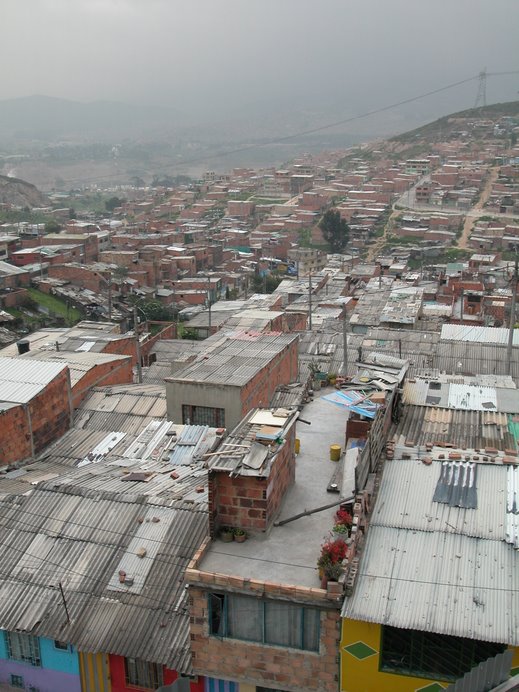
Worlds Apart: A slum climbs up he hill beside Los Andes University's newest building, left, named after billionare  Julio Mario Santo Domingo. 

With lots of inequality and poor social mobility, those at the bottom feel they have no chance to take part in the country's riches and their frustration grows. That's true in Colombia, where the same families have dominated business and politics - and appear likely to continue doing so. I read that the lion's share of Colombia's business leaders come from Los Andes University. I don't think that's because Los Andes is so much better than other universities, or its students any smarter. But the children of elite families who study there network and then get each other onto the boards of directors.

The Santos watch. Satin and sapphire
crystals for not much over $4,000.
Luxury is now within everyone's  reach!
Of course, we can feel better knowing that Cartier jewelry is actually in every person's reach. A Cartier executive pointed out in an interview that their watches and jewelry start at an affordable $800 - just several times the Colombian minimum wage.

"People start there and then move to the high-price items," he said.

Start saving up!

On the other hand, what use is a $4,000 watch, especially in Colombia, where taking out a cellphone in public can be dangerous? Certainly not for wearing on the street, where it won't last long, or for wearing at home in the mansion, which is full of clocks and where everybody knows you're rich, anyway.

A $4,000 watch is for showing off and glancing at conspicuously and repeatedly at ritzy events with other important people.

Things like this only perpetuate and intensify the isolation of the wealthy from the rest of Colombians by giving them another reason to hide from the masses who get by without such basic necessities as Cartier watches and jewels.

What can Colombia do to address this social chasm? One thing is tax the hell out of luxuries, and use them to create quality common spaces and resources for all Colombians, such as parks, hospitals and schools.

By Mike Ceaser, of Bogotá Bike Tours