Showing posts with label high-rises. Show all posts

Friday, April 20, 2018

The World's Tallest Shopping Mall?


The 19th Street entrance to the Bacatá's shopping mall.
The BD Bacatá was supposed to be a Bogotá landmark - and it is turning out to be, just not in the way its builders and the city had hoped.

At 67 stories and 217 stories, it is the tallest building in Colombia, the second tallest in South America and the world's first crowd-funded high-rise - and may be close to going broke.

Huawei, one of the mall's tenants.
According to news reports, the builders haven't paid contractors, and investors are asking where their money is. Even the building's name has been seized as an asset, according to one report.

The builders insist that they will finish the building - but it's already years overdue.

Meanwhile, some of the apartments in the shorter northern tower have been occupied, and the ground floor mall is functioning, altho some of the stores have yet to open.

Fashionable bags, coming soon.
Building a mega-project in a run-down section of downtown Bogotá always looked like a challenge. And the project ran into various challenges, including a huge rock at the site, and legal complications stemming from the building's wide variety of tenants: the shopping mall, offices, restaurants, apartments and a luxury hotel.
The Bacatá seen from Plaza Las Nieves,
a run-down district a few blocks away.

The project was perhaps a bad idea for non-economic reasons as well. Its adjoining streets are already congested and chaotic, and the surrounding blocks have little public space and no green space at all.

For the good of Bogotá, and especially downtown, let's hope that the Bacatá limps to completion. The blocks to the project's north are full of apartment blocks and university buildings under construction. It would be a pity to have an unfinished eyesore standing between the university district and the historical center.

If the Bacatá's owners cannot round up the resources to complete their project, hopefully the bank or a big investor (Donald Trump?) will step in a do so.

Until then, call the Bacatá's south tower the world's tallest shopping mall.

By Mike Ceaser, of Bogotá Bike Tours

Friday, October 14, 2016

A New Landmark Rises - for Better or Worse

The Torre Bacatá dominates the skyline in this view from La Candelaria.
Calle 19, in front of the Bacatá,
is already congested and chaotic.
The new Torre Bacatá, in downtown, adds a new landmark - and new problems, which the city appears not to have prepared for. Generally, it's good to build downtown, which limits urban sprawl and its compounding traffic troubles. But the 260-meter tall Bacatá, which will be the tallest building in Colombia and the second-tallest in South America, will cause huge troubles in its neighborhood.

The adjoining streets are already chaotic and congested, and this new mini-city will compound that. The Bacatá will contain offices, luxury apartments, a hotel and a shopping mall. And there's little open space, and no green space nearby. How about the quality of life for the residents of this new superstructure and those living nearby?

20th Street, behind the Bacatá:
narrow and already busy.
If I were the unfortunate person in charge of this city, I'd have said: 'Sure, go ahead and build, but you also have to help fund light rail lines on Calle 19 and Carrera Septima, as well as a public park nearby.' Fortunately for me, I'm not in charge.

Carrera 5, on the tower's eastern side, is narrow and pepetually traffic-jammed.
What will cars and trucks entering and leaving this garage on 19th do to traffic?
The only nearby public area is Las Nieves Plaza, the haunt of prostitutes, alcoholics and drug addicts.
Bogotá's skyline, and the Bacatá, seen from near the Central Cemetery on 26th St.
Bacatá, with dramatic architecture.

In a nod toward public space, the Bacatá provided this wide sidewalk on Calle 19.
By Mike Ceaser, of Bogotá Bike Tours

Tuesday, April 28, 2015

Reaching for the Sky, Forgetting the Ground?

Trouble on the ground? The unfinished BD Bacata just became the tallest tower in Colombia.
According to news reports, the BD Bacata Tower, being built by the intersection of Carrera 7 and Calle 19, just became the tallest skyscraper in Colombia, surpassing the 48-story, 196-meter Torre Colpatria, on Carrera 7 and Calle 26.

Reaching for the sky: An artist's
rendering of the BD Bacata tower.
I suppose that this is something to be proud of - despite some development researchers' observations that the construction of arrogantly tall buildings often anticipates economic swoons. 

The Bacata's website boasts about the project's urbanistic positives - mostly the fact that its central location won't contribute to sprawl and will reduce travel times to reach it. Those certainly are pluses, as is the potential to use public transit in the area. 

But none of that obviates the need for planning and investment to keep the surroundings livable and transit in the area functioning - things that aren't often the case now, even without this immensity. 

The 66-story BD Bacata will contain a parking lot, shopping mall, offices, apartments and a 364-room hotel. None of those are designed for poor people. Sadly, even with the area's wealth of bus service, most of the complex's users will likely arrive by car, snarling the chaotic traffic on Calle 19 and the narrow secondary streets. (Carrera 7 is currently pedestrian-only during the day.) 

Central Bogotá's skyline, with the Bacatá on the left.
While the Bacata's construction is advancing rapidly, I've seen exactly no, (zippo, 0, nada) transit improvements nearby to prepare for the onslaught of vehicles which this city-in-a-building will generate. In a rational city, of course, the Bacata's builders would be required to contribute to TransMilenio and-or light rail lines to expand the capacity of the adjoining avenues.

I won't even speculate about the capacity of nearby water, sewer and electricity service, nor mention the lack of nearby green space. And, how about urban renewal of the adjoining blocks, which are quite seedy? Will the Bacata's residents and users dare to walk a block outside the building, or immediately take refuge in a private vehicle - compounding perpetual traffic jams?

In an interesting aside, the Bacatá claims to be the world's first crowd-funded skyscraper.

By Mike Ceaser, of Bogotá Bike Tours

Tuesday, March 24, 2015

Skyscraper City?

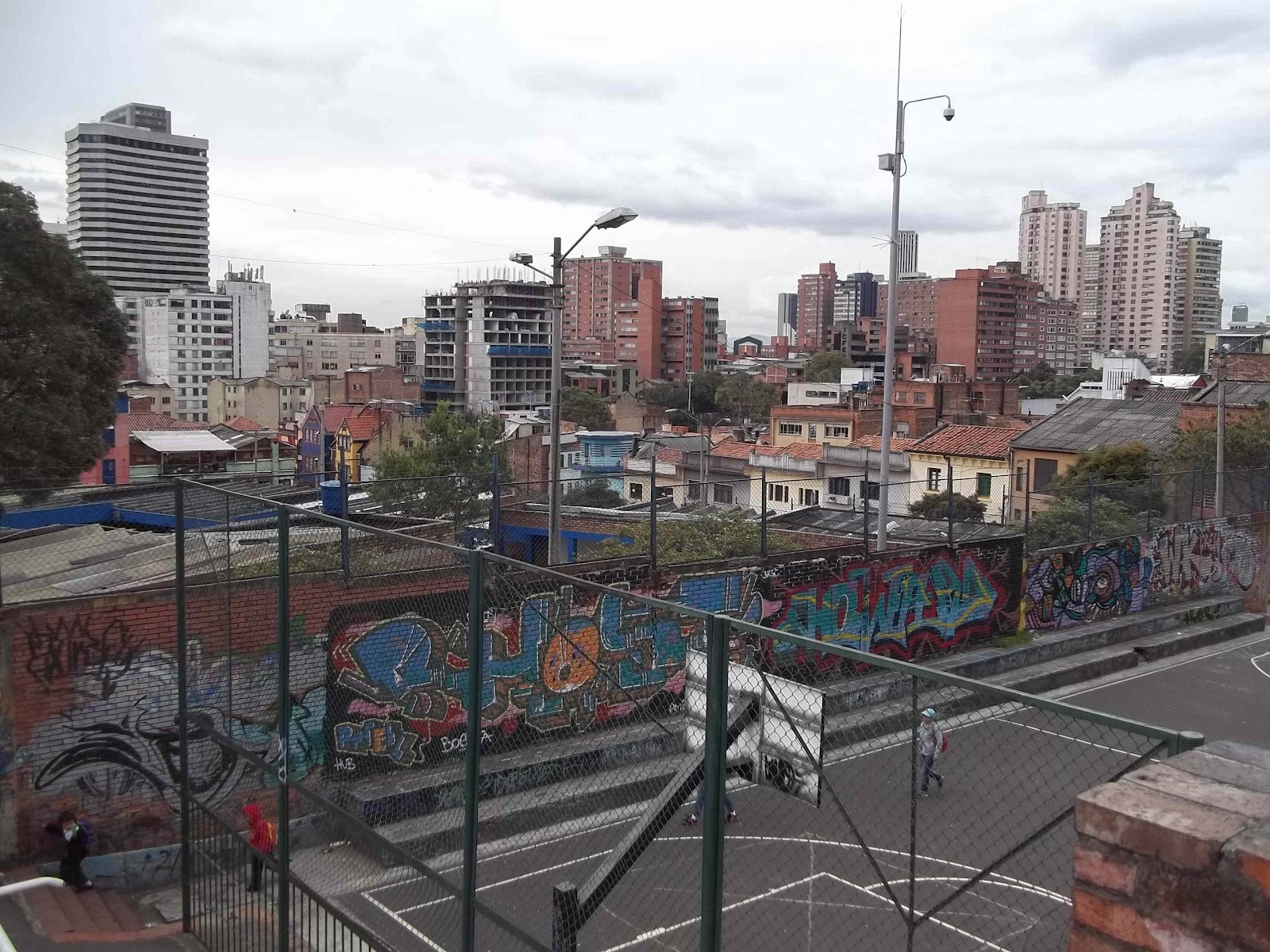
High and higher? Central Bogotá's skyline, with the Cerros Orientales behind.
Quietly, last December, Mayor Petro issued Decree 562, permitting the construction of skyscrapers across much of Bogotá, as long as certain restrictions are observed.

If you didn't hear about the decree at the time, you weren't alone. It received little attention, despite its potentially fundamental impacts on Colombia's capital. Now, however, the decree IS receiving attention - almost all of it negative.

High rises along Carrera Septima.
"I don't know any urbanist, architect or civic leader...who believes (the decree) will produce a better Bogotá," wrote ex-Bogotá mayor and urban sustainability expert Enrique Peñalosa. "The citizens, who will suffer the most, haven't begun to understand how this decree will destroy the character and quality of their neighborhoods."

Journalist and novelist Enrique Santos Molano, who describes himself as usually an opponent of Peñalosa, instead agrees in this case. High-rises, Santos Molano writes, "produce visual contamination...and overcrowding...A city planted with skyscrapers resembles a hell."

Peñalosa and Santos may be overreacting. The decree's goal is to make the city more dense, and as they themselves admit, that's a valuable goal, since it makes transport and providing public services much cheaper. And, are Chicago, New York, Singapore and other skyscraper cities really 'hells' on Earth?

The Torre Bacatá being constructed on Calle 19
is to be Colombia's tallest building.
The decree does exclude high-rises from some neighborhoods, such as Bogotá's historical center, and
directs city officials to take into account the surrounding neighborhood, amount of open space and other factors when issuing building permits. However, such considerations, naturally, turn out to be extremely malleable when construction companies' huge profits come into play.

This decree will be very destructive if it permits the growth of urban jungles, in which residents feeling trapped, and neighborhoods become impersonal, anonymous places with little green space, where streets feel like dark chasms deep in urban canyons.

High-rise construction can be positive for cities, but it should be planned carefully, considering factors such as public space, transport and sunlight. Unfortunately, that isn't true in Bogotá now, and won't likely be under Decree 562.

By Mike Ceaser, of Bogotá Bike Tours

Wednesday, March 14, 2012

Bogotá Reaches for the Sky - But What About the Ground?


An artist's conception of the BD Bacatá towers.
It's planned to be the tallest building in Colombia and the second-tallest in South America upon completion in 2014, and is intended to be an iconic addition to Bogotá's skyline.

And the 66-floor, 240-meter BD Bacatá hotel/apartment/retail complex, being built on the north side of 19th St. and Carrera 5, even has an iconic name: Bacata was the local Muisca Indians' name for this area, which the Spanish and Colombians distorted into 'Bogotá'.

Certainly, having such a tall building will become a point of pride to the city, and hopefully draw positive attention, tourism and investment. And, if handled well, it could revitalize what is now a somewhat run-down and chaotic avenue. In general, building up is good for cities, since it increases density, enlivens city centers and enables more efficiency in supplying services, collecting garbage and in transit.

Bogotá's skyline, seen from Concordia, will be changing.
But city transit officials better start thinking now about how to handle traffic around the site, which will become much heavier and more congested - no matter what the Bacata builders claim.

19th St. is chronically congested, polluted and chaotic. Carrera 5 is narrow, and barely moves during the evening rush hour. 20th St., on the building's north side is narrow but has light traffic but many student pedestrians who attend the university located there. That will change.

This new building, almost a neighborhood in itself with 700 parking spaces, will bring lots of traffic - and the least efficient, unmanageable type - delivery trucks which stop and start; taxis holding up traffic to pick up passengers. Not only that, but expect fancy shops and restaurants to sprout up nearby. That inevitable secondary development will generate still more traffic.

What's the solution?

Carrera 5, east of the Bacatá's site, jammed with traffic.
The city will reap a huge benefit if it makes 19th St. and 7th Ave. safe and sane enough so that at least some of the high-income residents of the BD Bacatá - not exactly the sort of people inclined to hop on buses - feel comfortable walking to nearby destinations in La Candelaria and on Seventh Ave. In fact, this is another reason for the Petro administration to implement a trolley line on Seventh Ave. (and why not a trolley or TransMilenio line on 19th?), to carry people from the Bacata south to La Candelaria and the government buildings and north to the National Museum, the Zona G, the Zona Rosa, etc., as well as the airport.

This space on 19th St. will be filled by the Bacatá.
Potentially complimenting this are the plans to turn the blocks between 19th and 26th Streets, still a bit seedy in places, into a cultural and educational district. This will mean solving the area's terrible traffic jams and making it pleasanter and safer to walk about, perhaps by adding public art, pedestrian zones, bike-ways and green spaces. Hopefully, in not too long, residents and visitors will find it attractive to walk from the historic center north past the Bacata to the Modern Art Museum, Independence Park, the Plaza de Toros and La Macarena. 

But that will require lots of planning and investment, in particular in controlling traffic. Implementing a congestion charge and encouraging cycling will help.

An artist's drawing of Bogotá's future skyline. 
By increasing the area's density, the Bacatá tower also adds yet another reason to turn at least part of the empty lot at 7th and 19th into a green area. Adding a supermarket and perhaps movie theatres on the site will reduce the vehicle trips and resulting traffic congestion and pollution in the area, while also adding life and liveability.

If the Spanish-Colombian Cultural Center (or some other institution) is ever actually built at 19th's east end, then this avenue will become one of the city's more important corridors. But if it remains chaotic and polluted, then instead of a pride of the city, it'll be an embarrasment. But solutions will require real holistic planning.

The Torre Bicentenario 

The Torre Bicentenario going up beside the Hotel Continental.


An artist's conception of the Torre Bicentenario.


Under construction just a few blocks south, on the Plaza del Periodista, is the more modest Torre Bicentenario, across from the historic Hotel Continental. The Bicentenario will also contain hotel suites and apartments, but will fortunately be located quite near transit and in a very walkable area. 


Plaza del Periodista, with the Bicentenario going up in the background. 


The Torre Colpatria, now Colombia's tallest building, seen from Ave. Septima. 

Bogotá's skyline at night. 

Central Bogotá seen against the hills. 
The Torres del Parque, behind the Plaza de Toros, were designed by Rogelio Salmona. 

By Mike Ceaser, of Bogotá Bike Tours