Showing posts with label people. Show all posts

Sunday, August 19, 2018

The End of the Trash Museum

Cyclists outside the Trash Museum back in the days of its full glory.
Bogotá's least popular anti-museum is no more.

The Trash Museum asks you what you're doing to the planet.
The Trash Museum, founded decades ago by the son of an upper-middle-class Bogotá family, became a regular stop on our bike tours, as well as a source of discord in its quiet Teusaquillo neighborhood.

As I heard the story, Antonio went to study in paris, where he rebelled against consumerism and wastefulness. He retunred hom, filled his family's house and yard with garbage. The museum became a landmark for bike tourists, but an eyesore for its neighbors, who at least once tried get to get Antonio evicted.

The house's front 'yard' was hidden behind a jumble of paper, plastic, boards and old shoes, decorated
'We are the trash culture!'
with signs denouncing mankind's wastefulness and announcing the planet's environmental collapse. 'How many of these objects came from your house?' asked one hand-scrawled sign. 'This is the way the world is,' announced another.

Passers-by contributed their own pieces of trash and even wrote their own statements. Sometimes, Antonio left his front door wide open, for anybody to enter and experience the museum's trash-packed interior, where he actually hosted friends.

The 'museum' even attained a degree of officialness. It was on Googe Maps and received an award from the Ministry of the Environment for environmental education.

"He was strong; a straight shooter." Antonio's brother gives us the sad news. But I suspect that the neighbors were relieved. 
A daring tourist ventures into the museum.
And Antonio certainly had his admirers, including his brother, who described him as "strong" and "a real straight shooter."

But, as much as I agree with Antonio's ideas - Bogotá's streets, sidewalks and waterways are strewn with paper and plastic from unnecessary packaging left over from mostly unnecessary products, which will either end up rotting in the Doña Juana landfill or float into the ocean, where animals will swallow it and choke to death.

A recognition from
the Ministry of
the Environment.
But Antonio, with his ways of antagonizing people, was not the best messenger. And I´m not sure whether his 'museum' was the product of principle, or just the rationalization of laziness. After all, Antonio spent his time indoors drinking himself to death.

Neither was he a particuarly pleasant person. Once when I stopped in front of the house with a bike
tour, Antonio Emerged from a amidst his trash and greeted us with an 'Heil Hitler.'

Later, we asked him what he did for a living.

"I'm the new Adolph Hitler," he told us.

About ten days ago, Antonio died, most probably from all of his drinking. His brother is clearing out his house and yard - a monumental task - and plans to rent out the property. Check it out soon on air BnB.
Hard at work clearing out the museum.

Ready to cart away the trash.
By Mike Ceaser, of Bogotá Bike Tours

Friday, October 20, 2017

A Look Back at Rogelio Salmona

The Torres del Parque, in the La Macarena neighborhood, above the Plaza de Toros Santamaria.
If you've lived in or even just visited Bogotá, you've seen the work of architect Rogelio Salmona - or at least his influence.

A stilt walker in the Gabriel Garcia Marquéz Cultural Center
in La Candelaria, designed by Salmona and financed by
the Mexican government.
Born in France in 1939 to a Jewish family, Salmona's family emigrated to Colombia in 1931. In 1948, in the wake of the Bogotazo riots, Rogelio moved to Paris and spent a decade working with famed architect Lecorbusier. He returned to Colombia in 1958.

Salmona died on Oct. 3, 2007, a decade ago this month.

Salmona, Colombia's most famous architect, loved to work with brick and incorporated lots of curves into his buildings. In a socially striated nation where many are paranoid about crime, Salmona integrated his apartment
Rogelio Salmona
complexes into their surroundings, rather than walling them off. Salmona also designed the Virgilio Barco Library in north Bogotá, the graduate studies humanities building on the Universidad Nacional campush, and the Nueva Santa Fe apartments and the neighboring Archivo General de la Nación, both just south of La Candelaria, as well as many others.

Walking thru many of Salmona's works, with their curving lines and stepped pools of water, gives one a sensation of a visit to an Arab desert oasis. And in fact, Salmona spent time in northern Africa.
An interior hallway of the Gabriel Garcia Marquéz
Cultural Center.

Unicyclists pedal on Jimenez Ave. in central Bogota. 
The Nueva Santa Fe apartments, just south of La Candelaria.

Entrance to the National Archive, also just south of La Candelaria.
The National Archive.


By Mike Ceaser, of Bogotá Bike Tours

Sunday, August 10, 2014

Poverty Amidst Plenty


Maria and two of her children.
The headlines roar it out: Colombia is one of the planet's economic stars, with a growth rate above 6% - perhaps the world's fourth-highest. Colombia recently overtook Argentina to become Latin America's third-largest economy.

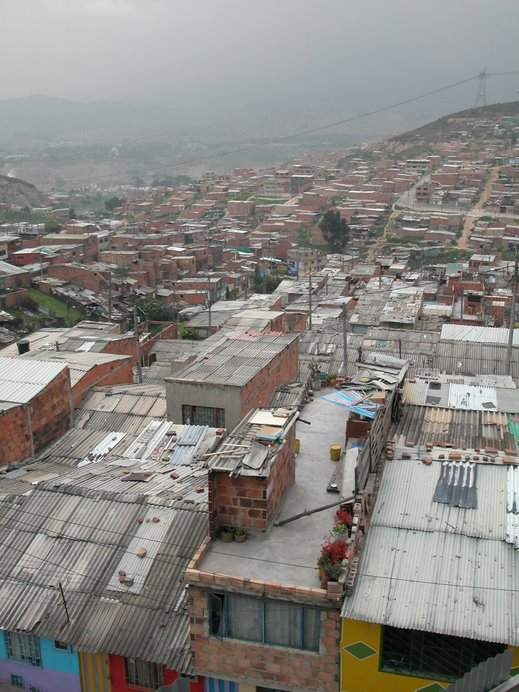
But not all Colombians are celebrating those headlines. Throughout the countryside, in the Pacific Coast and in south Bogotá, Colombia remains an extremely poor nation, many of whose citizens feel little opportunity to rise. 34% of Colombians live below the poverty line, according to government statistics which seem overly positive to me. But in some regions, such as El Chocó, more than half of the people live below the poverty line. Colombia also has one of the world's most unequal wealth distributions, altho both poverty rates and inequality have improved in recent years.

For that matter, we pass by lots of severe poverty every day in central Bogotá.

Maria Bridget, who is 33, is one of those people. I don't remember how I first met her, but I've known her for years, during which time she's squatted at times beside a river and with her six children and grandchild in a tenement room in the sometimes violent Santa Fe neighborhood.

Maria is not poor because she doesn't want to work. She and her children glue posters to polls and walls and vends trinkets, often balloons, on the pedestrianized stretch of Ave. Septima. But even so, it's always a battle to pay the 15,000 peso daily rent on the room she shares with her extended family.

Because she can only manage to pay only a single night at a time, she pays far more for a run-down room than would someone who could pay their month's rent in advance. Besides that, there are clothing and food costs - even tho the children eat some of their meals at school or in free municipal soup kitchens. Recreation doesn't appear to be in Maria's budget, except perhaps for the glue I smelled on her breath.

A girl in a Bogotá slum.
(Photo: Corresponsales del Pueblo)
"We have to get the rent any way we can," she says. "If we don't pay 4 or 5 nights in a row, they'll kick us out."

The balloons she sells on Ave. Septima belong to another woman, who farms them out. Maria earns 1,500 pesos from each of the balloons she sells for four or five thousand pesos. But some days, especially when it rains or the police evict street vendors, she sells only a few balloons.

"If I don't sell, I don't earn anything," she says.

She can make from 10,000 to 30,000 sticking posters on walls, but that work is irregular.
A Colombian hillside slum. (Photo: Wikipedia)

Maria and her own two siblings became orphans when she was ten after her father was shot to death and her
mother died of some disease she couldn't identify. She doesn't remember what her father did for a living or have any idea why he was killed.

It was drizzling when I spoke to Maria in a small fish restaurant in the Las Nieves neighborhood. The rain doesn't help balloon sales.

"Today I've only sold three balloons," she said, and headed back out to the street.

By Mike Ceaser, of Bogotá Bike Tours

Saturday, June 28, 2014

Born Without Hands, She Needs No Handout


Morales and her niece in her shop near San Victorino Plaza.
Mastering their tightly woven craftwork is a challenge for any young woman of the Zenu indigenous people in Cordoba Department. But Odalis Yaneth Moralez Velásquez had an added obstacle: she was born without arms.

Nevertheless, when she was eight, Morales began learning to make her people's traditional handicrafts: with her toes.

Weaving with her toes.
"I said, 'if I can do other things with my feet, why can't I weave?'" she recalled.

At first, it was difficult: "What a normal person learned in a week," she said, "I learned in two months."

Made by toes, worn on the feet.
But Morales persevered and succeeded.

But then appeared of a terrible force nobody could cope with. In 2009, right-wing paramilitary groups, which roam much of Cordoba, murdered Morales' father and older brother and stole the family's property. She says she has no idea why.

Devastated, Morales fled to Bogotá.

"I had to start from scratch," she says.

A rare sight: Customers in the La Fortaleza mall.
For years, Morales wove and sold her crafts on city sidewalks, where she often drew a crowd. I profiled her several years ago at work on La Septima.

Recently, however, she said police increasingly harassed street vendors, and so, when a mall owner who'd seen her on television offered her a shop rental, she moved in. She now sells her work in the La Fortaleza mini-mall off of San Victorino Plaza, adjoining Ave. Caracas.

Hidden indoors, however, she has much less foot traffic and fewer customers. Morales is a single mother with two children to support and a long commute from south Bogotá.

"This week, I haven't really sold anything," she says with her characteristic smile. Whereas on the sidewalk "there was always someone to buy, someone to help."

Artesanias Odalis: Cra 13A No. 12-13 Local 02. Pasaje Comercial La Fortaleza. 
Cel: 311-414-6865 / 300-715-7060. Land line: 795-5951. E-mail: artesaniasodalis@hotmail.com . 

Related post:

The Armless Weaver of La Septima


Let your fingers do the dialing.


By Mike Ceaser, of Bogotá Bike Tours

Sunday, March 2, 2014

A Lady and Her Rooster


I often meet this woman in the Parque de la Independencia, where I walk my dog and she walks her rooster. The rooster is 3 years old and is named Gillo. She lives in an apartment, which is not the most comfortable home for a rooster, so the park is his opportunity to stretch his legs.


By Mike Ceaser, of Bogotá Bike Tours

Tuesday, October 1, 2013

Tragedy Takes the Man Who Made the Green Men

Olave with some of his figures in his workshop in 2011.
Olave's Banana Republic.
Painter and sculptor Jorge Olave, probably the La Candelaria neighborhood's best known artist, who was probably best known for the green figures on balconies and rooftops around the neighborhood, was found dead in his workshop this weekend, apparently the victim of a homicide.

Olave created much more than the green figures which made him locally famous - and generated more than a few bizarre theories about their origin and meaning. (They were created in the mid-'90s. modeled after local residents.) Some of his figures were created from plastic resins, others from recycled materials. He also painted impressionistic scenes of La Candelaria, as well as works which suggest Andy Warhol. His creations also included critical social commentary.

Along with his children, Olave also created a 'Graffiti Art Shop' below his workshop on Carrera 3, where they sold often satirical, sometimes Banksy-style prints.
An image from a 2011 exhibit by Olave
about neglect in La Candelaria.

Olave sold works internationally and did exhibitions in the United States and Europe. He was also a great promoter of neighborhood culture and always welcoming to strangers interested in visiting his workshop - even when they were not likely to buy anything.

When I learned of the murder, I sent a text message to Olave's daughter Laura lamenting her father's death and calling it "a great loss for La Candelaria."

"It's a great loss for the world," she wrote back.

Police are investigating Olave's killing, according to press reports.

An Olave figure by the La Candelaria neighborhood City Hall.
Olave in 2011 in his workshop's stairwell.
By Mike Ceaser, of Bogotá Bike Tours

Thursday, September 26, 2013

Wilson of the Red Light District


We often run into Wilson while passing thru Santa Fe, the central red light district, during bike tours. Wilson is killing himself by drinking rubbing alcohol, but he's doing it cheerfully. I have no inkling about what Wilson lives off of, but he generally seems to have bathed and washed his clothing.

And Wilson retains a sense of curiosity. He was delighted to learn the meaning of 'Chicken Hell', the fried chicken place in the heart of Bogotá's low-life red light district.


Chicken Hell, in Bogotá's red light district, is poised to challenge KFC for world dominance.
By Mike Ceaser, of Bogotá Bike Tours

Thursday, August 15, 2013

Last of an Era in Colombian Bike Racing

Jose Duarte with one of his elegant hand-made frames. 
More than futbol or the official national sport tejo, Colombia may be best known internationally for its accomplishments in cycling. So, it's sad to see a cycling era end.
Bicicletas Duarte on Calle 68 in Bogotá.

With its red, green and blue front, Bicicletas Duarte looks like just one more in a strip of store/repair shops on Calle 68, one of Bogotá's several 'bicycle rows.' Like the neighboring stores', Duarte's showroom displays imported, Asian-made bicycles.

So, hard to believe that in the store's rear workshop you can find a legend of Colombian cycling.

The Duarte frame which won
 France's Tour del Avenir.
At 77, Jose Duarte walks with difficulty. His lower back aches from decades of leaning over bike frames. His voice is soft. Some of his memories of his decades in Colombian cycling are foggy. But he talks with quiet pride of his many accomplishments, both on the race course and in the workshop.

Born in the town of La Mesa outside of Bogota, as a teen Duarte bicycled to his electrician job. But at age 17 he discovered that his real vocationlay not in the plugs and wires he worked with, but the pedals and wheels he used to get there.

Duarte's hand-made frames
hang on a wall.
Duarte became a bicycle racer. During his 1956 to 1960 competition years, he rode with and befriended cycling legends such as Italian Fausto Coppi. Duarte competed in several Vueltas a Colombia and in 1959 won Colombia's national road racing championship. But his relationship with Colombia's cycling classics had just begun.

A Career Shift

In 1965, Duarte switched from riding bikes to building them, opening his first workshop.

The afternoon I dropped into Bicicletas Duarte, Duarte had just placed the latest classic lugged racing frame he was building into an acid bath. It may be one of the last of some 6,000 frames molded by his hands.

Strikingly, even more than his own accomplishments on two wheels, Duarte seems proudest of what others have accomplished on Duarte-made frames. In the 1978 Vuelta a Colombia, 35 of the the 90 racers rode Duarte frames. Duarte bicycles have won 6 Vueltas a Colombia, as well as the vueltas of Chile, Mexico, Costa Rica, Panama, Guatemala and Venezuela - and undoubtedly others as well. But the greatest achievement is memorialized on his shop wall in the form of the dark blue frame which won France's 1985 Tour del Avenir. The facing wall exhibits snapshots of Duarte with cycling legends including Bernard Hinault and Eddy Mercx, who visited his shop.

Duarte built bikes for Rafael Niño, who won the Vuelta five times, as well as Miguel Samaca, Cristobal Perez and other Colombian cyling legends.
Inside Bicicleta Duarte's bike repair shop.
But not all of Duarte's famous clients were athletes: He also built bikes for politicians, including charismatic presidential candidate Luis Carlos Galan, assassinated in 1989 by cocaine kingpin Pablo Escobar. Duarte and Galan also trained together.

Galan "was not such a good cyclist," Duarte recalls, "but he was a good politician."

Duarte's showroom, which sells mass-produced
bikes from Asia. 
Duarte then built bikes for and trained with Galan's succesor, Cesar Gaviria, who went on to win the presidency. Duarte recalls how presidential assistants would call him at 5 a.m. to announce a top-secret training ride. He would board a presidential helicopter and be transported to some country road, where he and Gaviria would pedal amidst a phalanx of armed guards.

Ironically, in the early 1980s Duarte had also built bike frames for drug capo Escobar himself, altho

Duarte says that at the time Escobar's business was little known.

Duarte, left, fitting politician Luis Carlos Galan. 
"He was my friend," Duarte admits. "But that was before he became a big capo. He was just starting out."

Escobar financed a bicycle racing team and a bicycle factory named Ossito, as well as football teams and other sports. His brother Roberto was a talented bike racer until he got involved in Pablo's business.

"He exported those frames," Duarte says of Escobar. "Nobody knew what they put inside."

When they traveled overseas to race, Escobar's cyclists doubled as cocaine smugglers. In the end, some were killed, others did prison time.

Jose Duarte examines a racing bike's wheel. 
Financed partly by drug money, the 1980s and '90s became an outstanding period for Colombian cycling. Today, with apparently much cleaner finances, Colombian cyclists are once again accomplishing great things in European road races. Leading the charge is the extraordinary Nairo Quintana, who finished second in this year's Tour de France, where he also won the best climber and best young rider jerseys. Quintana, like Duarte, came from a poor family and pulled himself up by his bootstraps (or bicycle pedal straps). Duarte believes that the best bicycle racers come from such humble backgrounds.

Sadly, cycling culture has become profoundly corrupted by doping since Duarte's era. Inevitably, suspicions surround every outstanding cyclist, including Quintana.

Duarte with bike racing buddies Hernan Herron
and Jorge Luque.
Back in his day, Duarte recalls, "we drank panela and oatmeal," he recalls. "The strongest thing we took was Alka Seltzer."

Meanwhile, bicycles have also evolved into hi-tech, computer-equipped machines built around frames made of aluminum and sophisticated alloys. Asian, factory-made aluminum bikes have captured the popular market. The racing frames Duarte makes by hand out of steel and chromium-molybdenum tubing are sought only by those who love classics.

"These cost a million pesos," he says of his frames. In comparison, fat-tubed aluminum frames "cost 300,000 pesos." He motions again at his own elegant creations. "Nobody wants these."

Perhaps that what's left Duarte feeling a bit resigned and tired.

Jose Duarte in his shop. 
During Duarte's first decade building frames, four competitors appeared in Bogotá - "but they didn't last," Duarte says. "Some went bankrupt, some died."

Today, others also make custom bicycle frames in Bogotá - mountain bikes, fixies, etc - but Duarte doesn't rate them highly.

"Those are common frames," he says. Except for himself, "Nobody makes fine frames."

Grudgingly, Duarte's family business has evolved with the times. His two sons who have pursued careers with bicycles repair aluminum and carbon fiber frames. As for himself, Duarte says he's about done with frame building.

"I'm tired," he says, standing in his workshop beside a row of steel Duarte frames. "I don't want to make any more frames."

But his decision is not absolute. He will still build frames for friends, altho that will depend on the outcome of the spinal surgery he has scheduled for the coming weeks to repair several lower back vertebrae damaged from decades leaning over bicycles.

Duarte doesn't make hand-made steel tube frames to be fashionable or retro. He does it because they're all he knows and because he likes their slim, simple elegance. I left Duarte's shop with terribly mixed feelings - impressed with the man's skill and dedication, but sad about the twilight of an era of artesanal framebuilding.

"People have lost their love for these artesanal frames," laments Claudia Reyes, Duarte's daughter in law, who manages the bike shop. "Working on them isn't easy."

Thanks to the great Colombian bike racing blog Cycling Inquisition, where I first read about Jose Duarte. 

By Mike Ceaser, of Bogotá Bike Tours