Showing posts with label bullfighting. Show all posts

Thursday, September 13, 2018

Of Fracking and Bullfighting

Is this Colombian animals' biggest problem? A Colombian bullfighter at work
this February in Bogotá's Santamaria Plaza.
Recently, there's been lots of critism to two activites in Colombia: fracking and bullfighting.

Fracking
Both are questionable for different reasons. Fracking, which releases hydrocarbons by fracturing underground rock formations, can pollute water resources and cause minor earthquakes, according to critics.

And bullfighting seems like a holdover from the Dark Ages, which should have died out along with
witch burning and gladiator battles. Bullfighting is also cruel. And, making entertainmet out of killing an animal can only bring out the worst in spectators.

Nothing else to protest? Marching against
bullfighting in downtown Bogotá.
In recent months, fracking's opponents have lobbied, filed lawsuits and written opinion pieces calling for the procedure to be banned in Colombia.

And bullfighting's opponents have for years battled - futilely - in the streets, courtrooms and Congress to have the practice prohibited.

But fracking and bullfighting are only tips of the iceberg of the larger phenomena of the fossil fuel industry and animal mistreatment. Yes, fracking causes environmental damage, but so do the conventional oil and coal industries: they trigger deforestation, drive climate change, pollute the seas and poison the air when burnt. The oil shipping industry, like all shipping, damages marine life with noise, by transporting exotic animals and by collisions with marine mammals. In short, the fossil fuel industry's impacts are innumerable, and fracking is just a tiny part of that.

Is it fracking, or just oil? A  seabird dirtied by
spilled oil doesn't care where that oil came from.
And if bullfighting is cruel, practices such as cockfighting and factory farming are much crueler and affect many more animals.

But fracking, like GMOs, gets attacked because it seems new, strange and sinister.

And bullfighting represents many things despised by its leftist opponents: the wealthy, Mayor Peñalosa and the traditional landowning class.

And while both fracking and bullfighting are very questionable activities, the danger is that by obsessing with these two narrow issues, activists ignore the wider problems. And, if they actually win these two battles, they may feel that the larger battle is won and they can cease fighting.

By Mike Ceaser, of Bogotá Bike Tours

Friday, August 24, 2018

Bullfighting's Back for Good (or Bad)

Bogotá's Santamaria Bullfighting Stadium: Empty and lonely.
The plaza in its usual condition:
empty and unused.
In the latest round in the battle over bullfighting, the Constitutional Court has ruled that cities cannot ban bullfighting where it's traditional. That means that bullfighting will go on in Bogotá's Santamaria Plaza - for a while anyway. (Even if the bullfighters win in court, anybody who takes a look at bullfighting's aging audience can see that in another generation or two its fan base will check out permanently.)

Meanwhile, bullfighting's opponents are trying another strategy: calling on Bogotá's city government, which owns the Santamaria Bullfighting Plaza, not to rent it to the bullfighters.

Anti-bullfighting protesters.

Bicycle tourists outside the stadium.
That might be legally dubious, and it would also be a real pity. The bullfights would simply be shifted elsewhere, as they were while the Santamaria was being renovated a few years ago. Meanwhile, the handsome, Moorish stadium, would be even more abandoned than it is already.
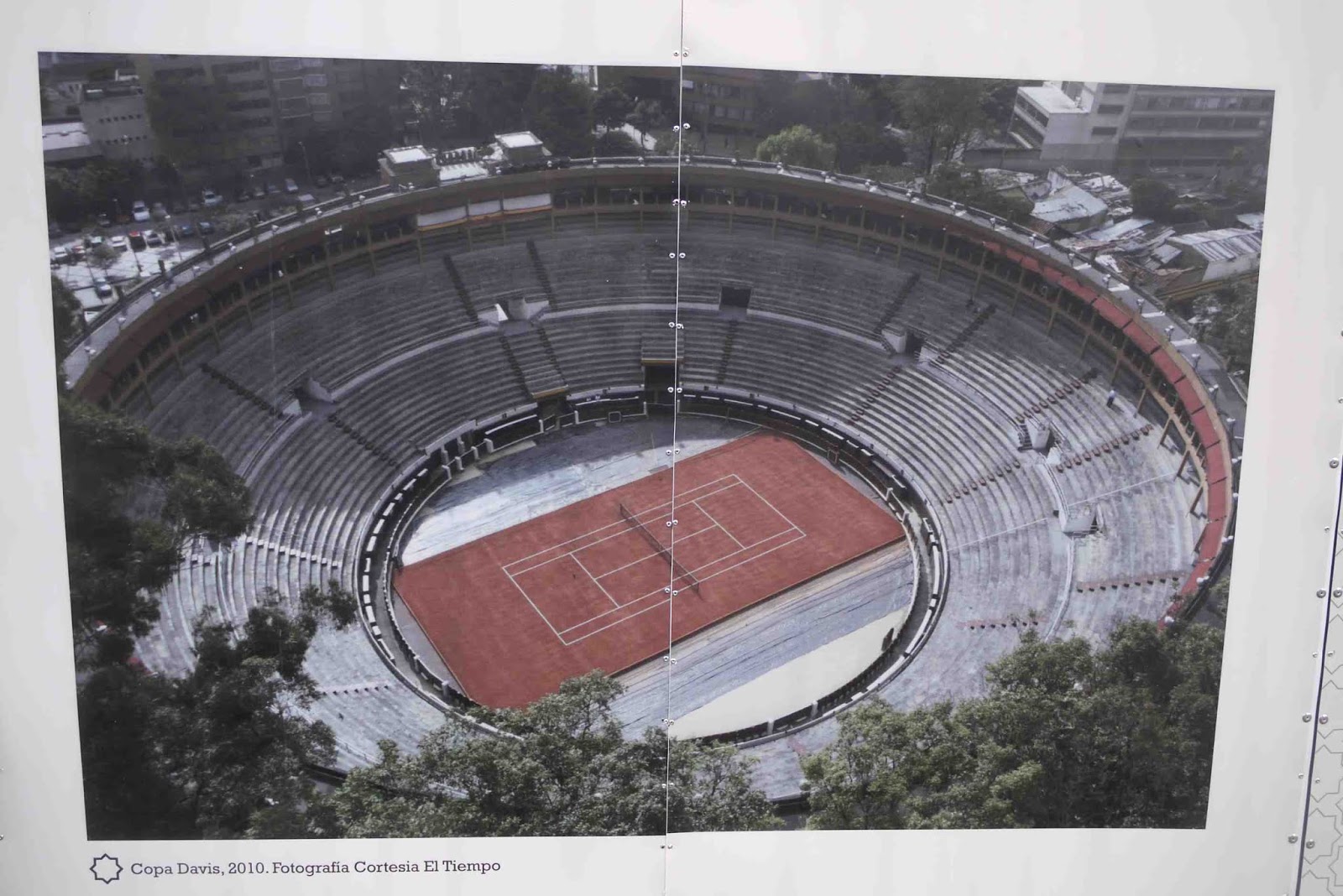
One of the few uses, a tennis match.
The Santamaria stadium, built in 1931, centrally located and recently renovated, is, incomprehensibly, almost never used for events except for bullfights. If the bullfights move out, then this Bogotá landmark will be even more completely vacant than it is already.

The Santamaria would be great for cultural and musical events. Imagine afternoon jazz festivals, weekend theatre, children's sports...the possibilities are endless. The lack of activities is incomprehensible.

If the city puts the Santamaria to other uses, as it should, then by all means ban bullfighting there. But until that happens, let this Bogotá landmark at least be used for something.

The plaza's only visitors. tourists.
Anybody who reads this blog knows that I have a bit of cynical view toward the bullfighting protesters. Sure, bullfighting is cruel and seems like a holdover from the Dark Ages. However, other thngs, such as cockfighting and factory farming, are much crueler and affect many more animals. Why does only bullfighting get protested?

By Mike Ceaser, of Bogotá Bike Tours

Saturday, January 27, 2018

Bogotá's Final Bullfighting Season?


Anti-bullfighting protesters march in Bogotá last Sunday.
Workers preparing the plaza for bullfighting recently.
Bogotá's sometimes-annual bullfighting season started last weekend. But, no matter how many ears and tales the fighters are awarded and how many bulls they kill, the real story story is the fate of bullfighting in Bogotá and the rest of Colombia.

Bullfighting has been under siege here since Mayor Gustavo Petro managed to block the activity
during most of his mayoralty. However, a 2016 court ruling obligated the city to allow the fights because they are a tradition here, even tho current Mayor Enrique Peñalosa (perhaps after having observed that the anti-bullfighting crowds are far larger and more motivated than are the bullfighting fans), says he wants to ban bullfighting as well. It also seems as tho bullfighting is getting aged out, since today's young people have other interests, such as videos, football and Pokemon Go.

Men buying tickets to a bullfights. Bullfighting reportedly is
losing popularity, and its fans are aging.
City officials have talked about holding a referendum to let Bogotanos vote on whether or not they want bullfighting to continue, but it's not clear what legal weight such a vote would carry. A senator has also introduced legislation to ban bullfighting nationally. Yet, while only a tiny minority of people seem to like this blood sport, they tend to be economically and politically powerful, giving them a good shot at blocking any anti-bullfighting laws.

A billboard advertises
Bogotá's 2018
bullfighting season.
No matter that the bulls live good lives before they are brought to the Plaza de Toros, where the fight lasts only a quarter of an hour. And no matter that much, much worse practices, such as cockfighting and industrial farming, which affect many more animals, are ignored by protesters: It still is a fact that killing an animal for sport and
entertainment is a cruel spectacle which harkens back to centuries ago.

But if bullfighting ends, will the historic, Moorish-influenced stadium find another life? The panels the city put on its front call it the 'Plaza of a Thousand Uses,' but it receives almost no use at all outside of bullfighting season and a few tourist visits. A rare exception this year was the Davis
Cup Tennis Tournament, held in the stadium. (Colombia lost Croacia.)

Bicycle tourists outside the bullfighting stadium.
A sport with a future? Advertising a bullfighting school.


A rare alternative use for the stadium: An art festivale.


Women's volleyball in the bullfighting plaza.

Big time wrestling inside the bullfighting plaza.
By Mike Ceaser, of Bogotá Bike Tours 

Thursday, May 4, 2017

Is All Animal Suffering Equal?

Too cruel? A bull and Spanish bullfighter in the Santamaria plaza.
(Photo: Fernando Vergara)
The Colombian government has proposed a law prohibiting bullfighting and related activities in Colombia. That would be a big blow to bullfighters and aficionados, since Colombia is the third-biggest bullfighting country, after Spain and Mexico.

But bullfighting is a throwback to an era of bloodsports such as bear baiting, and many sociologists believe that violent entertainments like these promote a more violent society. The proposed law says its goal is to 'strengthen cultural citizenship for peace, respect for life and integrity of sentient beings, by eliminating bullfighting as an expression of violence and cruelty.'

A bird stands over a defeated foe in an
illegal cockfight in the United States.
Good for them. But I've never understood why animal rights advocates stop at bullfighting. What about cockfighting, which involves killing many more animals, in a more brutal fashion. And how about the many thousands of animals killed in slaughterhouses? Does anybody have an idea about how they live and die?

(Bullfighting-related violence goes beyond that between bullfighter and bull. This year bullfighting returned to Bogotá after five years, igniting huge, violent protests. The last Sunday of bullfighting, a bomb exploded on the sidewalk above the plaza, killing two police officers and injuring some 20 people. The government blamed the ELN guerrillas.)

A young man confronts police during anti-bullfighting protests early this year. 

Young men wrestle a small bull in a corraleja.
(Photo: Vice)
The law's sponsor, interior minister Juan Fernando Cristo, also says that bullfighting "gravely damages children...by increasing aggressiveness, anxiety and emotional impacts."

But if that is the law's authors' concern, then why don't they just prohibit children from attending bullfights? And how about protecting kids from all the violence in movies, television and video games?

Bullfighting gets picked on because it's conspicuous and associated with the wealthy and the landowning class. But of the various ways in which Colombians mistreat animals, it seems like one of the most minor. Banning bullfighting may very well be a good thing, but it's only a first step in protecting animals from abuse.

An afterthought: Bogotá's La Santamaria Plaza is a handsome building, located in the center of the city, with seating capacity for more than 30,000 people. Whether bullfighting returns to there or not, the building should be used for other events, such as concerts, art exhibitions and the like. Instead, it's sat empty for the past years.

By Mike Ceaser, of Bogotá Bike Tours

Sunday, October 18, 2015

Protesting Bullfighting...As Always


Scenes from today's anti-bullfighting march, to which a group of anti-frackers united themselves.

Mayor Petro, a bullfighting opponent, had wanted to include a referendum on bullfighting in the upcoming Oct. 25 municipal elections, but a judge nixed the idea. The mayor appealed, so perhaps the protesters are still hoping against hope that the referendum goes forward.

As always, I'd like to ask the bullfighting protesters why they focus solely on this, which affects only a few dozen animals, but ignore the much more widespread cockfighting, not to mention factory farming, which mistreats innumerable animals (and probably people's health) every single day.

Mayor Petro, who's term is almost over, has not allowed bullfighting here since 2012. The Santa Maria is now closed for renovation.


The Colombian government has enthusiastically embraced fracking, altho it may not be economically viable here.


By Mike Ceaser, of Bogotá Bike Tours

Thursday, September 24, 2015

The Latest Bullfighting Round


Posters announce the 'Anti-bullfighting referendum.'
A performer dressed as a bull at an
anti-bullfighting demonstration.
Mayor Petro's anti-bullfighting crusade may have received a fatal stabbing from the Concejo de Estado, which ruled today that Petro's planned referendum on the issue was illegal, because the city doesn't have the authority to decide on such a traditional practice.

Petro hasn't allowed bullfighting in the historic Plaza Santamaria since Feb. 2012, and with or without a referendum fights aren't likely to return soon, since Petro has scheduled renovation work there.


Young bullfighters practice in the Santamaria Stadium.
By Mike Ceaser, of Bogotá Bike Tours

Wednesday, February 4, 2015

Bullfighting's Back?

They won. Hunger striking bullfighters in front of the Santamaria Plaza last year.
Brace yourself for the protests.

Coming soon: Anti-bullfighting protesters
march thru downtown Bogotá.
The Constitutional Court ruled today that Bogotá Mayor Gustavo Petro must reopen the Santamaria Bullfighting Plaza to bullfights, ending a long court battle.

A court had previously ruled that bullfighting is traditional in Bogotá, and the mayor lacked authority to ban it. He appealed, and the high court ruled against him.

For Petro, this is political disaster. Animal rights advocates have been among his most vocal backers, and this court ruling nullifies one of his few concrete accomplishments.

The Santamaria's empty arena. 
But Petro still has cards to play. It's probably too late to organize bullfights for the 2015 season, which normally runs from early January thru late February. And Petro claims that the 80-plus-year-old Santamaria Plaza needs a major renovation. The renovation project's contracting process keeps getting suspended for lack of interested companies, but expect Petro to rush it thru now to create another justification for keeping the plaza shut. The city's recreation agency has already closed the handsome plaza to tourists, for unfathomable reasons. Bullfighting advocates suspect that the real motive behind the renovation plans is to make the plaza unusable for its original purpose, bullfighting.

Setting aside bullfighting's artistic merits, or lack of them, it's always seemed to me that la fiesta brava gets picked on unfairly among the wide range of animal abuses permitted in Colombia. A few dozen bulls fight and die during a normal season in La Santamaria, but innumerable roosters suffer and die in the city's legal cockfighting pits, while nobody says a word. And, recently, I talked to a Spaniard setting up industrial pig and chicken farms here. The man told me that Colombia has no animal welfare laws. They do in Europe, he admitted "because they're crazy" there.

Evidently, Colombia's a very sane nation, since nobody lifts a finger to improve the conditions of farm animals.

Young bullfighters show their moves in front of the Santamaria Plaza.
The historic Santamaria Plaza during a pro-bullfighting demonstration.

Does anybody care? Animals packed together on industrial farms.
By Mike Ceaser, of Bogotá Bike Tours

Wednesday, November 12, 2014

Bringing Bullfighting Back to Bogotá?


Bullfighters Cesar Rincon, El Juli and others on stage today in front of the Santamaria Plaza.
Will Bogotá see bullfighting again?
No idea why someone was
waving a United States flag.

A group of active and retired bullfighters, including Colombia's Cesar Rincon and the Spaniard Julián López Escobar, known as 'El Juli,' led a rally today outside the Santamaria bullfighting stadium demanding that the historic plaza be reopened to bullfights.

Mayor Gustavo Petro has not allowed bullfighting in the plaza for the past two years.

A group of young bullfighters, called novilleros, have been staging a sit-in for the last 100 days in front of the plaza. Meanwhile, bullfighting supporters have also been battling the mayor in court, and achieved a victory several months ago, when a court ruled that the mayor didn't have the authority to prohibit bullfighting. The mayor has appealed that ruling.

The Petro administration has not only banned bullfighting, but recently also prohibited tourist visits to the stadium, because of scheduled renovation work - even tho no work is actually going on. Upon becoming mayor, Petro said he'd convert the Plaza de Toros into a Plaza de Todos - a 'Place for Everybody.' Instead, it's become a Place for Nobody.

In related news, the novilleros carrying out the sit-in say that a ghost appeared in a photo they took of themselves in a bullfighting stadium passageway.

Strangely, no anti-bullfighting protesters appeared today.

Ghost in the bullfighting plaza? Looks more like a shirt hung up to dry.
Bullfighting advocates have been sitting in for more than 100 days in front of the Santamaria Stadium.
Bullfighting supporters play a board game.
By Mike Ceaser, of Bogotá Bike Tours