Showing posts with label deforestation. Show all posts

Wednesday, April 11, 2018

A Hail Mary for the Amazon

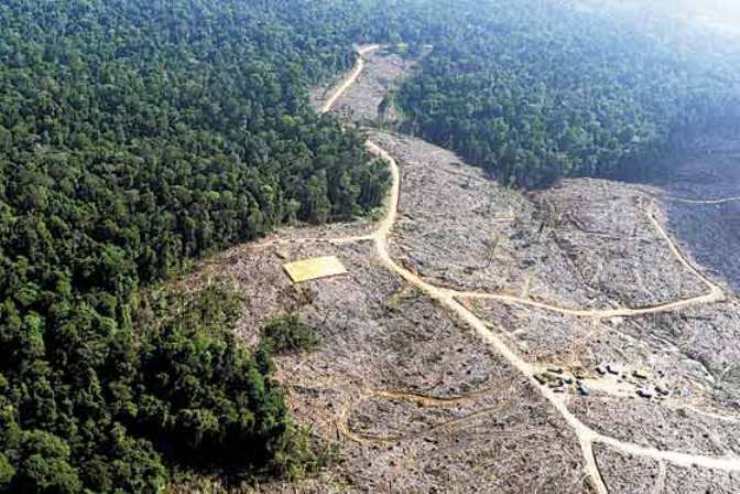
Deforestation in the Amazon is accelerating. (Photo: WWF)
In what might be called a desperate hail mary pass to save the beleaguered Amazon rainforest, a Colombian court gave the region region rights, a bit similar to a person.

The concept is great. After all, Colombian is suffering a terrible - and accelerating - loss of forest. Between the years 2015 and 2016 deforestation rose 44%, destroying close to 200,000 hectares of forest in 2016 and accompanying biodiversity, much of it in the Amazon. And deforestation apparently has speeded up since then.

The acceleration may result in part from the peace agreement with the FARC guerrillas, who
Deforestation in Brazil. (Photo: Getty Images)
controlled a lot of territory in Colombia's remote regions and its jungle south. By threatening miners, farmers and cattleraisers in remote regions with robbery, extortion and kidnapping, the guerrillas involuntarily protected those areas. Today, the FARC are demobilizing, leaving Colombia's natural diversity open for business - and exploitation.

But the basic motives underlying deforestation are capitalistic: A jungle, tragically, is worth more dead and gone than it is living and dynamic - at leat in the short term. Loggers, soybean farmers, coca leaf growers, mahogany loggers and others feed their families next month and next year by destroying forest, although all of us will pay much more in the long run.

The court's ruling is very admirable - and very idealistic.

But unfortunately, the illegal miners, ranchers and loggers who are clearing Colombia's jungles are not likely to respect a judge's opinion. The fundamental problem is that the jungle contains immense resources waiting to be stolen, with almost no protection. In some regions, just a few rangers are charged with protecting tens of thousands of square kilometers of wildlands, leaving them unprotected at all. It's a depressing situation with no solution in sight.

However, while courts and park rangers aren't likely to do much, each of us can reduce pressure on the Amazon a bit by minimizing our own consumption of Amazon products, such as hardwoods, beef and soybeans produced by deforesting jungle.

A bus pollutes central Bogotá. Don't kids have a
right to be protected from this?
This lawsuit was filed in the name of Colombian children's right to a healthy environment and protection from the impacts of global warming. The right to a healthy environment is in Colombia's Constitution. That begs the question why courts don't protect urban kids' rights to a clean environment with healthy, breathable air?

By Mike Ceaser, of Bogotá Bike Tours

Sunday, March 4, 2018

The FARC guerillas: Environmental Protectors or Villians?

FARC guerrillas: Environmental criminals, defenders or both?
The FARC's demobilization was supposed to be a boon for the environment, as coca leaf planting dropped and the guerrillas were transformed from environmental depredators to environmental defenders.

However, deforestation in Colombia has accelerated, and, if we're to believe them, in the FARC Colombia's jungles lost important defenders.

In the areas where the FARC guerrillas were the de-facto government, they claim that they prohibited deforestation, banned polluting into rivers, and controlled hunting.

An oil pipeline bombed allegedly by the FARC
guerrillas in February 2013.
Many of those policies were not only to protect the environment, however: They also protected the FARC forces. Intact forests hid the guerrillas from Colombia's military. And keeping trash out of rivers avoided tell-tale clues of the guerrillas' whereabouts.

On the other hand, the FARC certainly committed wholesale environmental depredations, by protecting drug crops which caused widespread deforestation, and sponsored illegal mines, which devastated countless river valleys. The FARC also bombed petroleum pipelines, poisoning rivers, jungles and cities' drinking water.

But one thing which seems clear is that, whether or not they intended it, the FARC's terrorism, kidnapping and extortion scared potential exploiters out of Colombia's remote regions. With Colombia's internal conflict winding down, businesses and farmers invaded virgin areas, accelerating deforestation. Between 2015 and 2016, deforestation increased by a terrifying 44%, and appears set to continue accelerating.

At the same time, cocaine production, one cause of deforestation, which was supposed to decline with the guerrillas' demobilization, has also accelerated.


By Mike Ceaser, of Bogotá Bike Tours

Monday, October 23, 2017

'Deforested Bones'

A skeletal bird made from wood represents deforestation's impacts.
Colombia's immense biodiversity is going fast, in great part because many creatures' forest habitats are disappearing.

A deforested danta.
And the National University's Natural History Museum's current exhibition dramatically exhibits that with sculptures of wild animals made from sticks, pieces of bark and charred wood gathered in deforested areas.

Peace with Colombia's various outlaw organizations was supposed to strengthen protection of the environment. Instead, deforestation has accelerated the last several years, to an incredible 20,000 hectares per hour, or 178,000 hectares per year - about double the entire land area of the Dutch Antilles. According to the museum, half of Colombia's high-altitude wetlands and its foothhill forests are gone, as are 90% of its tropical forests.

With the forests, go all the species living in them.

Deforestation is driven primarily by the expansion of agriculture, both legal and illegal, including cattle ranching. Every time a new road or pipeline is cut thru forest, observers watch the deforestation radiate out from the initial line.
A deforested jaguar.

The museum's exhibition, called Deforested Bones, includes messages warning against consumerism. However, our unbridled consumption of natural resources is only one cause of a complex phenomenon. Other parts are poverty that makes farmers desperate to feed their families, wealth which enables landowners to corrupt government officials, and twisted government policies which routinely give natural resource extraction priority over environmental conservation.

A deforested sloth.

A deforested spider monkey.
The natural history museum also has permanent exhibitions about anthropology, evolution, archaeology and Colombian wildlife.

A museum visitor sticks his hand into a crocodile's mouth.
By Mike Ceaser, of Bogotá Bike Tours

Sunday, August 27, 2017

Stump City: The Deforestation of Bogotá

A freshly-cut tree stump on Carrera Septima, in the city center.
Trees cool cities down, reduce pollution, noise and stress, and add beauty to urban areas. They can also provide habitat for bats and birds, which eat pesty insects. But, sadly, anybody walking past the series of stumps along Carrera 7 in downtown could be forgiven for believing that Bogotá's suffering an urban deforestation.

A forlorn tree stump on Las Nieves Plaza.
Urban trees can certainly cause trouble: they fall down, drop branches and leaves, and their roots can break sidewalks and water pipes.

So, when one of those grand old trees becomes a nuisance, the easiest response may be to just cut it down. That solution is not only easiest, but also the most profitable: I understand that the city contractor gets paid for each tree it cuts down (rather than each tree it saves) and also gets to sell the lumber.

With incentives like that, it's a surprise that any tree is still standing.

It wouldn't be so bad if they actually replaced the trees, but the city rarely seems to.

Along Carrera 7, the stumps have it. I didn't see any signs of replanting, either.


In the Parque Nacional, this big tree is leaning over, but otherwise healthy. Will officials cut it or save it?
Manuel can't hold the tree up, but a steel or cement column might. Instead, bet that the tree will be cut down.
Update: The city is doing some sort of work on Carrera Septima, which may be the reason for cutting down all of those trees. Perhaps there's hope yet for the urban environment, if not for the rural one.

By Mike Ceaser, of Bogotá Bike Tours

Monday, July 24, 2017

The Unkindest Cuts

Deforestation in Colombia is set to accelerate with planned budget cuts.
Nobody can dispute that Colombia has huge environmental challenges: Deforestation has accelerated by 44% over the last few years, to 20 hectares erased every hour; illegal drug crops are invading national parks; and the peace agreement with the FARC guerrillas commits the government to stop the advance of the agricultural frontier.

So, what's the government's response?

From Semana magazine: 'The cuts which the environmental
sector will be subjected to in 2018.'
To slash the budgets of an array of environmental entities, including the Instituto Humboldt, the Institute of Hydrology, Meteorology and Environmental Studies (Ideam) and even the National Parks, from 632 billion pesos to 232 billion, or by 63%. That's according to a preliminary budget seen by Semana magazine. Such cuts make Donald Trump's war on the environment appear downright gentle. (I'm not clear on the relationship of these budgets to that of the environmental ministry.)

Incredibly, Minister of the Environment Luis Gilberto Murillo doesn't seem troubled by this financial massacre. "The budget isn't the only indicator of the environmental sector's resources," he said. "Resources are being mobilized like never before."

If only he'd explain where those resources are coming from.

The drastic budget cut - and the lack of an outcry over it - reflects the low priority environmental causes receive here. Minister Murillo may be sharp, capable and sincere, but before this job he had no discernable environmental experience. One suspects he's there in order to have an Afro-Colombian face in the cabinet. His predecessor had been a toy company executive.

By Mike Ceaser, of Bogotá Bike Tours

Wednesday, April 26, 2017

Mocoa - An Act of God or of Man?

The Mocoa tragedy was made worse by deforestation in the region and human-driven climate change.
When torrential rains pushed tons of mud over the town of Mocoa, in Putumayo Department, killing more than 300 people at the end of March, many condemned the 'natural disaster.'

Rescue workers in Mocoa this month.
However, the disaster's iimpact was made much worse by human actions which prepared the way. Colombia is suffering an accelerating deforestation. And the region surrounding Mocoa had been severely deforested during recent decades, reducing the soil's capacity to soak up rainwater. When rain falls onto deforested soil, it runs off quickly, carrying soil, trees and rocks with it. Forests can also serve as protective barriers. In fact, in El Carmen, the one Mocoa neighborhood which escaped destruction, residents had preserved their protective forest.

More broadly, The New York Times reports that more frequent natural disasters in places such as Colombia and Peru appear to be tied to human-driven global warming.

Before rushing to condemn the vagaries of nature, Colombians should also reflect upon their own actions.

By Mike Ceaser, of Bogotá Bike Tours

Tuesday, April 21, 2015

The Wood Racket


Stacks of wood for sale on Calle 13 in central Bogotá.
If you decided to buy a wooden table rather than a plastic or metal one because, being biodegradable, it's 'greener', perhaps you should reconsider.

Illegally cut? Stacks of recently cut lumber. (Photo: La Nacion)
According to a recent report from the World Wildlife Fund, 75% of lumber harvested in Colombia is done so illegally, so that table top may have a criminal history. The illegal logging contributes to Colombia's galloping deforestation rate of close to a half million hectares per year. Even so, illegal logging accounts for only about a quarter of Colombia's deforestation, most of which is caused by land clearing for agriculture, including illegal drug crops, according to Jesus Orlando Rangel, who studies natural history and the environment at the Universidad Nacional, in Bogotá.

Deforested land, which quickly turns into desert.
The statistics, naturally, are in dispute. The World Bank pegs the proportion of illegally-cut wood at only 42%. And the government calculates deforestation at the still horrific rate of 'only' about 240,000 hectares per year.

Who's to blame for this? Corruption, lack of rule of law, violent illegal groups...the whole mix of Colombian problems - problems we can only hope get resolved before the trees run out.


Lumber for sale in central Bogotá. Cut legally?
By Mike Ceaser, of Bogotá Bike Tours

Wednesday, January 7, 2015

Deforestation Nation

Slowing down? Deforestation in the Colombian Amazon. (Photo: MongaBay)
The news was hopeful, even inspiring. On a planet whose environment condition seems to be worsening at an accelerating rate, Colombian authorities announced in late 2014 that the nation's deforestation rate had plummeted from 310,349 hectares in 2012 to only 120,933 hectares in 2013 - a 60% drop.

Unfortunately, the good news probably wasn't true.

In fact, according to researchers from the Universidad Nacional, deforestation has not dropped, and 400,000 hectares per year.
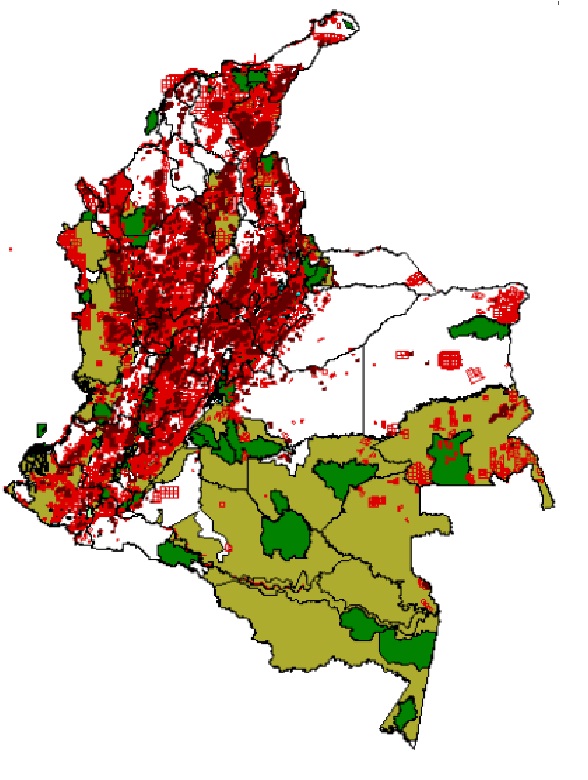
Colombia is losing forest fastest in the red areas
on the coast and in the Andes.
(Image; Claslite)
is actually much worse than the worst figures. The researchers estimate Colombia's deforestation rate at above

Causes of deforestation include logging, mining and the expansion of agriculture (both legal and illegal).

"If the government wants statistics which serve it for its development plans, it must urgently gain credibility in cases like this one," the university's news service wrote.

The galloping deforestation destroys not only biodiversity and the habitats of indigenous peoples, some of whom are going extinct, but is also eliminating an important part of Colombia's natural patrimony.

Those fast-disappearing forests might otherwise have been sustainably logged, and could also serve as valuable storehouses of carbon, or as sources of medicines and as tourist attractions. Their destruction produces short-term incomes - usually small ones - but destroys the nation's capital. The profits appear on the nation's import-export balance sheet, but the loss is ignored.

Deforestation in the Amazon, including Colombia. Data is from 2007-8. (Map from WWF)
After forests are cut down, the land gets rapidly exhausted, leaving behind erosion and desertification.

The supposed drop in deforestation is not the government's only miraculous environmental statistic. When Bogotá environmental authorities announced this year that the city's air was substantially cleaner, independent experts shook their heads and asked how it was possible, with the number of vehicles increasing and no apparent application of environmental controls.

Tragically for the region's forests, they seem to lose no matter what happens to the economy. When commodity prices were high, so was pressure to deforest to extract materials from wold areas. But as
commodity prices have declined, reducing nations' incomes, countries may frantically cut down trees in order to rip out resources as fast as possible to balance their budgets.

By Mike Ceaser, of Bogotá Bike Tours

Wednesday, October 8, 2014

Globalizing Away the Amazon

A shipping container sinks into an Amazon lake in the exhibit on now in the Universidad Nacional.
A shipping container sinks into - or replaces a lake of lily pads; A giant tree is transformed into paper
This tree is already paper.
before even being cut down; an indigenous man recounts how his people's sacred land was invaded by geologists searching for oil using underground explosives.

The exhibit, called Selva Cosmopolitica (Cosmopolitan Jungle) on now in the Universidad Nacional's Museo de Arte, sends a simple message: Globalization and commercialization are destroying this unique and irreplaceable global resource.

The same message has been told, of course, time and time again: Amazon deforestation leapt 29% last year over the year before (altho it was still lower than that registered in other recent years); in recent years, Colombia has lost more than 300,000 hectares of forest per year.

The causes are global, even when the immediate actors are local. The world's appetite for beef is booming, driving ranchers to clear ever more land to graze cattle. And the use of ethanol in gasoline - even when made from corn grown in North America - can increase markets for grains in Brazil, generating deforestation there.

The exhibit's text explanation describes the Amazonian peoples' complex relationships to nature, which is so different from the way we urbanites live. And, sadly, such a complex, balanced relationship is being replaced by a simple one defined by resource extraction. Tragically, while such exploitation produces very short-term benefits and few jobs, it is killing the Amazon forever.

The works in the exhibition are by Fabián Moreno, Abel Rodríguez, Ursula Biemann, Paulo Tavares, Miler Lagos, Delcy Morelos and Miguel Ángel Rojas.


'Selva Cosmopolitica' (Cosmopolitan Jungle)


This man described how petroleum prospectors set up explosives on his people's sacred land.
Not sure what this man was doing. Probably looking for a way to exploit the jungle.


By Mike Ceaser, of Bogotá Bike Tours

Sunday, September 28, 2014

Doom for the Darien?

Luxurian vegetation in the Darien Gap. (Photo: Naked Man in the Tree)
The Darien Gap (Photo: Wikipedia)
The Darien Gap is one of those archetypal wild places.

A corridor of jungle between Panama and Colombia roamed by guerrillas and narcotraffickers and home to great natural biodiversity, the Darien is the one untamed segment left between Alaska and Tierra del Fuego. Bicyclists making the epic tour from one end of the Americas to the other have to get off for this one stretch and take a ferry between the Panamanian and Colombian coasts.

But that may soon change, because of a thirst for money and electricity. Colombia and Panama are planning to build a power line to carry electricity from Colombia, which abounds with hydroelectric power, to Panama and eventually as far north as Mexico.

The economic incentives are clear and immediate, but the environmental and social impacts will come only later.

A native Embera girl in
Panama's Darien Province.
(Photo; Wikipedia)
Chopping a 100-kilometer long corridor thru this legendary jungle will inevitably destroy it. The electrical corridor will not only become a barrier to animal migration, but also an invasion route for illegal farmers, miners and hunters. Deforestation and fires, already taking place, will accelerate and spread out from the power line, driving many native species to extinction. The invasion of construction workers, miners and loggers will bring alcohol, prostitution and fatal diseases to the native Embera-Wounaan and Kuna peoples, who will be decimated.

Plans for the $450 million project are supposed to be finalized next year, and it's projected to start operating in 2018, generating some $250 million in annual income for Colombia.

Deforestation is already going on in the
Darien region.
(Photo: VillalonSantaMaria)
I haven't found specific plans for the cable's route. But, while an undersea route would be much more environmentally sound, an overland route would be much cheaper.

Guess which path the Colombian and Panamanian governments are likely to choose?

By Mike Ceaser, of Bogotá Bike Tours

Saturday, May 4, 2013

One Hand Gives, the Other Takes Away

Mining titles and requests (in red and brown)
and protected areas. (Image Source)

Colombia has announced what might be a watershed effort to protect Colombian biodiversity: 300 million dollars to preserve two million hectares distributed over three ecosystems: dry forests, Orinoquia savannahs and marine waters.

It's certainly a critical effort. For example, Colombia has lost 98.5% and counting of its dry forests. Its marine areas are assailed by pollution, overfishing and climate change. And rainforest is being chopped down to make way for mines, illegal and legal agriculture and petroleum exploitation.

El Tiempo called the new plan, named 'Naturally Colombia,' "a vital step in the preservation of our biodiversity."

But, sadly, if we judge by the country's historic respect for its protected areas.
Deforestation in Valle del Cauca. (Image UNAL)

This report in yesterday's El Espectador starts off by observing that "in theory the national parks are untouchable," but in reality "there are 37 mining titles within national parks, threatening their equilibrium."

Colombia's intentions to protect its biodiversity are often admirable. But in practice, apathy,
corruption and weak laws often make those good intentions pointless. Colombia, after all, already has 56 national parks covering 12 percent of the country's land territory, which Naturally Colombia intends to expand to 17. (Two percent of its seas are officially protected. Naturally Colombia wants to expand that to 10 percent.)

But will expanding 'protected areas' just overstretch the frail protection resources even further? Will the same functionaries who hand out mining concessions in existing national parks see the new protected areas as anything more than new land for mining? Pressure to exploit minerals is only increasing with improved security in remote areas, and that will redouble if the FARC and government reach a peace agreement.

Naturally Colombia is a creation of Colombian government agencies working with the German government and NGOs including Conservation International, the Nature conservancy, the World wildlife Fund and the Fundacion Natura. Those are serious people, giving me hope that this will actually work.

Naturally Colombia could be a saviour for Colombian biodiversity - but only if it can avoid past failings.


By Mike Ceaser, of Bogotá Bike Tours

Monday, March 18, 2013

A Hero for Bogotá's Hills


Jose Baquero stands before Monserrate, with a newspaper about his fight to protect the hills. 
Deforested land where La Externado
University is building its towers.

He's a small man, who lives in the hardscrabble neighborhood of Belén and supports himself and his three teenage children by installing natural gas stoves.

But Jose Baquero, 50, hasn't hesitated to take on some of the city's most powerful institutions in his long battle to save Bogotá's beleagured Eastern Hills.

Baquero was in the news recently when he organized a protest march against a pair of towers being built by the Universidad Externado in the hills in forest above La Circunvular Avenue. He has filed legal objections and recently organized a protest march, which he said was attended by 40 people.

Jose Baquero on a Bogotá street, carrying a packet of
documents about the Eastern Hills.
It's a David-and-Goliath struggle for a man of humble means who didn't attend college and until today didn't even have an e-mail account. Impressively, he expresses confidence that he'll be able to stop La Externado's project, even tho the forest has already been cleared and work is proceeding. That's despite the university's money, connections and team of attorneys.

"Any fight is winnable," he asserts.

Baquero is president and a co-founder of the Civic Environmental Comittee for Bogotá's Eastern Hills, which was founded 25 years ago, but still doesn't even have a website.

What's most impressive to me about Boquero - and pathetic about the rest of us - is that in a city of nine million people, all of whom benefit from the hills, as well as NGOs and city officials charged with protecting the environment, Boquero seems to be the only person actually doing something to defend those hills.

A sign at the construction site last year gives permission
for building up to seven floors. It doesn't mention
basements or multiple towers.
With his lack of sophistication and resources, he's an unlikely crusader. Yet, he's also representative of the majority of Bogotanos, for whom escaping from the city for a weekend in the countryside is an unaffordable expense. They have to find nature in the city's urban parks - and its Eastern Hills, if their forests survive.

According to news reports, one trouble for Baquero is that the hills are in a sort of legal limbo, subject to multiple and contradicting municipal resolutions and court rulings. Still, it seems to be popular belief and common sense that the hills which provide a green backdrop for the city, as well as oxygen and rainwater, are common patrimony.
In a recent photo, the sign has been replaced by another one
describing two towers of eight floors  with three basement
levels and 484 parking places.

Another problem is the weakness of laws and, perhaps, officials' lack of determination. Recently, the media reported the construction of an illegal road in the hills in north Bogotá. Despite unanimous opinion that the road was illegal and that it crossed several protected forests, according to the last thing I read, officials said they could not have it removed, altho they did promise to find the road's builder.

Boquero also pointed out an apparent contradiction in the university's construction plan, which is posted on a signboard at the site. One sign, which Boquero said he photographed late last year, describes plans to build two seven story towers without basements. But a sign at the site now says the university has permission to build two eight-story towers with three basement floors. Those floors will apparently contain the project's 480 parking spaces - a contradiction to the city's goals of promoting mass transit and discouraging use of the private car.

Jose Baquero and friends in defense of the hills. 

In the past, Boquero has challenged construction projects by La Universidad de Los Andes and La Universidad America, which he said violated hillside protections. Those projects include a swimming pool complex built by Los Andes and fencing which Boquero says illegaly excludes the public from hillside rivers. He said he also participated in an 'popular action' against the cutting of trees in Parque de la Independencia in order to build a bridge over 26th St. to the Museum of Modern Art. That project, already mostly finished, is now finally moving ahead.

Despite Boquero's crusade, powerful institutions like La Externado have continued deforesting and building on the hillsides. But Boquero is not discouraged. He claims to have stopped additional construction by Los Andes University, among other battles.

"That's why I don't have any fear," he says.

A sign near Monserrate says that this is an
 'Area of Protective Forest Reserve.'
While he and I talked on La Plaza del Periodista in La Candelaria, some friends of his walked past. There were a dark-skinned family of indigenous descent. Boquero said that they lived in the hillsides, where a number of families have homes, whose legality is uncertain.

"The city just told them they couldn't plant potatoes on their land," Boquero said. "We poor people get shafted, but the rich get permits to do whatever they want."

Boquero also said that he and others had requested permission to build a fourth floor on the La Concordia neighborhood's public high school, which is in the heart of the city's historical center. They were refused because of historical preservation laws. Yet, La Externado is building eight-story towers.


Baquero points out that without the hills' forests, Bogotá's remaining wetlands will suffer, and the city will experience worse flooding from rainstorms. The problem, says Boquero, is that, if La Externado builds its towers, "there'll be another and another and another..."

Boquero seemed thoroughly informed and determined, with his feet planted on the ground. However, he did describe one extraordinary experience. He said that recently he was kidnapped, drugged and dumped outside of town north of Bogotá. He didn't offer any evidence of the supposed ordeal, which would be a serious crime if true, and said that he had no idea who had done this. Whatever the truth of this experience, it might also be true that just a bit of insanity is needed to carry out such a Don Quijote-like struggle.

Boquero has other dreams, including an 'ecological corridor' extending up Jimenez Ave. to the Quinta de Bolívar and then along La Circunvular, an area in which the city planned several public parks which have never actually been created. But getting people to visit a park in the Eastern Hills will be a challenge unless the area's reputation for muggings changes. Boquero, in fact, said that while in the hills recently thieves tried to steal his camera. He fought them off, but the camera was damaged, and he can't afford to pay the repair shop's charges.

But with lighting and security, he expects Bogotanos to use such a park.

"It's what I wish for," he said.

Baquero also hopes to replace the cement posts on La Candelaria's sidewalks with planters to give the very grey neighborhood some green.

Baquero is has scheduled a second protest march against La Externado's project, this one to start at Plaza del Rosario at 9 a.m. April 1.

"We have to double the number from the previous march," he says. "Maybe get 100 people.

"I'm keeping the faith. I won't give up."

Jose Baquero: 313-805-3888

By Mike Ceaser, of Bogotá Bike Tours