Showing posts with label corruption. Show all posts

Friday, December 7, 2018

Just Explain The Money, Mr. Petro

Petro and wads of cash, in the leaked video.
Gustavo Petro is generally remembered as a poor administrator as mayor of Bogotá, and he lost badly when he ran for president. But he has at least been generally known for his probity and for having ideals, whether you agree with them or not.

However, those positive qualities are now under siege these days due to a decade-old video released by his political enemies in which Petro is seen receiving wads of cash of uncertain origin.

As Petro has repeatedly pointed out, receiving wads of cash isn't illegal. But it does looks bad, because it's how people like Pablo Escobar and innumerable corrupt politicians handle their finances, and so requires an explanatio: 'The money came from my mother'. 'I had dug the money up on my ranch.' 'A supporter gave it to me.'

In fact, Petro did offer a simple explanation: He claimed that the cash was a donation from prominent arquitect Simon Velez, who reportedly does not like using banks. But Velez quickly issued a statement flatly denying having given or loaned Petro money. El Tiempo also reported that the other two people who appear in the video along with Petro received city contracts. That's not necessarily illegal, either, but it does look very bad.

Unused bike racks installed during Petro's
mayoralty serve as seats for street vendors.
Petro counterattacked by charging that the video was illegaly leaked by his enemies to distract attention from their own corruption scandals. That's probably true. But whatever the video's origin, that doesn't change its substance.

A lot of people, including me, who thot Petro was a disappointing mayor, had held on to faith that he was at least personally not corrupt.This was despite indications to the contrary, such as the multiple, huge bike parking racks installed on Plaza San Victorino during the last months of his mayoralty - even tho few people ever park bikes on the plaza. Those huge new racks, which quickly turned into seats for street vendors, were very likely the result of a sweetheart contract given to someone with city hall connections, who handed over wads of cash to pay for the privilege of getting a contract to install useless bike racks.

In the same way, bribery can waste public funds, cause governments to build unnecessary, disfunctional roads, purchase overpriced, useless medical equipment and even kill people. And, by undermining faith in the mainstream parties, corruption makes extremists such as Venezuela's Chavez and Brasil's Bolsonaro look more attractive - potentially leading their nations toward disaster.

And corruption has a poisonous effect on democracies. A recent poll found that Latin American support for democratic systems is at a low point, with fewer than half of the public giving democracy their full faith. A big part of the reason for that is the pervasive corruption, and Petro's unexplained cash only deepens that perception.

That's all we need, Mr. Petro, is a clear, verifiable explanation of those bills' origin. But every day that we wait for that explanation in vain adds to the perception that that was dirty money.

By Mike Ceaser, of Bogotá Bike Tours

Friday, August 24, 2018

Six 'Yeses' and One 'No' on Corruption

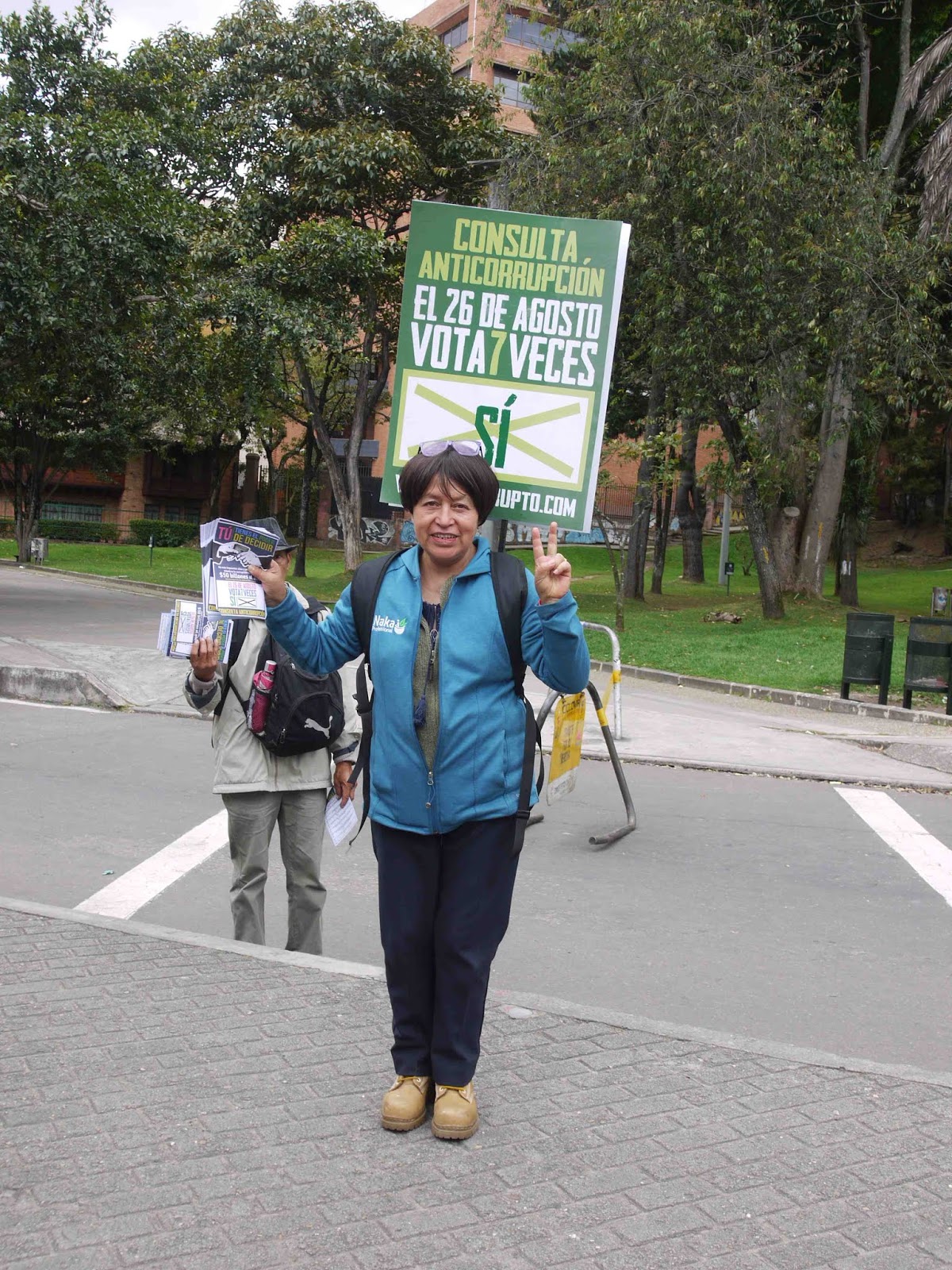
Campaigning against corruption.
This Sunday's anti-corruption referendum is well-intended - but also a bit misguided.

Most of the initiatives, which would increase transparency about government officials' finances, are positive.

But one of the referendum's measures would cut goverenment officials' salaries. That sounds satisfying to those of us who dislike politicians.

But stop and think for a minute: Is a politician who is well-paid or one who is poorly-paid more vulnerable to being corrupted? The poorly paid politician needs money badly and figures he has less to lose by letting a businessman grease his palm in exchange for a contract.

And policemen, who get paid miserably, are some of the most notoriously corrupt officials in Colombia.

Two tourists told me recently how they stepped out of their hotel in La Candelaria one evening smoking a joint, only to have cops pull up and threaten them with arrest. The brave defenders of the law finally let the tourists off for a payment of about 400,000 pesos. That's a huge chunk of a beat cop's monthly income. Many cops, I'm sure, make more money shaking tourists down than they do from their salaries.

Slashing politicians' salaries sounds more like anti-politician resentment than any rational anti-corruption policy.

For better or worse, the anti-corruption referendum is unlikely to reach the minimum participation level to have legal affect.

Needless to say, if Colombia really wants to reduce corruption it should remove one of corruption's biggest drivers: Prohibitionist drug laws.

By Mike Ceaser, of Bogotá Bike Tours

Saturday, May 19, 2018

Can Venezuela Pull a Malaysia?

Najib Razak, ex-Malaysian
prime minister, who lost an
election this month.
A notoriously corrupt strongman appears to hold a lock on his country's leadership. In the run-up to elections, he uses oil income to saturate the country with his campaign ads, controls most of the media and uses gerrymandering and other tricks to ensure his reelection victory.

The nation I have in mind is Malaysia, the southeast Asian nation which held national elections ten days ago. But I might as easily be talking about Venezuela, which is to hold a vote tomorrow in which its authoritarian president Nicolas Maduro is expected to use a rigged system to get himself reelected, despite running his oil-rich nation into the ground. In both nations, the government used legal charges and technicalities to bar opposition candidates from even running in the election.

To everybody's amazement, Malaysia's opposition party won the election, and the Barisan Nasional coalition, which had ruled Malaysia since independence in 1957 lost power.

That might provide a glimmer of hope for the opposition in Venezuela in tomorrow's voting. There,
Venezuelan president/dictator Maduro.
Pres. Maduro has taken control of nearly all the media and government institutions and is allegedly using payments and intimidation to win tomorrow's election.

Colombian Pres. Santos reported this week that Colombia had seized a big shipment of food allegedly intended to be used by the Venezuelan government to pay for votes, altho much of the food was already rotten. Santos also charged that the Venezuelan government planned to give Colombians Venezuelan ID cars and have them vote for the government.

But Venezuela differs in important ways from Malaysia, where the opposition candidate who won the prime ministryship had already been prime minister, and so many people had a positive image of him. On the other hand, Malaysia's economy was fairly strong, whereas Venezuela's is in free fall, potentially motivating many people to vote against the government.

But, barring a miracle, Mauro will win reelection tomorrow and continue stiffening his dictatorial rule and worsening his nation's economic disaster. And hundreds of thousands of Venezuelans will continue pouring into Colombia.

And the Malaysian election likely has redoubled Maduro's determination to win at all costs tomorrow. After all, Malaysian's ex-leader may now be put on trial for his alleged monumental corruption.

By Mike Ceaser, of Bogotá Bike Tours

Saturday, April 7, 2018

Not Ready for the Rain

Amphibious vehicles? A taxi and a motorcycle make their way
thru the deep waters of the Santa Fe neighborhood.
Bicyclists do better in the water,
thanks to their taller, skinnier wheels.
You'd think that's the city the engineers who designed Bogotá's streets had in mind when they included these huge depressions at major intersections, creating lakes during every heavy rain.

Except that it does rain in Bogotá, and I don't suppose that anybody wanted streets to turn into lagoons. Instead, one suspects that an unethical contractor ripped off the city and citizens by using inadquate fill under the roads.

Who's gonna sue those contractors? The same city which approved their lousy work?

Not likely.


By Mike Ceaser, of Bogotá Bike Tours

Sunday, September 24, 2017

The Fiscalía's New Museum

Inside Bogotá's newest museum - the Fiscalia's.
Add to Bogotá's memorable museums its newest one: The Fiscalía's.
Carlos Lehder.

Yep, seriously. The Fiscalia, or Attorney General, the agency charged with accusing and prosecuting criminals, has played a key role in the biggest dramas in Colombia's recent decades, many of which are on display in the new museum. Most impressively, the museum also includes the government's own sins.

The museum is also unintentionally a testament to the violence, corruption and general mayhem which drug prohibitionism has inflicted on Colombia. Not surprisingly, one subject the museum does not touch is decriminalization - despite its demonstrated success - because it would take away the Fiscalia's business.

Everybody's heard of Pablo Escobar, but many fewer know the name Carlos Lehder - even tho he was crazier and perhaps even richer than Escobar. Lehder admired both John Lennon and Adolf Hitler. He tried starting his own populist political party. And he even bought a Caribbean island, kicked off the inhabitants and used it to party and stockpile cocaine. But he was so unstable that Escobar supposedly betrayed him to the DEA. Lehder is still rotting away in a U.S. federal prison.

Model of an early drug-smuggling sub.
Supposedly, Escobar bought a used Soviet submarine to smuggle cocaine north, but never actually used it. Today, drug cartels build home-made diesel submarines and even aquatic drones, load them with cocaine and send the drug north.
Martyred Justice Minister
Rodrigo Lara Bonillo.

Another less-remembered character of the era was the crusading Minister of Justice Rodrigo Lara Bonillo, who prosecuted members of the Medellin cartel and was gunned down for it in Bogotá in 1984. His killing triggered the war between the government and Esocbar.

In the end, the leaders of the less-famous Cali cartel were captured and extradited to U.S. prisons, where some still remain. In contrast, many Medellin cartel leaders gave themselves up and received short sentences in Colombia - despite being much more murderous.

A jet ski which supposedly
belonged to Pablo Escobar.
Both the Medellin and Cali cartels were destroyed during the 1990s, and the paramilitaries and most guerrillas have also since disbanded. Yet, today Colombia probably exports record amounts of cocaine.

Bloque de Busqueda members looking at Esocbar's corpse
on a Medellin rooftop in 1993.
However, foreigners, particularly those recently arrived in Colombia, may not recognize other episodes - such as the Proceso 8000.

In the Proceso 8000, Liberal Party Pres. Ernesto Samper's (1994-98) presidential campaign was discovered to have received money from the Cali cocaine cartel.

The investigation brought the conviction of other government officials, but Samper himself was found 'neither guilty nor innocent' by a Congress - altho today few doubt he knew about the dirty money. It led to Washington canceling Samper's U.S. Visa - a huge embarrasment for a close ally - and the U.S. The episode was named after a folder containing key documents - altho I did not see that folder in the museum.

Cali cartel leaders on their
way to prison in the U.S.
One might trace Colombia's rejection of its traditional political parties and the eventual election of Pres. Uribe partially to the Proceso 8000 scandal. After Samper, came Pastrana's failed negotiation with the FARC, and then Uribe's U.S.-backed military offensive against the FARC, which many believe forced them to the bargaining table - albeit at a huge cost in human rights. The hard-right Uribe did not come from either of the two traditional political parties.

Display about the FARC guerrillas.
After the end of the Cali and Medellin cartels, the violence and narcotrafficking didn't let up. Colombia still had to deal with the socialist FARC and ELN guerrillas, which were born in the 1960s, and their right-wing paramilitary enemies.

A captured FARC document listing weapons,
including gun cartridges and explosives.
The government didn't defeat any of these groups. The paramilitaries demobilized during the mid-2000s, receiving up to 8-year terms, despite horrific crimes. The government also negotiated a controversial demobilization deal with the FARC and is now talking to the ELN.

FARC propaganda.
A laptop belonging to FARC leader 'Mono Jojoy' recovered
after he was killed in a government bombardment in 2010.


Probably the darkest chapter in recent Colombia history was paramilitarism - the right-wing death squads organized by landowners with government and military collaboration, which carried out many massacres, often of campesinos, including women and children, based only on suspicion of sympathy for the guerrillas.

The jeep driven by police investigating crimes in
1989 in Santander Department. 
One of the more notorious of the massacres carried out by paramilitaries with collaboration from the regular military was that of La Riochela, in 1989 in Santander Department. Fifteen judicial investigators had traveled to a remote area to investigate killings. Paramilitary fighters stopped them and cold bloodedly murdered twelve of them under orders from a Medellin cartel leader and with support from the regular military. After the killings, the 'paras' hid their weapons in a military base.


Victims of the La Rochela massacre.

Yet another dark chapter involving the regular military were the 'false positives' killings during the
Uribe government. At that time, the military gave military units rewards of bonuses and time off for killing guerrillas. Some units responded by kidnapping poor young men, killing them and disguising them as guerrillas in order to collect the rewards. The killings received national attention when a group of young men were kidnapped from Soacha, in south Bogotá, and later found dead near the Venezuelan border, labeled as guerrillas.

An exhumation kit for buried corpses.

Running thru the museum's displays, of course, is the subject of drug trafficking, which has helped finance nearly all of Colombia's violent groups (and some non-violent ones).

A cocaine.making lab. Lots of chemicals involved. Cocaine is niether green nor organic.
And cocaine can and has been smuggled inside nearly everything.
Coffee beans with cocaine inside.

'Candies' used for smuggling cocaine.

Colombian clock used for smuggling cocaine.

Pool balls, used for smuggling cocaine.

A car tire used for smuggling cocaine.
Unsurprisingly, the museum does not touch the subject of decriminilizing drugs, a policy which has produced lots of benefits when tried in Portugal. That doesn't surprise, because such a policy would reduce the Fiscalia's business.

The Museo de la Fiscalia is located in this building on Carrera 13 just south of Calle 19, in central Bogotá.
You can leave your bike in the parking lot across the street. Admission is free. 

By Mike Ceaser, of Bogotá Bike Tours

Tuesday, August 29, 2017

Odebrecht Bulldozes the Environment

Odebrecht didn't stop at paying off politicians.
The 1071-km Ruta del Sol is to run from near Bogotá
to the coast near Santa Marta.
Odebrecht, the Brazilian construction giant whose name has become synonymous with corruption thanks to close to a billion dollars in bribes to governments across Latin America and Africa, did not stop at obtaining contracts on corrupt basis.

The company and its business partners also violated and ignored environmental laws on at least one of its headline projects in Colombia, according to a new report by Colombia's Controlaria.

The Controlaría found 442 violations of the environmental licenses of the $4 trillion peso-plus project, of which Odebrecht is part of the consortium. These involved waste water disposal, lack of reforestation, noise, mishandling of wildlife, and others.

The consortium "is not only not complying with the terms of the environmental licenses, but is not making any effort to comply," the Controlaria wrote.

Odebrecht bribed officials throughout
Latin America.
(Image: Notimerica)
But that's only the beginning of the scandal: It turns out that the National Environmental License Authority, the ANLA, did not fine the consortium a single time for those violations.

And even worse, other megaprojects, such as the dredging of the Magdalena River and the repair of the
Canal del Dique, are being carried out without even bothering with environmental permits, and in the case of the river, the ANLA has not bothered to oversee the project for nine years, the Controlaria found.

Is this a matter or corruption or just sheer apathy and laziness by supposed government watchdogs? Probably both.

For one of the planet's most biodiverse nations, and which claims to treasure its natural wealth, this situation goes way beyond scandalous. And it's in addition to the inherent damage done by these proyects, such as drying out wetlands, dumping silt into rivers and oceans, and facilitating deforestation by slash and burn farmers.

By Mike Ceaser, of Bogotá Bike Tours

Monday, August 21, 2017

Corruption Accomplishes Something


Jumpin' Jack Flash
During his last year as mayhor, Gustavo Petron built this nice wooden platform along Calle 26 across from the Central Cemetery and furnished it with tables and chairs for folks to sit around or enjoy lunch. Despite the noise and pollution from the adjoining avenue, the area was actually used - for about a month, until the tables and chairs all disappeared.

Further west along Calle 26, the city build similar platforms, but these were never even furnished.


The whole project stank badly of an administration ladeling out public money to friendly contractors - no matter the usefullness of the work- which is a long-winded way to say 'corruption'. (They also installed bike racks in a place where nobody would want to park a bike -which racks were promptly stolen.)

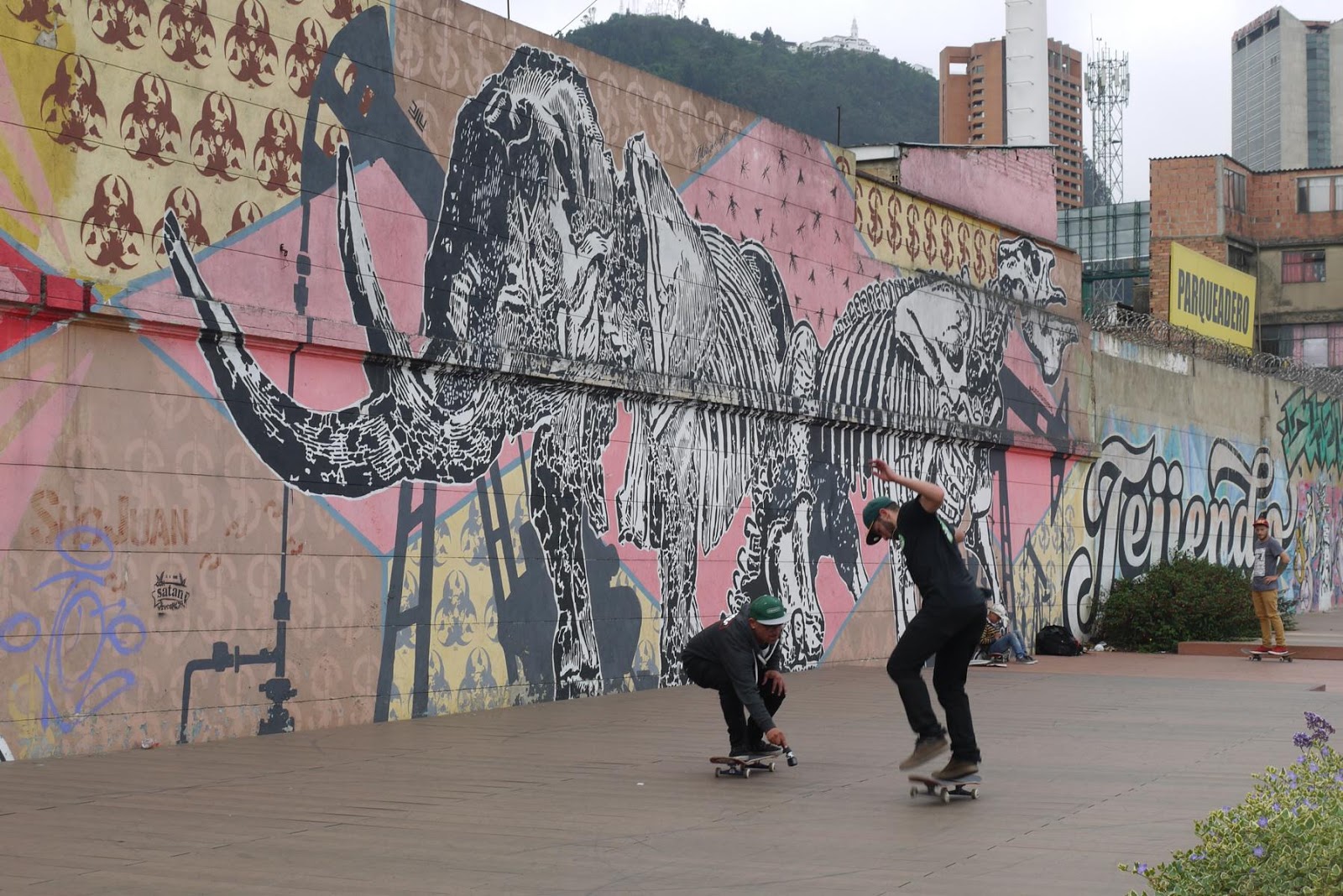
But the public expense has not been completely useless. The wooden platforms have become popular skateboard parks, as these photos attest. And the huge city-funded murals don't harm the visuals at all.


The below scenes, further west along Calle 26, with backdrops of murals by Toxicomano y DJLU, are in a stretch where the Petro administration built wooden platforms, but never did anything at all with them. Is that corruption compounded by mismanagement?

Happy skateboarding!


By Mike Ceaser, of Bogotá Bike Tours

Wednesday, August 9, 2017

A (Police) Code for Corruption

Don't talk back! If this kid being arrested talks back
to the junior cops, it could cost him.
You can insult the president, your grandma or even a priest - but disrespect a cop and you'll pay for it: 657,000 pesos, according to the new Codigo de Policia.

Keep you mouth shut and cooperate! Police evict
booksellers from a downtown sidewalk.
No matter that 'disrespect' is a vague term, inevitably left up to the cop's own judgement - and that speaking one's mind about the police seems like a basic civil right.

And don't urinate in public, either, because that means a 736,000 peso fine.

And if you're brutish and prejudiced enough to insult a member of the LGBT community, you might have to shell out 657,000 pesos. But insulting anybody is bad, so why should LGBT people be singled out, when insulting someone for being fat, female, black or Armenian seems just as wrong?

The new Police Code, which went into effect on Monday, may be well-intentioned. But its fines seem arbitrary, out of proportion and destined to increase police corruption.

Had too much fun at the local bar, and cop spotted you pissing against a tree on the way home? Maybe that's a bad thing, except for the nitrogen-starved tree - but what's the likelihood that you'll be willing to pay close to a million pesos for your transgression? Instead, you'll reach in your pocket for a 20,000 peso bill and hand it to the notoriously malleable police officer.

And is urinating in public really twice as bad as publishing someone's intimate photos on the Internet without their consent, which means only a 325,000 peso fine? Publishing such a photo can ruin someon's career, while urinating just makes a doorway stink.

Practicing the oldest profession on a central Bogotá plaza
outside of the designated red light district.
And then there is the odd 'crime' of 'obstructing expressions of affection' (not including sexual ones), which I suppose is intended to protect LGBT people's rights to display public affection. But don't conclude that the new police code is about free love, because having sex in public and practicing prostitution outside of designated areas are also subject to fines.

Not that the new codigo is all bad -.if it were only enforceable. For exampole, selling cigarrettes to minors now carries a fine. But that's been illegal for years - as is selling loose cigarrettes - yet every corner seems to host a street vendor eager to sell a smoke to anybody with a few coins in their hand.

Colombia is not Singapore, and unless penalties are realistic, they'll only feed corruption and disrespect for the law, rather than a more ordered country.

By Mike Ceaser, of Bogotá Bike Tours

Tuesday, May 2, 2017

Petro's Empty Bike Racks

On Plaza San Victorino, one of Petro's bike racks finds a user.
This small bike rack has been sitting nearly empty for years.
What made the Petro administration conclude that
the plaza needed a hundred more bike parking spaces?
It's a strange political circumstance: Gustavo Petro, whose term as mayor of Bogotá is most remembered for trash-filled sidewalks and his resulting temporary ouster, is now a leading candidate for president.

Sure, Petro did do some good things: He finally got rid of the cart-pulling horses called zorros, which
Another Petro bike rack finds users!
often suffered beatings and hunger. And he stopped bullfights from being held, though they returned this year. And those aren't exactly urban transformations. Petro's administration also did pour money into services such as soup kitchens in poor neighborhoods - but then nearly every mayor does that.

Meanwhile, Bogotá's trashy sidewalks, air pollution and chaotic traffic, amongst other urban ills, all continued. A lot of us had hoped that an ex-guerrilla leader would find some daring, innovative solutions to those problems.

But one thing which even Petro's enemies agree about is that he's not corrupt. But while that may be true personally, I found evidence on Plaza San Victorino that corruption existed around Mayor Petro.

A lonely bicycle in a rack built for two dozen of them.
As many Bogotá residents know, San Victorino is not a safe place to leave your bike locked-up. It's located only a few blocks from the one-time drug-and-crime den called El Bronx, and it's still roamed by drug addicts and thieves who'll strip parts from your bike if not steal the whole thing.

All of which makes San Victorino an inadvisable place to park a bike. That, however, didn't stop the Petro administration, or one of its contractors, from installing racks there for some 200 bikes. Naturally, they are almost completely empty all of the time. But somebody earned a bundle of money by installing them.

Alongside Calle 26, you'll also find Petro-era wooden flooring as well as more bike racks, which
What does an empty bike rack say about Petro's governance?
were never used. (Actually, the unused racks were stolen.)

I don't know much about Petro's public works. But the little glimpse I've seen of them here in the center makes me wonder how many of Petro's buddies got rich by misusing public funds during his presidency.

Petro's administration did contribute to cycling by adding bike lanes, including the one alongside the Parkway in Teusaquillo. However, he could have supported cycling a lot more by placing these racks someplace where cyclists would actually use them.
A pretty low bar. 'You can say whatever you want against him, but you can never say that he stole public resources from the city.' Well, perhaps. 


By Mike Ceaser, of Bogotá Bike Tours