Showing posts with label animal rights. Show all posts

Thursday, May 4, 2017

Is All Animal Suffering Equal?

Too cruel? A bull and Spanish bullfighter in the Santamaria plaza.
(Photo: Fernando Vergara)
The Colombian government has proposed a law prohibiting bullfighting and related activities in Colombia. That would be a big blow to bullfighters and aficionados, since Colombia is the third-biggest bullfighting country, after Spain and Mexico.

But bullfighting is a throwback to an era of bloodsports such as bear baiting, and many sociologists believe that violent entertainments like these promote a more violent society. The proposed law says its goal is to 'strengthen cultural citizenship for peace, respect for life and integrity of sentient beings, by eliminating bullfighting as an expression of violence and cruelty.'

A bird stands over a defeated foe in an
illegal cockfight in the United States.
Good for them. But I've never understood why animal rights advocates stop at bullfighting. What about cockfighting, which involves killing many more animals, in a more brutal fashion. And how about the many thousands of animals killed in slaughterhouses? Does anybody have an idea about how they live and die?

(Bullfighting-related violence goes beyond that between bullfighter and bull. This year bullfighting returned to Bogotá after five years, igniting huge, violent protests. The last Sunday of bullfighting, a bomb exploded on the sidewalk above the plaza, killing two police officers and injuring some 20 people. The government blamed the ELN guerrillas.)

A young man confronts police during anti-bullfighting protests early this year. 

Young men wrestle a small bull in a corraleja.
(Photo: Vice)
The law's sponsor, interior minister Juan Fernando Cristo, also says that bullfighting "gravely damages children...by increasing aggressiveness, anxiety and emotional impacts."

But if that is the law's authors' concern, then why don't they just prohibit children from attending bullfights? And how about protecting kids from all the violence in movies, television and video games?

Bullfighting gets picked on because it's conspicuous and associated with the wealthy and the landowning class. But of the various ways in which Colombians mistreat animals, it seems like one of the most minor. Banning bullfighting may very well be a good thing, but it's only a first step in protecting animals from abuse.

An afterthought: Bogotá's La Santamaria Plaza is a handsome building, located in the center of the city, with seating capacity for more than 30,000 people. Whether bullfighting returns to there or not, the building should be used for other events, such as concerts, art exhibitions and the like. Instead, it's sat empty for the past years.

By Mike Ceaser, of Bogotá Bike Tours

Sunday, October 6, 2013

Are Animals People Too?

'Break the chains of animal slavery.' I thot that by definition 'slavery' referred to people. 
Animal rights activists, some quite radical, staged yet another march today from La Plaza de Toros to Plaza Bolivar. Activists deserve our admiration for caring and getting off of their butts and speaking out.

However...my attention's always grabbed by the way these people generally attack bullfighting - even tho Bogotá's mayor has banned it here - while ignoring much greater cruelties such as cockfighting and factory farming, which continue virtually without criticism. 

Some of the marchers also called for 'animal equality' - yet, I saw only people walking leashed dogs, but not the reverse. While we're on the subject, how can I make myself equal to my goldfish?
Marching for animal equality - but they don't say equal to whom.

A bloody bull.

A bull's head rides above the crowd.

People walk their dogs on leashes. But, if animals are equal to people, shouldn't the dogs be walking the humans?

'Free the captain.' Does this refer to the Greenpeace activists arrested the other day by Russia?


By Mike Ceaser, of Bogotá Bike Tours

Wednesday, March 20, 2013

Circuses Without Animals (But Which Ones?)


These animal rights protesters set up this colorful demonstration today  in front of Congress, on Plaza Bolivar, demanding passange of a law prohibiting circuses from using animals.

It seems like an admirable goal, since many of those animals are likely abused.

I asked one of the demonstrators, tho, whether humans aren't animals and whether Congress isn't a circus. She had to agree. So, wouldn't this law also ban politicians from Congress? Perhaps fear of losing their jobs and perks is why Congress hasn't voted for this law.


By Mike Ceaser, of Bogotá Bike Tours

Sunday, October 7, 2012

Animal Rights: the Radical View

Bogotá Mayor Gustavo Petro already stopped bullfighting in Bogotá's city-owned plaza. 
Animal rights advocates also marched today, some of them taking quite radical positions comparing human possession of animals to human slavery. But my dog Parchita doesn't seem to feel particularly oppressed. 

As usual, the marchers' main cry was against bullfighting, even tho that's already seems to be ended in Bogotá, at least as long as Gustavo Petro is mayor. On the other hand, practices like factory farming, corraleja, cock-fighting and , which is also legal, never seem to get criticized. Perhaps that's because bullfighting is seen as an elitist activity, associated with the traditional land-owning class. 


I asked these people, who are holding up a newspaper called 'Animal Voices,' why the animal rights movement didn't address animal welfare on factory farms. They told me to send an e-mail to the address in the newspaper - as tho concern for farm animals were an original idea.

'Animals, slaves of other animals.'
Some protesters, like these hooded guys, take very radical positions. 

But animal welfare, like most issues, is complex. Altho I didn't see it addressed, I've no doubt that the demonstrators would denounce hunting. But many hunters are important advocates for environmental conservation, which benefits all sorts of animals. 

And, we harm animals and the environment (and people) every day in many ways, by burning fossil fuels and thru consumerism. But that all happens far away and less dramatically. 

Police talk to cat woman in the bullfighting plaza. More commonly, they'd be yelling and throwing things at each other. 


'No turning back' says a banner hanging on the bullfighting stadium, where bullfights are no longer allowed. 
'You love some animals and eat others.' 


By Mike Ceaser, of Bogotá Bike Tours

Sunday, July 29, 2012

Drumming for Peace


This colorful and slightly eccentric group was drumming for peace today near the planetarium and bullfighting stadium. For Sept. 11, they're planning to drum for 126 hours straight in defense of human and animal rights.


By Mike Ceaser, of Bogotá Bike Tours

Tuesday, June 26, 2012

The Bullfighting Stadium's Radical Makeover

Stop! Animals Free of Torture!
'Petro: We Support Your Decision' to end bullfighting,
says this sign in the center of the bullfighting plaza. 
Just a little while ago, when the bullfighting stadium's security guards thought a potential visitor looked like an anti-bullfighting protester, they told them to go away.

But as of about ten days ago the stadium passed from the administration of the Corporacion Taurina to the municipal Institute of Recreation and Sports (IDRD), transforming the plaza into a place of animal rights activism determined to end bullfighting.


A bike tour participant gives an interview denouncing bullfighting. 

Notes on a message tree, mostly denouncing bullfighting. 
By Mike Ceaser, of Bogotá Bike Tours

Monday, May 28, 2012

Time to Fold Up That Capote


The staff at the Plaza de Toros Santamaria, Bogotá's bullfighting stadium, tell us that the usual August amateur bullfights definitely won't happen this year. That makes sense, since those fights are sponsored by the city, and Mayor Gustavo Petro has said he opposes bullfighting. Whether or not there'll be a 2013 bullfighting season in January and February, when some of bullfighting's biggest stars come down here, is still up in the air.
The possible end of bullfighting is a victory for animal rights and for opponents of the glorification of violence and killing.

But it is sad for the young men who practice their veronicas in the plaza with dreams of stardom. (In reality, of course, they're much more likely to get badly injured than become millionares.)

I wonder, tho: If bullfighting ends, will the animal rights activists who protest the corridas turn their attention to other, worse cruelties, such as cockfighting and industrial animal raising? 
Somehow, I doubt it. Bullfighting, besides being a high-profile sport, is also seen as elitist, and so receives criticism on class grounds as well. Cockfighting, on the other hand, is a working class activity. And food animals and raised and slaughtered out of sight.

And, the city needs to find a new use for the bullfighting stadium, a handsome building in the middle of town. As it is, it's used for bullfights barely two months per year. But it'd be great for concerts, theatre or other activities. The residents of the Torres del Parque behind the stadium need to become more tolerant. After all, they knew the plaza was there when they moved in.


By Mike Ceaser, of Bogotá Bike Tours

Monday, January 16, 2012

Bogotá's Horsecarts: Urban Eyesores, or a Way of Life?

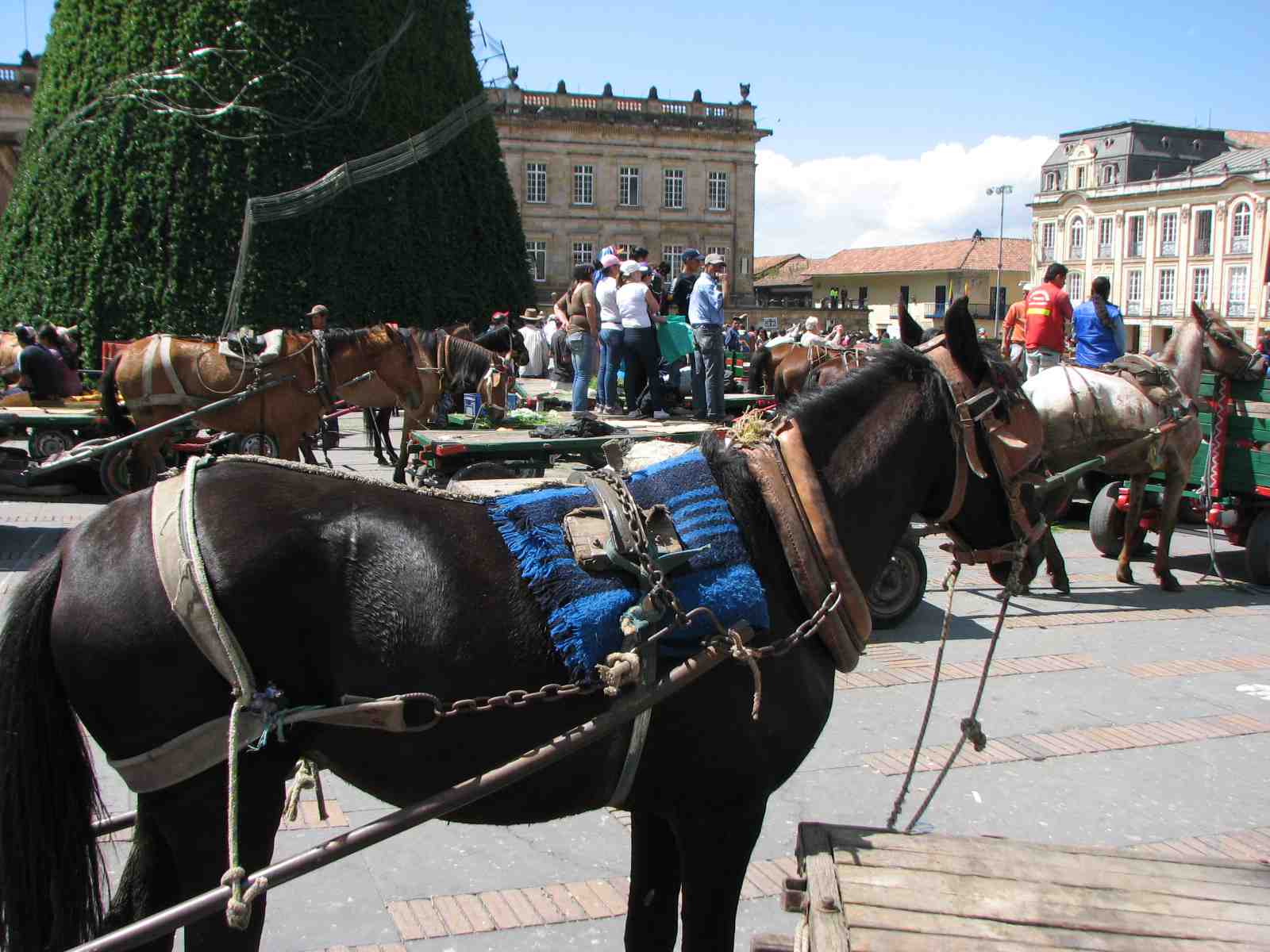
Horsecarts and their drivers invaded Plaza Bolivar. 
This morning, Plaza Bolivar looked like a scene from a century ago, with hundreds of horsecarts crowded onto it. 

But these horsecarts, known as zorreros, were rallying for their right to be a part of Bogotá's present and future. Bogotá has thousands of horsecarts - used by poor people who scavange and resell stuff, vend from the carts or make deliveries.

The city has repeatedly tried to ban the horsecarts, and the latest deadline is coming at the end of this month. However, the city hasn't advanced at all with a plan to give the horsecart users motorized tricycles to replace the carts. The plan would probably never work, anyway. For these families, the horsecarts are not only a way of making a living, but also a way of life, and they won't easily change - nor can they likely afford to buy gasoline, when the horses are fed virtually for free.

And does Bogotá really need more polluting motor vehicles?

Poor, workikng people: a zorrero family.
The zorreros also fullfill important social and environmental functions, recycling, taking away junk, and thus reducing landfill use. I often see zorreros trotting thru La Candelaria crying out for people to bring out their pieces of junk, which the horsecart people either sell or find a use for.


It sure seems contradictory that at the same time that Bogotá is trying to kick off a recycling program, it's considering banning the vehicles which the cities' principal recyclers use.


Animal rights defenders say that many of the horses are abused, underfed and overworked, which is undoubtedly true. Some have also made the absurd argument that the horsecarts are bad for traffic congestion - when a glance at Bogotá's traffic jams makes obvious that they're there because there are way too many cars, not horsecarts. City officials' real reason for wanting to ban the carts, one suspects, is a desire to create an image of a sanitized, modern city. But close to half of Bogotanos live in poverty, and the city's wealthy deserve to be reminded of that.

If the city does ban the horsecarts, then the impoverished families with little education who depend on them would be pushed even deeper into poverty and some will undoubtedly turn to crime.


The real solution is for the city to produce more jobs. But that will take a long time, if it ever happens. Until then, the zorreros are supporting their families and fulfilling an important social, economic and environmental function.

I'd suggest that the wealthy in their polluting SUVs, purchased by burning coal or marketing useless gimmicks, who feel so embarassed and annoyed by the zorreros' mere existence, contribute much less for their city.


Related Posts: End of the road for Bogotá's horsecarts?

The zorreros fight for their way of life.

While their drivers have lunch, these horses do too in the Santa Fe Neighborhood. 

Overloaded? A horsecart trots up Calle 13.


By Mike Ceaser, of Bogotá Bike Tours