Showing posts with label streetcars. Show all posts

Thursday, June 1, 2017

Memories of El Tranvia

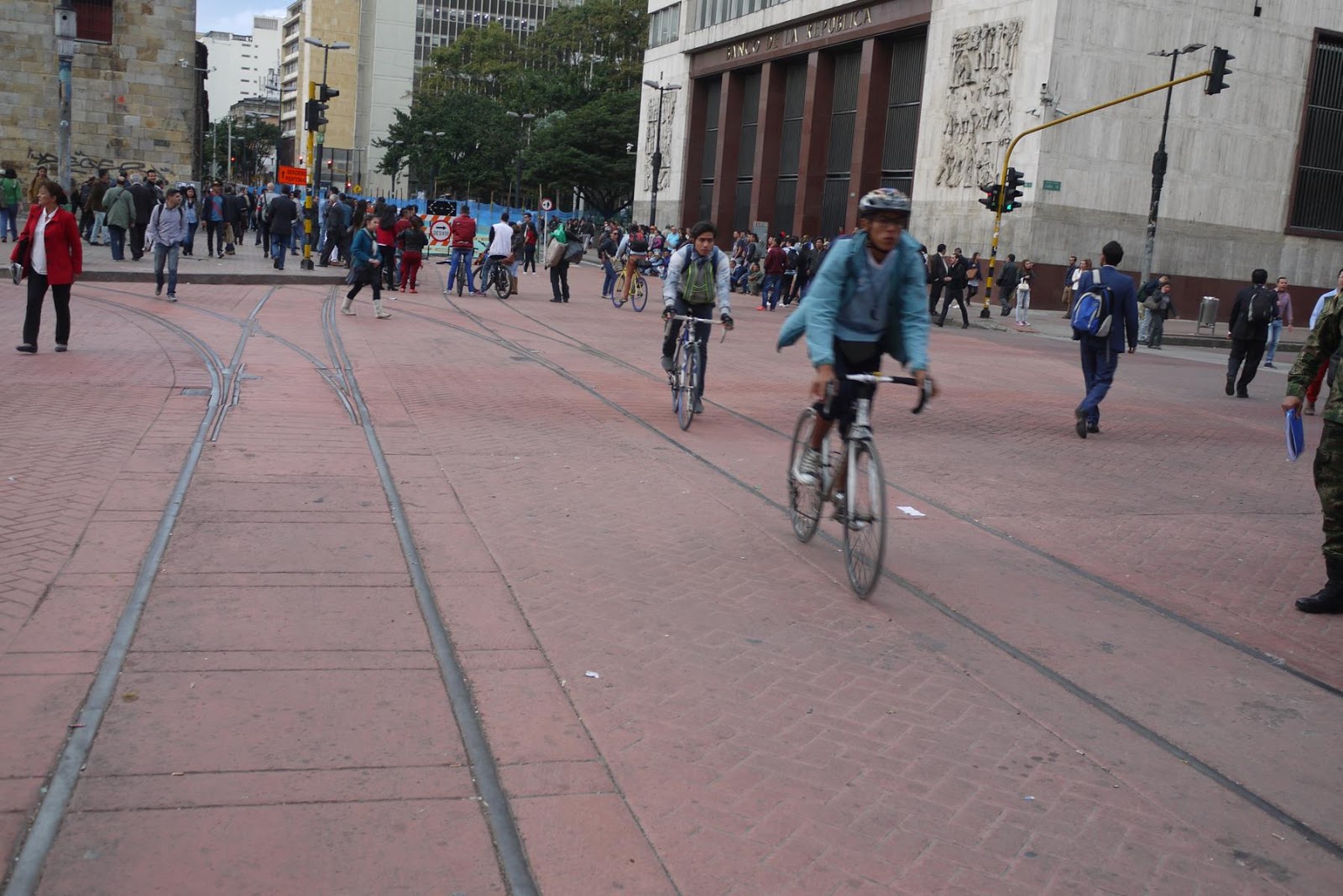
On Carrera Septima, near Calle 21, streetwork has exposed the old Tranvia rails.
The roadwork on Carrera Septima north of Calle 19 have unearthed something which will bring back memories for the very old Bogotanos: Old tranvia rails.

Tranvia rails preserved on Calle 10 and Carrera 9.
After more than a half century moving bogotanos about without poisoning the air, the legendary tranvia, or streetcars, were mortally wounded during the 1948 bogotazo. A few years later, the mayor had the rails covered with asphalt, entombing the system. A few dozen meters of rails were left exposed as a sort of memorial on Carrera Septima at Jimenez Ave, and in a few other spots the rails remain visible. And during pedestrianization work on Carrera Septima in 2015, workers also uncovered old rails.

The tranvia was first created in the 1880s, when it was pulled by horses and mules. In 1892, the wooden rails were replaced with iron ones. About 1910, electricity began replacing animal power. In April, 1948, during the Bogotazo riots, many of the railcars were pushed over and burned.

Since then, buses, often loud and polluting, have ruled the city, despite occasional plans to build a new tranvia along La Septima.


On Carrera Septima, near where Jorge Eliecer Gaitán was assassinated, triggering the Bogotazo riots, the tranvia rails have been preserved as a memorial. The riots destroyed the tranvias.
El Tranvia restaurant in Chapinero, by la Iglesia de Lourdes.

A map of the old tranvia network, in the street on Carrera Septima. Tranvia lines extended to Chapinero to the north and to the west to Plaza España. 
A plaque on Carrera Septima says that rich and poor rode the tranvia together, all equal as long as they could pay the fare.


The old tranvias at work.


The tranvias were pulled by mules and horses until about 1910, when electrification began.
Tranvia cars burning during El Bogotazo in April 1948.

"I was convinced that that sservice was a danger in the streets of Bogotá and that it had to be ended." Bogotá Mayor Fernando Mazuera Villegas explaining why he had the tranvia's rails covered with asphalt a few years after the bogotazo. (Plaque on Carrera Septima.)

By Mike Ceaser, of Bogotá Bike Tours

Sunday, April 19, 2015

History Unearthed on Carrera Septima

Old streetcar tracks uncovered on Carrera Septima.
Skating by streetcar tracks
near Ave. Jimenez.

Laborers working on the pedestrianization of Carrera Septima have uncovered some reminders of the Bogotá of yore - tracks of the old tranvias, or streetcars.

The tranvia network was damaged severely by the April 1948 Bogotazo riots, which followed the killing of populist leader Jorge Eliezer Gaitan. The system limped on for a few years, until a mayor who was in the pocket of the competing bus companies, had his friends asphalt over the tracks.
Remaining streetcar tracks
in San Victorino.

The streetcars were replaced by 'modern' buses, which have brought us noise, pollution and traffic chaos.

Mayor Petro has proposed a light rail line for Carrera Septima, altho it is one of many Petro ideas which have gone nowhere.

Municipal archaeologists are proposing a museum to display the rails and other objects. They'd better hurry: Sooner or later, bazuco addicts are liable to carry off the antique rails to sell them as scrap metal.

A toppled streetcar burns during El Bogotazo. Some say the bus companies paid rioters to destroy the tranvias.
By Mike Ceaser, of Bogotá Bike Tours

Saturday, June 2, 2012

Will Bogotá Get on Track?

Cars in central Bogotá. Private cars,
often carrying only on person,
take up most of the space on Bogotá's streets.

Mayor Petro's ambitious transit blueprint will dust off a mode which Bogotá hasn't seen for a long, long time: Trains.

Trolleys and streetcars have played a big role in Bogotá's history, but today the only train that operates in Bogotá is the vintage tourist train which carries holidayers to and from Zipaquira on weekends and holidays.

Work on the Museo Nacional TransMilenio station,
supposed to open for operation early next year.
A light rail line along La Septima would be
the continuation of this TM line. 
Petro's plan puts a streetcar on Seventh Ave., another train on the projected Longitudinal Avenue of the West (ALO) and two more on avenues crossing the city. Then, of course, it also includes a subway line making a loop thru central Bogotá. Then, there also two new TransMilenio lines and a pair of cable cars serving poor neighborhoods in south Bogotá.

If the plan actually gets completed, the city will be encircled by passenger rail lines.

Of all those projects, the streetcar, or Tranvia, on Ave. Septima has generated the most controversy. Critics say a light rail would only carry a few thousand people per hour - far less than a subway line, or the corridor's commuter flow. Under that reasoning, light rail will do wonders to turn Ave. Septima -which passes by many of the city's most important landmarks - from a chaotic, polluted mess to an orderly, pleasant and efficient avenue. The city also has a grand plan to turn the avenue into a 'green corridor' complete with electric buses and facelifts all along its route. But a light rail won't come close to handling La Septima's future passenger demand.
Progress: Ave. Septima's bridge over
Calle 26 is supposed to be done within a few weeks.

Still, thousands of passengers per hour is substantial. And a streetcar has the advantage of attracting higher-income commuters who would be reluctant to get onto a bus or even a subway.

These projects - if they're actually built - will move bogotanos faster across the city. But don't expect them to solve the city's traffic congestion or pollution nightmares. By a decade from now, when much of this infrastructure may have been completed, a million additional private cars will have flooded the city.

That is the real transit crisis facing the city. And without strong measures, such as a congestion charge and fines for single passenger vehicles, the city's transit faces collapse with or without new rail lines.
TransMilenio buses pass a traffic jam on Carrera 30,
near Palo Quemao market. Unless the city takes
strong measures about exploding private car use,
it'll turn into one big traffic jam. 


By Mike Ceaser, of Bogotá Bike Tours

Monday, December 5, 2011

Back to the Future on Seventh Ave?

Seventh Ave. today: Chaotic, polluted and slow. 
The future Seventh Ave?
First, there were horse-drawn cars, then came streetcars, then buses, then private cars, then electric trolleys, then TransMilenio - and then back to streetcars, now known as tramcars or light rail?

Mayor-elect Gustavo Petro plans to build a streetcar line on Seventh Ave. It's just the latest of many transit schemes for the historic but chaotic and polluted avenue, including a subway, a TransMilenio line, a scaled-down TransMilenio line, an 'ecological corridor' and now light rail.

              Light rail has several positives:

* It's narrow, enabling it to fit into skinny Seventh Ave.
* It doesn't pollute.
* Light rail looks sleek and modern, gives a city a panache and can attract tourists.
* While light rail's construction costs and time might be greater than an express bus line's, light rail's operation and maintenance costs are lower.
* Perhaps most importantly, higher-income people, like most of the residents along Seventh Ave., are more willing to ride trains than buses.

Passengers in a light rail car.
               But on the negative side:

* Light rail lacks the flexibility of an express bus system.
* It'll probably take longer and be more expensive to build than light rail would.
* Most importantly, it'll require passengers to deboard and perhaps change stations when transferring from the streetcar to Transmilenio (or a subway) and back again.

If the tramway does get built, it'll take Bogotá back to the first half of this century, when streetcars -called tranvias - carried bogotanos from south Bogotá up to Chapinero (a separate city then). At first, the cars were pulled by horses and mules, then for a short time operated on batteries until power lines were installed.

Streetcars on Seventh Ave. near Plaza Bolivar.

Riders hang out of the doors of a streetcar on Seventh Ave. 
The streetcar system, operated by the Bogotá City Railway Company,  became a symbol of Colombian nationalism in 1910 in an explosion of resentment against the system's U.S. owners. Shortly before, the United States had separated Panama from Colombia and made it into an independent nation in order to dig the Panama Canal. When one of the Railway Company's American owners, Johnson Martin, insulted a Bogotá policeman, Bogotanos responded by boycotting the  streetcar system until its owners were forced to sell it to the city of Bogotá.

Streetcars burning during the Bogotazo
The municipal owners continued expanding the system and buying new streetcars. However, in 1948 tragedy intervened. The assassination of populist politician Jorge Eliecer Gaitan triggered huge riots, called the Bogotazo, in which many buildings were burned, thousands of people were killed and the streetcars pushed over and torched. Many believe that the owners of rival bus systems, eager to destroy the competition, paid rioters to destroy the streetcars. The streetcar system limped on until 1951, when the mayor ordered the rails paved over, killing the system.

It's sad contemplating what might have been if Bogotá had preserved, expanded and modernized its urban rail system. Today, clean and orderly streetcars might carry people across the city, without the pall of smog now enveloping many Bogota avenues, and also serve as a tourist attraction.

Streetcar tracks can still be seen on Seventh Ave. and Jimenez, apparently left there as a memorial to Gaitan, who was assassinated nearby. 
A map of Bogotá in 1910 shows the streetcar line running along Seventh Ave. and then north to Chapinero. 
Find more info at: The Tramways of Bogotá (from wich I borrowed several pictures.)

Wikipedia: Los Tranvias de Bogotá.

Del Tranvia del TransMilenio


By Mike Ceaser, of Bogotá Bike Tours