Showing posts with label transit. Show all posts

Sunday, September 9, 2018

A Climate Protest Against...Peñalosa

Rallying for the climate - kind of - in the Parque Nacional.
At a rally against climate change yesterday participants protested against...Mayor Peñalosa.

The gas masks say 'No TransMilenio.' Does this make sense
 if it means keeping the old 'rolling chimney' buses around?
Some of the issues seem reasonable, such as protesting the recent cutting of urban trees (the city says that some trees have become hazards). And defending the Van der Hamm protected area north of Bogotá, which the city wants to develop (the city says the protected area has already been damaged).

But the rally's primary emphasis seemed to be opposition to the expansion of the city's TransMilenio express bus system...the very same system which has won international awards for reducing climate change gases.

And, while it is a different, if related, issue, many TransMilenio buses are relatively clean burning, and the city promises that buses on the planned
'Bogotá free of fossil fuels.' We'll
expect that one tomorow.
Septima corridor will be electric or gas-powered zero emission vehicles. Meanwhile, many of the old buses running on the avenue are literal rolling chimneys. Is keeping those polluters on the road by opposing TransMilenio really pro-environment?

Even more absurd were the calls for a 'Bogotá free of fossil fuels.' If only! But such unrealistic fantasies only distract from achieving real changes.

And if these people were really against climate change, they'd oppose the private cars inundating the city by the tens of thousands every year, which generate much more greenhouse gas per-rider than buses do, as well as hogging space and clogging roads. But I didn't see a word against private cars.
Two old 'rolling chimneys' which passed the park where they were protesting against TransMilenio.


Protest these? New relatively clean TransMilenio buses on Carrera Septima.


Don't cut down trees!


Smoking away. No contradiction between protesting pollution and polluting.
Smoking away: These pollution protesters saw no reason not to pollute themselves.

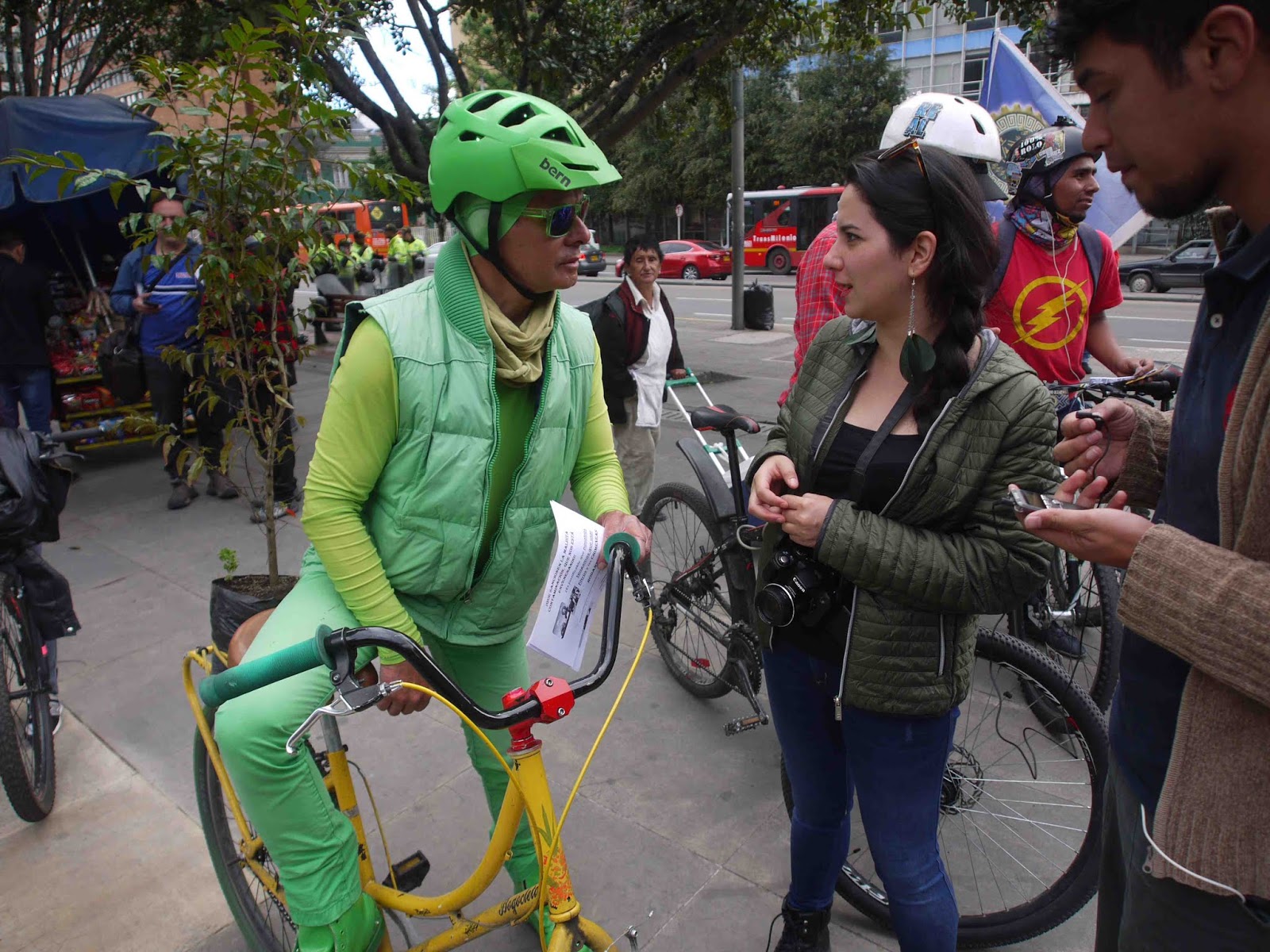
Activist Greenman at the protest.

No TransMilenio on Carrera Septima - because we like those old rolling chimneys!


No TransMilenio on Ave. 68.

Protect the wetlands.
By Mike Ceaser, of Bogotá Bike Tours

Sunday, April 8, 2018

Tell TM to Stop Smoking Us!

Watch out! Poison gas coming!
TransMilenio is in the process of making a momentous decision, which could affect Bogotanos'
Run, run, away!
quality of life for decades to come. The bus rapid transit system is preparing to purchase some 1300 new buses to replace existing ones, which have outlived their planned life expectancy of 12 years.

But, what kind of buses will TM buy?

City officials say they plan to purchase mostly Euro 5 buses, which should be less polluting than the current ones. That, however, will depend on how they are maintained. And, judging from the smoke-belching quality of some of the current buses, the maintenance leaves lots to be desired.


Clean alternatives include hydrogen, natural gas and electric buses.

Why the city has apparently not seriously considered the first two is beyond me. Those cleaner
A 'clean, green' low-emission bus
purchased recently by TM.
engines may not have the same accelaration power as diesel, but I've seen electric buses charging up steep hills in San Francisco, California. And most of Bogotá is flat. Bogotá HAS considered electric buses, and even has one operating as a test vehicle. From what I've read, its disadvantages are mostly cost. Electric vehicles cost more to buy, and the infrastructure for supplying sufficient electricity and charging the buses would be costly.

Mayor Peñalosa also says that electric versions of the long, bending buses which Bogotá plans to buy simply do not exist.

Transmilenio's sole electric bus. (Photo: http://bogota.gov.co/temas-de-ciudad/ambiente/primer-bus-electrico-de-transmilenio-en-bogota)
However, electric vehicles suffer fewer breakdowns and cost less to maintain, so Bogotá could save money in the long run. And then there are all the health costs from pollution, and all the companies which decided not to locate here and tourists who decided not to come here because they didn't want to breathe smoke.
A trollebus in Bogotá. The last clean trollebuses left Bogotá's streets in 1991, leaving us with belching diesel vehicles.
(Photo: Barry Blumstein)

The old is new again: A historic electric bus in San Francisco, California.
A modern zero emission electric bus rolls up a hill in San Francisco, California.

By Mike Ceaser, of Bogotá Bike Tours

Wednesday, April 4, 2018

Bogotá Needs a Congestion Fee!

An every-day traffic jam in Bogotá.
'Three to a car.' A Petro-era plan to require
car-pooling was never enforced.
This week, transit experts are meeting in Bogotá at Corferias to discuss solutions for the horrendous traffic congestion in Bogotá and other big cities.

Noisy, polluting traffic in La Candelaria:
Making cycling, walking and
generally living unpleasant.
Bogotá has been consistently ranked as one of the traffic jammed cities in Latin America and in fact the world. And, unless authorities take strong action, the situation will only get worse and worse as thousands more cars and motorcycles are packed into its roads.


What's the solution?

Pico y Placa has manifestly failed, and may even have made congestion and pollution worse by incentivizing the purchase of second cars.

The city's weak promotions for car pooling have accomplished almost nothing.

A sign announing London's
congestion charge zone.
(Wikipedia)
And the city's efforts to promote bicycling have been worthwhile, but their potential is limited. Colombia is not Holland. Only a small minority will ever be willing to ride bikes, unfortunately.

Meanwhile, the social and commercial pressures to drive, combined with big subsidies for cars, will continue crowding more vehicles onto our streets.

We can't build out way out of this nightmare.

The only solution is a London-style congestion charge.
London's congestion fee
increased cycling (blue).
(Wikipedia)


The charge discourages driving.

The charge finances mass transit.

London's congestion
fee reduced driving (red).
(Wikipedia)
By reducing noise, congestion and pollution, the fee makes cycling and walking much more pleasant.

It's the only solution.


By Mike Ceaser, of Bogotá Bike Tours

Monday, March 5, 2018

The Sitp's 'Transition' to Nowhere

The Sitp bus system was supposed to improve, if not revolutionize, Bogotá's transit. The old 'battle for the centavo,' in which buses raced each other madly to pick up passengers, was supposed to end. Order would descend on Bogotá's streets as buses stopped for passengers only at designated bus stops instead of screeching to a halt wherever the passenger happened to be waiting. More efficient buses and routes would also reduce Bogotá's traffic jams. And, by replacing the dirty old buses with clean new ones, the city's air would improve.

Unfortunately, very little of that has happened. Rather than replacing the old buses, the city just slapped labels on them, declaring them 'transitional' Sitp buses, as tho those labels would have some magical transformational effect on the vehicles. And, years later, the perpetual 'transition' has no end in sight.
A Sitp bus broke down on Calle 26 -
apparently with a wheel or tire problen.      

Neither do the 'transitional' Sitp drivers, who presumably work under new training and instructions, seem to behave better than did the pre-Sitp drivers.

Meanwhile, even with all of these failings, several of the companies operating the Sitp buses are close to bankruptcy.

But this incident I witnessed the other day on 26th St., across from the Central Cemetery and the Centro Memoria, has come to represent for me the Sitp's failings.

But, lo and behold, another Sitp bus pulls up to take the stranded passengers.

Here we go!

And the new, 'good' bus takes off - with a blast of smoke. 


Yet another of Bogotá's 'rolling chimneys.'

The Sitp 'transition' rolls ahead.
 By Mike Ceaser, of Bogotá Bike Tours

Friday, September 9, 2016

Could Uber Unsnarl Bogotá's Traffic?

Not if the Viceministry of Transport has its way!

Bogotá traffic congestion - an answer in Uber?
Uber, one of the most disruptive and innovative technologies to come along in awhile, has created lots of enemies.

And in Colombia those include not only cabbies, but also the viceminister of transport, who has vowed to shut down the service by blocking its app.

Uber certainly is unfair. Cabbies invest a lot in their vehicles, training and licenses, with the reasonable expectation that this will provide them a career in driving. And then Uber comes along, and suddenly anybody with a car and a smartphone can suddenly be a taxi driver.

It is very unfair. But that's history. The computer was terribly unfair to typewriter companies, the digital camera to film makers, and the automobile to harness makers (and horses). Printing put lots of scribes out of work.

If Transport Viceminister Alejandro Maya gets his way, he'll not only halt Uber, but also
technological advancement. And Uber is only a piece of the shared, coordinated economic revolution, which just might make life in Bogotá a whole lot better.

Taxis under threat. But can Uber do better?
The New York Times reports that Uber, Google and others are experimenting with carpooling, driverless cars and other forms of transport sharing.

Uber unquestionably fills a desire for more convenient, courteous transport service. But, so far, Uber's impacts on traffic are more debateable. Does it put more vehicles on the roads, worsening traffic jams and pollution? Or, by reducing the need for owning a personal car, does it ultimately reduce the number of vehicles?

Whatever the truth, Uber-type technologies clearly have the potential to slash road congestion and improve safety. Self-driving cars will one day soon be much safer and more efficient than human-driven vehicles. Technological platforms open huge potential for car-pooling (something which Bogotá, insanely, has never really invested in). And the New York Times envisions a future with personal vehicles replaced by commonly-used ones, reducing the demand for parking lots, which consume huge portions of urban areas. (Will the viceminister also oppose that change, in defense of the vested interests of parking lot owners?)

But none of those paradigm shifts will be possible if viceminister Maya succeeds in blocking Uber.

(Incidentally, Colombia's banking system is apparently resistant to working with PayPal.)


By Mike Ceaser, of Bogotá Bike Tours

Tuesday, June 2, 2015

Why SITP Isn't Working

Is anybody in there?
For an idea of why the city's SITP bus system is agonizing, just watch the passing buses by an intersection such as Carrera Septima and Calle 19, in the city center.

The SITP buses are empty or only sparsely filled, while the private buses generally carry a good number of passengers.

Count the passengers.
All the passengers inside this extra-long SITP bus could fit into a four-door car. 


Not a good place to make friends.


Meanwhile, this SITP bus runs apparently empty.


By Mike Ceaser, of Bogotá Bike Tours

Bogotá's Transit Reform - Still Stuck at Start

A bus stops at a green light, blocking Carrera 10, to let a passenger board.
Bogotá's much-ballyhooed transition from private, commercial buses to publicly-managed SITP buses started off this week so slowly you might not have noticed, if not for the headlines.

Between now and November, the city's thousands of privately-owned and run buses are supposed to either be retired or switched to public control and management and integrated into the SITP system. 

Perhaps that will happen - or perhaps before then the city will discover that it doesn't know how to operate a bus system which people actually want to ride. 

In any case, on the first days of this transition, I found the usual lack of a basic ingredient necessary for bringing order to Bogotá's streets: Law enforcement.

...another bus stops in the middle of the block and in the middle of the street to pick up a passenger.
The calibradores, who tell private bus drivers how far another bus on the same line is ahead of them, were supposed to disappear with the private buses. They're still at work.

A police post at the same intersection. The cops here protect against muggings, but turn a blind eye to transit violations. 
A bus belches diesel smoke. 

By Mike Ceaser, of Bogotá Bike Tours