Showing posts with label United Nations. Show all posts

Friday, October 17, 2014

And WHY NOT Venezuela on the Security Council?

In a cartoon from El Tiempo Venezuelans complain about shortages of food and toilet paper and lack of a free press. But we're in the Security Council! Pres. Maduro replies. 
Venezuela made news this week by getting elected to the lofty heights of the United Nations Security Council.

After all, Venezuela's government is progressively strangling independent media, has made its courts puppets and is frequently accused by human rights organizations of abusing and imprisoning legal protesters.

A few headlines from Human Rights Watch's (HRW) Venezuela page:


So, Venezuela is no example to be set high to be admired by other nations.

But the Security Council members as a group are not exemplars of respect for human rights.

Of the five permanent members, with veto power, one, China, is an outright dictatorship, and a second, Russia, is a democracy in form only and a regular repressor of human rights.

Then there's current member Nigeria, whose security forces are accused by HRW of "indiscriminate arrest, detention, torture, and extra-judicial killing," of supporters of the radical Islamist group Boko Haram, as well as burning and destroying homes in regions with Boko Haram support.

And Chad, where government forces have committed "the vast majority of summary executions and unlawful killings, and almost all village burnings, have been carried out by government forces, often in reprisal for rebel attacks," says HRW.

Among those joining the Security Council along with Venezuela is Malaysia, whose government, HRW says, "should cease using the country’s sedition law to arbitrarily arrest opposition lawmakers, activists, and critical academics."

If only U.N. member nations made respect for human rights a criteria for election to important positions. But they don't, as a look at the nations which have even served on the U.N.'s Human Rights council will show. Neither does there seem to be much effective peer pressure for member governments clean up their acts.

Nevertheless, the U.N. does provide a place for debate and conversation - and perhaps that's why there's been no global war since the U.N. was established in the wake of World War II.

Once on the Security Council, Venezuela will use its position as a platform to rant and rave, mostly against the United States. Let them yell. That's free speech. But very few - except for the Bolivarian Revolution's True Believers - will believe them.

For its part, Colombia has kept quiet while Venezuela has "turned into an autocratic, despotic state," in the words of the New York Times. Colombia's motives are obvious: Venezuela is an important trading partner and supports the peace negotiations with the FARC guerrillas - a centerpiece of Pres. Santos' reelection campaign. But that doesn't make Colombia's behavior any more ethical.

By Mike Ceaser, of Bogotá Bike Tours

Saturday, March 30, 2013

The Axis of Killing

South American homicide rates:
The region has some of the
world's highest murder rates. 
At the risk of being associated with a United States president of limited intellectual and moral capacity, it's hard not to call the triumvirate of tyrranies which blocked the United Nations Arms Treaty yesterday evil, evil, evil.

North Korea, a totalitarian dictatorship which has millions of its own people in concentration camps and threatens nuclear war to get attention; Syria, who dictator is massacring his own people; and Iran, which has also threatened to annihilate at least one of its neighbors, have blocked an arms treaty which could cut the ongoing slaughter of civilians around the world.

The arms treaty would, finally, impose some common-sense rules on the international traffic in weapons ranging from handguns to surface-to-air missiles. The treaty would, among other things, try to keep weapons out of the hands of murderous dictatorships. Maybe that's why these three regimes oppose the treaty.

The question shouldn't be whether or not to approve this treaty, but why such common-sense rules weren't created many years, civil wars and massacres ago.

Homicides on headstones. (Photo from IPS news)
The treaty is strongly supported by both Mexico and Colombia - nations which have been scourged by firearms violence fed by the globe's unrestricted weapons trade.

Fortunately, the treaty could still become international law thru a vote by the General Assembly, where support appears to be overwhelming. Then, however, it will have to be signed by individual nations. Nations such as Russia and China, which have sold weapons to authoritarian regimes, will probably resist
Assault rifles and bullets: Subjects for free trade?
signing, as will nationsl like Pakistan, which wants to weapons to threaten India, at the expense of its own children's food and education. For its own part, the U.S.'s powerful and paranoid gun lobby opposes the treaty because, it says, it could restrict private ownership of guns - even tho both the treaty's authors and independent analysts say that won't happen.

Ironically, the treaty would actually benefit the wealthy arms exporters in North America and Western Europe which already apply strict controls to their arms sales. That certainly doesn't make it right to hawk weapons to nations which lack money for food and schoolbooks, but it's a little bit less evil.

Ironically, one of gun rights' fundamentalists' strongest arguments is the supposed need for citizens to protect themselves against a tyrranical government. So, it's ironic that gun rights defenders are allying themselves with and defending the interests of exactly such dictatorial regimes, which obviously are not worried by a free trade in arms.
By Mike Ceaser, of Bogotá Bike Tours

Tuesday, November 9, 2010

Displacement - the Unseen Tragedy

Colombia is not the world leader in many things. But the country may now be the world's no. 1 in something very  tragic - human displacement.

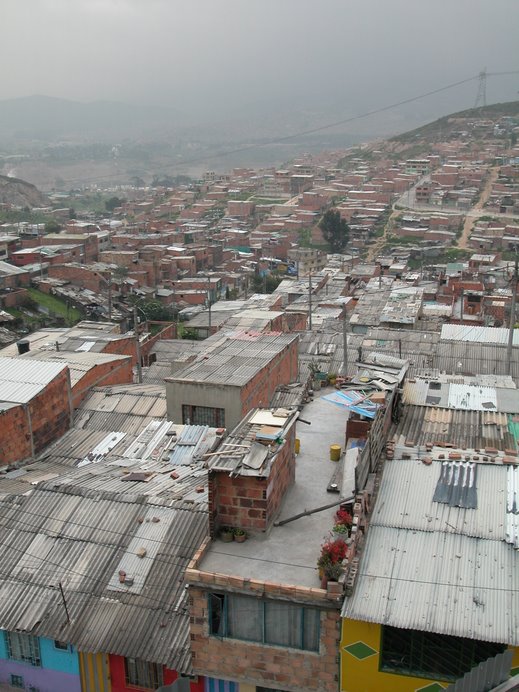
The phenomenon of desplazados has been a chronic problem in Colombia, as outlaw guerrillas and paramilitaries - and sometimes even the military itself - have forced peasants and townspeople to abandon their homes and farms. Often, the victims' only alternative is death.

After five years living in Colombia, much of that time working as a journalist, I've heard dozens of horrific stories of displaced people. In many cases, their family members were murdered by outlaw groups, their children or husband forced to become guerrilla or paramilitary fighters, and their land and livestock stolen by the outlaw groups.

Traditionally, Colombia has been considered to have the world's second- or third-largest number of displaced people, behind countries such as the Sudan, the Congo and Iraq. But a report the other day by a United Nations official in Ecuador says that Colombia with some 3.7 million displaced people (in addition to 350,000 refugees, most of them in Ecuador) has the world's largest refugee population.

The Colombian government denies this.

It's not easy to measure, since Colombia's is a long-running, relatively low-level conflict, and the displaced people slowly reintegrate themselves into society, making them a fluid, rolling population. But whether Colombia is number one or not is really just a technicality. The fact that Colombia has millions of displaced people is a tragedy from every perspective. And for the displaced themselves, the numbers and Colombia's ranking don't really matter.

What really matters is for these outlaw groups to stop terrorizing Colombia's humblest people, and for the government to quit debating numbers and do more to try to address this tragedy.

By Mike Ceaser, of Bogotá Bike Tours