Showing posts with label jimenez avenue. Show all posts

Thursday, September 7, 2017

Waiting for the Pope


Thousands of Colombians (and a few gringos) flooded Jimenez Avenue this morning to see Pope Francis drive by.

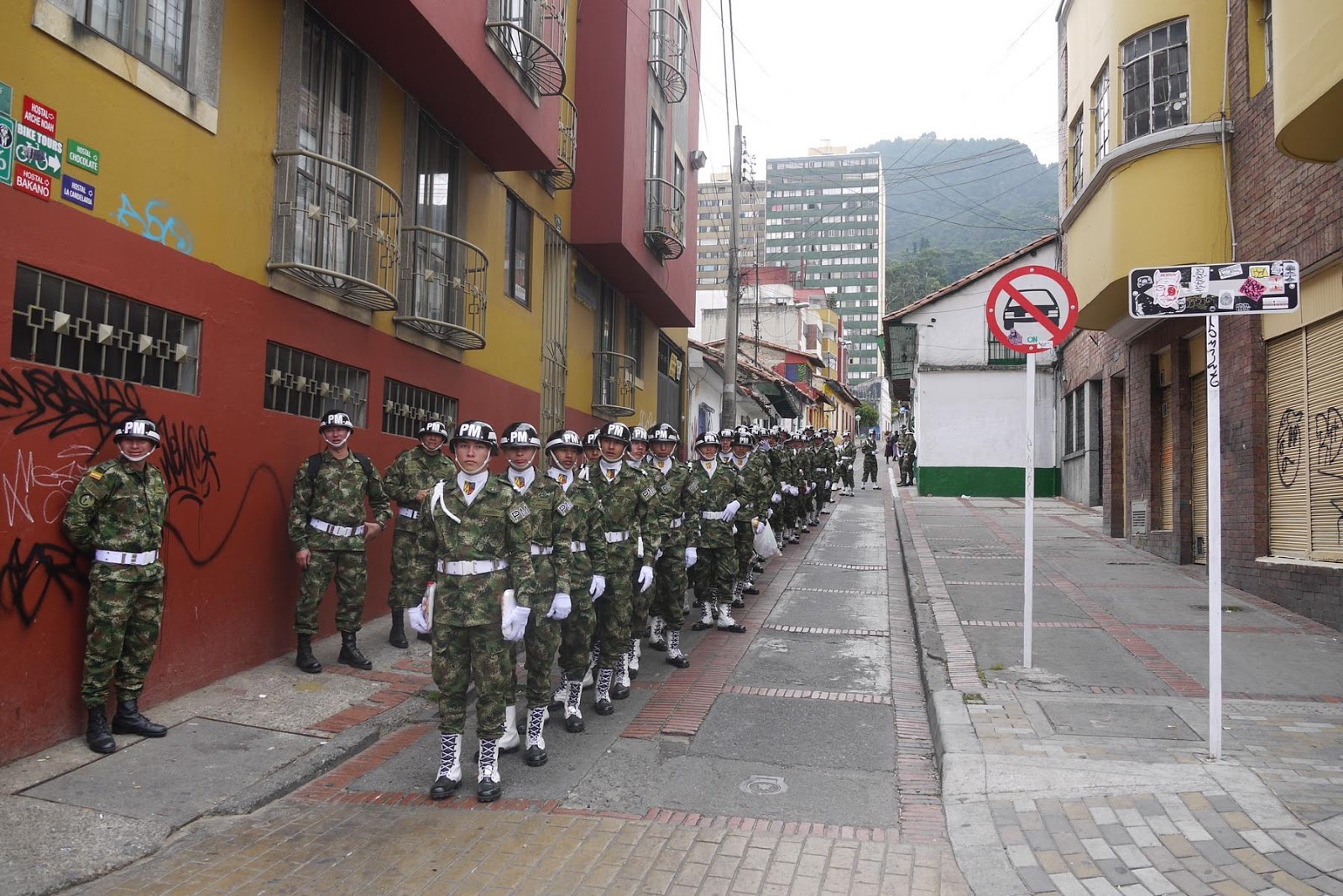
Military Police wait on a side street, for whatever.
 

These guys, sleeping something off, had no use for the Pope.


Make a call while you wait.


Lining up to watch the Pope. Usually, people line up here to watch futbol.


The Pope doing mass on Plaza Bolivar didn't discourage these folks from evangelizing for some other Christian belief.
'Do it from below.' On a manhole cover.


These dogs had their own priorities.
On Caracol TV, 'The Pope talks to the young people,' with a minor grammatical error.


Waiting in a wheelchair, praying for a cure.
The Popemovil, on Calle 22.
By Mike Ceaser, of Bogotá Bike Tours

Friday, August 11, 2017

Lighting Up La Jimenez


This week, as part of the Fesival de Verano, parts of La Candelaria's Jimenez Avenue is lit up. The works were done by artists from far-flung locales, including Peru, Spain, Australia and even Colombia. Take a walk, and play with the lights.


By Mike Ceaser, of Bogotá Bike Tours

Wednesday, August 6, 2014

An Empty Ave. Jimenez?


An empty future for Ave. Jimenez?
A pothole on Ave. Jimenez.
In his rush to 'humanize' Bogotá, Mayor Petro seems to be shutting it down. Some of his changes, such as pedestrianizing part of Ave. Septima, have been positive. But under Petro the handsome Santamaria bullfighting stadium sits vacant, and he now appears to want to turn Ave. Jimenez into a ghost corridor.

Residents protested the other day against a city plan they claim would shut down the Museo de Oro and Las Aguas TransMilenio stations. City officials say that's not in their plans (altho I have read that it is), but that they do intend to remove one important bus line.

La Candelaria residents protest against plans to reduce or
eliminate bus service along Jimenez Ave. (Photo: El Tiempo)
The city's reasoning seems to be that the buses damage the avenue's brick surface, designed by architect Rogelio Salmona. While that is true, it's also inevitable. The avenue was intended for transit, and without it in use the city center's already chronic traffic congestion will get even worse.

And other cities, such as Portland, Oregon, seem to have discovered durable brick surfacing for bus routes.
A brick bus avenue in Portland, Oregon. (Photo: ASLA)
TransMilenio buses backed up on Ave. Jimenez.
Scenes of daily (and nightly) traffic jams in La Candelaria. With reduced bus service, they'd get worse.

By Mike Ceaser, of Bogotá Bike Tours

Wednesday, April 11, 2012

Elvira and Her Horse With No Name

Elvira's horse grazes before the perpetually unbuilt Spanish Cultural Center.
If you've walked up the Eje Ambiental, you might have seen horses grazing placidly, looking somewhat out of place near Universidad de los Andes, Colombia's most elite private university.

Seeing the horses and their owners amidst Colombia's future elite reminds me of the huge gap in this country between the poor and wealthy, as well as how hard some people work to get by.

Elvira, this horse's owner, lives on the hillside above the universities. She descends with the horse, which has no name, every day she can to collect discarded food from La Candelaria's restaurants, which she feeds to the animals her family raises on the hillside. The family also has another horse, named TransMilenio. But there's little point in naming horses, said Elvira, since they don't come when called like horses.

Elvira, who is 67, said her family used to make good money raising pigs, until sanitation authorities visited about eight years ago and told them that the pigs' odors were bothering nearby students. The officials also nixed rabbits for the same reason. Now, hers and other hillside families can only keep horses, cows and chickens.

"They said the pigs stank and I don't know what else," Elvira said bitterly. "The rich do whatever they want to the poor."

There are, of course, valid reasons to control livestock raising, whether in the city or the country. Animal waste, if not properly treated, pollutes water and can cause disease. (A couple of years ago I got a horrific case of amoebas from eating lettuce grown on a hillside amongst livestock.) As I understand it, the families living on the hillsides don't have permits or own the land, but have often been there for many years. They also are poor people.

It's important to preserve the hills, but also to respect the people living there. Perhaps the city and nearby universities can work with the families to turn their land into farms demonstrating sustainable, eco-friendly agriculture. Those families can also act as informal wardens to protect the hills from illegal homebuilding, crime and arson. This would be a win-win-win for the hillside families, city and the environment.

By Mike Ceaser, of Bogotá Bike Tours

Monday, December 26, 2011

A Palace for the Arts

The Palacio San Francisco, on Jimenez Ave., is to become an arts center. 
Despite being a democracy, the Colombian capital contains several palaces, including the Palacio de Nariño - the Presidential Palace - and the Justice Palace.
The elaborate scuptures on the building's roof are
named 'Peace' and 'Work.'

Now, it is also to have an Arts Palace.

That very grand, very handsome and very empty building on Jimenez Ave. beside the San Francisco Church used to house the government of Cundinamarca, the province surrounding Bogotá.

The site's recorded history begins in 1557, when Franciscan priests built a church where the San Francisco Church - Bogotá's oldest - still stands, on the corner of Jimenez and Seventh avenues. (Back then, the San Francisco River, today buried in a pipe, flowed down what is today Jimenez.) Beside the church, the Franciscans also built a convent.

In 1861, however, Pres. Tomás Cipriano de Mosquera confisticated the Catholic Church's property and turned the convent into the provincial capital building. But a 1917 earthquake badly damaged the building. The next year, the government began construction of the existing building, which took 15 years to complete (making the current TransMilenio projects look speedy).  Then, the new building was heavily damaged in the 1948 Bogotazo riots, which followed the assassination of populist politician Jorge Eliecer Gaitan across the street.

With the construction of the new, futuristic, pyramid-shaped provincial government building on 26th St., in 1997 the building on Jimenez Ave. was handed over to the management of the nearby Universidad del Rosario.

If there's anything La Candelaria already has lots of, it's art. So, it's good that the new building will contain recording, music and dance studios for people to work in. It is also to contain documentation and exhibition about Cundinamarca's history, culture and environment.


A majestic window in neoclassical style. 
When the arts center is completed, hopefully within a few years, La Jimenez could be an artsy corridor. The basement of the demolished building across Jimenez has been turned into an arts space, as has the old Odeon Theatre a block up Ave. Septima, and the Spanish government keeps promising to build a Spanish-Colombian Cultural Center higher up the avenue. At the top end of the avenue, between Los Andes University and the Quinta de Bolivar, is the Warehouse Art Center. In the other direction, there are plans to convert the decrepid building beside the old train station into an arts academy.

 Find photos and other info on the building's website here.
TransMilenio buses roll past the San Francisco Palace. 

Evidently, The British Council once occupied the building. 

The elaborate crown of one of the building's columns.
 
Restoration is going on, as this temporary roofing attests. 


On the building's side, a plaque from a beekeepers organization honors poet enrique Alvarez Henao, autho of the poem 'The Bee.' The only connection I can find is that the Franciscan priests were known for beekeeping. 


The Franciscans' coat of arms, on the adjoining church, includes beekeeping
equipment (and a paintball stain). 

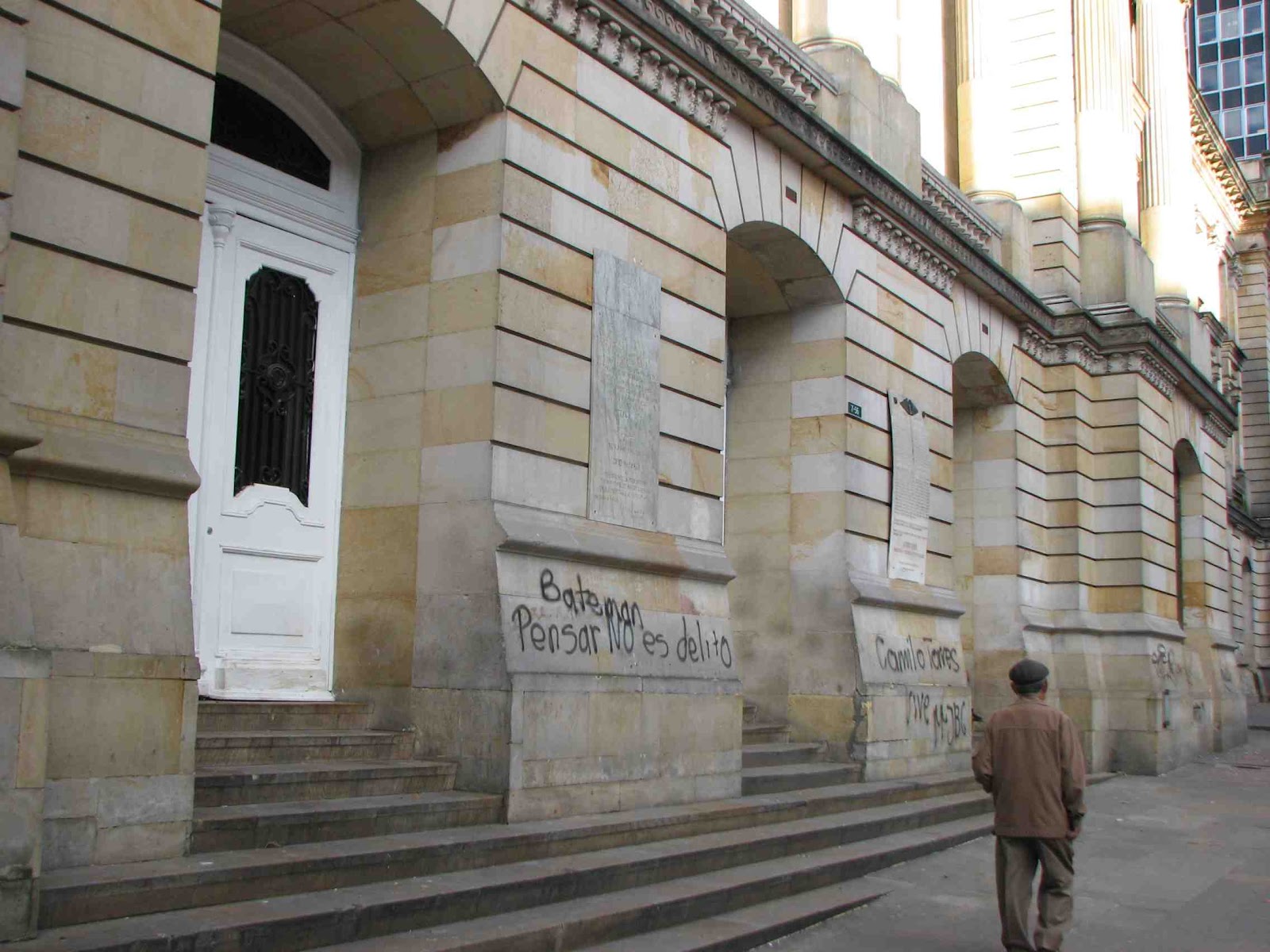
The palace got graffitied recently by student protesters. 


Statue of Pres. Carlos Lleras Restrepo. 


A street vendor at work on the sidewalk. 

Windows ironwork. 
By Mike Ceaser, of Bogotá Bike Tours