Wednesday, December 7, 2011

Noche de las Velitas


A boy carefully lights candles on a sidewalk. 

The Noche de las Velitas, or Night of the Little Candles, is an annual celebration observed only in Colombia, in which people light candles and lanterns in the streets. It marks the beginning of Christmas.

In Bogotá, La Candelaria, the city's historical center, is the center of the celebration.


Colored lanterns decorate a sidewalk. 

A girl lights a candle on the edge of the fountain in La Plaza del Chorro. 

The Callejon de las Brujas, off La Plaza del Chorro. 

Lanterns and lights in the Callejon del Embudo. 


The Noche de las Velitas is also an occasion for visiting neighbors and socializing in the streets. 

Lighting candles on a windowsill. 

La Plaza del Chorro, where Bogota was founded. 
A girl lights a candle from a torch in La Plaza del Chorro. 


Kids, and adults, dance around a bonfire.

These kids went a little far on the Night of the Candles. 


In the Callejon del Embudo. 

A pretty lady lantern. 


A theatre and a hotel lit up on Calle 10. 

Leave a candle in the window. 
By Mike Ceaser, of Bogotá Bike Tours

Colombia in World War II

A sailing ship called a 'goleta,' like Colombia's The Resolute, sunk by a Nazi U-boat in 
Today is the 70th anniversary of Japan's 1941 attack on Pearl Harbor, which brought the United States into World War II - and pulled Colombia in in its wake.

Colombia, like most of Latin America, formally backed the Allies during the war, lending use of its territory and natural resources, but did not participate in fighting. Colombia was, however, strategically important because of its nearness to the Panama Canal, which the Allies feared could be attacked by Germany or Japan.

At the war's start, many Colombians still resented the U.S. for its role in turning the province of Panama into an independent country in order to dig a canal across the isthmus. But U.S. Pres. Franklin Delano Roosevelt had improved relations with his Good Neighbor Policy. Also, then-Colombian Pres. Eduardo Santos (the great uncle of current Pres. Juan Manuel Santos) was a Liberal and had studied in France, and so sympathized with the French, who were suffering under Nazi occupation.

After the Pearl Harbor attack, Colombia broke relations with the Axis powers and allowed the U.S. to station troops in the country - a relationship which has continued until today. Colombia had also accepted some Jewish refugees from Europe during the pre-war years, but, like most countries, shut the door in the late 1930s.

Extra! Extra! Read all about it! Colombia declares state of beligerance towards the Axis powers.
In June, 1942, a Nazi U-boat sank the Colombian sailing ship The Resolute, killing six sailors. (Some sources say the Germans sank three Colombian ships.) In response, Colombia declared a state of 'belligerancy' against the Axis powers. In 1944, the Colombia destroyer ARC Caldas, escorting a tanker on its way to Panama, sighted and sank a German U-boat, apparently Colombia's only hostile action during the war.

The Hotel Sabaneta in Fusagasugá, where
several dozen Germans and Italians
were interned during the war.
More troubling, Colombia, like much of Latin America, participated in the U.S.-backed policy of monitoring, expelling and interring Japanese, German and Italian citizens. A group of prominent Japanese and Germans were even put aboard a ship headed toward New Orleans and then the Portuguese colony of Mozambique in Africa, altho it's not clear whether they got there. Many other citizens of German, Italian or Japanese origin had their property confiscated.

Another group of several dozen Japanese and German citizens was interned during the war, under the protection of the Spanish and later the Swiss embassies. They apparently suffered little except for boredom, in a hotel in the tropics.

One colony of Japanese farmers in Cauca province received particularly close observation by Colombian officials, because of fears that they might build an airstrip, from which planes could attack the Panama Canal.

Biblioteca Luis Angel Arango: Colombia and Allied Cause in World War Two - Thanks to the BLAA for the photos of the hotel and the El Tiempo headline. 

The Japanese Community in Colombia During World War II

By Mike Ceaser, of Bogotá Bike Tours

Tuesday, December 6, 2011

No More FARC!

Marchers on Seventh Ave. carry a sign reading 'No More.'
Thousands of Colombians marched today in protest against the FARC guerrillas and their practice of kidnapping. The FARC have been around for almost a half-century, but these protests were triggered by the guerrillas' recent murder of three policeman and a soldier whom the guerrillas had kidnapped and held in the jungle for more than a decade.

A dove hangs before City Hall. 
The FARC aren't likely to lay down their arms in response to the protests. After their cold blooded murders of the four kidnappees, the FARC said cynically that they 'regretted' the deaths. And the guerrillas' civilian support has dwindled to only a few percent of the population, mostly among leftist university students and peasants in coca leaf growing regions.

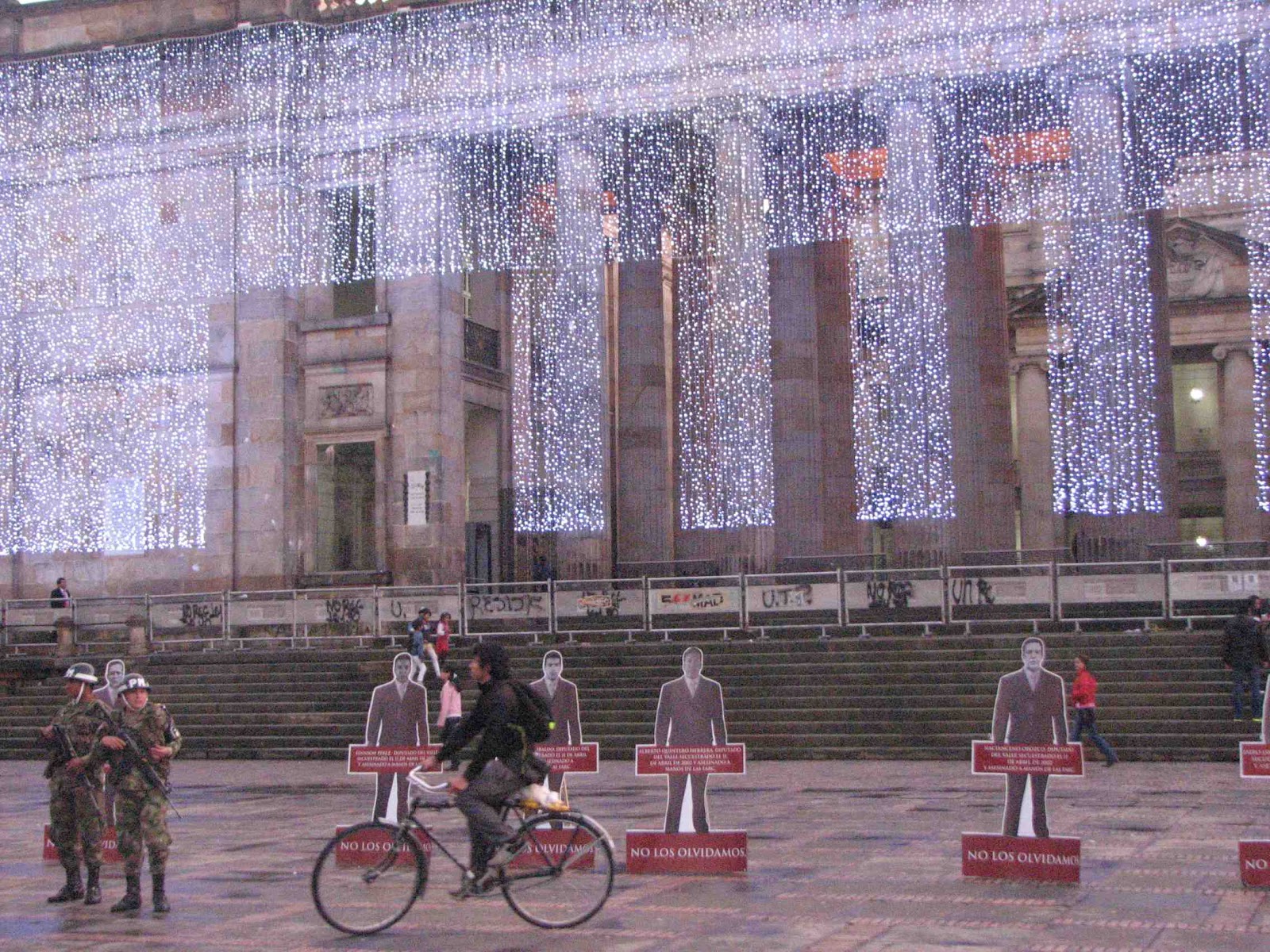
Mounted police stand in the Justice Palace above a sign referring to the military's successful 2008 rescue of guerrilla hostages, called Operation Checkmate. The graffiti and paintball marks are from recent protests by public university students.  
Photographs represent 11 deputies from the Cali area
 whom the guerrillas kidnapped in 2002 and murdered
 in the jungle in 2008.
The guerrillas began in the 1950s as peasant armies fighting for the landless, but long ago lost their way. They now commit monstrous human rights violations, including kidnapping, recruiting children, driving peasants from their homes, planting land mines and forcing women guerrillas to have abortions. Colombia's government and military have also violated human rights - but at least a legal system exists to enforce some accounting on their part. You can't say the same about the guerrillas, for whom violating rights is standard operating procedure. Colombia's is also a very unequal society, with a small, wealthy elite and about half the population living in poverty.

But the FARC are no solution to these problems, and in fact make them worse. I shudder to think what would happen if a vicious organization like the FARC did somehow achieve power.

Displaced people, invisible victims of Colombia's
conflict, demand assistance from the government.
Many are victims of the guerrillas.
But even if one did swallow the idealistic rhetoric on the FARC's websites about revolution and social justice, it's more than obvious that the guerrillas are further than ever from taking over the state, and that they'll never achieve it. So, why not lay down their arms and end this almost half-century of suffering?

And the recent election of Gustavo Petro, one-time leader of the M-19 guerrillas, as mayor of Bogotá shows once again that legal, democratic routes to power exist, even for revolutionary leftists.

47 years of destruction and lies against the
Colombian people - No More FARC!
Refreshingly, this march was not monolithic in viewpoints. I saw demonstrators advocating the Humanitarian Accord, in which the government would exchange imprisoned guerrillas for hostages held by the guerrillas. The guerrillas also advocate the Accord, but Pres. Santos today repeated the government's opposition. The government says an exchange would only encourage more kidnapping and free guerrillas to continue killing and kidnapping. Other demonstrators urged us to find the solution in Christ. But Colombia is a highly-Catholic nation, so it's unclear why Christ hasn't already helped it.

Despite being weaker than ever, the FARC have shown few signs of openness to negotiations. But, with a huge income from the illegal cocaine trade, the government will have a hard time defeating them militarily. The strongest blow Colombia and the world could deal Colombia's guerrillas (and the Taliban and many other violent groups) would be to legalize and regulate illegal drugs.

A group carries a Virgin Mary statue across Plaza Bolivar. 

Christ is the real solution, says this banner. 


The El Tiempo newspaper building dressed in white. 


A man shows off a T-shirt with FARV written on it, a reference to evidence that Venezuela has supported the FARC guerrillas. 

A homeless man stands in front of figures of deputies from Cali murdered by the FARC in 2008.


This man's sign called for the government to agree to a prisoner exchange with the FARC guerrillas. 


This couple displayed photos of their disappeared son.

People sit watching on the edge of the Justice Palace. 


Police pay tribute to fallen comrades. 

Repent and convert - Jesus Christ is coming soon. 

Mounted police, called carabineros, stand above a sign calling for the Humanitarian Accord, which the national government opposes. When I returned to the plaza in the evening this sign had been taken down, altho by whom I don't know.

Demonstrators call for a prisoner exchange between the guerrillas and the government.
A telescope, trained on Monserrate, appears to be aimed at a dove. 


A snack vendor tries to interest the bored anti-riot police. 

By Mike Ceaser, of Bogotá Bike Tours