Wednesday, July 4, 2012

Shifts in the War on Drugs?


Peña Nieto: Reconsidering the drug war.

When, a few months ago, Colombia and other countries put the War on Drugs up for discussion at the Americas Summit in Cartagena, some people predicted it would open the door to reassessing the prohibitionist policies. 

Three recent events make me suspect that's started happening.

- Last week, Colombia's high court brought back the right to carry a 'personal dosis' of drugs.

- Meanwhile, the Uruguayan government is planning to grow and market marijuana, in order to take the profits away from violent criminal organizations.

- Finally, and perhaps most importantly, Mexican president-elect Enrique Peña Nieto told PBS News Hour that "I'm in favor of opening a new debate in the strategy in the way we fight drug trafficking. It is quite clear that after several years of this fight against drug trafficking, we have more drug consumption, drug use and drug trafficking. That means we are not moving in the right direction. Things are not working."

That's not good news for Washington, which has backed current Mexico Pres. Felipe Calderon's Colombian-style war against Mexico's drug cartels. That strategy has generated huge amounts of violence in Mexico, while producing questionable impacts on the illegal drug trade.

Mexico seems likely to shift strategies under Peña Nieto, whose PRI party has historically made deals with narcotrafficking cartels to reduce violence. The question is how explicit and how dramatic this shift will be, in the face of inevitable criticism from Washington. 


By Mike Ceaser, of Bogotá Bike Tours

How Slanders Start


Piedad stands by her man. 

The other day, Colombia's leftist ex-senator Piedad Cordoba gave an interview in which she charged that Venezuelan opposition presidential candidate Henrique Capriles had recieved aid from Venezuelan businesses in Colombia and from Colombian ex-President Alvaro Uribe.

All of which sounds very believable. Venezuelan businesses, whereever they may be, certainly have a right to support the Venezuelan presidential candidate of their choice, and that's not likely to be the leftist Chavez. Uribe's politics are just as predictable - his hate for Chavez verges on paranoia. But I'd bet that any support from Uribe would cost Capriles more votes than it would get him. 

Cordoba apparentely offered no evidence or examples to back her claims. But that didn't stop her interview from generating sensationalist headlines. Ultimas Noticias, which I remember as a generally balanced Caracas newspaper, headlined its story: 'Cordoba Asserts that Capriles is Advised by Narcos,' and reported that Capriles was 'advised by businesses related to narcoparmilitarism in Colombia.

But I've read about a dozen news stories about Cordoba's comments - most of them, admittedly, copies of Ultmas Noticias' story - and found not a single quote from Cordoba actually making this assertion. (I can't find the original video at all).

Yes, ex-Pres. Uribe has been credibly linked to paramilitaries, and he has consulted with Venezuela's anti-Chavez opposition. And Venezuelan businesses in Colombia (where many have come fleeing Chavez's policies) most likely support Capriles. But this doesn't add up to Capriles being advised by narcoparamilitaries. And, in any case, Cordoba apparently didn't even say this.

But the headline's there, anyway, and will come up in Google searches forever. 

It reminds me of responses I got to a blog post about Wikileaks founder Julian Assange's seeking asylum in Ecuador, whose government has been no friend of free speech. One critical commentator claimed that the Swedish women who have accused Assange of sexual crimes of 'having connections to the U.S. CIA.', again offering no evidence. When I asked for evidence, a commentator pointed me to some Internet pages saying that the women had written articles critical of the Cuban government on websites or other publications supposedly supported by the CIA. Those publications may or may not actually be backed by the CIA, but that's beside the point.

There are plenty of reasons to criticize the repressive Cuban dictatorship, and doing so doesn't make you a CIA tool - even if you do it, probably unknowingly - on a CIA-backed website.

Returning to Colombian ex-Sen. Cordoba, who can't seem to resist defending everything the Chavez government does: The Venezuelan government appears to have gotten caught red-handed meddling in another government's internal affairs with a video showing Venezuelan Foreign Minister Nicolás Maduro meeting privately with a group of Paraguaya's top generals just before that nation's parliament tried and convicted its leftist Pres. Fernando Lugo and replaced him with the country's vice president. Officials in Paraguay's new government allege that Maduro was urging the generals to rise up and block the parliament's action. Whatever the legality of the Parguayan parliament's dubious ousting of Lugo, one country's foreign minister's meeting with another's generals in the midst of a crisis seems even less acceptable.

But Cordoba had no doubts about Maduro's actions, and called the accusations against him "anecdotes." Maduro "represents a new form of diplomacy," she said, adding: "I am absolutely convinced that this doesn't involve the most minimal interference in another country."

Perhaps Cordoba should bcome Venezuela's media spokeswoman.


By Mike Ceaser, of Bogotá Bike Tours

Invisible in Life, but Remembered in Death

In life, Juan de Dios Mira was just one more of the homeless people living along the railroad tracks near Palo Quemao in Bogotá's Los Martires district. But in death his friends, one of whom is sleeping on the sidewalk nearby, remembered him, and made this simple but colorful memorial. 


By Mike Ceaser, of Bogotá Bike Tours

Monday, July 2, 2012

Marching Powder

Inmates in Bolivia's San Pedro Prison. (All photos taken by Mike Ceaser, around the year 2000.)

Children in San Pedro Prison.
Thomas McFadden would have been just one more guy doing time in a Third World prison for trying to make fast and easy money smuggling drugs - except that McFadden got locked up in La Paz, Bolivia's hyper-corrupt San Pedro Prison and befriended Australian lawyer-turned-writer Rusty Young. 

The result, Marching Powder, is a memorable account of McFadden's years in San Pedro. Marching Powder may not match the grueling prison accounts like Papillon and Midnight Express, but it does capture the craziness and corruption of Bolivia and San Pedro prison - where prisoners hold the keys to their own cells, manufacture cocaine and sometimes sometimes do prison tours for foreigners. 

And Marching Powder, of course also provides an implicit commentary on the War on Drugs.

In San Pedro's kitchen. 
Rusty Young during a visit
to Bogotá two years ago.
From the book's beginning, when McFadden is betrayed by a police official whom McFadden has bribed to let his cocaine shipment thru, to the book's end, when McFadden pays off judges to let him off of a trumped-up drug charge, this book is about corruption. I lived for several years in Bolivia and visited San Pedro Prison multiple times, and throughout the book I kept telling myself: 'Yep, that's Bolivia!' 

The prison's swimming pool. McFadden describes an
episode in which a mob murders three alleged
child rapists in this pool. 
San Pedro, with its stores, families, churches and neighborhood organizations, is arguably a more humane place to be locked up than many normal prisons - A french drug trafficker and mercenary doing time there told me 'This would be the world's best place to be imprisoned - if you could only get your sentence.' Indeed, the prison seemed to be full of inmates who'd spent years there without being getting their trial, much less sentence - one of the disfunctional systems' myriad arbitrary and wholesale human rights violations. McFadden's experience starts with him being thrown into a cell and forgotten, apparently a strategy meant to force him to confess, then later deposited in San Pedro, where he crawled into a bathroom to sleep and was beaten up by other inmates who believed that he was from the U.S. (the country which inspired Bolivia's hated drug laws).

A prisoner relaxes in his cell. 
Clothes drying in crowded San Pedro Prison. 
After his initial crisis, McFadden actually flourishes in prison. Marching Powder drew me in with its accounts of McFadden's entrepeneurial efforts in prison, including opening businesses, operating criminal projects and doing tours for foreign tourists. At one point, McFadden even finds work in a prison cocaine factory in order to 'keep myself out of trouble.' But prison was all fun for McFadden. His conflicts with other inmates, particularly the evil Fonsecas, and the tragedies of unfortunates shipped off to die in the cold and barren Chonchocoro prison in the altiplano, are also gripping. But I could have used less about his love affair with an Israeli tourist, which wasn't so different from a love affair anywhere. On the other hand, I would have appreciated much more about other inmates: their crimes, their backgrounds, their roles in Bolivian society. When I visited San Pedro a decade ago, I recall hearing accounts of campesinos doing long sentences because a small plot of coca bushes, the base ingredient for cocaine, had been found on their land. In some cases, the drug crop may not even have been theirs. Others, called mulas, had been caught transporting small packages of drugs, from which someone else would make most of the profit, but they'd pay any penalty. These sorts of impoverished people are the ones who get trapped by the system, railroaded, and end up living in San Pedro with their wives and families.
A French mercenary works on art in his cell
in San Pedro Prison. 
In San Pedro's carpentry shop. 
This prompts me to ask what ends imprisonment in San Pedro Prison achieves: Does it punish criminals? Protect society from criminals? Preserve human rights? It's hard to argue that it accomplishes any of these things, altho it clearly does provide great criminal training and ruin lots of lives. Does Bolivia's penal system fight crime, and the drug trade specifically? Sure, McFadden suffers in prison - but he keeps on dealing. (The book at times reads like a how-to manual for drug smugglers). And, for every smuggler that gets caught, many must successfully bribe or sneak their way thru and enjoy the profits. On the other hand, San Pedro is full of people doing time for petty offenses or none at all, simply because they are poor and powerless. All of this at huge human and financial costs for an impoverished nation.

While reading Marching Powder, I also wondered about the experience of the author, Rusty Young, a young Australian lawyer, whom I met in Bolivia (where he struck me as too much of a cokehead to ever write a book), and again here in Bogotá. Young gets portrayed as something of a hero in the book for helping McFadden beat a second, trumped-up charge and finally leave prison. I would have enjoyed a chapter describing Young's own impressions first-hand: It's not every day that a lawyer from a rich nation pays to spend time in a corrupt third-world prison.

Lunchtime in San Pedro. 
And I spent much of the book wondering about McFadden's own background: Was his family poor? Rich? How did he get into drug-smuggling? Why? What happened to all the money he must have made? McFadden evidently had a long exprience running drugs to Europe, but he provides no details. Perhaps he left this out for legal reasons, altho it seems as tho the years and statutes of limitations would make earlier crimes irrelevent. This lack is the book's single greatest failing, in my opinion. 

The source of the trouble: Coca bushes. 
It's hard to feel very sorry for McFadden, who made quick money thru bribery and smuggling an addictive substance knowing full-well the possible consequences. While incarcerated, McFadden got the assistance of the British consulate and a UK prisoners' rights organization, was aided by friends back home and got the love of a beautiful Israeli girl - not to mention plentiful and cheap cocaine and marijuana. That many people who've committed no crimes at all should be so lucky!

A La Paz graffiti says 'Don't fall asleep - chew coca.'
I also looked unsuccesfully for some remorse or reflection from McFadden about his trafficking. He says that before San Pedro he'd never tried cocaine, a claim which seems dubious (but if true is another condemnation of the prison system). McFadden seems to have enjoyed San Pedro's plentiful drug supply, altho without those daily highs he might have used his prison time more productively, perhaps by studying something. In San Pedro, he witnesses pathetic cases of drug addiction - just as he must have seen in the outside world. Yet McFadden never reflects on the human impacts of his profession, and in fact continues shipping drugs from prison.  

Headed to San Pedro? A Bolivian coca farmer whose plot has been erradicated. 
Naturally, I also wonder what McFadden is doing today. I suppose that if I had to guess, judging by his long experience and his continued success smuggling drugs while in prison, I suspect he might back at his old profession.  

With its imperfections, Marching Powder is an interesting and entertaining book which will open your eyes. 


Protesters, many of them coca farmers, in Cochabamba, Colombia. 

Protesters, many of them coca farmers, march in Cochabamba, Colombia. 

Schoolgirls in San Pedro.

By Mike Ceaser, of Bogotá Bike Tours

The National Museum's New Face Revealed


After close to a year of construction, they've removed the walls and revealed the National Museum's new front - which looks a lot like the old one, except with wheelchair access. Seems like there must have been a better solution, such as adding a ramp to one of the side entrances. 

In any case, the National Museum, with its mixture of art, history, anthropology and contemporary culture is one of Bogotá's best museums, altho much less known than others, like the Botero and Gold Museums.

Related posts

Carlos Pizarro, Colombian Guerrilla and Martyr


By Mike Ceaser, of Bogotá Bike Tours

Sunday, July 1, 2012

The Minimum Drug Dosage Returns - But Hold Your Fire.


Colombia's high court has ruled that possessing the famous 'minimum dosage' of drugs is a right of personal development for Colombians. This had been true for many years, until conservative ex-Pres. Alvaro Uribe persuaded the legislature to ban the dosage, with the justification that drug sellers were hiding behind the law by carrying only the legal amount on their person. Uribe's Law of Citizen Security imposed prison sentences of 64 to 108 months for possessing up to 1,000 grams of marijuana or 100 grams of cocaine. The court decision depenalizes possession of one gram of cocaine and 20 grams of marijuana.

Even now, buying and selling drugs is still illegal, creating a fundamental contradiction.

And there's also a huge breach between the legal ruling and what happens when a cop stops someone on the street.

One friend says that the cops can confisticate the drugs, but no longer arrest you. Or that they can make you eat the drugs. I understood that the ruling was to replace punishment with rehabilitation for drug users. I suspect that the cops can still do a lot of things, especially if you look like you can't afford a lawyer.

I am also confused by most of the media coverage of the minimum dosage debate, which has focused on the idea that addicts require treatment, not punishment. That's true enough, but ignores the fact that most cocaine and marijuana users, just like most drinkers of alcohol, are recreational consumers who want not treatment, but just to be left alone.

Attorney General Eduardo Montealegre told El Tiempo that he supported the court ruling: "This decision protects the right to equality and autonomy and the free development of a person's personality," he said. "The state doesn't have the right to tell a citizen how he should orient his life. There are areas where personal autonomy takes precedence over the majority opinion."

High police officials and even Pres. Santos have backed decriminalizing and regulating some drugs.


By Mike Ceaser, of Bogotá Bike Tours

A Healthy LGBT Spectacle?

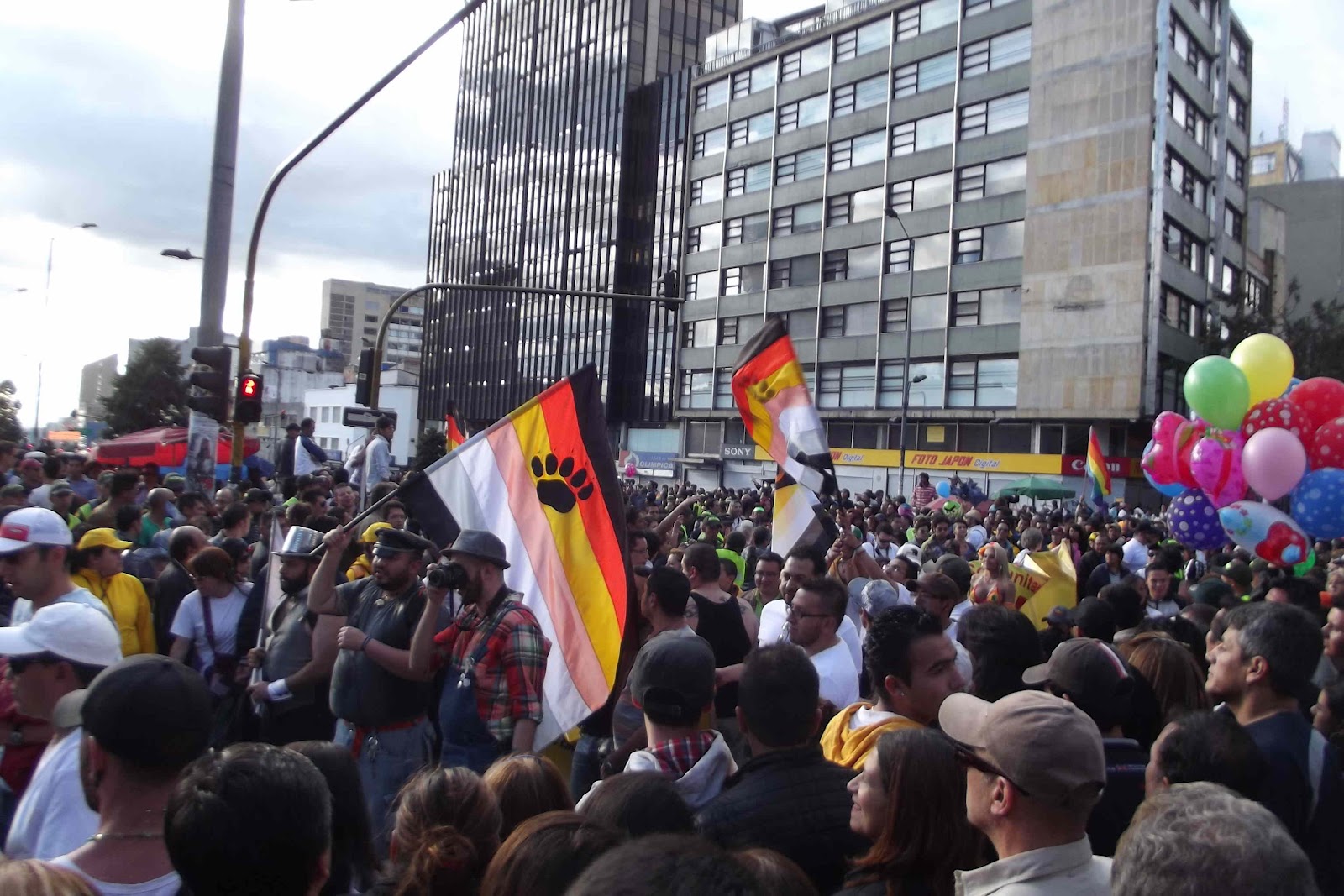
Bogotá's sexual minority, or LGBTI community, held a big, colorful march thru downtown today in protest against bullying, which has recently received attention here, as it has in many countries. 
Bullying is an ugly thing, and hopefully this march will help reduce it. But I generally ask the same thing about these gay parades, which attract huge crowds of oglers, most of whom presumably are not gay. 

Members of sexual minorities should have equal rights and be treated with the respect due anybody. But do these public spectacles contribute to that? For the sake of employment or residence, a person's sexual orientation should be no more important than whether they are left or right-handed or blue- or brown-eyed. And, undoubtedly, countless gay and lesbian people are our neighbors or co-workers without us knowing it or caring about it if we do. 
The shirt says 'All couples deserve equal rights.'
But spectacles like today's, with extravagantly-dressed transgender beauty queens dancing thru the streets dressed like characters from a fantasy movie or escapees from a freak show, do anything BUT contribute to the idea that LGBT people can also be ordinary friends, neighbors, schoomates and co-workers. Rather, they contribute to a stereotype that these are freaky individuals so different from the rest of us that they serve only as curiosities.


By Mike Ceaser, of Bogotá Bike Tours