Monday, November 5, 2012

Faith and Passion on Plaza Bolivar


An impassioned believer raises her arms. 

'Bogotá, city of God - Halleluya!' Perhaps not everybody would agree. 

The preacher had a real talent for moving the crowd. Of course, they came to be moved. 

Flags waving in front of Plaza Bolívar's Christmas tree. The event mixed faith and patriotism. 
As if there was too little noise, a man hawks colorful horns on the Cathedral's stairs.

The event was organized by the Bethesda Missionary Center, which advertised on this pay phone. So, yes, pay phones are still good for something. 

This man appears all over selling Bibles on CD.


Capitalism and faith do mix. This man was selling flags to believers. 

Pigeons scared by the yelling fly in front of the Justice palace. 

Arms raised on the Cathedral's steps. 


A woman wheels away an old man in a wheelchair. 

A vendor arrives carrying cobs of corn on her head. 
By Mike Ceaser, of Bogotá Bike Tours

Sunday, November 4, 2012

Obama, Romney and Colombia

U.S. Pres. and Democratic Party
candidate Barack Obama.

Which of the candidates to be president of the United States would be better for Colombia?

Historically, Colombians have usually hoped for Republican presidents in the White House, based on the belief that they'd provide more aid. In fact, in 2008 Colombia was one of the few nations where a majority of the people supported John McCain over Barack Obama.

Analysts interviewed by El Tiempo in today's paper generally agree that Obama's better for Colombia this time, mainly because of the government's incipient peace negotiations with the FARC guerrillas. That's in part because of the participation of the socialist states of Cuba and Venezuela in the negotiations. The Republicans have opposed many contacts with those countries' governments (except, of course, for buying lots of Venezuelan oil and selling it anything and everything it wants), so a Romney victory might cool the U.S.'s backing for the peace negotiations, which are to be held in Havana. This would be particularly true if a Romney administration, like Bush II, appointed anti-Castro Cuban emigres to high positions.

Republican Party presidential
candidates Mitt Romney.
On the other hand, Romney has promised to increase U.S. defense spending, which could translate to more military aid to Colombia. If the FARC believe that, it could serve as a stick telling the guerrillas to make concessions - or else. But it's questionable to what degree Romney would follow thru with these military increases, as with so many of his promises, in a time of budget austerity and when U.S. citizens are weary from two less-than-succesful overseas conflicts. And that's particularly true for Colombia, which has gotten almost no attention and is already considered a success story.

Another likely difference in a Romney administration would be its approach to the War on Drugs. While this hasn't been much of an issue during the campaign, it's safe to say that Republicans support prohibitionism, aggressive drug crop erradication and interdiction, while Democrats put more emphasis on treatment and less on imprisonment. Obama, who reportedly tried illegal drugs in his youth, has been disappointingly timid in many of his policies. But I harbor hopes that in a second term, when reelection is no longer an option, he'd be more daring. A recovering economy, too, would give him more manuevering room. So, perhaps, some degree of drug depenalization, as Pres. Santos has suggested, could become an option. As any reader of this blog knows, I believe that depenalization is worth trying, because it would take profits away from the violent groups which have done so much harm to Colombia and much of the rest of Latin America.

Romney has also said he'd open up more trade with Latin America. But it's difficult to see how he'd do this, since the Obama administration has already signed several free trade agreements, including one with Colombia. But Romney, a wealthy businessman who clearly favors big business interests, would likely pay less attention to human rights and environmental concerns.

Finally, there are also general issues which don't directly affect Colombia or Latin America, but for which the U.S. wields great influence. In protection of the environment, action against global warming and policies favoring the middle class, Obama is likely to do much better than Romney, it seems to me, and such policies in the U.S. will spread benefits to Latin America and the world.


And there's one more thing: Obama seems to be much more popular than Romney in Colombia and most of the rest of the world. That means something too, for relations with the world's superpower.

By Mike Ceaser, of Bogotá Bike Tours

Saturday, November 3, 2012

When Cigarette Ads are not Ads


Cigarette advertising is not advertising...
To the long list of laws which are worth little more than the paper they're written on we can add the tobacco control law passed in 2009.

...when the cigarette company says it isn't.
I thot of this when I noticed the proliferation of these cigarette advertising displays in many stores. I guess that the cigarette makers have forgotten that the law prohibits all advertising. After the law went into effect last year, cigarette ads did come down in many stores - but the tobacco companies found a way to put them back up, by pretending that all they are are cigarette display cases. The people supposed to enforce the health laws apparently operate under the same delusion.

The owner of one of these stores told me that the law prohibited them from displaying the actual cigarette boxes they're selling in view of customers, which presumably is to keep them out of sight of young people. I pointed out that this law hasn't been enforced at all against the street vendors, who also continue selling loose smokes, which is also prohibited, including to children.

"The law is only applied to us," the storeowner said, "the ones who pay taxes." He's correct.

A street vendor sells loose cigarettes, illegaly,
on Plaza San Victorino
This isn't to say that the law's not a good thing. Tobacco advertising has been eliminated from the radio, and, I presume, from television (I don't have one, so can't say for sure). And the prohibition against indoor smoking is mostly respected, at least in Bogotá. The new health warnings on packs are also graphic and dramatic. (However, these new ads-which-are-not-ads do not carry health warnings, since they're not ads.)

But smoking remains epidemic, particularly among young people, who easily buy tobacco, which kills some 22,000 Colombians every year. Tragically, that death rate, which far exceeds the number killed in the country's armed conflict, is likely to increase.


By Mike Ceaser, of Bogotá Bike Tours

Friday, November 2, 2012

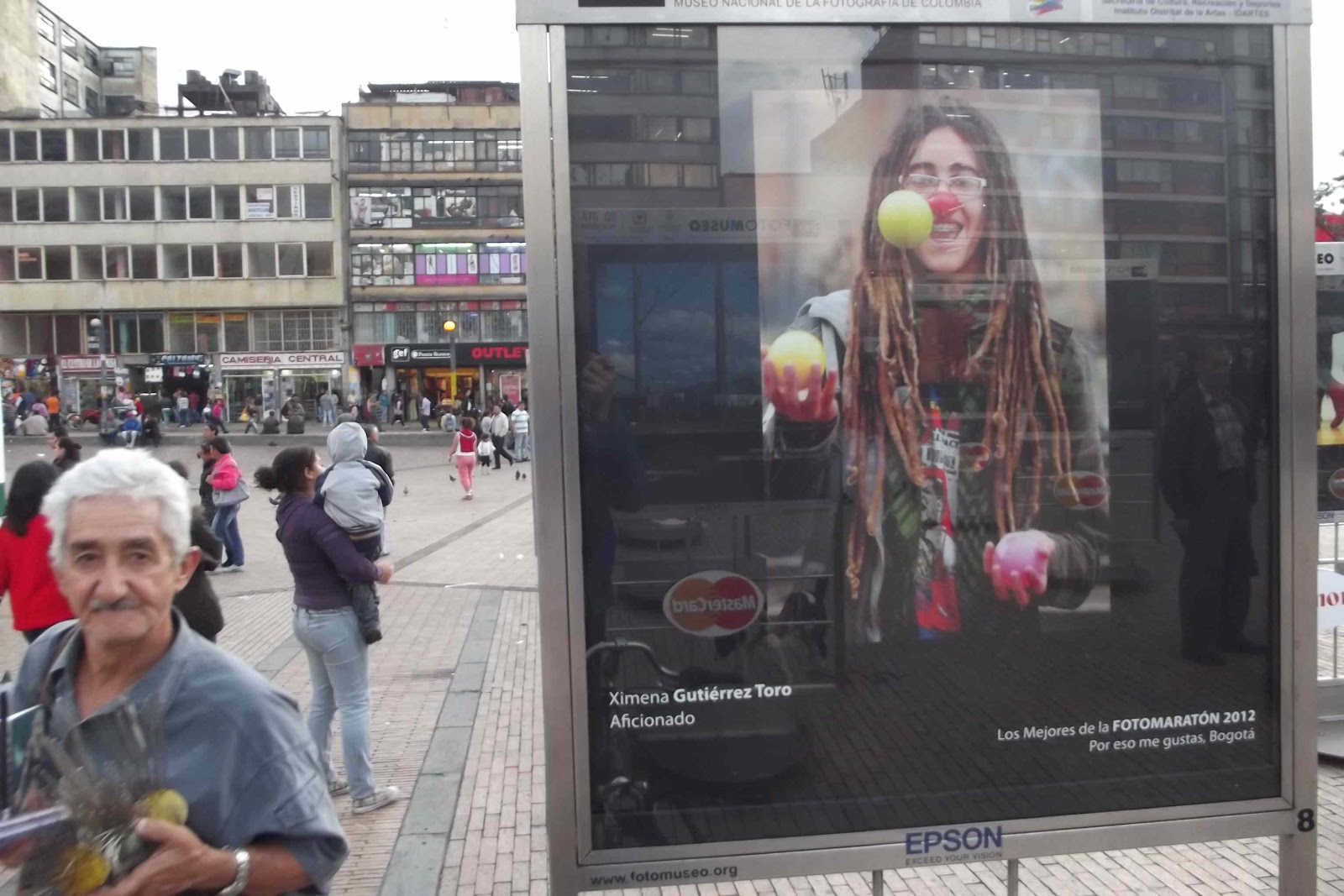
The Fotomaraton hits San Victorino Plaza


And the results are in! The winners of this year's Fotomaraton, 48 hours of photographing by amateurs and professionals, are on display on San Victorino Plaza. I didn't think the pictures were as ingenious and striking as other years'. Rather, most struck me as handsome pics which might make it into a Lonely Planet guide, rather than making some sort of statement or displaying hidden aspect of Bogotá.


This dog, with his 'Smile' sign, is a common sight in downtown.  (Followed by his owner collecting coins.)

One of the few which seems novel. In a forested area near the airport someone hangs clothing to dry. 


A cheery scene of a woman with her baby. The woman looks familiar to me. 


A woman who looks like she stepped off of a London street. 


The La Concordia market in La Candelaria. 


Many of the photos showed La Candelaria, Bogotá's historic center. I regretted that more of the photographers didn't venture into Kennedy, Usme, even Usaquen - altho you can lose your camera in some of those places. I didn't even see any scenes of San Victorino, one of the most colorful and lively parts of the city.

A few San Victorino scenes:

This building was gutted by fire a few months ago. The stores which had been inside hung posters on it with their new locations. 
This building burned down several years ago and has never been rebuilt. 

A busy San Victorino street.

Vendors on San Victorino Plaza. 

A storefront. 

Vendors on San Victorino. 


Sock vendors wait for a final sale. 


The Fashion Station. 

By Mike Ceaser, of Bogotá Bike Tours

A Wiphala Appears Along 26th Street


This indigenous-style flower artwork appeared in front of Renacimiento Park today, along 26th St., beside the Botero sculpture of a fat man on a fat horse.

The piece includes the words 'Let's Creat Dignity', 'Don't Forget' and 'Let's Remember', as well as 'Wiphala', which refers to a multicolored flag now used to represent the indigenous peoples of the Andes Mountains. A similar flag may have been used by the Inca Empire, but that's controversial. In the flower artwork's center is the outline of Colombia.

Does this flower artwork qualify as a Wiphala?


An indigenous Wiphala flag.
By Mike Ceaser, of Bogotá Bike Tours

Thursday, November 1, 2012

Petro's Bogotá to Grow Taller, More Mixed

Children play basketball with downtown Bogotá in
the background. Soon, the towers will be taller.

Mayor Petro made two policy decisions this week, which, if carried out, will mark the city's future permanently.

And they'll make for a better city - if they're implemented well. This means no hectares or even square kilometers of uninterrupted houses. Instead, Petro's Bogotá is to be built of mixed use neighborhoods - streets with businesses on street level and housing above, or at least with business streets and residential ones side-by-side.

A mixed-use street in La Candelaria, with shops,
apartments, restaurants and a university.
Why is mixed-use better? It's good for human, health and even environmental reasons. Mixed use neighborhoods also tend to be more mixed in income and ethnicity, it seems to me. Having shops, services and entertainment next door or a block away is also more practical, and saves time. Such neighborhoods also seem more vital, with more street life and contact between neighbors.

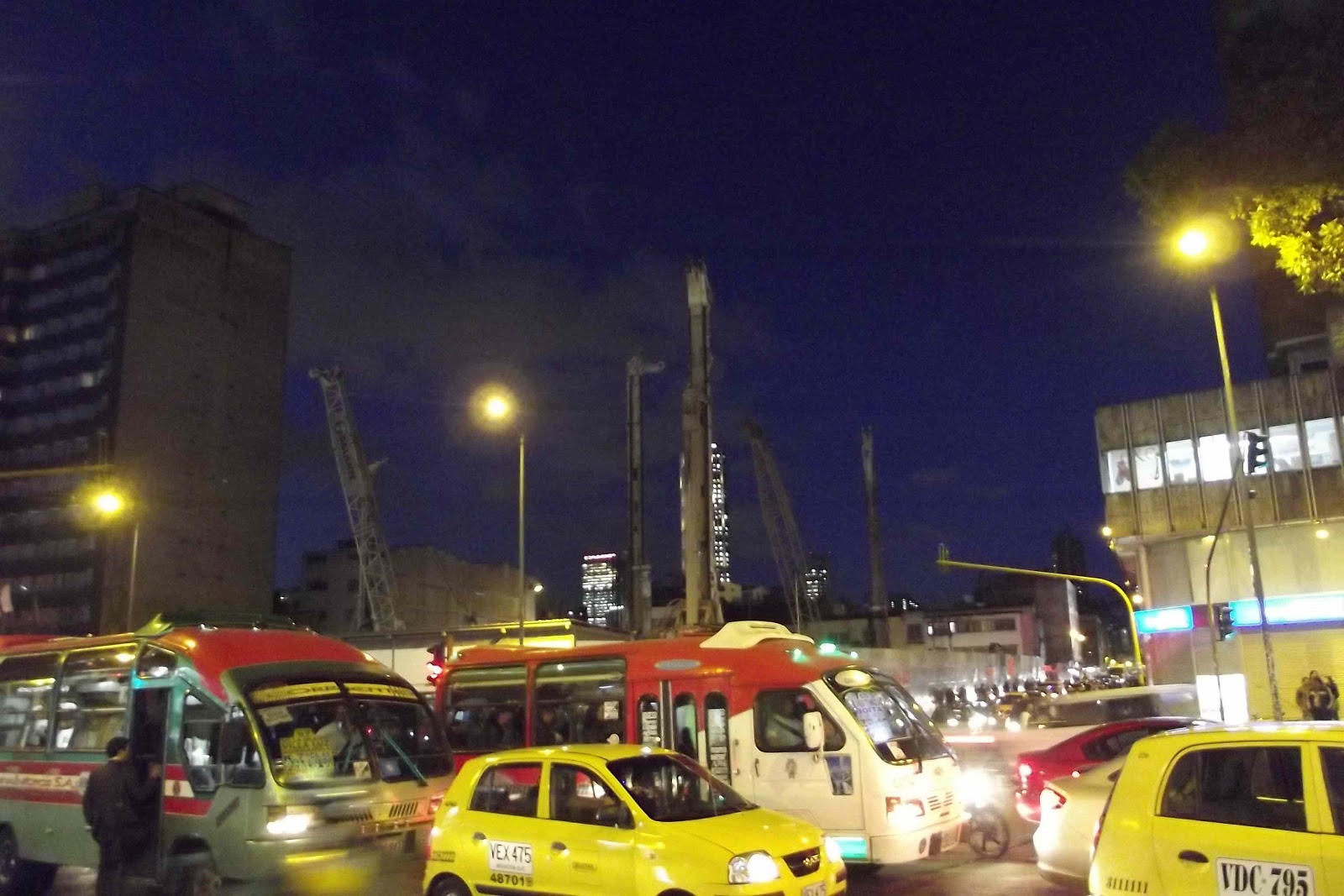
Traffic congestion in front of the construction site of
BD Bacata tower. If traffic is this bad now, what will happen
when the tower's completed?
And, believe it or not, mixed use is also better for the environment and for residents' health. I grew up in a residential suburb in Northern California. Sure, it was pleasant and low-crime. But it was also very monochrome and monotonous. My mother used to repeat proudly that it was the first neighborhood in the region to be racially integrated. But when we lived there there were only two black families, amongst hundreds, or even thousands of houses. And, like all suburbs, ours was so supremely car dependent that people only had to look - out of their car window as they drove past - to see whether someone's car was in their driveway to know whether they were home or not. Want a beer or a liter of milk? That meant driving a mile or more to the supermarket and back. Certainly, the fuel burnt - not to mention the time wasted - was far more than the cost of the milk or beer. And, such an auto-addicted culture is terrible for the environment and for people's health. It's no coincidence that the U.S. has soaring rates of obesity, heart ailments and diabetes- many people never get out of their cars and walk.

The Torre Bicentenario on Plaza del Periodista
is almost finished. 
Mixed-use neighborhoods also build more community spirit. You stop and talk to neighbors on the sidewalk, which seems to me much more like quality time than exchanging honks as while driving past at 30 kph. And you know Doña Julia at the corner store and Don Julio in the chicken restaurant on the next block. A supermarket miles away just isn't the same.

Shops on Ave. 19. Across the street are
 hotels and apartments.
Of course, few people want to live above a bar or beside a nightclub. That's why multi-use neighborhoods also require wise planning policies and intelligent, uncorrupted decisions. Neighborhood codes and residents' participation are fundamental.

A street in La Candelaria, with shops, restaurants,
a dance studio, hostels and apartments. 
Petro's other policy decision, to remove height limits is also potentially positive, if well implemented. Higher buildings increase land values, and, by increasing density, make for a more vital city and make transit and other services more efficient. But too many big buildings and inefficient transit are a formula for urban chaos. That's why growth needs to be wise, carefully-planned growth.

A case in point is the BD Bacata hotel/office/shopping tower being built on 19th Avenue in downtown Bogotá. If completed as planned, it'll be Colombia's tallest building. But the traffic nearby is already chaotic. Such a mammoth building will make traffic a nightmare unless the city takes action, such as building the light rail line planned for Ave. Septima and putting a TransMilenio line or other rational transit on 19th. A subway station would also be great - but Bogotá's first subway line is still at least a decade and billions of dollars in the future.

Fortunately, they still have time - the Bacata's foundation is still being laid.


By Mike Ceaser, of Bogotá Bike Tours

Is Bullfighting Back for Bogotá?

Back in business? Young men train to become bullfighters in the Plaza Santamaria in Bogotá.
A long tradition: A mural in the National University
portrays ancient bullfighting.

The other day, a high court ruled that bullfighting is a Colombian tradition, and therefore municipal governments cannot prohibit it.

The fight over bullfighting is far from over, since Bogotá Mayor Petro has made ending the fiesta brava in Bogotá one of his most high-profile causes. He has talked, for example, of the city's zoning to ensure that the Plaza Santamaria can never again host a bullfight.
Anti-bullfighting activists carry a banner
 on Plaza Bolivar.
But the bullfighters, and their powerful allies in business and government, will defend their profession.


In Medellin, municipal leaders have proposed non-kill bullfighting. But that would take away much of the art for the toreros and aficionados. And

Bullfighting memorabilia for sale on a Bogotá sidewalk. 
the bulls would just be killed afterwards, out of sight, so what's the difference. Apropos of that point, I read somewhere an animal rights advocate's sarcastic proposal that bleachers be set up in slaughterhouses for bullfighting fans. I'm all for the idea - not so much to replace bullfighting, but to improve what very possibly are horrifically inhumane conditions in the meat industry. I have never heard, in any case, of anybody monitoring industrial farming's practices, much less protesting against them.


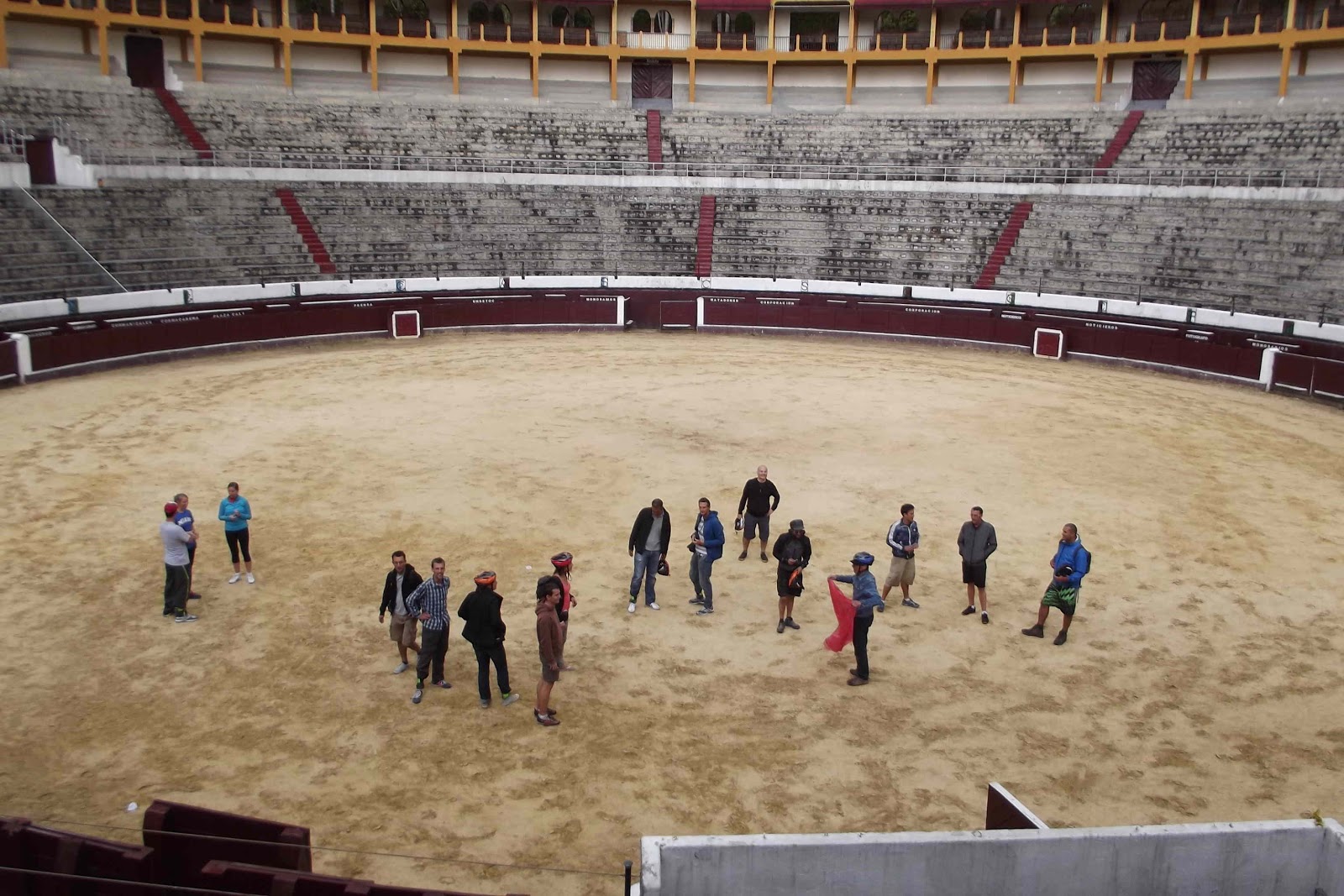
A young bullfighter shows a young tourist how to hold the cape.

An anti-bullfighting banner on the plaza's entrance says: 'There's no going back' on the bullfighting ban. 

Bike tourists in the Plaza Santamaria.

The Moorish Plaza Santamaria in Bogotá.
Bike tourists play at bullfighting in the Plaza Santamaria. 

By Mike Ceaser, of Bogotá Bike Tours