Thursday, March 7, 2013

Women in Painting from Colsubsidio


Today, March 8, is International Women's Day, part of Women's Month. So I visited a new museum for me, the Colsubsidio Museum of Art and Culture in the elegant La Merced neighborhood just south of the Parque Nacional. Until March 31 it's got an exhibition of art portraying women. The artworks are all reproductions, but I can't tell the difference. And, since they're reproductions, you can get close to and even touch them, and don't have security guards glaring at you.

I suspect the exhibition would disappoint some feminists, tho, as most of the works are by men and many are nudes and even downright erotic. Others are cheery, haunting, somber. For a quick tour of great art, the museum's worth a visit, before or after a stroll thru the park. It's open every day but Sunday until 6 p.m.

I also finally learned what Colsubsidio is. It's a fund paid into by a payroll tax on companies and finances things like subsidized products and recreation for the the workers. The taxes also pay for this museum, so it's a good thing these paintings are only reproductions (altho Colsubsidio does also own some original works).


By Mike Ceaser, of Bogotá Bike Tours

Tuesday, March 5, 2013

Hugo Chavez and Me

The death of Venezuelan Pres. Hugo Chavez likely ends an era of firebrand populist leftism in Latin America, creates new questions for Colombia and gives me reason to be nostalgic about some of the most memorable journalism I ever did - or am likely to.

Still, the way he died was a pathetic episode fitting for a man whose rule was both dynamic and destructive for his country.

Caught Up in a Coup

I moved to Venezuela just weeks before the April 2002 quasi coup, which swept him from power for 48 hours before he came roaring back on the shoulders of loyal military men. That was great journalism, and sort of makes me wonder whether this man, who overcame his enemies time and again and became such a presence over Latin America, could now just return from the dead like the messiah he seemed to believe himself to be.

Covering the coup and counter-coup in an unfamiliar city full of paranoia and confusion was naturally an unforgettable experience. I had just moved to Caracas, knew almost nobody, had no home Internet connection, and had only an old laptop whose floppy drive was broken - fatal in those pre-USB. When the turmoil began I was at the mercy of taxi drivers whose priority was not to find me an open internet cafe, but to maximize their fare by driving me across town and back.

Read All About It! Selling El Tiempo's
special edition about Chavez's death.
Still, frantic and confused, I managed to work. I participated in the huge marches which culminated with Chavez's kidnapping by coup leaders, who spirited him off to a Carribean island. But the coup quickly turned tyrranical, as its leaders - who included businessmen and Catholic Church officials - suspended the Constitution and civil rights. Even people who had wanted Chavez out agreed they didn't want this, and popular opinion and loyal military brigades brought him back.

One evening, amidst it all, I was in a taxi headed towards Miraflores, the presidential palace. Frantic crowds were milling around in the streets. On the tops of high-rises were sillhoueted figures. Were they snipers? Both sides were charging that their supporters had been shot by snipers. Suddenly, the taxi driver stopped, still blocks from the palace. He was too scared to continue.

I got out, into the crowd, and an editor called from a U.S. newspaper.

"Who's in control there?" he asked.

"How can I possibly know?" I replied.

I went home, wrote frantically, and then raced to an Internet cafe, where I retyped the stories from my laptop's screen and sent them in. Often, I did this while surrounded by teenagers chatting and playing video games, oblivious and uncaring about their nation's fate.

One evening near the end of this drama I was in an Internet cafe frantically writing a story, when an employee approached me.

"Would you mind changing machines sir?" he asked. "Then you can continue chateando."

"Chateando??!!!" For the love of god, I protested, I was not chatting, but documenting their nation's drama for the world. But the young kid didn't care. I had to change machines, losing valuable minutes. But, a few minutes later, he was back again.

"Sir, the boss has asked for you to leave."

"What! Why?" I almost screamed. "I'm very busy."

The employee was unmoved. "The other customers are complaining," he told me.

My further protests didn't help, and so, furious and panicked, I saved my work and ran out the door.

Miraculously, there was another open Internet cafe across the street. Here, however, several people were sitting waiting for computers. The minutes until deadline counting down in my head, I sat down beside another foreigner and proceeded to tell him my story, hoping for sympathy and assistance. He nodded with understanding.

"You don't smell too good," he observed.

Of course. I hadn't showered or probably even changed clothes for three days.

But the man was helpful and let me move ahead of him in line. This Internet cafe was less olfactorily sensitive and I was able to finish and file my stories just in time.

Later, I did a memorable investigative story about links between the opposition groups involved in the coup and U.S. 'pro-democracy' financing, which won me points with Chavistas.

A Hollow Revolution

I had moved to Venezuela with real hope that Chavez's 'revolution' offered real answers for the poor of Latin America, a region where tremendous poverty coexists with wealth and abundant natural resources. But, as time went on, Chavez's 'revolution' seemed to me like more and more of a fraud, designed more to buy power and votes than to help his country. I visited a literacy program in which the readings consisted of propaganda about the wonders of Chavez and the evils of the opposition. A few years later, the government boasted that illiteracy had been eliminated. That would have been news to many of my neighbors if they could only have read enough to understand it.

I visited public hospitals where the elevators and air conditioning didn't work, the intercom system had been stolen and basic supplies such as gauze and alchohol simply didn't exist. Chavez did import Cuban doctors to work in poor barrios. that program undoubtedly did some good, but I had doubts after interviewing leaders of pro-Chavez medical organization whose policy was supposed to be prevention. They were all obese, and I had to ask them to please put out their cigarrettes, as the office's air was stifling with smoke.


A Killing on the Border

And then there was the crime. During my last several months in Caracas, three or four people were murdered in the lower-middle-class street where I lived. And the galloping inflation, about which my neighbors, many of whom were poor, struggling people, complained constantly. All sort of corruption also spun out of control in Chavez's Venezuela. It seemed as tho nearly every cop and border official was looking for a bribe.

One time, I was returning to Venezuela from Colombia, crossing the border in the semi-desert La Guajira region. There, I passed the Colombian border post, crossed a forested no man's land where money changers hung out with wads of bills, and then came to the Venezuelan border post. At the Venezuelan post, the guards proceeded to search my few bags until they discovered my old laptop.

"Look, he's got a laptop," they announced, as tho it were a bomb. "What's the meaning of this? We must report this to our chief."

I knew that there was nothing wrong with having an old, used laptop, especially when you're a journalist. But I also knew that if these officials wanted to mess with me, they could, and they would, until I forked over a bribe. While I pondered we to do, we suddenly heard gunshots come from the no-man's-land. Robbers had run out of the forest, shot and robbed one of the money changers and disappeared back into the trees.

The border agents, ashamed to be trying to extort a petty bribe while people were being murdered in their area of responsibility, told me to take my laptop and go. I did, feeling very bad.


A Revolution Run on Free Gasoline

But to an environmentalist like myself, probably the most infuriating and hypocritical of Chavez's policies was his gasoline subsidy, which pushed the price of a gallon of gas down to just a few cents a gallon - and had it constantly dropping.

The results are obvious: waste, pollution, endless traffic jams - and all for a subsidy which took money which could have funded schools, police and hospitals and gave most of it to the rich (and to Colombians, who buy smuggled gasoline). Of course, Chavez didn't let his own policies stop him from warning the world about environmental destruction and climate change, and denounce the United States for burning oil irresponsibly.
Meanwhile, by tilting the electoral playing field, eliminating government checks and balances and getting rid of term limits, Chavez was turning himself into an elected autocrat.

while living all of this, I recieved a steady stream of hostile e-mails from idealistic young Chavistas celebrating La Revolucion - from far away in the U.S.


A Yanqui-Caused Cancer?

Now that Chavez has died - soon after getting himself reelected by assuring his people that he was cured of cancer - there will probably be elections, and Chavez's hand-picked succesor Nicolas Maduro will probably win. (Maduro showed his stripes tonight with a long tirade about how the opposition had certainly caused Chavez's cancer. The proof? That Israel supposedly poisoned PLO leader Yasser Arafat.
Anyway...)

It was only the latest evidence-less assassination charge against dark powers. Much more likely, Chavez's cancer came from the cigarettes he smoked, or the air polluted by his populist policies.
Vice President Maduro, altho uncharismatic, will likely win an election thanks to sympathy for Chavez and the fact that the state has been transformed into a Chavista electoral machine.

Maduro will inherit lots of problems from El Comandante Chavez, including huge budget deficits, the region's highest inflation and soaring crime rates, particularly homicide.

Chavez's death removes a charismatic leader and deep-pocketed financier for the region's leftist regimes in Bolivia, Argentina, Ecuador, Cuba and Nicaragua.

As for Colombia, Chavez's death raises lots of questions. He evidently was supporting the government-FARC peace negotiations in Havana. Will his succesor have the desire or the stature to do the same? During Chavez's 14 years in power, Colombia and Venezuela had many confrontations, altho relations have recently improved. Who knows what Chavez's succesor might do. Will he be more ideological? A guerrilla sympathizer? Will he blame Colombia for all of Venezuela's ills?

Time will tell.


By Mike Ceaser, of Bogotá Bike Tours

Monday, March 4, 2013

Fading Grandeur: La Iglesia del Voto Nacional

A grand, elaborate and nearly vacant church.

Some photos I took today of the Iglesia Voto Nacional on Los Martires Plaza. This weekend the Los Martires district held its annual festival and you can still see the band's stage on the plaza.

Los Martires has been in the news recently because of the city government's efforts to impose order on the adjoining street of perdition known as El Bronx.

The neighborhood played a fundamental role in Colombian history. Revolutionary battles took place in the area. And during the revolution, the Spanish executed many Colombian patriots in the area. After the disastrous 1,000 Days War, the Iglesia del Voto Nacional was constructed in 1902 to show the nation's gratitude for peace and hopes for a peaceful future. (Voto means 'vow.') Tragically, it didn't work, since and Colombia's internal armed conflicts have continued.

Over the last century, the neighborhood around the church has declined economically. The Plaza, which memorializes some of the country's greatest martyrs, is the haunt of homeless drug addicts. But the church preserves a lot of its original grandeur. Sadly, however, few parishioners were there to appreciate it today. However, a church employee told me that many people do come for Sunday mass, including even the Italian ambassador.

The Iglesia del Voto Nacional on Los Martires Plaza. 
The neighborhood around the church, once wealthy, now has relatively few residents, and many of them drug addicts, who are less than devout. But the Bogotá city government has plans to bring new life and residents into the city center, which could also bring more congregants to El Voto Nacional and the center other mostly-empty churches.

The employee also told me that the church's exterior structure was recently repaired. Now, they're looking for financing for the interior of this landmark of Colombian history, culture and faith.

During today's mid-day mass fewer than a dozen people sat in the pews, which had room for perhaps a thousand. But a woman attending the door said that on Sundays many people come. 


Soldiers stand by Los Martires' Plaza's monument to Colombia's martyrs. 

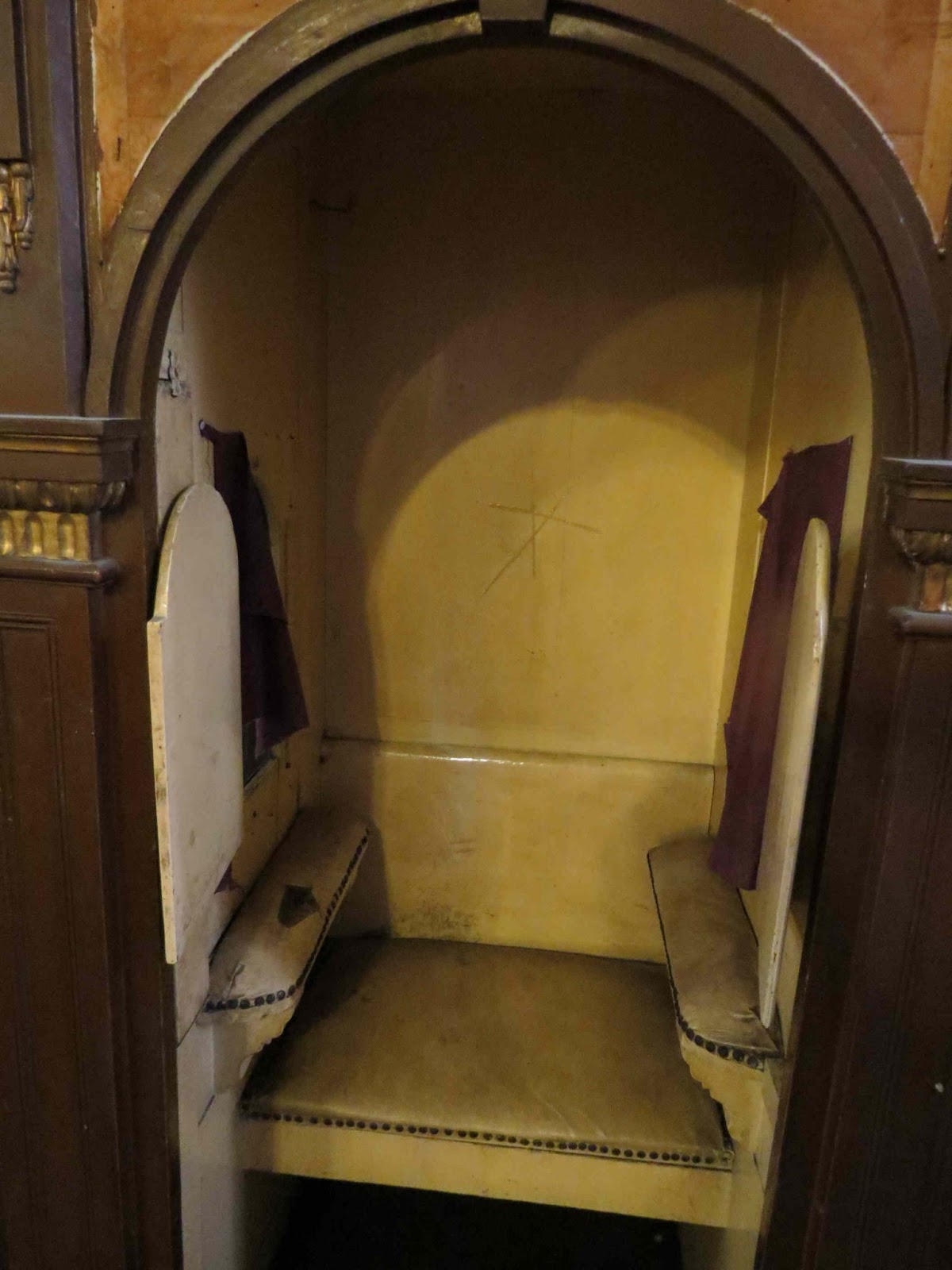
A seat waits for the priest to hear confesion. 
The priest appears tiny before the church's elaborate decorations. 
The infant Christ, backlighted in a window. 


The church's ceiling paintings badly need cleaning and restoration.... 

...as does this one on a wall. 


A saint in a stained glass window. 
The Voto Nacional's arched entranceway.


Believers' candles. 


Will these empty pews ever be full again?

By Mike Ceaser, of Bogotá Bike Tours

Remembering the Disappeared

A group of human rights activists painted this mural today on Ave. Septima just south of Calle 19, on one of the most-used walls in the city. The mural, which says simply 'More than 20,000 disappeared,' is an in-your-face reminder of human rights violations which most of us prefer not to think about.

The woman on the right is Nydia Erica.
You can debate the numbers, as well as the group's political perspective. During their lively accompanying hip hop performance, the lyrics condemned the government and big corporations, but I heard no mention of Colombia's leftist guerrillas, who continue committing wholesale human rights violations. 


Rapping away.
The group calls itself Beligerarte, and is associated with the Fundacion Nydia Erica. She was a member of the M-19 guerrilla group, who the painters told me was disappeared in 1987, two years after the group's disastrous attack on the Justice Palace. The number of disappeared in that episode is still the center of public controversy.

Some claim that 12 survivors were 'disappeared' by the military. Other sources say only two. But a lawyer representing Colombia before an international human rights court recently made headlines by claiming that there were no disappeared in the episode. 

The group said this was the first of several public events memorializing the disappeared which they plan to carry out this year. When I asked them why they chose this year, they said 'Better this year than next year.'

A good point.

Drumming away. 


The tile says that 12 people were 'disappeared' by the military during the retaking of the Justice Palace in 1985. Other sources say there were only two documented disappearances. 


'More than 20,000 disappeared.'

By Mike Ceaser, of Bogotá Bike Tours

The Man Who Would Be God


Amen Ra. Who says he's not God?

'You can't preach that here.'
I met Pablo Fajardo, AKA Alexander Hamilton, AKA Amen Ra (in chronological order) the other evening in La Plaza del Chorro, where he stood in the chapel doorway preaching in his powerful, stentorian voice about god to a few bystanders, who were ignoring him.

It turns out that Ra, who said he was born in Colombia in 1973 and adopted by a British couple, but ended up somehow in Houston, Texas, believes that he is God.

He even says so himself - and who should know better?

"I am God," he declares, loudly and fervently.

Ra told me that he was born Pablo Fajardo, his adoptive parents renamed him Alexander Hamilton (one of the U.S.'s founders and an advocate of big business) and that he named himself Amen Ra. I'm not sure when he realized that he was God.

Unless he really is God, Ra also has a slightly exaggerated view of his own role in the world. In Houston, he says he protested against the war in Iraq - and singlehandedly stopped the war. That was why, he says, he was expelled from the United States. I suspect that U.S. authorities would tell a slightly different version of the story, perhaps involving crimes committed by a non-citizen alien. Ra told me that he had had some trouble with the law, including stealing a Nintendo game console. A non-citizen who commits felonies can be deported from the U.S.

He seemed paranoid. Ra believes that here in Colombia the rich and the government are prohibiting him from expressing himself, getting a job or having a girlfriend. It all has to do with Colombia being a 'republic' rather than a democracy, he explained. Or, perhaps there is something to what he says. After all, both the U.S. and Colombia claim to respect free speech rights - for anybody who can afford to buy their own newspaper or television station.

Thanks to a monthly allowance sent by his brother, Ra rents a cheap room near the Santa Fe red light district and appears to spend his time preaching.

Soon after I spotted Ra preaching in the doorway of the chapel of El Chorro de Quevedo plaza a policeman walked up, displayed a set of handcuffs and ordered him to stop, under threat of arrest. It occurred to me that I should stick up in his defense. After all, he's got a right to talk, no matter how crazy, and he wasn't doing anybody any harm. But it crossed my mind that the police's response would be 'What's a gringo doing sticking his nose into this?' and ignore me. Now I think my justification was an excuse.

In any case, I stayed quiet, which was wrong.

And just perhaps there is something to what Ra says about society wanting to quiet people like him. After all, his speaking, for all of his unlikely ideas, carries a real power. And, maybe just perhaps he is really is God. Just try to prove him wrong.


By Mike Ceaser, of Bogotá Bike Tours

Sunday, March 3, 2013

Un-Outlawing Discrimination?


Inspector General Alejandro Ordoñez

Colombia's strongly conservative Inspector General Alejandro Ordóñez has joined a lawsuit against enforcement of the nation's anti-discrimination law. The law imposes prison sentences for discriminating against someone based on race, religion or sexual orientation.

Strange as that seems for a man supposed to make sure officials obey the law, Ordóñez's move makes sense for him, and perhaps even for Colombia.

Ordóñez claims the anti-discrimination law could violate free speech and religious rights of religiously devout people. One has to suspect, tho, that what the Very, Very Catholic and conservative Ordóñez really objects to is having to recognize equal rights of sexual minorities. After all, Ordoñez seems to want to return to an era long-past when everybody was either heterosexual or in hiding. That conservatism seemed to be present in his son's recent wedding, at which the priest performed mass in Latin, with his back to the audience. Those are traditions long abandoned by most Catholics, altho departing Pope Benedict also appears to want to bring them back.

Still, Ordoñez may have some valid points. Some Catholics and members of some other religions believe that homosexuality is a sin. Would obligating them to, say, rent an apartment to a gay couple violate their freedom of religion?

On the other hand, what if, God forbid, one of those extremist racist and anti-Semitic religions from the United States set up down here? Using Ordoñez's reasoning, would they have a right to exclude blacks and Jews from their churches and businesses? How about simply expressing their racist beliefs on the Internet or in church?

On these issues, I tend to support freedoms, at least as long as there's no pressing danger to others.


Giving blood, a fundamental right?

It seems to me that the priest of Ordoñez's church has a right to preach that homosexuality is a sin - but only inside the church, where listeners are there voluntarily, and not on a streetcorner where he'd be subjecting passers-by to his ideas. Also, urging his followers to go out and take hostile actions against gays or lesbians would cross the line of acceptability.


These are complex issues. Sadly, sexism is fundamental to many religions. The Catholic Church, for example, bars women from the priesthood and many other important church positions. Does the anti-discrimation law, taken to its logical extreme, ban the Catholicism?

Undoubtedly, many Colombians (like people in every country) say things every day which could be considered discriminatory. In recent months, several such comments have been made in Parliament. One deputy made derogatory comments about investing in El Chocó, an impoverished, mostly Afro-Colombian region near the Pacific Coast. That deputy recieved disciplinary sanctions from Parliament. Another senator made insulting remarks about gay male sexual acts.

Another issue is blood donation. It seems pretty clear, for obvious reasons, that certain diseases, beginning with AIDS, are much more common amongst sexually-active gay men than amongst the general population. Prohibiting gay men from donating blood may technically amount to discrimination. But it's also common sense and biological reality.

Blatant discrimination! Newspaper help wanted
ads specify female salespeople.
It would make no sense to endanger public health just to satisfy the letter of the law.

What about discrimination based on gender? That is rampant in hiring, where help wanted ads routinely specify the gender of potential employees. And, it's always seemed to me that the widespread practice of attaching one's photo to one's resume opens the door wide to discrimination based on ethnicity, physical attractiveness and other qualities.

By Mike Ceaser, of Bogotá Bike Tours