Monday, December 15, 2014

Bogotá - Still Trash City


Garbage - specifically, the stuff dumped in public spaces - has been Mayor Gustavo Petro's nemesis.

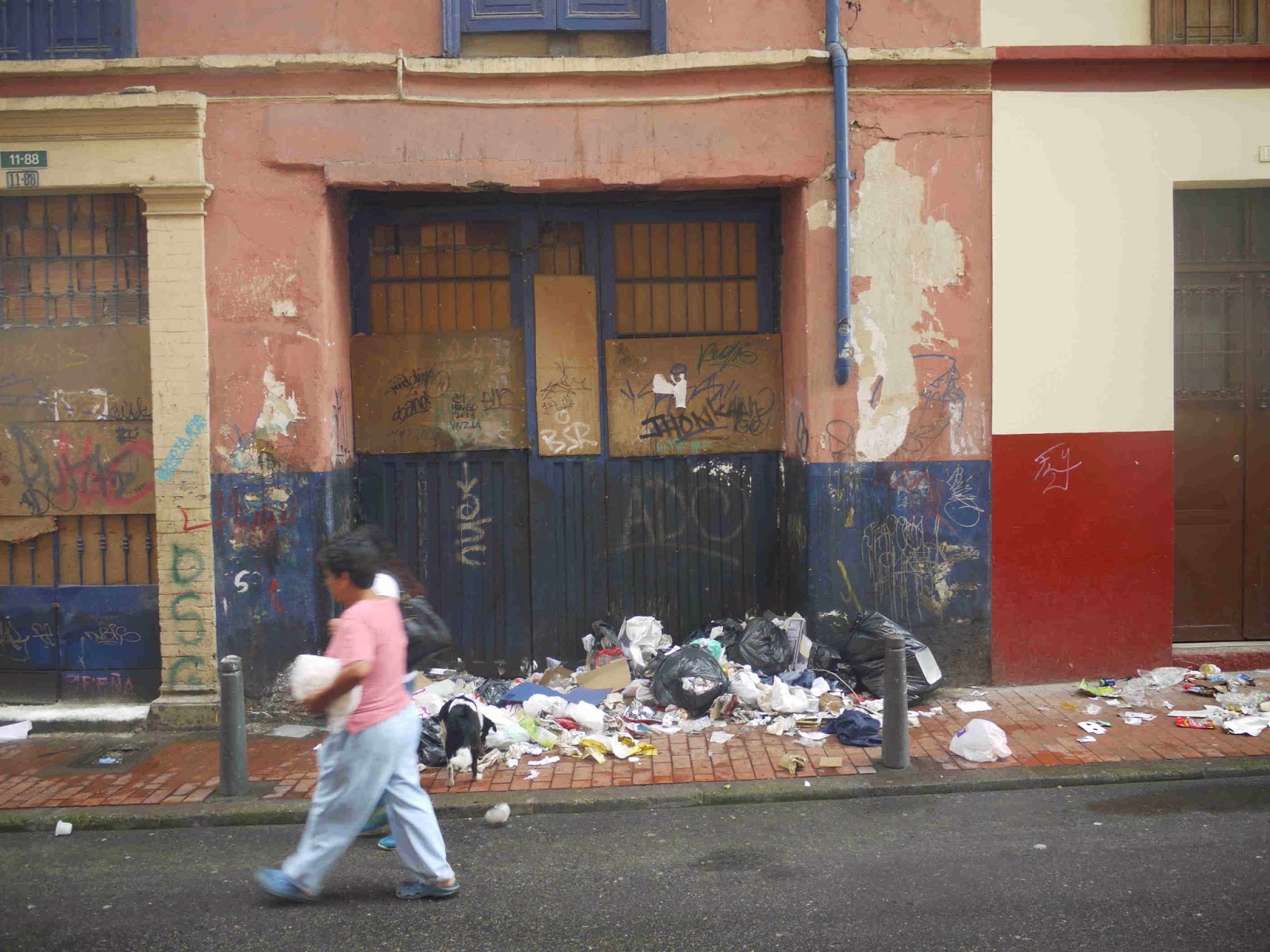
Petro's plan for transforming the city's collection system from private to public resulted in mounds of trash on sidewalks all over the city and eventually got Petro temporarily ousted from office. That was followed by the city's Basuro Cero (Zero Garbage) campaign, which only involved ever-increasing production of garbage - and recycling campaigns, which have produced no noticeable changes in trash disposal habits.

A pedestrian passes a trash-strewn sidewalk in La Candelaria.
Finally, the city issued a law, which went into force about ten days ago, which was supposed to finally and absolutely cure the garbage problem by fining people who did not dispose of their trash at the right time, in the right locations and in the correct-colored bags.

Of course, in a city of millions of people accustomed since forever to tossing their trash willy-nilly onto the sidewalks, where dogs and homeless people tear open the bags and paw thru it for anything they can consume or sell, an unenforceable law changed nothing. If Petro had bothered to ask the opinions of any Bogotanos, they could have saved him the trouble of creating a doomed law.

City 'Zero Garbage' workers sweep up a bit
of the city's tons of garbage.
Recently, Petro lamented to El Tiempo that 'We might have created a revolution.' Yes, he might have, if he had only implemented sensible solid waste policies tested and proven by other cities, such as deposit laws, taxes and other charges to shift the cost of trash disposal onto the businesses which produce and sell the products - thus motivating them to reduce, reuse and recycle their trash.

But Petro, despite being an ex-guerrilla, chose conservative policies obviously doomed to failure. That's nobody's fault but his own.


By Mike Ceaser, of Bogotá Bike Tours

Sunday, December 14, 2014

Photo of the Day: The Aquatic Car


During recent days, Bogotá has experienced some intense rains (altho they usually don't last long).

Even tho Bogotá should be used to rain, the city obviously isn't prepared for it, as this scene proves. Water pools up in low places, producing urban lakes.

This taxi, however, didn't seem to mind too much, and continued on its wet way.

By Mike Ceaser, of Bogotá Bike Tours

Saturday, December 13, 2014

Relax Americans: You're Safe

James Watson,
murdered DEA agent.
Members of the taxi-driver gang which murdered a U.S. DEA agent in north Bogotá in June of last year during a mugging-gone-awry are being sentenced in a court in Virginia, and you can be certain that these guys regret their crime.

"If I could go back in time, I would," taxi driver Andrés Álvaro Oviedo, who was sentenced to 20 years in prison, was quoted in El Tiempo. "I made a mistake and know I'm going to pay for it. I never wanted to hurt anybody."

(The five men were extradited to the U.S. on the shaky justification that the smart phone which they stole contained classified DEA information - even tho the gang sold the phone without bothering to check its data.)

Whether someone who 'never wanted to hurt anybody' had any business joining a band of muggers is more than debatable. But so is Oviedo's sentence: 20 years in prison - even tho he didn't actually participate in the crime, because his taxi broke down on his way to the scene. Colombian paramilitary leaders, some guilty of hundreds or thousands of murders as well as other crimes, are getting out of prison this year after doing just 8-year terms.

Two of Oviedo's associates in the robbery-murder received prison sentences of 25 and 27 years, while the principal actors in the crime are expected to receive terms of 40 and 60 years.

These guys may very well deserve to spend the rest of their lives in prison for a crime which the judge called "grave and brutal." That's particularly true since they undoubtedly had committed previous robberies and perhaps even murders which went unpunished (and perhaps the fact that those victims were Colombians had something to do with that).

The harsh sentences may be intended to "send a message to the world that whoever attacks a U.S. citizen will pay a high price," wrote El Tiempo.

If that was the goal, they picked an effective way to accomplish it. As a result, we U.S. expatriates can relax. Any mugger who suspects a potential victim may be a gringo will surely turn around and assault someone else.

But if the goal of the justice system, either in the U.S, or Colombia, is to deter potential future
Ernesto Manzanera killed five in a car crash
and fled the scene, but is at home resting.
criminals, then perhaps they should apply similar harsh punishments to other killers, such as Avianca co-pilot Ernesto Manzanera, who while driving at 180 kilometers per hour in the early morning smashed into another car and killed its four occupants. A judge gave Manzanera home detention, and so he's resting comfortably awaiting his court date. Manzanera could be subject to 18 years in prison, but if his case follows the pattern of previous drunk driver killers, he'll receive a few years of home confinement of dubious enforcement.

One might argue that, in contrast to the cabbie gang, Manzanera did not intend to kill. But his extreme recklessness and irresponsibility come close to the same level of moral culpability. And after the accident Manzanera fled the scene and turned himself into police only 15 hours later, when any evidence of alcohol or drugs would have been flushed from his system. When Manzanera fled, at least one of his victims was still alive, compounding Manzanera's responsibility for her death.

That not all crimes or criminals are punished equally is a cliché. But occasions like this offer the opportunity to examine why that is and how the system of 'justice' could actually be true to its name.

By Mike Ceaser, of Bogotá Bike Tours

Friday, December 12, 2014

End of the Road for Rolling Chimneys?

A TransMilenio bus belches smog along the Environmental Axis in La Candelaria today. Has this one covered a million kilometers?
Those highly-polluting buses and trucks popularly called 'rolling chimneys) are a bane on Colombia's
A private bus belches smoke on Carrea 10. Will
these buses be controlled as well?
streets and cause thousands of premature deaths every year in Bogotá alone.

A new law reported on by El Tiempo today is to require exhaust filters in TransMilenio buses with more than one million kilometers under their belts as well as those blue SITP buses built before 2009.

The rules are a step forward for Bogotá officials, who have until now basically ignored air pollution, even tho it causes several thousand premature deaths every year - but they appear to leave huge gaps.

Do we really believe that TransMilenio buses only start polluting after covering a million kilometers? And what about SITP buses built before 2009, which presumably pollute more than the newer ones?

Most of all, what about the private buses, many of which are extremely old and polluting?

Finally, since existing laws are not enforced, what should make us believe that these new ones will be?

A truck belches away. Will they be controlled.
A SITP bus turns a corner with a blast of smoke.
El Tiempo reports: 'Buses to use filters to pollute less.' I'll believe it when I see it.

By Mike Ceaser, of Bogotá Bike Tours

Thursday, December 11, 2014

San Victorino Gets the Xmas Spirit

Want some stylish shorts?
You know it's Christmas season when you can't walk across Plaza San Victorino.

The plaza is the center of Bogotá's budget, often pirated, clothing retailers. As Christmas approaches, the plaza fills up with informal sellers, to the chagrin of nearby stores, which pay rent and taxes. In past years, police have tried to clear the sellers away, sometimes causing riots. This year, authorities appear willing to let them stay, just as long as they leave space for pedestrians.

According to El Tiempo, some vendors are sleeping on the plaza in order to not lose their vending spots. And perhaps also to save on rent.

Need a pair  of shorts, a football jersey or a swimming pool to finish off that Christmas shopping list? Hurry on down!


Counterfeit football jerseys are always in style.


Socks for sale.
Want a ´poncho?
After dark, the scene's still hectic.


By Mike Ceaser, of Bogotá Bike Tours

Tuesday, December 9, 2014

Imagine That! The FARC and Al Qaeda!

A report that the FARC guerrillas are collaborating with al Qaeda to smuggle their drug shipments
The report was published in Morroco's
al Massae newspaper.
across the Sahel region in north Africa on its way to Europe made headlines today - but should be no surprise.

According to the report, the FARC pay a tax of 15% of the cocaine's value to al Qaeda of the Magreb in return for free passage across the Sahel region of north Africa. The story was published today in Morroco's al Massae newspaper, based on local police reports. Al Massae is not a leader in world journalism, and the Morrocan police are not Scotland Yard. However, it'd be difficult to believe that a FARC-al Qaeda link did not exist.

The huge and barely governed Sahel region in north Africa.
After all, profits seek and find the shortest route, and narcotraffickers' goal is to get their product to market. Does anybody believe that the FARC, who kidnap, massacre civilians, recruit children and plant car bombs would shy away from working with al Qaeda just because the fundamentalist Islamic group kidnaps, massacres civilians, recruits children and plants car bombs?

In the past, the FARC have cooperated with terrorist organizations such as the Irish Republican Army and ETA, the Basque separatist group. Why would they avoid al Qaeda?

The FARC will cooperate with anybody - and I suspect that nearly anybody, including legal International Consortium of Investigative Journalists and the Center for Public Integrity details how the minerals coltan and tungsten mined and trafficked by the FARC were allegedly sold to legitimate businesses, which used them to manufacture cellphones, computers and other electronics we all use every day.
al Qaeda in the Magreb militants
show off their weapons in the desert. 
corporations, will do business with the FARC, just as long as they expect to profit from it and not suffer bad p.r. or lawsuits. This report by the

Barring effective law enforcement - a rarity in much of Africa and Latin America - illicit goods will flow to where they generate the most profit. For example, I've heard that Colombian cocaine trafficked thru Africa on its way to Europe is traded for blood diamonds, which are then smuggled back to South America.

The European Union's 'security strategy in the Sahel' calls the area "a crisis-shaken region where frontiers blur. Poverty and the fragility of state infrastructures have given free rein to parallel powers, militias, arms-runners and drug dealers."

In a situation like that, there's only one way to stop the FARC, al Qaeda and other outlaw groups from profiting from Colombian cocaine, and that is decriminalizing the drug so that instead legal (if not always law-abiding), tax paying companies buy and sell it.

By Mike Ceaser, of Bogotá Bike Tours

Monday, December 8, 2014

Maim, Kill and Go Home to Rest

Police examine cars after crash which killed four. The driver of the other vehicle was sent to his home today by a judge.
(Photo: El Tiempo)
The peace negotiations with the FARC guerrillas are generating controversy because of the impunity sure to be given to guerrillas and soldiers guilty of murder, displacement and other severe human rights violations.

But impunity's critics could look right here in Bogotá, where killers routinely go home to rest: just because they killed using cars and while drunk.

A drunk driver in a Venezuelan embassy car left this disaster
scene in early November. A judge sent him to his home,
and I've heard nohing more about the case.
(Photo: El Tiempo)
The latest example is that of 24-year-old Ernesto Manzanera, who, in the early morning of Dec. 2, while speeding along the Autopista Norte, smashed into a car containing four members of the Moreno family, killing them all. Manzanera fled the scene, and only turned himself in to police 15 hours later, at which time an alcohol test came out negative.

This morning, in a closed hearing, Manzanera, who is a co-pilot for Avianca, was charged with 'culpable homicide,' which in the United States would roughly translate to involuntary murder. Despite protests of the victims' relatives, the judge sent Manzanera to his home to await trial. Manzanera's father, Ernesto Manzanera Jiménez, now apparently retired, was a prominent politician in Cundinamarca.

In the first days of November, Aníbal Enrique Tapia, drunk and driving a luxury BMW with injured 11 people and killed one in north Bogotá. A judge charged him with homicide and sent him home to rest. The Venezuelan Embassy said in a statement that Tapia was a Colombian citizen and had used the car without permission. It did not explain why an irresponsible person with an alcohol problem had access to an embassy vehicle. I've searched the Internet and found no more recent information abut Tapia's case.
The posters, critical of the peace
negotiations, say 'Colombia without impunity.'
diplomatic license plates from the Venezuelan embassy,

Altho these killers go home after their first audience, one would hope that they would eventually be tried, convicted and imprisoned.

However, that doesn't seem to happen, either.

Recent prominent include one in which the scion of a wealthy Cali family killed three members of a motorcycle club on the outskirts of Bogotá and another in which a young man rear-ended a taxi, killing its two passengers and leaving the driver paralyzed. The second driver, Fabio Salamanca, was initially sent to rest in a hospital because of the stress he suffered from the accident he caused. Salamanca did spend a short time in prison before a judge sent him to his comfortable home to pay his debt to society.

In both those cases, as will likely happen in the more recent ones, the drunk drivers apparently paid
Fabio Salamanca killed two and left third paralyzed
and is serving out his sentence at home. (Photo: El Espectador)
off the victims' families to drop charges. Such a 'punishment' may bring some compensation to the families, but it does little for the rest of us, who continue to be at the mercy of drunks, who know that they can kill and go home, just as long as they have money in their pockets.

In a dramatic piece of evidence of this, Hollman Cangrejo, the taxi driver who was left quadriplegic, bought another taxi with the compensation money he received from Salamanca. This may, that taxi, with someone else at the wheel, was hit by a drunk driver who fled the scene. Fortunately, this drunk was chased down and caught by other taxi drives. No word on whether or not he went to prison.

By Mike Ceaser, of Bogotá Bike Tours