Monday, September 19, 2016

The New Septimazo

Looking for some style?
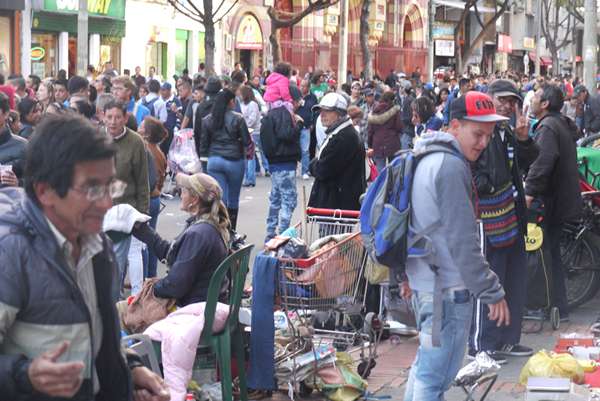
On Sunday afternoons, Carrera Septima transforms spontaneously into Bogotá's biggest variety store, with all the random and wonderful things you can imagine - clothing, electronics, art and food. Check it out. You'll find something you want.


Found what I needed.

Refreshment stand.


The world's literature, at your feet, for a few thousand pesos.
Need a charger for that old cellphone?
Want to fire up the old VCR?

Someone's got the time.
Nearby, rises the BD Bacatá tower, Colombia's tallest.

A battery for every (old) phone.

Just the thing for the kitchen.


South of Calle 19, the offerings move up an estrato in cost and sophistication.

A running exhibition about (government sponsored) human rights violations.
Sweaters from Ecuador.
Get your portrait painted.
By Mike Ceaser, of Bogotá Bike Tours

Friday, September 16, 2016

Cultural Cacophony in the Gabriel Garcia Marquez


On the main patio of the Gabriel Garcia Marquéz Cultural Center you'll find something startling - unless you consider big time wrestling high culture: There's a wrestling ring, surrounded by lurid and violent images of Mexican wrestling.

Sure, violent, obnoxious, glamorous wrestling is big in Mexico, but does it really rate center stage in an institution named after Colombia's Nobel Prize-winning novelist? (The center, bizarrely, has no exhibition about Marquéz himself.)

However, in the art gallery downstairs, one finds something more fitting: an exhibition about the legendary and tortured Mexican artist Frida Kahlo. Frida fans will enjoy the different perspectives on the artist, who suffered physically from polio and a car accident (she underwent 32 reconstructive surgeries) and a tumultuous relationship with muralist Diego Rivera, a fellow communist. Both Rivera and Kahlo, who was bisexual, had numerous affairs, altho they managed to stick together.

Kahlo died in 1954 following several suicide attemps.

Perhaps fittingly, Frida painted herself, portraying her own physical and mental sufferings.

In the exhibition, 23 Mexican, one Chilean and one Mexican artists, portray Kahlo's suffering, sexuality and religiosity.


Frida, Prince, or both?

Frida having fun.


By Mike Ceaser, of Bogotá Bike Tours

Tuesday, September 13, 2016

Whose Green Space Is This?

Green soon gone? A park in peril.
For as long as I've known the area, neighbors as well as students have used this green space at the upper end of Jimenez Ave. alongside the Universidad de los Andes to walk their dogs, play football, etc.

A doggie conversation in the park.
However, I recently learned, from a university employee and neighbors, that Los Andes plans to replace the park with a mostly cement plaza as part of their new building project, which however does include lots of new green space inside the university.

I have no idea who owns or administers this space, but it is clear that, over the years, residents have come to depend on it as their neighborhood park. There isn't much other useful green space nearby, of course. The area in front of the Quinta de Bolivar is hilly and has a reputation for muggings. The green patches in the Plaza del Periodista are roamed by drug pushers, which scares others away.

The university plans to replace the
police bunker with a new building.
For the university to unilaterally remove the grassy areas, without public consultation, seems abusive and high-handed, and perhaps even illegal.

This is not the only damaging project being carried out by a university in La Candelaria. On the hills above the neighborhood, the Externado University is constructing two huge towers, turning the green hillsides into cement walls.

One would have hoped that leading universities, which teach about sustainable development, preserving the environment and improving quality of life, would apply those values to their own actions. One would hope.

Lots of cement, little green, in the university's vision. (Photo: Facebook)
An overhead view. (Photo: Facebook)
These new apartment towers nearby will soon fill with students - who will also want green space.
By Mike Ceaser, of Bogotá Bike Tours

Sunday, September 11, 2016

Injustice, Recycled

Extradited paramilitary leader Salvatore Mancuso.
The New York Times has this long and detailed piece about the light punishments received by many of the far-right paramilitary leaders who demobilized in the mid-2000s and were extradited to United States prisons.

The story makes a strong point: these guys, who may have smuggled tons of cocaine - not to mention ordering massacres, rapes, kidnappings and forced displacements - have gotten shorter sentences than some streetcorner pushers. (Here's ex-Pres. Uribe's response to the story.)

The story, however, is a bit narrow. While the paras' sentences are scandalously short, in the U.S. they did more time on drug charges than they would have back in Colombia for crimes, including crimes against humanity, under the infamous Justice and Peace Law. And, in theory, the death squad leaders are supposed to be returned to Colombia to be prosecuted for their non-drug crimes, altho the Times reports that many have obtained residency in the U.S., apparently as payback for revealing their cocaine smuggling secrets.

As a result, crimes such as massacres, kidnapping, rape and forced displacement, may never be punished at all.
A paragraph from the New York Times story listing some of Mancuso's alleged crimes.
Impunity? Aftermath of the massacre of Bojayá, in which a
FARC missile  landed on the town's church, klling more than
a hundred women and children hiding inside.
But the biggest scandal here, in the eyes of many, is that Colombia is about to do it all over again with the FARC guerrillas. The FARC have also committed horrendous crimes and human rights abuses, if perhaps not on the same scale as the paramilitaries', and under the peace agreement their leaders can not be extradited and will not even go to prison, as long as they confess what they've done. Instead, they'll get 'special detention,' a vague term likely to mean restricting them to a specific municipality.

And FARC members guilty of crimes against humanity, as long as they have confessed, will even be eligible to serve in Congress in one of the FARC's ten guaranteed seats.

None of which is to say that the FARC-government peace deal is not a good thing. However, political leaders should be careful that the FARC deal does not follow the paramilitaries down a path of injustice.

By Mike Ceaser, of Bogotá Bike Tours

Friday, September 9, 2016

Could Uber Unsnarl Bogotá's Traffic?

Not if the Viceministry of Transport has its way!

Bogotá traffic congestion - an answer in Uber?
Uber, one of the most disruptive and innovative technologies to come along in awhile, has created lots of enemies.

And in Colombia those include not only cabbies, but also the viceminister of transport, who has vowed to shut down the service by blocking its app.

Uber certainly is unfair. Cabbies invest a lot in their vehicles, training and licenses, with the reasonable expectation that this will provide them a career in driving. And then Uber comes along, and suddenly anybody with a car and a smartphone can suddenly be a taxi driver.

It is very unfair. But that's history. The computer was terribly unfair to typewriter companies, the digital camera to film makers, and the automobile to harness makers (and horses). Printing put lots of scribes out of work.

If Transport Viceminister Alejandro Maya gets his way, he'll not only halt Uber, but also
technological advancement. And Uber is only a piece of the shared, coordinated economic revolution, which just might make life in Bogotá a whole lot better.

Taxis under threat. But can Uber do better?
The New York Times reports that Uber, Google and others are experimenting with carpooling, driverless cars and other forms of transport sharing.

Uber unquestionably fills a desire for more convenient, courteous transport service. But, so far, Uber's impacts on traffic are more debateable. Does it put more vehicles on the roads, worsening traffic jams and pollution? Or, by reducing the need for owning a personal car, does it ultimately reduce the number of vehicles?

Whatever the truth, Uber-type technologies clearly have the potential to slash road congestion and improve safety. Self-driving cars will one day soon be much safer and more efficient than human-driven vehicles. Technological platforms open huge potential for car-pooling (something which Bogotá, insanely, has never really invested in). And the New York Times envisions a future with personal vehicles replaced by commonly-used ones, reducing the demand for parking lots, which consume huge portions of urban areas. (Will the viceminister also oppose that change, in defense of the vested interests of parking lot owners?)

But none of those paradigm shifts will be possible if viceminister Maya succeeds in blocking Uber.

(Incidentally, Colombia's banking system is apparently resistant to working with PayPal.)


By Mike Ceaser, of Bogotá Bike Tours

Thursday, September 8, 2016

The Question

On October 2, Colombians will vote up or down on the peace agreement with the FARC guerrillas.

However, the question on the ballot will ask something a bit different.

"Do you support the final agreement to terminate the conflict and build a stable and durable peace?"

Marching for the SI vote on Carrera Septima in Bogotá.
The referendum question doesn't mention the guerrillas, because the government know that would generate lots of public rejection. And, whether the deal will really end the conflict is very dubious. The smaller ELN guerrilla group has not entered negotiations, and a grab-bag of criminal groups and right-wing paramilitaries are still out there, eager to swoop in and occupy the FARC's territories and take over their drug trafficking, illegal mines and other businesses. In fact, El Tiempo reports that the ELN and criminal bands are already moving in.

Colombia, sadly, has structural problems which have scarred its history with violence and won't likely go away thanks to a few signatures and FARC guerrillas' turning in their weapons. The country has huge areas with little government presence and fortunes in illegal money waiting to be scooped up. And its high poverty rate and lack of good jobs - particularly in rural areas - supplies many unemployed young men willing to risk their lives and freedom by joining violent, illegal organizations.

But the government is determined to see the peace deal approved, in part because Pres. Santos' legacy is riding on it. Thus, the 'biased referendum question,' as La Silla Vacia suggests. Most of the rest of the Colombian media, which is cheering for a SI vote, naturally ignores this issue.

La Silla Vacia also points out that the election's rules are tilted in favor of the government and the SI vote. In particular, government resources such as telephones and vehicles can be used to campaign, and since the Santos administration favors the SI, they'll be used mostly that way.

The peace deal also has severe flaws, to which the government and media has given little attention. The most glaring of these are the human rights issues. FARC members who've committed grave crimes will have undergo only a mostly symbolic punishment just as long as they confess their crimes. These people will even be eligible to serve in parliament, where the FARC will have ten guaranteed seats.

Despite the flaws and the biased question, the peace deal may be a good thing for Colombia, if it at least reduces levels of violence. But nobody should expect it to cure all the nation's ills. Colombia still has lots of work to do.

While the biased question may help SI win, it also undermines the referendum's legitimacy and may make the outcome less legitimate in the eyes of Colombians and international observers.


By Mike Ceaser, of Bogotá Bike Tours