Saturday, May 6, 2017

Marijuana Marchers vs. the Police

Riot police on Carrera Septima, by the Parque Nacional, with marijuana marchers in the background.
The marijuana march was massive. 
Today's marijuana legalization march brought out thousands of people, mostly young, who marched down Carrera Septima and ended up on the Plaza del Periodista - until the cops swept in and drove them out.

It was a bit of a surreal scene. An anti-riot police tank arrived and proceeded to make a long speech - in English - advertising the speaker system's capacities. Then, they gave the marijuaneros ten minutes to clear out.

'This march has been carried out without incident so far,' said the loudspeaker.

One group held a 'Yes to the personal dosis' banner in front of the tank, to no avail. Afew protesters threw bottles at the tank, and one spray painted something illegible on its side. But soon, the cops started tossing acoustic bombs and the plaza quickly emptied out.

What was the point? Why didn't they just let them stay and smoke?


The marijuana march ended in La Plaza del Periodista, in La Candelaria, which was packed.


About 6:30 p.m. the police arrived, on foot, motorcycles and in tanks.

A pot protester writes graffiti on a anti-riot tank.

A 'Yes to the Personal Dose' banner confronts a tank.

A photo opportunity for foreigners.

The plaza cleared out quickly. I didn't smell tear gas, but the cops apparently threw sonic bombs.


A line of riot police on Plaza del Periodista.

The empty plaza, crowded just a few minutes before.

Yet more cops come motoring in.

By Mike Ceaser, of Bogotá Bike Tours

Friday, May 5, 2017

What's Missing From These Lunches?

Children lunching in La Candelaria.
I noticed these schoolchildren eating lunch today outside the patrimony office in La Candelaria. But for me something was missing: They consumed soft drinks, pizza, but no fruits or vegetables. Or, how about a sandwich, with tomato and lettuce.

I don't know about you, but my school lunch always included an apple and an orange or other fruit. All of that sugary, processed and cholesterol-packed food won't do these kids' futures any good.


A few blocks away fruits and veggies for sale in La Concordia's market.
By Mike Ceaser, of Bogotá Bike Tours

Thursday, May 4, 2017

Is All Animal Suffering Equal?

Too cruel? A bull and Spanish bullfighter in the Santamaria plaza.
(Photo: Fernando Vergara)
The Colombian government has proposed a law prohibiting bullfighting and related activities in Colombia. That would be a big blow to bullfighters and aficionados, since Colombia is the third-biggest bullfighting country, after Spain and Mexico.

But bullfighting is a throwback to an era of bloodsports such as bear baiting, and many sociologists believe that violent entertainments like these promote a more violent society. The proposed law says its goal is to 'strengthen cultural citizenship for peace, respect for life and integrity of sentient beings, by eliminating bullfighting as an expression of violence and cruelty.'

A bird stands over a defeated foe in an
illegal cockfight in the United States.
Good for them. But I've never understood why animal rights advocates stop at bullfighting. What about cockfighting, which involves killing many more animals, in a more brutal fashion. And how about the many thousands of animals killed in slaughterhouses? Does anybody have an idea about how they live and die?

(Bullfighting-related violence goes beyond that between bullfighter and bull. This year bullfighting returned to Bogotá after five years, igniting huge, violent protests. The last Sunday of bullfighting, a bomb exploded on the sidewalk above the plaza, killing two police officers and injuring some 20 people. The government blamed the ELN guerrillas.)

A young man confronts police during anti-bullfighting protests early this year. 

Young men wrestle a small bull in a corraleja.
(Photo: Vice)
The law's sponsor, interior minister Juan Fernando Cristo, also says that bullfighting "gravely damages children...by increasing aggressiveness, anxiety and emotional impacts."

But if that is the law's authors' concern, then why don't they just prohibit children from attending bullfights? And how about protecting kids from all the violence in movies, television and video games?

Bullfighting gets picked on because it's conspicuous and associated with the wealthy and the landowning class. But of the various ways in which Colombians mistreat animals, it seems like one of the most minor. Banning bullfighting may very well be a good thing, but it's only a first step in protecting animals from abuse.

An afterthought: Bogotá's La Santamaria Plaza is a handsome building, located in the center of the city, with seating capacity for more than 30,000 people. Whether bullfighting returns to there or not, the building should be used for other events, such as concerts, art exhibitions and the like. Instead, it's sat empty for the past years.

By Mike Ceaser, of Bogotá Bike Tours

Wednesday, May 3, 2017

Do Rivers Have Rights?

Colombia's Constitutional Court made a surprising ruling recently.
The Atrato River flows into the
Caribbean near the border
with Panama.

The court ordered the government to end illegal mining in the Chocó region and clean up the widespread environmental damage mining has caused. But the ruling went further, and declared that the Atrato River possesses rights which must be respected - giving the river a legal status something like personhood.

There's no doubting the environmental catastrophe caused by illegal mining, logging and other resource extraction activities in the Chocó region. Huge areas have been deforested and poisoned with mercury. According to news reports, mercury concentrations in residents' blood may be as many as 120 times higher than levels considered safe.

Land denuded by illegal mining in the Chocó region.
But stopping the environmental damage is easier said than done. Illegal and informal gold miners use mercury because it's the cheapest, easiest way to pull out the precious metal, and believe they can't afford to use safer methods. Poverty drives impoverished Chocó residents to suffer the dangers and miserable conditions in illegal mines, and that won't change until Colombia's economy undergoes a transformation.

Future court decisions will define what rights a river can have, and perhaps, also give trees, seas and non-human aniimals human-like rights as well.

But, in light of Colombia's inability to protect its rivers and forests, it would be nice to arm those trees, rivers and forests and enable them to protect themselves

The lawsuit was filed by the NGO Tierra Digna, which works to protect the rights of traditional communities.

By Mike Ceaser, of Bogotá Bike Tours

Tuesday, May 2, 2017

Petro's Empty Bike Racks

On Plaza San Victorino, one of Petro's bike racks finds a user.
This small bike rack has been sitting nearly empty for years.
What made the Petro administration conclude that
the plaza needed a hundred more bike parking spaces?
It's a strange political circumstance: Gustavo Petro, whose term as mayor of Bogotá is most remembered for trash-filled sidewalks and his resulting temporary ouster, is now a leading candidate for president.

Sure, Petro did do some good things: He finally got rid of the cart-pulling horses called zorros, which
Another Petro bike rack finds users!
often suffered beatings and hunger. And he stopped bullfights from being held, though they returned this year. And those aren't exactly urban transformations. Petro's administration also did pour money into services such as soup kitchens in poor neighborhoods - but then nearly every mayor does that.

Meanwhile, Bogotá's trashy sidewalks, air pollution and chaotic traffic, amongst other urban ills, all continued. A lot of us had hoped that an ex-guerrilla leader would find some daring, innovative solutions to those problems.

But one thing which even Petro's enemies agree about is that he's not corrupt. But while that may be true personally, I found evidence on Plaza San Victorino that corruption existed around Mayor Petro.

A lonely bicycle in a rack built for two dozen of them.
As many Bogotá residents know, San Victorino is not a safe place to leave your bike locked-up. It's located only a few blocks from the one-time drug-and-crime den called El Bronx, and it's still roamed by drug addicts and thieves who'll strip parts from your bike if not steal the whole thing.

All of which makes San Victorino an inadvisable place to park a bike. That, however, didn't stop the Petro administration, or one of its contractors, from installing racks there for some 200 bikes. Naturally, they are almost completely empty all of the time. But somebody earned a bundle of money by installing them.

Alongside Calle 26, you'll also find Petro-era wooden flooring as well as more bike racks, which
What does an empty bike rack say about Petro's governance?
were never used. (Actually, the unused racks were stolen.)

I don't know much about Petro's public works. But the little glimpse I've seen of them here in the center makes me wonder how many of Petro's buddies got rich by misusing public funds during his presidency.

Petro's administration did contribute to cycling by adding bike lanes, including the one alongside the Parkway in Teusaquillo. However, he could have supported cycling a lot more by placing these racks someplace where cyclists would actually use them.
A pretty low bar. 'You can say whatever you want against him, but you can never say that he stole public resources from the city.' Well, perhaps. 


By Mike Ceaser, of Bogotá Bike Tours

How to Kill a Neighborhood


When the city slashed a four-lane avenue through the hardscrabble Egipto neighborhood above La Candelaria last year, it may have eased the commutes of some wealthy Bogotanos, but it cut the heart out of this already-troubled neighborhood.

A mother and daughter walk past a spot where small
businesses were demolished to widen the avenue.
Construction not only razed small businesses and homes along the avenue route, it also divided the neighborhood in two and has residents risking life and limb to cross what had been a narrow street.

Few residents of the impoverished and high-crime Egipto neighborhood own cars, but they suffer the expanded avenue's dangers, pollution and ugliness.

Planners seem to have forgotten about pedestrians: Street lights are far apart. Here, two women climb over the dividing rail. 
Pedestrians then must wait for a chance to cross the avenue.
The avenue benefits wealthier outsiders. Few Egipto residents own cars. 

By Mike Ceaser, of Bogotá Bike Tours
Monday, May 1, 2017

May Day 2017: A Good Time for Workers?

The CGT, a confederation of unions.
On Carrera Septima a man holds signs saying
'What peace?' and 'No more magnicides.'
 Workers, unions and leftist political parties staged their annual May Day march today, demanding greater worker rights. But how are workers doing? Pres. Santos provided a cheery perspective: 22 million Colombians have formal jobs, the president said, the highest number in 16 years. And Santos claimed that in 74 of his 80 months in power the number of employed has risen.

In contrast, Luis Alejandro Pedraza, president of the CUT labor confederation, says that workers are losing out - both economically and with their lives. The level of union membership has plummeted, he calculates, from 16% of workers
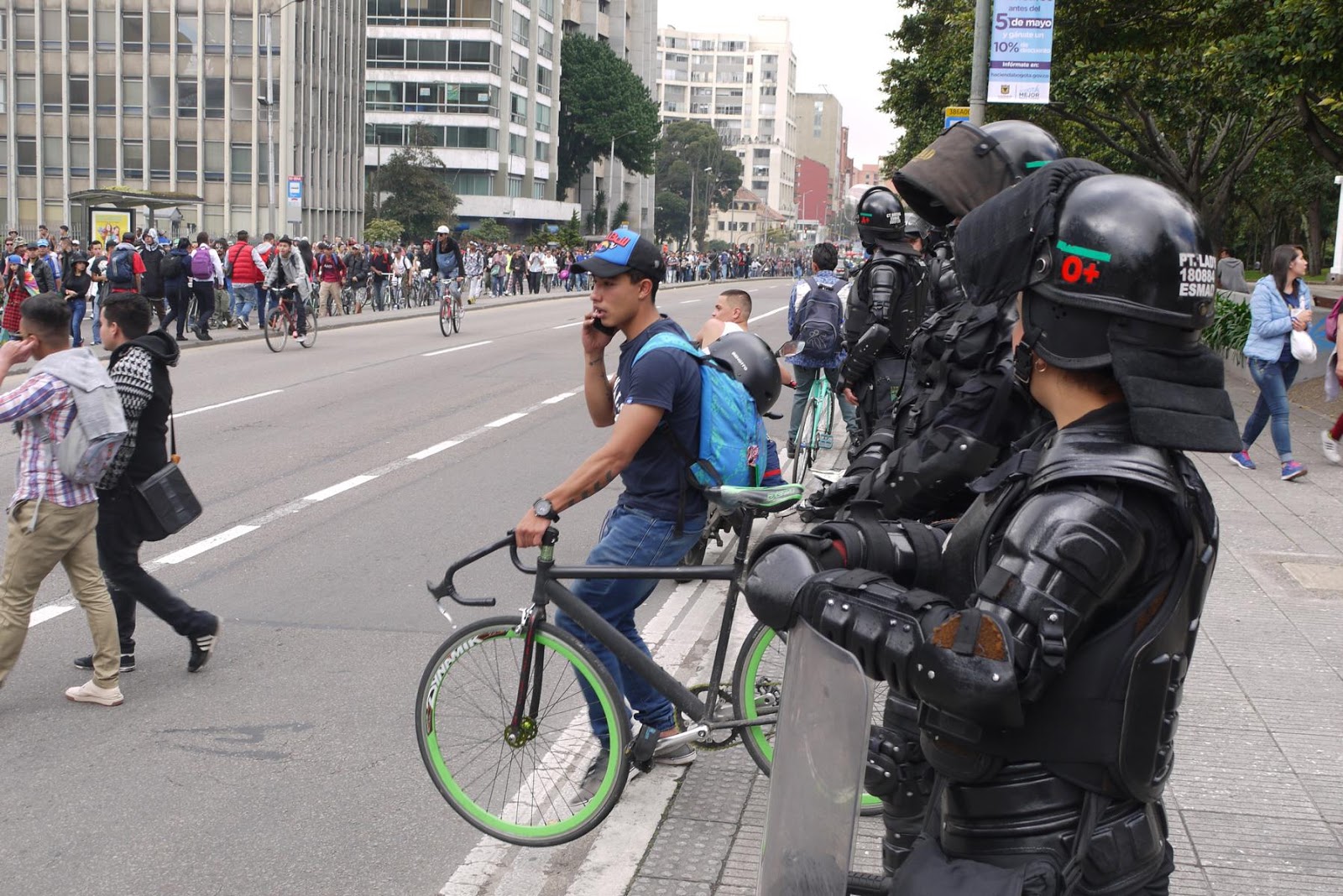
A man takes pictures with a
background of riot police.
in 1986 to 3.7% now, and he says that both the government and private companies avoid paying full benefits by hiring workers using short-term contracts.

Most fundamentally, however, Colombia has few good jobs because its economy depends heavily on exporting raw materials with little added value. A manufacturing economy builds a middle class, but those jobs keep shifting to China.


Still dreaming a lost dream: Communist Party marchers.
(The libertarian Volokh Conspiracy blog wants to rename May Day 'Victims of Communism Day.')


'Denounce!' mistreatment of workers.
By Mike Ceaser, of Bogotá Bike Tours