Tuesday, August 20, 2013

A Short March to the Left

Marchers demand a Constituent Assembly to rewrite Colombia's Constitution. The FARC guerrillas had briefly made such a demand, but seem to have dropped it. 
Today's supposedly huge marche by students, unions, leftist political parties and others underwhelmed with its numbers. Other marches by the usual spectrum of leftist organizations, such as the Marcha Patriotica, have filled Ave. Septima for hours and paralyzed half of Bogotá. This one barely streched over several blocks. Are leftists losing their fire just when peace negotiations might bring the FARC guerrillas into the democratic structure?

Riot police's top priority: Protect the long-suffering McDonald's restaurant.

'Los Emputados.' Apparently, these folks consider themselves Colombia's 'Indignados.'

The M-19 Guerrillas - or their stand-ins - made a brief appearance. 


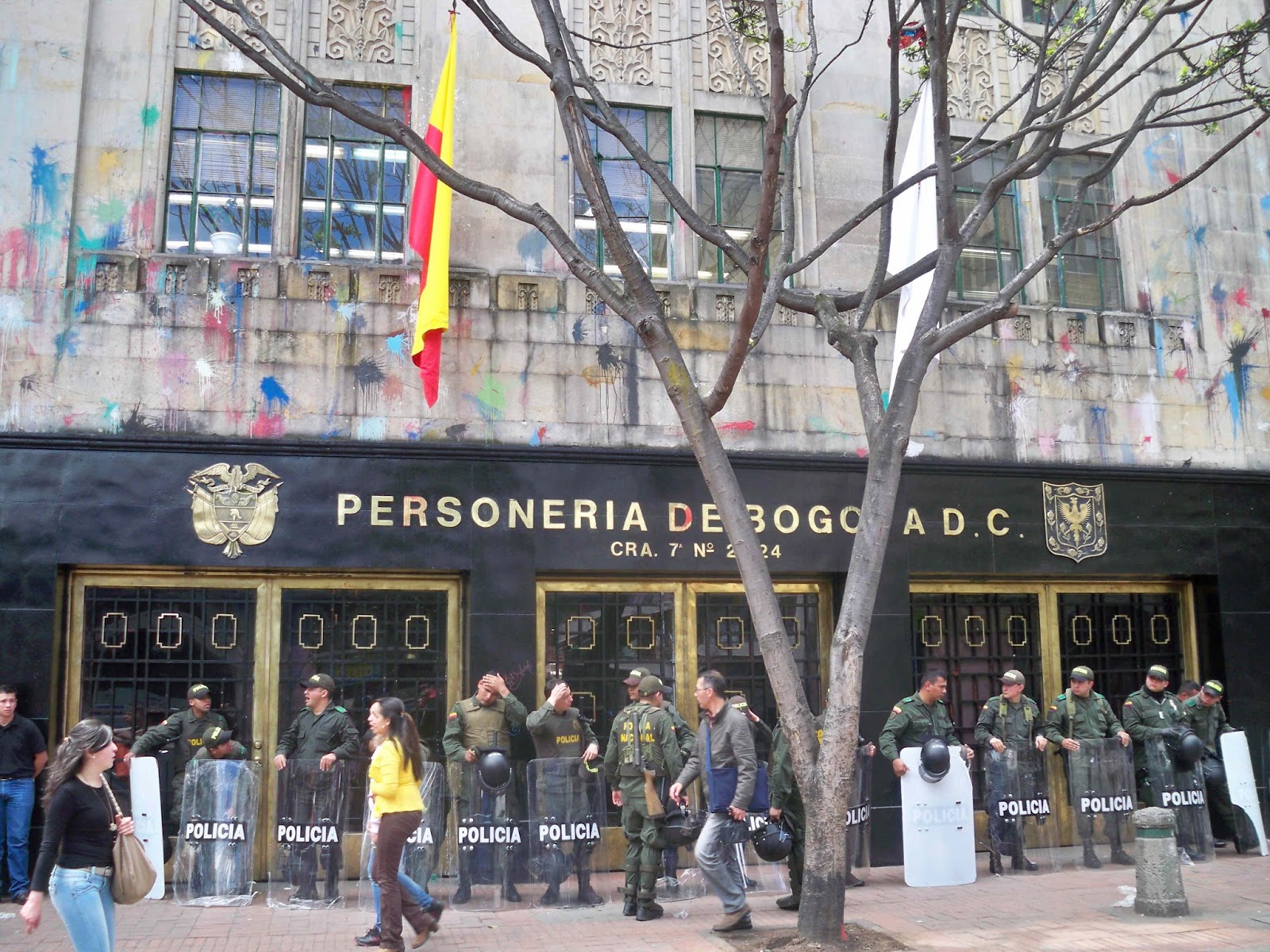
The Personeria, a local government office supposed to defend individual rights, has suffered colorful indignities from many previous protests. I didn't see any paint flying today. 

Police line near the Palacio de Justicia waiting for protest marchers. 
By Mike Ceaser, of Bogotá Bike Tours

Monday, August 19, 2013

Reggaeton al Parque?


This group of young people marched down Ave. Septima today to raise awareness about one of the most pressing and transcendental issues facing Bogotá today: The city lacks a Reggaeton al Parque festival to go along with the existing Rock al Parque and Salsa al Parque festivals.

For tomorrow, big protest marches are planned by students, unions and other leftist organizations. Perhaps they'll march to a reggaeton beat, tho.


By Mike Ceaser, of Bogotá Bike Tours

Sunday, August 18, 2013

Colombia's Invisible Mines

Colombia exports about 100 tons of tungsten per year. But, strangely, the country has only one legal tungsten mine - and it isn't operating, according to a recent Bloomberg News report. Instead, the tungsten - used in cars, smartphones and tablet computers - apparently comes from an illegal mine called Tiger Hill operated by the FARC guerrillas in southern Colombia.

Today's El Espectador contains a report about Colombian municipalities which recieve substantial incomes from gold mining royalties. Strangely, however, many of those municipalities have few or no gold mines.

Then there's coltan, also used in many electronic devices. Colombia has little coltan - but Venezuela apparently has lots of it, in particular near the Colombian border. In 2009, Venezuela prohibited coltan mining. That didn't shutter the industry, however, but just pushed it into the hands of outlaws such as Colombia's guerrillas, paramilitaries and other criminal groups.

Illegal mining has long been a bane for Colombia's society, economy and environment. Illegal artesanal miners use poisonous materials such as cyanide and mercury but don't have the knowledge or resources to safely dispose of them. But illegal mining has become a growing source of income for illegal groups. In 2012, Colombia exported almost $2 million dollars worth of tungsten to a single company in the United States which manufactures wire and other industrial supplies, according to Bloomberg news. After Bloomberg inquired, the buyer said it would stop purchasing Colombian tungsten.

And the legal mining industry, with all of its own social and environmental impacts, uses the spectre of illegal mining to pressure governments to approve large-scale mining. After all, in a country like Colombia with abundant minerals, corruption and weak rule of law, if legal companies do not exploit minerals, most likely somebody else less answerable to the law will do so.

By Mike Ceaser, of Bogotá Bike Tours

Friday, August 16, 2013

Humans Discover the Olinguito - and Condemn It?

An olinguito. (Photo: Smithsonian Magazine)
This week, the Smithsonian Institution announced the 'discovery' of a new species of carnivorous mammal, related to the raccoon, native to the cloud forests of Ecuador and Colombia. It's the first new carnivore species to be identified in the past 35 years.

Indigenous people walk thru Yasuni National Park.
Will oil drilling devastate their culture? 
Except that the olinguito isn't really new. Specimens had been studied in laboratories and even kept in zoos - where the keepers couldn't understand why they weren't interested in mating with other with their zoo companions. It turned out that zoologists had been confusing the olinguito with other, species in the olingo genus.

Ecuador's Yasuni National Park,
on the Colombian border.
Humans' tardy realization that the olinguitos were a distinct species in the olingo genus probably doesn't matter as much to the olinguitos as do peoples' other activities - their invasion and deforestation of the olinguitos' cloud forest habitat. Almost half of the little animals' habitat has already been destroyed by agriculture and urban development.

And that trend looks to accelerate with Ecuador's decision this week to open its vast Yasuni National Park to oil drilling. The park, which covers 9,820 square kilometers may be one of the most biodiverse places on earth, according to Wikipedia. In a single hectare, it has as many insect species as all of North America, as well as myriad bats, amphibians and mammals. Several groups of indigenous people also inhabit the park, living in voluntary isolation from outsiders.
How much impact? Mining titles
awarded by Colombian departments. 

But the park, a UNESCO Biosphere Reserve, also close to a billion barrels of oil. In 2007, the Ecuadorean government offered to leave that oil underground if other countries would pay Ecuador half of the oil's value, or more than 3 billion dollars. But Ecuador received only $13 million and more than $100 million in pledges.

"The world has failed us," Ecuadorean Pres. Rafael Correa said this week, and criticized rich countries' "hypocrisy."

Yasuni National Park at nightfall.
(Photo: Understory.ran)
Correa is right, of course. But one can also criticize Correa's policies as short-sighted and selfish. When it is burned, the oil will pump hundreds of millions of tons of global warming gases into the atmosphere, making Ecuador, a member of OPEC, even more of an accomplice in climate change. The drilling work will also trigger wide pollution and deforestation.

I don't think that the olinguito, which inhabits high-altitude regions, lives in Yasuni park. But Ecuador's decision is only the beginning of wider oil exploration and mining across the Amazon. Ecuador, in fact, is also opening huge areas adjoining the park to oil drilling. And Colombia, naturally, is opening its own wilderness areas to resource exploitation. (Coincidentally, this week Nicaragua also announced that it will open sea waters awarded to it last year by an international court to oil exploration. The waters are disputed by Colombia, which had barred oil exploration from the region, which contains the largest barrier reef in the Americas.)
A waterfall in Yasuni National Park.
(Photo: Sense and Sustainability)

Matt Finer of the Center for International Environmental Law told Britain's Guardian newspaper that Ecuador's decision was "deeply disappointing..."The Yasuni-ITT Initiative was the lone exception to the relentless expansion of hydrocarbon projects deeper into the most remote tracts of the western Amazon. Now there is really no viable alternative to stop the wave of drilling slated for the most biodiverse region of the world."

The olinguito may have entered human awareness only to be soon driven to extinction by human greed. And with it will go many other species still unknown to humanity.

By Mike Ceaser, of Bogotá Bike Tours

Thursday, August 15, 2013

Last of an Era in Colombian Bike Racing

Jose Duarte with one of his elegant hand-made frames. 
More than futbol or the official national sport tejo, Colombia may be best known internationally for its accomplishments in cycling. So, it's sad to see a cycling era end.
Bicicletas Duarte on Calle 68 in Bogotá.

With its red, green and blue front, Bicicletas Duarte looks like just one more in a strip of store/repair shops on Calle 68, one of Bogotá's several 'bicycle rows.' Like the neighboring stores', Duarte's showroom displays imported, Asian-made bicycles.

So, hard to believe that in the store's rear workshop you can find a legend of Colombian cycling.

The Duarte frame which won
 France's Tour del Avenir.
At 77, Jose Duarte walks with difficulty. His lower back aches from decades of leaning over bike frames. His voice is soft. Some of his memories of his decades in Colombian cycling are foggy. But he talks with quiet pride of his many accomplishments, both on the race course and in the workshop.

Born in the town of La Mesa outside of Bogota, as a teen Duarte bicycled to his electrician job. But at age 17 he discovered that his real vocationlay not in the plugs and wires he worked with, but the pedals and wheels he used to get there.

Duarte's hand-made frames
hang on a wall.
Duarte became a bicycle racer. During his 1956 to 1960 competition years, he rode with and befriended cycling legends such as Italian Fausto Coppi. Duarte competed in several Vueltas a Colombia and in 1959 won Colombia's national road racing championship. But his relationship with Colombia's cycling classics had just begun.

A Career Shift

In 1965, Duarte switched from riding bikes to building them, opening his first workshop.

The afternoon I dropped into Bicicletas Duarte, Duarte had just placed the latest classic lugged racing frame he was building into an acid bath. It may be one of the last of some 6,000 frames molded by his hands.

Strikingly, even more than his own accomplishments on two wheels, Duarte seems proudest of what others have accomplished on Duarte-made frames. In the 1978 Vuelta a Colombia, 35 of the the 90 racers rode Duarte frames. Duarte bicycles have won 6 Vueltas a Colombia, as well as the vueltas of Chile, Mexico, Costa Rica, Panama, Guatemala and Venezuela - and undoubtedly others as well. But the greatest achievement is memorialized on his shop wall in the form of the dark blue frame which won France's 1985 Tour del Avenir. The facing wall exhibits snapshots of Duarte with cycling legends including Bernard Hinault and Eddy Mercx, who visited his shop.

Duarte built bikes for Rafael Niño, who won the Vuelta five times, as well as Miguel Samaca, Cristobal Perez and other Colombian cyling legends.
Inside Bicicleta Duarte's bike repair shop.
But not all of Duarte's famous clients were athletes: He also built bikes for politicians, including charismatic presidential candidate Luis Carlos Galan, assassinated in 1989 by cocaine kingpin Pablo Escobar. Duarte and Galan also trained together.

Galan "was not such a good cyclist," Duarte recalls, "but he was a good politician."

Duarte's showroom, which sells mass-produced
bikes from Asia. 
Duarte then built bikes for and trained with Galan's succesor, Cesar Gaviria, who went on to win the presidency. Duarte recalls how presidential assistants would call him at 5 a.m. to announce a top-secret training ride. He would board a presidential helicopter and be transported to some country road, where he and Gaviria would pedal amidst a phalanx of armed guards.

Ironically, in the early 1980s Duarte had also built bike frames for drug capo Escobar himself, altho

Duarte says that at the time Escobar's business was little known.

Duarte, left, fitting politician Luis Carlos Galan. 
"He was my friend," Duarte admits. "But that was before he became a big capo. He was just starting out."

Escobar financed a bicycle racing team and a bicycle factory named Ossito, as well as football teams and other sports. His brother Roberto was a talented bike racer until he got involved in Pablo's business.

"He exported those frames," Duarte says of Escobar. "Nobody knew what they put inside."

When they traveled overseas to race, Escobar's cyclists doubled as cocaine smugglers. In the end, some were killed, others did prison time.

Jose Duarte examines a racing bike's wheel. 
Financed partly by drug money, the 1980s and '90s became an outstanding period for Colombian cycling. Today, with apparently much cleaner finances, Colombian cyclists are once again accomplishing great things in European road races. Leading the charge is the extraordinary Nairo Quintana, who finished second in this year's Tour de France, where he also won the best climber and best young rider jerseys. Quintana, like Duarte, came from a poor family and pulled himself up by his bootstraps (or bicycle pedal straps). Duarte believes that the best bicycle racers come from such humble backgrounds.

Sadly, cycling culture has become profoundly corrupted by doping since Duarte's era. Inevitably, suspicions surround every outstanding cyclist, including Quintana.

Duarte with bike racing buddies Hernan Herron
and Jorge Luque.
Back in his day, Duarte recalls, "we drank panela and oatmeal," he recalls. "The strongest thing we took was Alka Seltzer."

Meanwhile, bicycles have also evolved into hi-tech, computer-equipped machines built around frames made of aluminum and sophisticated alloys. Asian, factory-made aluminum bikes have captured the popular market. The racing frames Duarte makes by hand out of steel and chromium-molybdenum tubing are sought only by those who love classics.

"These cost a million pesos," he says of his frames. In comparison, fat-tubed aluminum frames "cost 300,000 pesos." He motions again at his own elegant creations. "Nobody wants these."

Perhaps that what's left Duarte feeling a bit resigned and tired.

Jose Duarte in his shop. 
During Duarte's first decade building frames, four competitors appeared in Bogotá - "but they didn't last," Duarte says. "Some went bankrupt, some died."

Today, others also make custom bicycle frames in Bogotá - mountain bikes, fixies, etc - but Duarte doesn't rate them highly.

"Those are common frames," he says. Except for himself, "Nobody makes fine frames."

Grudgingly, Duarte's family business has evolved with the times. His two sons who have pursued careers with bicycles repair aluminum and carbon fiber frames. As for himself, Duarte says he's about done with frame building.

"I'm tired," he says, standing in his workshop beside a row of steel Duarte frames. "I don't want to make any more frames."

But his decision is not absolute. He will still build frames for friends, altho that will depend on the outcome of the spinal surgery he has scheduled for the coming weeks to repair several lower back vertebrae damaged from decades leaning over bicycles.

Duarte doesn't make hand-made steel tube frames to be fashionable or retro. He does it because they're all he knows and because he likes their slim, simple elegance. I left Duarte's shop with terribly mixed feelings - impressed with the man's skill and dedication, but sad about the twilight of an era of artesanal framebuilding.

"People have lost their love for these artesanal frames," laments Claudia Reyes, Duarte's daughter in law, who manages the bike shop. "Working on them isn't easy."

Thanks to the great Colombian bike racing blog Cycling Inquisition, where I first read about Jose Duarte. 

By Mike Ceaser, of Bogotá Bike Tours

Tuesday, August 13, 2013

A Fatal Passion for Street Art

Graffiti artist Diego Becerra, left, shot by Bogotá police in 2008, and Israel Hernandez, right, killed two weeks ago by police in Miami Beach, Florida. (Photo: El Tiempo)
The killing of a young Colombian-American graffiti artist by Miami Beach, Florida police last week recalls the killing five years ago of a yong grafitero in north Bogotá.

Both Diego Becerra,17, and Israel Hernandez, 18, were talented graffiti artists. Both were surprised by police while painting walls and killed soon after. Unfortunately, their art is looked upon negatively by many people, and often associated with crime.

Becerra's case has become something of a cause celebre in Bogotá. Initially, police charged that the youth had committed a robbery before they pursued him. But it soon became clear that police had framed Becerra in order to cover up the killing. Since then, three police officers have been charged in the killing and cover up, and two police colonels put under investigation.

For his part, Israel Hernandez was allegedly killed by a Miami Beach taser, a weapon which emits a supposedly paralyzing but non-harmful electric shock. Hernandez's father, who is also named Israel, told W Radio that his son had also been hit on the head. The elder Hernandez vows to see his son's death will be investigated and the guilty punished.

Ironically, the Hernandez family moved to Miami from the sometimes violent La Guajira region because the elder Hernandez had experienced threats, he said. Somewhat ironically, in the radio interview, Hernandez called Miami a city 'where rights are respected.' It will be interesting to see whether Hernandez's case is pursued as thoroughly as Becerra's has been.

Also this week, in the state of Virginia a Colombian woman was also allegedly strangled to death by her American husband, who is now in prison.

The United States was once the land of opportunity for many Colombians: a place where Colombians went to escape their own nation's violence. Today, as Colombia's rates of violence drop and its economy grows, that historic relationship may be shifting.

It's time to change the traditional view of graffiti artists as probable delinquents and criminals. Some people who paint walls are just gang members vandalizing public space. But Hernandez had won awards for his artwork and exhibited in Miami art galleries. While not everything painted onto walls is attractive, or even art, good street art contributes a lot to a city. Putting them into the same category is like
And, I'm certain, many more people get to enjoy a piece of street art than do a painting hidden away in a museum.

By Mike Ceaser, of Bogotá Bike Tours

Monday, August 12, 2013

Drummond Coal's Cynical Strategy

Coal or just dirty water? A crane dumps material
from a Drummond coal barge into the sea. 
Between the night of Jan. 12 and the morning of the 13th a barge used by Drummond coal started to sink, causing the company to allegedly dumped 500 or more tons of coal into the sea near Santa Marta.

But instead of leading to stricter environmental governance, Drummond's aggressive legal response could hobble Colombian environmental law enforcement.

The spill might never have been revealed at all, if not for the president of the Association of Sick Workers of the Drummond Port (Asotredp), an ex-Drummond employee, who publicized photos of the dumping and alleged that Drummond had dumped coal into the sea several times previously after ignoring the Port captain's orders to cease loading during bad weather.

After the January episode came to light, environmental authorities responded with fury.responded with fury.

"Drummond did not adecuately activate a contingency plan, according to what is established in the management plan, since it did not inform local authorities of the emergency in an opportune and effective manner," said Luz Helena Sarmiento, director of the National Environmental Licenses Agency (ANLA).

Minister of the Environment Juan Gabriel Uribe said that Drummond could be fined almost 3 billion pesos - $1.5 million dollars - and that the company had compounded its violation by delaying reporting the spill.

"They had three days to report what happened, and they violated that term," Uribe said.

Drummond asserted that it had dumped only water mixed with coal into the sea, that it had had had no obligation to report the incident to the ANLA, and that the rest of the coal had actually been transferred to another barge - altho authorities questioned that claim.

Despite the companies' assertions, authorities temporarily suspended its right to ship coal.

One might expect that, in such a situation, Drummond would swallow its medicine and work with environmental authorities to clean up its act and help improve environmental practices - but it doesn't look that way. Instead, on its website the company whines that it "feels like a victim themselves" (sic). And, El Espectador reports, Drummond is using a legal strategy that could permanently hobble environmental law and authorities trying to regulate mining.

On the one hand, according to El Espectador, Drummond has filed a tutela - a legal complaint - claiming that it is not the ANLA but the Maritime Directorate which should be investigating and sanctioning these sorts of environmental violations. That would drastically reduce the possible fines and roll back environmental norms by a decade. And, how many people believe that a Maritime agency would be a vigorous environmental watchdog?

Drummond also filed three other legal complaints accusing the ANLA of violating Drummond's rights and of bias against the company.

The lesson here, if Drummond's strategy succeeds: Don't mess with Drummond, or else your environmental laws will be weakened and your environmental agencies handicapped by charges of unfairness. Colombia's already weak environmental enforcement system could be permanently handicapped further.

Of course, many mining and other companies would smile at that prospect.


By Mike Ceaser, of Bogotá Bike Tours