Monday, September 16, 2013

What the FARC May Have to Fear

A mural on 26th St. in Bogotá memorializes the thousands of victims of the 'genocide of the Union Patriotica Party.'
The tomb of assassinated Union Patriotica
presidential candidate Jaime Pardo Leal in Bogotá's
Central Cemetery.
Yesterday was the 60th anniversary of a peace treaty between dictator Gustavo Rojas Pinilla and leftist guerrillas lead by the legendary Guadalupe Salcedo. After years of bloody conflict between the Liberal and Conservative political parties, known as La Violencia, the government and Liberal guerrillas had declared cease fires, permitting the peace treaty.

But less than four years later while Salcedo visited Bogotá he was shot dead in the street by police along with two of his bodyguards.


In March 1990, the M-19 guerrillas demobilized, signed a peace treaty with the Colombian government and began participating in the nation's political system. But the next month their leader and presidential candidate Carlos Pizarro was assassinated during an airline flight, perhaps by the government.

During the 1980s and '90s, the Union Patriotica, a very leftist political party, competed for political offices across the country and on many levels. However, thousands of its members were assassinated by right-wing forces, including its presidential candidates Jaime Pardo Leal in 1987 and Bernardo Jaramillo in 1990, devastating it as a party. The killings are often referred to as 'The Genocide of the Union Patriotica.' Many consider the U.P. to have been the FARC guerrillas' attempt to participate in Colombian politics. Today, the party has been reconstituted legally and, if the FARC-government reach a peace treaty in Havana, the U.P. could be the guerrillas' vehicle for integrating themselves into Colombian politics.
A poster announces a meeting of the reconstituted
Union Patriotica Party.

FARC guerrilla leaders and the Colombian government are now negotiating peace in Havana, Cuba. Understandably, the guerillas have reason to fear the risks they could face after any peace treaty is signed.

And, of course, this coin has two sides. The FARC themselves have committed many crimes, among them assassinations of politicians.

By Mike Ceaser, of Bogotá Bike Tours

Bogotá's Rolling Junkyards


The old bus failed on Calle 26 and its driver got out and tried pushing it.
In theory, Bogotá has a program, called chatarrizacion, or junking, to remove those old, junky, highly-polluting buses and other vehicles from city streets. Unfortunately, Mayor Gustavo Petro's administration has apparently forgotten about it.

I thot about that while observing this vehicle trying to make its way along Calle 26 the other day.

His effort was futile.

So, the passengers got out and pushed.

With a blast of toxic pollution, the bus gets going. Celebration!

The bus rolls on, to pollute another day.
Drivers of old buses carry a sign demanding more compensation for junking their vehicles. 

The woman's shirt says 'Chatarrizacion with dignity.'
By Mike Ceaser, of Bogotá Bike Tours

Saturday, September 14, 2013

The U.S. Embassy's Awkward Neighbors


Jorge Alberto Parra, right, with companions by their tent across the street from the U.S. Embassy.
Just a few years ago, Jorge Alberto Parra had a solid job working in General Motors' Bogotá assembly plant as a mechanical engineer and welder. Today, he shares a plastic-walled tent with several other ex-GM employees, without running water, a toilet or electricity, except for a television run off of a cell phone battery.

770 days protesting, and counting.
The story of Parra and his companions might be just another story of poverty and survival, if not for the fact that their campsite is across the street from the U.S. Embassy in Bogotá. From their humble abode, Parra and his friends believe they've forced one of the world's most powerful corporations to change its policies and hope to compel the company to rehire them.

Parra is the president of ASOTRECOL, the Association of Injured Workers and Ex-Workers of General Motors Colombia. The protest began in August 2011 with 68 participants, Parra says, including mechanics, welders and electricians complaining of carpal tunnel, tendonitis hernias, they claimed they developed working at the GM plant. Parra himself says he came down with tendinitis, bursitis and carpal tunnel during his nine years working for GM. But GM did not recognize the workers' ailments as job-related, says Parra.
Parra inside the protesters' tent. 

The group set up across the street from the embassy instead of the GM factory because at that time the US government owned much of GM, having bailed the company out during its bankruptcy. Also, Parra believes that the U.S.-Colombian Free Trade Agreement obligates the U.S. government to improve worker conditions at U.S.-owned factories here.

During their stay here, the protesters have carried out a hunger strike, during which they sewed their lips shut, and also a pseudo-crucifixion.

The protesters' residential arrangement may be rudimentary, but has its comforts. They've got free round-the-clock security thanks to the embassy entrance across the street, free internet from a nearby hotel and bathroom and phone charging services from nearby businesses.

The employees of the heavily fortified embassy seem to tolerate the protesters at their front gate. But sometimes they do a little more. Parra says that P. Michael McKinley, until recently U.S. ambassador, even made several friendly visits to the protesters. (The new ambassador has not yet been appointed.)

The protesters are easy to spot
on this quiet, residential street.
McKinley "is a really friendly guy," says Parra.

But relations with embassy soured when the men symbolically crucified themselves and the embassy responded by calling the police, who closed down the block and sent in an anti-riot squad. Later the personaria, a municipal human rights entity, "who said we were provoking the embassy," Parra recalls.

U.S. unions and churches have supported the protest. The United Auto Workers even flew Parra to the U.S. for a six-month speaking tour. The pressure apparently produced some results. Last year, mediators from the States came down and tried to broker an agreement between the protesters and GM officials. But Parra says the company offered each of them only 10 million pesos - about $5,000 - and a course in opening small businesses, but that the company made clear it didn't want them back. What the workers really want, he says, are new jobs with GM.

GM Colmotores recently issued a statement saying that they had never fired employees because of health problems and that they had tried to resolve disputes via mediation and according to Colombian law.

Still, Parra believes, their protest has accomplished a lot - pushing GM to improve its treatment of workers injured on the job.

"We've accomplished more than ever before," says Parra.

And Parra says his group is determined to keep camping indefinitely.

"We're here until victory!" he says. "We'll welcome the new ambassador."


By Mike Ceaser, of Bogotá Bike Tours

Thursday, September 12, 2013

Crazy Car Economics


Does cheaper fuel mean a better life...or just more traffic jams?
A Bogotá city counciler wants to limit parking lot fees, altho they have been regulated over and over again in recent years.

Colmbia's public, Congress, truckers and legal system are fighting - as always - over the formula for pricing diesel and gasoline.

All of which makes me wonder: Why does Colombia insist on trying to control the prices of things driving related? If the government tried to control the prices of, say, carrots, shoes or newspapers, we´d call it ridiculous (and accuse the government of becoming Chavista, with all of the shortages and economic chaos government price controls bring.)

I have a modest proposal: Allow the market to set gasoline, parking and other prices. That's how Colombia, which so enthusiastically embraces free trade and capitalism, handles nearly all the rest of its economy.

Why should the car economy be different?

-A bus belches pollution. Deserving of cheap fuel?

In fact, subsidizing or limiting costs for driving is one of the most damaging things a country can do. Low prices produce short-term populist support for leaders but generate long-term damage for society. That's because of the huge externalities, or social impacts, which cars produce: stress, noise, pollution, traffic jams, sedentarism, inefficient use of land, global warming, and on and on. Gasoline and other taxes don't come close to paying for those costs.

Subsidizing gasoline is also a subsidy primarily for those who least need it - big corporations and the wealthy - who consume much more fuel than the poor do.

Lowering the fuel price will cost the treasury trillions of pesos, according to the government. That money supports destitute senior citizens and provides subsidies for poor families.  That will have to be made up somehow - either in fewer services or higher taxes somewhere else. Or else the poor will go cold and hungry for the sake of bigger traffic jams and more pollution.

Underpricing parking (and worst of all offering free parking) produces terrible urban impacts, including encouraging driving and creating parking shortages. The same drivers who celebrate low parking rates today will complain when parking lots shut down and then park their cars on the sidewalk.

Fuels should be taxed heavily in order to discourage unnecessary driving and to compensate for driving's huge infrastructure costs and impacts on society. But let markets determine the base price. That way, oil companies and gas stations will charge based on their costs and what they could get by exporting the fuel. In other words, they'd charge what the fuel is worth. What's wrong with that? After all, it's how the coffee, banana and flower markets work.

How will Colombia make up the huge deficit from cutting gasoline prices? How about taxing books? Food? Bicycles?
Graphic from El Tiempo comparing international gasoline prices. Colombia is at the upper - cheaper - end of the left-hand column. It's also notable that the western European nations, which have high standards of living, also have expensive gasoline. Basket cases such as Venezuela subsidize fuels.


By Mike Ceaser, of Bogotá Bike Tours

Tuesday, September 10, 2013

The New Centro Memoria Falls Short


The new Centro Memoria, with its reflecting pool. In the background are now-empty mausoleums, once part of the Central Cemetery. 

The recently opened Centro Memoria, just off of 26th St. near the Central Cemetery, is heavy with symbolism of Colombia's long, tragic domestic conflicts: the somber building, whose design suggests a headstone; the building's walls, embedded with vials of earth representing tens of thousands of victims of the conflict; and the very location of the Centro, in Bogotá's Central Cemetery.

A visitor to the center can obtain a general understanding of Colombia's long, tragic and often senseless internal conflicts (as long as that visitor knows Spanish). But the displays - texts, photos and a video - don't rise much above high school level and do nothing to bring the conflict's tragedy home to visitors, much less bringing it to life.

An exhibit about the history of Colombia's
guerrilla groups looks like it could have come from a
high school textbook...and perhaps did. 
The Centro's very limited exhibitions consist of panels with texts and photos and a short film providing a summary of Colombia's violent history and the actors involved. It's interesting - I learned things - but this is what kids are supposed to learn in high school and tourists could find on Wikipedia. The Centro Memoria should provide something additional and different. (On the positive side, an employee told me that the exhibitions will be expanded and change every few months.)

The Centro Memoria could fill in a gap in Bogotá's cultural and educational offerings. But I found myself wishing that its exhibits were more dynamic, more interactive.

How about victims' testimonies about their experience, both written and on video?

An exhibit about the paramilitary demobilization points
out that only a tiny number of paramilitary fighters have
 been prosecuted judicially, despite their horrific crimes. 
How about asking visitors what they would do if confronted by some of the horrific situations produced by Colombia's conflict.

What if guerrillas threaten to take away your children and turn them into child fighters? Do you abandon your town or farm for refuge in the city?

How about if paramilitaries threaten your family unless you denounce your neighbors as guerrilla sympathizers?

What if you're a soldier whose unit is expected to murder civilians to inflate guerrilla kill numbers? Do you cooperate or risk your own life and career by opposing your comrades?

The video: 'From Gaitan to La Havana.'
If you live in a town where paramilitary death squads are performing 'social cleansing' by hunting down and killing prostitutes, drug addicts and small-time criminals, do you keep quiet?

What if you're a small farmer ordered by a cartel to plant drug crops? Those sorts of terrible decisions have contronted thousands or even millions of Colombians, and could bring home the drama of the nation's conflict.

Dictator Gustavo Rojas Pinilla in a scene from the video.
And how about asking visitors to consider some of the big questions facing Colombia in its negotiating with the FARC guerrillas in Havana Cuba? How should guerrilla leaders be punished for their numerous crimes? Or, should Colombia give in to their demands for particularly the punishment - or lack of same - to be given to the guerrillas. Is political representation for the FARC too high a price to pay for representation in Congress, as a necessary price for ending a half-century of killing, kidnapping and forced displacement?
The 1954 massacre of
university students by the
Rojas Pinilla regime.

Neither did I see an examination of the roots of Colombia's violence: the drug trade and unequal distribution of land and wealth, which continues today. The illegal drug trade, which made 'Colombia' shorthand for violence during the 1980s and '90s and continues financing Colombia's outlawed organizations today. Would legalizing drugs, as Pres. Santos has suggested, deprive Colombia's violent groups of their fuel?
Old radios on a wall. I don't know what
these were doing there. 

Colombia's current conflict involving leftist guerrillas, right-wing paramilitaries and drug cartels is only the most recent chapter in its domestic conflicts. Before that was the politically-driven La Violencia. Before that, other guerrillas and terrible civil wars.

A display details the number of
people killed and displaced
by the conflict. 
Certainly, the Centro Memoria is primarily a research organization. It participated in a recent report which documented hundreds of thousands of killed and millions displaced during recent decades of Colombia's conflict. But those studies will be read mostly by academics and NGO officials. The Centro Memoria provides an opportunity to tell the tragic story to a different audience, of students, tourists and casual visitors. But to do that well will require more dynanism and immediacy.

In fact, I was struck to find a bunch of colorful mobile exhibits about political activists assassinated in Bogotá left outdoors to be damaged by the wind and rain.

Capsules of soil imbedded
in the walls represent victims
of the conflict. 
As a sideline, it'd also be nice to have an exhibition about the archeological research done during the building's construction. Students from the National Unniversity excavated human remains and found evidence of witchcraft and other occult burial practices, as well as Bogotanos' lives during decades past. They did not, however, find remains of victims of El Bogotazo, the huge riots triggered by the April 1948 assassination of populist leader Jorge Eliecer Gaitan in downtown Bogotá, when thousands were killed. Photos show bodies piled up in the Central Cemetery, and historians have long believed that victims were interred in mass graves on this block to the cemetery's west. Gaitan's assassination intensified a violent conflict between the Liberal and Conservative political parties known as La Violencia, which killed hundreds of thousands of people during the following decade.

The Centro Memoria is located just off of Calle 26, just west of the Cementerio Central. It opens every day except Sunday and is just a short walk from from the TransMilenio station of the same name. 
An 'Act of thanksgiving' from the faithful. A candelabra in a wall from the land's time as part of the cemetery.
The center's land includes this large, wooded field. What use will they give it?
These mobile exhibits about political activists and leaders assasinated in Bogotá have been left outside to be damaged by the sun and wind.

The Centro has two parking lots for cars, one of them underground, but no bicycle parking. 

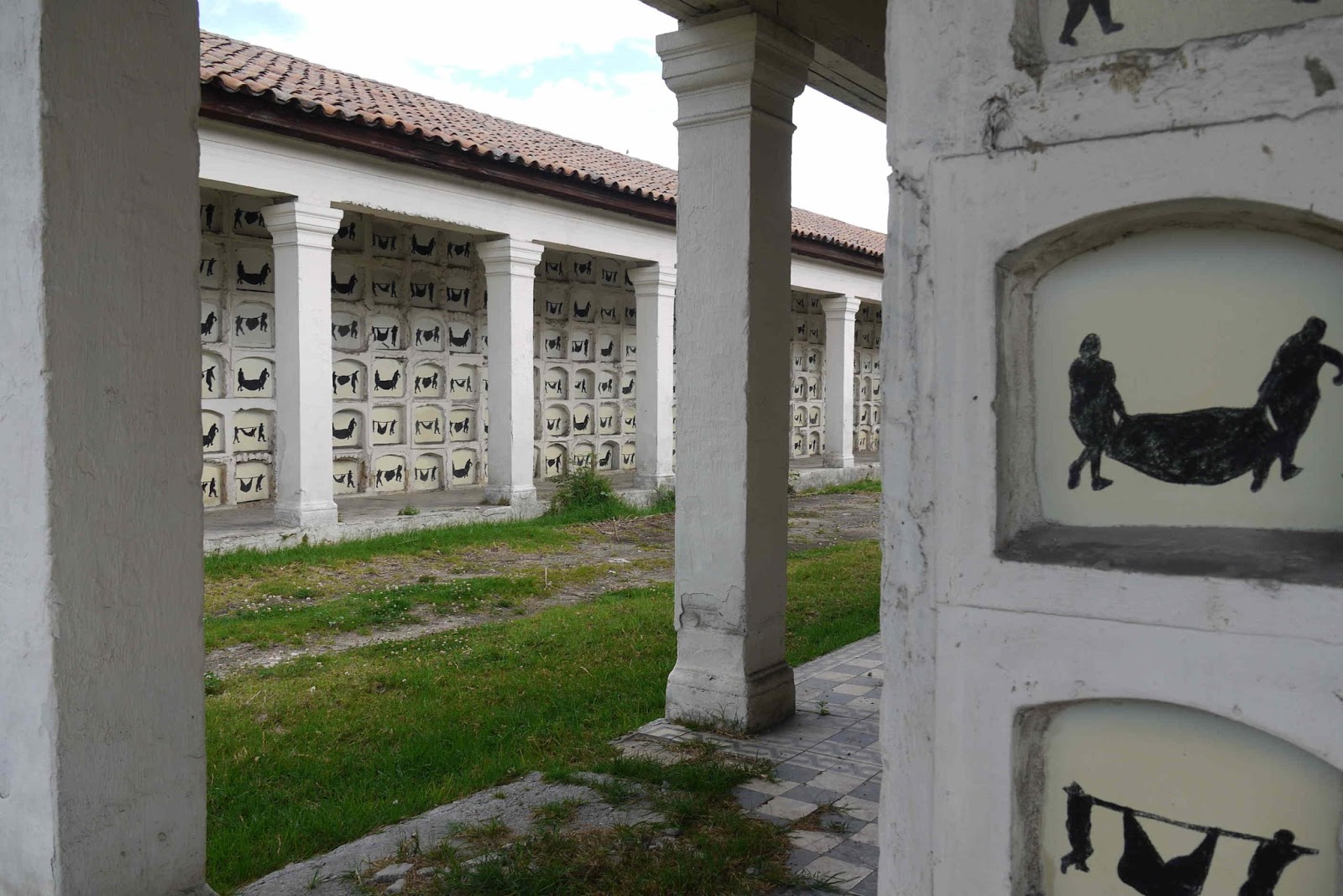
Images of the now-empty mausoleums, once part of the Central Cemetery. A pair of artists stenciled images of dead being carried on stretchers, representing victims of Colombia's conflict. It was a huge project - there are some 9,000 tombs.


Empty tombs.


By Mike Ceaser, of Bogotá Bike Tours

Monday, September 9, 2013

The Fault of Free Trade?

'The cry of the people.' During a recent march, protesters equate free trade agreements and multinational corporations with slavery.
Protesters in recent weeks in support of Colombia's struggling small farmers aimed much of their anger at one target: the Free Trade Agreement with the United States, which they say has opened the gates to imports and pushed down crop prices.

The FTA did reduce tarrifs and remove other barriers to imports of foods and many other products. However, in the case of agricultural products, the tariff reductions have barely begun - making it very doubtful that US imports are to blame - yet - for Colombian farmers' hardships.

On beans, for example, tariffs are to be phased out over a decade, at 10% per year. For milk, the phase-out period is 15 years, for rice,19 years. Since the treaty went into effect only last May, tariffs have barely changed. Many crops also have grace periods, during which tariffs are not reduced at all, and the agreement includes safeguards for Colombian farmers in case imports skyrocket.

And, the import statistics also cast doubt on the idea that free trade is to blame. Potato farmers have perhaps been the most vocal protesters - but last year's official potato imports totaled only 1 percent of Colombia's potato production. In the case of milk, imports constituted only 3 percent of domestic production. Can those tiny amounts really depress prices much?

In contrast, estimates suggest that contraband imports, primarily from Ecuador, are much greater and have much more impact.

But the idea that imports from the U.S. haven't yet hurt Colombian farmers doesn't mean they won't. In fact, they will, and Colombia will have to deal with many thousands of destitute farmers who will migrate to cities and live in poverty and misery.

On the other hand, free trade agreements do bring cheaper consumer products. But are those really beneficial if they mean cheaper junk food and


By Mike Ceaser, of Bogotá Bike Tours

Saturday, September 7, 2013

Soldiers for Peace

A soldier lights a candle for peace. 
This evening, a group of  residents of Chapinero organized this candle lighting ceremony on the Plaza de Lourdes, in Chapinero. One told me that the candles, which spelled out 'PAZ', were a protest against violence during recent marches and demonstrations in support of farmers protesting low prices for their products. Some of the protests in Bogotá turned violent, in great part because of hooded rioters called encapuchados.

Such a perspective on recent events is perhaps not surprising for residents of middle class Chapinero. Others would probably find the violence in deeper, root causes, such as economic exploitation of farmers.

I was struck by the participation of soldiers in the ceremony. But I probably should not have been. After all, they suffer most from Colombia's violent armed conflict. On the other hand, tho, peace would deprive them of work.

The candles on Plaza Lourdes spelled PAZ - PEACE.


By Mike Ceaser, of Bogotá Bike Tours