Thursday, December 9, 2010

Bogotá's Christmas Lights


In Parque de la Independencia
The Nativity Scene in Plaza Bolivar, on the steps of the Catedral Mayor
Although Colombia's 1991 Constitution ended its status as a Catholic nation, Bogotá is not shy at all about dressing itself up in Christmas lights.
The lights on Monserrate, overlooking the city.
Plaza Bolivar with El Congreso in the background
Plaza Bolivar, the Palacio de Justicia

In the National Park
Añadir leyenda

Flying fish in Independence Park
Bike tourists in the National Park
San Francisco, Bogotá's oldest church. 
Santa Ana Church, in the Teusaquillo neighborhood
Along Seventh Ave., during the Septimazo
By Mike Ceaser, of Bogotá Bike Tours


Colombia's Tragic Rainy Season


This rainy season has set records in the quantity and fury of the rainstorms. In Bogotá, streets have turned into rivers and the city's rivers flooded their banks. Across the country, the storms have killed more than 200 people and driven many thousands from their homes. The storms have also damaged many crops, meaning higher food prices.

But the worst single tragedy was a landslide near Medellin, which killed dozens of people. Pres. Juan Manuel Santos blamed the catastrophe on climate change.

The Red Cross is one of many organizations collecting aid for victims.

By Mike Ceaser, of Bogotá Bike Tours

Tuesday, December 7, 2010

Noche de las Velitas/Night of the Candles


La Noche de las Velitas, or the Night of the Candles, is Colombia's annual celebration of the Immaculate Conception. The event marks the start of the Christmas celebration - even tho Christmas decorations have been up in Bogotá parks and plazas since October.

In Bogotá, La Noche de las Velitas is most famously celebrated in the La Candelaria neighborhood, and you'll find the most candles burning along historic 10th Street.
The scene on 10th St. 
On the annual Noche de las Velitas neighbors turn out to socialize on the street. And some of the old republican and colonial homes open their doors and their residents set candles in the doorways.
Carfully lighting candles. 
In the Callejon del Embudo
Celebrating the Virgin. Most of the plastic and paper candleshades used advertised beers. 
On the Plaza del Chorro.
A bucketfull of candles. 
Colorful candleshades


By Mike Ceaser, of Bogotá Bike Tours

Monday, December 6, 2010

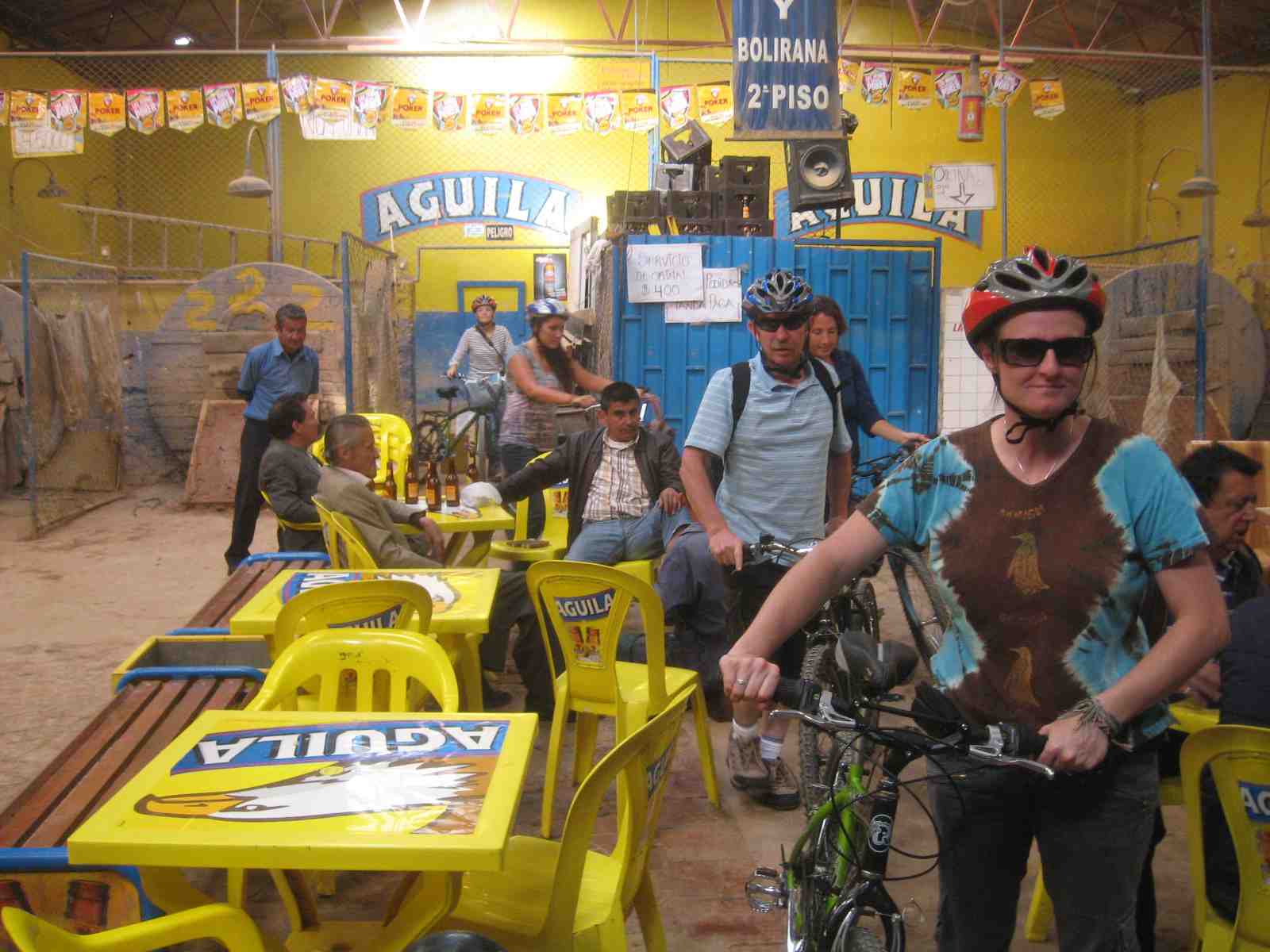
The Game of Tejo

Ready to throw.
Among things Colombian, tejo ranks right up there with chicha, beauty pageants, vallenato music and bandeja paisa. 

You could call it Colombia's version of tossing horseshoes or bocce balls - but with a bang. In tejo, you throw an iron disk weighing up to several kilograms at a clay pit area. But the real excitement comes when slams onto one of the gunpowder-filled paper envelopes on the target area, which explodes with a satisfying bang!
Tejo style!
Tejo is descended from a pre-Colombian game named turmequé, in which players hurled a gold disc called a  zepguagoscua as far as they could.

In 2000, Colombia's Congress declared tejo to be the country's national sport. (Perhaps a wise move, since Colombia does so poorly at international futbol.)
And my hand is almost big enough to palm a basketball!
The goal: hit one of these little gunpowder-filled envelopes!
This novice player got one of the envelopes, and plans a brilliant future in tejo.
While popular in Colombia, tejo's not likely to spread to other, more lawsuit-minded nations. Just imagine the ambulance-chasing lawyers salivating over the prospects of drunks tossing heavy blocks of metal.
Tejo playing is financed and lubricated by lots of cerveza.
The champion Bogota Bike Tours tejo team rolls homeward. 
By Mike Ceaser, of Bogotá Bike Tours

Friday, December 3, 2010

The Stately Teusaquillo Neighborhood


Teusaquillo is perhaps Bogotá's largest neighborhood in square kilometers, and probably its most stately. The neighborhood grew up in the early and mid-1900s, when it was Bogotá's wealthiest area.

Today, Teusaquillo extends north from the edge of the Central Cemetery to include the sprawling National University and even Simón Bolívar Park.

In Teusaquillo, you'll see many houses built in Victorian, Tudor and German architecture. The neighborhood is also known for the Parkway, a narrow, three-kilometer park. After La Candelaria, Teusaquillo contains the city's largest concentration of theatres. It also contains the home of leftist martyr Jorge Eliecer Gaitan, whose home is now a museum.

One of the neighborhood's stately churches. 

Jorge Eliecer Gaitan, leftist martyr murdered in 1948. 

This man has turned his home into a museum constaining objects he collected over his lifetime. 

The Parkway creates a green corridor through the neighborhood. 

Iglesia Santa Ana, (which is surrounded by illegal abortion mills.)  
This London-style housing block now houses a private university. 
The National Theatre, founded by Fanny Mikey.The building was once a Jewish Synagogue. 


Cycling along one of Teusaquillo's tree-lined streets, with European-style houses.
By Mike Ceaser of Bogotá Bike Tours

Parque Central Bavaria

Parque Central Bavaria is a trendy shopping, restaurant and office complex in central Bogotá, located across Seventh Ave. from the National Museum and in the neighborhood known as the Centro Internacional.

The Bavaria complex has interesting roots. The brewery was founded by Jewish-German immigrant Siegfried Kopp, who built a reputation as a good employer. In fact, he helped create the La Perseverancia neighborhood on the hillside overlooking the brewery for his workers. Today, Kopp's grave in the Central Cemetery has become a pilgrimage site for believers, who call him a saint.
The German architecture is evident on the original buildings. 
The Bavaria complex won several awards during the 1960s as an example of urban renewal.


As I walked through snapping photos, one of the guards halted me:

'Photography is prohibited here!' he told me.
'What possible reason could there be for that?' I asked him.
He stayed quiet, shamed by the senselessness of the rule he was asked to enforce. 'That's what they told me,' he said.

Anyway, see more pics here.

In 2005, Bavaria was purchased by SABMiller, ending 116 years of independence.

A  front view of the old brewery building.

The Bavaria complex's park provides a patch of green near the city's center. 
Nearby, office/apartment towers are going up. Nice to see investment in central Bogotá.

By Mike Ceaser, of Bogotá Bike Tours