Friday, December 24, 2010

So Long to Democracy in Venezuela

All Vote Together, in Venezuela's National Assembly

With the seating of a new Venezuelan National Assembly, with only a slim Chavez majority, imminent, Chavez has found a way to be rid of that nuisance while retaining democratic appearances - made it irrelevent.

In the past days, the outgoing parliament has given Chavez power to rule by decree for 18 months, further restricted the media, including the internet, neutered the university's political power and, most dramatically, slashed the frequency in which the new Assembly will meet. To minimize annoyance from any local anti-Chavez politicians, the government has created pro-Chavez 'communes', and transferred much of the budget to them.

Is Venezuela still a democracy? Well...it does hold elections - but then so do Cuba, Iran, Belarus and lots of other dicatorships, which also happen to be Venezuelan allies.

Why should Colombia be concerned? Historically, authoritarian governments are much more inclined to launch military attacks, and Chavez constantly seeks external demons to blame domestic problems on. More authoritarianism in Venezuela also means less oversight from the media or opposition political parties - and so more opportunity for Chavez to support Colombia's guerrilla groups, which are considered terrorists by Colombia's and many other governments.

It's quite sad, since Venezuela had South America's longest tradition of democratic government. But those governments were corrupt and did not solve the country's poverty, despite its great petroleum wealth and other resources.

It will be sad watching Venezuela's likely accelerating slide into a dictatorship resembling Cuba's.

However, as in North Korea, Belarus, Cuba and Zimbabwe, the rest of the world will do (and can do) little to rescue democracy. In any case, the U.S., which did so much to prop up authoritarian right-wing governments when they served its interests, will also tolerate left-wing authoritarianism when the alternative would mean higher gasoline prices.

By Mike Ceaser, of Bogotá Bike Tours

Thursday, December 23, 2010

Mooching Mongrels

Good master or exploiter, this homeless man in Chapinero found a way to turn these stray dogs into a profit stream. Unfortunately, I suspect that the coins this guy collects go to wine or drugs, and that the food that he and his four-footed friends eat comes from the garbage cans.
I've seen variations on the theme in Bogotá, including one set of dogs trained to carry bowls in their mouths and approach diners in outdoor restaurants. But I was once approached by a guy leading a dog with a festering sore on its side and begging for money for the dog's medical treatment. That beggar was too delicate, I guess, to mutilate himself. More photos of human-canine relationships here.

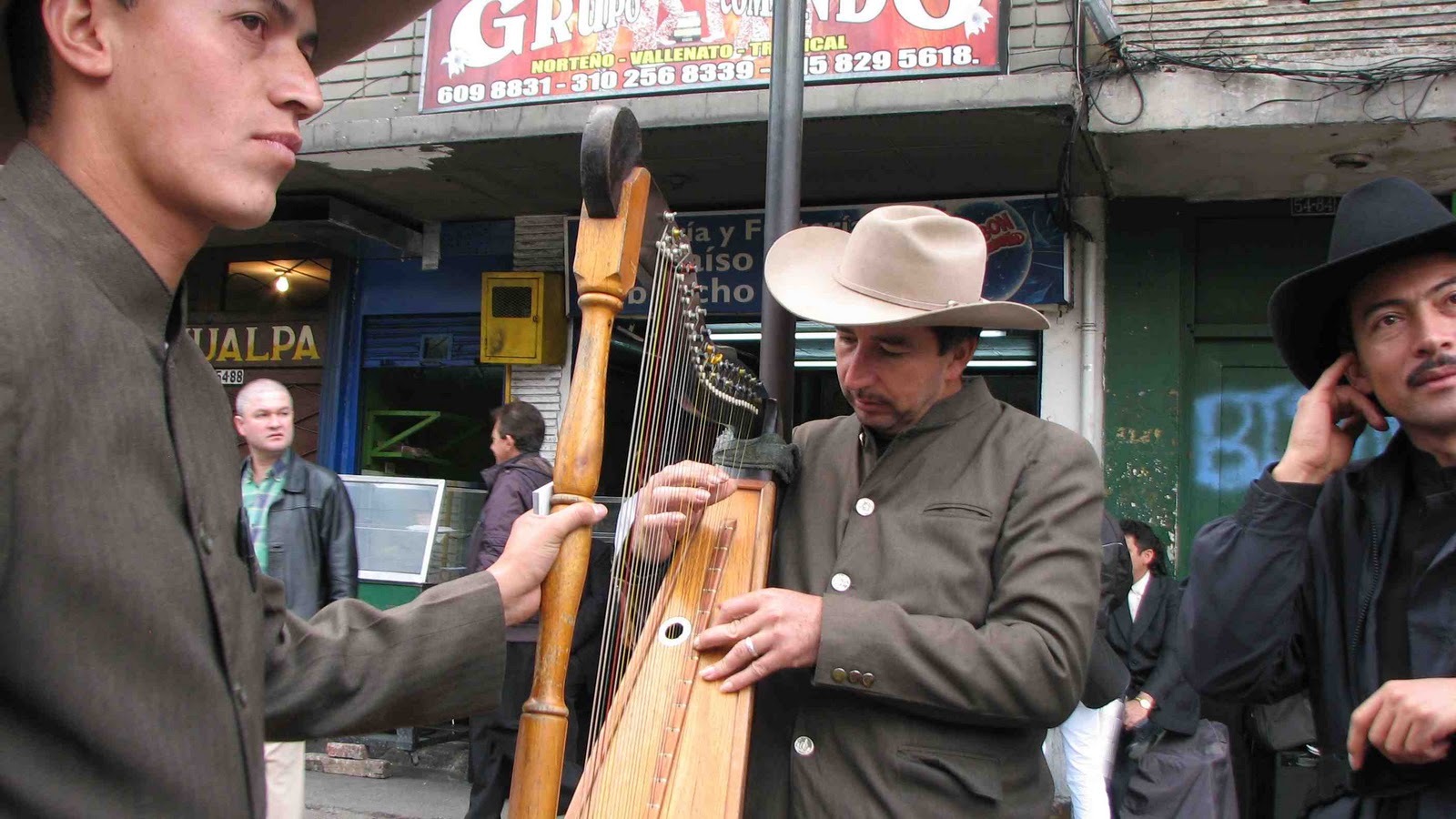
The Musicians' 'Beach'


Ready for a Vallenato?
No, there's no beach in 2,600-meter Bogotá. But there is a 'playa' in the Chapinero neighborhood, where three afternoons each week musicians wait for work.

Mariachi man
Seeking Mariachis? Vallenatos? A harp or an accordian? Don't bother with Craigslist: Your musicos are awaiting you at 55th St. and 14th Ave., just outside the Transmilenio station.

The musicians said they usually wait on Thursday, Friday and Saturday afternoons. They charge by the hour, and aren't cheap - get ready to pay several hundred thousand pesos per hour.

If you're gonna throw a party, but want to save the trip out to Chapinero, these musicians do have telephones:

Carmenza Monterrey y su Mariachi
Cel: 321-429-9661

El Aventurero y su Mariachi Aguilas de Mexico
Cels: 310-201-6302/ 300-560-1685/316-285-9617

Henry Noguera y su mariachi, los Mensajeros de Guadalajara
Cel: 321-248-6282/ 320-219-1168
Man with accordian for rent
These guys got work.
Mariachi men

By Mike Ceaser, of Bogota Bike Tours

Sunday, December 19, 2010

Man vs. Nature: Both Lose


The collapse of Colombia's Canal del Dique, which connects the Magdalena River to Cartagena Bay, has inundated many towns and 600,000-hectares of farmland. As Louisiana residents learned not long ago, nature can't be held back forever.

In Colombia's case, man not only built a wall to vainly hold back water, but man's impacts on the environment also increased the intensity of Colombia's weather, contributing to this year's phenomenal rains and flooding.

The scene in Bogotá today. 
By Mike Ceaser, of Bogotá Bike Tours

Drug Prohibition Stays Strong in Latin America

Prohibit and it'll go away?
This interesting overview of drug laws across the continent shows how little headway depenalization has made in the continent which has likely suffered the most from the war on drugs.

Is this because of the region's conservative Catholic heritage? Because of the influence of the U.S.? Because drug prohitionism has succeeded in reducing use and associated crime?

Well, it certainly can't be the third choice...

In Colombia's own case, it's gone backwards. Despite backing for decriminalization from its major newspapers here, here and here, Congress last year eliminated the 'personal dosis law,' which permitted the possession of small amounts of any drug for personal use.

With billions of dollars in aid during the past decade, Colombia has reduced the number of hectares of drug crops - but those have shifted to Peru and Bolivia. Meanwhile, Colombia's drug-fueled violence seems to have shifted to Mexico.

By Mike Ceaser, of Bogotá Bike Tours

Friday, December 17, 2010

Venezuela's Continuing Slide Toward Dictatorship

Red all over, and ready to write laws.
Venezuela's National Assembly just voted itself into irrelevency by giving Pres. Chavez the power to rule by decree for 18 months over wide areas of national life. Chavez has already turned the courts into puppets,  nationalized large parts of the country's economy and intimidated or shut down much of the once-independent media.

Chavez, who has also eliminated his own term limits, was happy to rule through the National Assembly as long as nearly all of its members were his yes-men and women. But in recent elections, opponents got about half of the votes and Chavez's allies held onto only a tiny majority in the assembly.

All for one and all for Chavez. Chavez's sort of parliament. 
For Chavez, evidently, an Assembly with a vigorous opposition had the potential to be troublesome, so better to rule alone, using as an excuse the country's disastrous flooding. Is that any justification to rule by decree for 18 months in areas such as finance and telecomunnications? Or, might this be a way to seize even more power, as his domestic troubles grow.

Unfortunately, Chavez's critics leap to compare him to Adolf Hitler, the arch-evil. Chavez is bad, but he's still a long way from Hitler, and such arguments give the professional Chavez apologists an opening to defend the man as being 'well, not so bad.'

For Colombia, this is worrisome. Chavez is an unstable ideologue, who seems to have a religious belief in a bizarre form of socialism and in himself as saviour. He thrives by stirring up nationalism against 'foreign threats' (read, 'Colombia'). He's also been buying weapons and apparently arming and financing Colombia's leftist guerrillas. With more power and less oversight for Chavez, those tendencies might accelerate.

By Mike Ceaser, of Bogotá Bike Tours

Chapinero, Bogotá's Gay Neighborhood

Brokeback mountain cafe bar
Chapinero is one of Bogotá's largest neighborhoods, and well known for its nightlife, shopping and gay community. The best known nightclub is probably the Theotron. For a conservative, Catholic nation, Colombia has surprisingly progressive laws for same-sex couples: they can register civil unions, inherit from each other and receive each other's pensions. However, strangely and shamefully, and perhaps due to oversight, Colombia recently abstained during a United Nations vote which removed the category of sexual minorities from a list of groups which member nations were called on to protect from extrajudicial killings.

Here's El Tiempo newspaper's guide to Chapinero's gay culture.
Iglesia de Lourdes, Chapinero's centerpiece
Kenneth Cole and McDonald's. What country are we in, anyway?
A new sight in Bogotá: A female couple walks the street.
Located in north Bogotá, Chapinero is mostly upper middle class and includes La Zona Rosa, an expensive, American-style nightlife and shopping area.
Chic, fashion and money.
A historical home in the midst of Chapinero: once the home of  a military hero of the revolution against Spain.
Perhaps a half century ago, this area was still countryside and fincas.
Chapinero fashion
Eros, one of the neighborhood's many 'love motels.'

Chapinero has its own red light district, or 'zona de tolerancia.' Tarjeteros on streetcorners hand out cards like these. Most strip clubs, of course, double as brothels, whether legally or not. I once had a neighbor who actually managed one of these places. He said that many of the girls who worked there were university students paying for their educations. He said that others were married, but that their husbands actually didn't know what they did for a living. Undoubtedly, my neighbor told me only the 'positive' side of the business, and there must be lots of exploitation and child prostitution as well. 


More Chapinero scenes: the man who begs with dogs and the musicians' beach.

By Mike Ceaser, of Bogotá Bike Tours