Showing posts with label central bogota. Show all posts

Tuesday, August 29, 2017

What's Going on With the BD Bacata?

See anybody working on those unfinished upper stories? Neither to I.
Announced with lots of fanfare, the BD Bacatá tower was to be a glorious new landmark on Bogota's skyline: It would consist of Colombia's two highest buildings, containing high-status offices, luxury apartments, a hotel and a shopping mall.

And it yet may be. But today, it's an inglorious one.

The ground-floor mall is operating.
The two-tower complex's taller, 67-floor south tower, with its knife-like design said to be modeled after a skyscraper in Dubai, stands unfinished, and I haven't seen anybody working on its upper stories for months. (The ground-floor mall is open, and some of the apartments are said to be occupied.)

Even as the building's upper columns and walls suffer from heat, cold, sun and rain, the builders have stayed silent, and the media haven't enquired - despite this conspicuous problem - leaving one to speculate.

Did the money run out? The Bacatá was crowdfunded, said to be the world's first skyscraper financed that way. The investors, who were promised that the building would be finished and they'd be enjoying returns years ago, are understandably upset.

It's often good to increase urgan density instead of spreading a city out. But the Bacatá was built in an area with already congested streets and little public space - and much less green space - nearby.

Sure would be a pity for this building to stand as a monument to unrealistic ego and excessive ambition.
Offices and apartments for rent.
Incidentally, I sent BD Bacata a message via their website asking them what was going on, but they have not replied.

By Mike Ceaser, of Bogotá Bike Tours

Wednesday, May 31, 2017

The New Bronx

It was El Bronx. What will it be in ten years?
A year ago, this was a place of frantic activity: Drug dealing, prostitution, even torture and murder. Today, it's quiet, except for a few laborers demolishing the old buildings.

Plenty of drug addicts are still around. 
This was El Bronx, for years Bogotá's most notorious street, until one year ago Mayor Enrique Peñalosa sent in thousands of police to clear it out. Inside, they found torture chambers, cemeteries and child prostitutes and crack addicts.

The treatment of the people they found there was very irregular: some reportedly were bussed to surrounding towns and simply left there, while I'm told that others were dumped on the edge of the polluted Bogotá River. According to the city government, several hundred entered treatment for drug dependency.

The neighborhood's environment has changed. Fewer drug addicts wander about, and the threatening atmosphere is reduced.

One neighboring storeowner had conflicting feelings about the change. On the positive side, some
The entrance to what was El Bronx.
customers are no longer afraid to come to the area, she said. The homeless and drug addicts didn't bother her personally, she said, 'since they were doing their own thing,' but they did stink.

Many of the drug addicts now spend their days lying on the median strips of neighboring avenues.

The city has ambitious plans for the area, including attracting health care, design industries, higher education and building low-income housing. The neighboring Martires Plaza and the Iglesia del Voto Nacional are being refurbished.

But the city's plans feel like a threat for local businesspeople. The store owner said business owners fear the city will use eminent domain to purchase their properties without giving them a fair price.

The neighboring Iglesia del Voto Nacional is being renovated.

And Los Martires Plaza has also been fixed up.

The city is building apartments and shopping in what was the old Cartucho neighborhood.

Los Martires hardware stores.
 The neighborhood is full of small retail businesses.
And bedwear shops.
Once a wealthy neighborhood, some grand old homes remain.
Homeless drug addicts spend their days on La Plaza España.
A few blocks west, La Plaza España has changed little. Perhaps Bronx residents moved here.

Street art on Plaza España.

An old man sits in front of a closed pasta factory on Plaza España.
By Mike Ceaser, of Bogotá Bike Tours

Friday, May 15, 2015

Where Stones Become Jewels


Working the emeralds.
This afternoon, I visited one of the many emerald workshops around El Rosario Plaza. S mall place in a nondescript building, it turns out stones worth from a few bucks to thousands of dollars. Some of the products of this dark little den may later decorate the bodies of royalty and millionaires.

The most valuable stones from Bogotá's emerald district go to Japan, Hong Kong, New York and Europe. Like Colombia's coffee, the lower-quality stones stay here.

Emerald miner and trader Angel Torres, who showed me the workshop, told me that, even after centuries of exploitation, only a tiny percentage of Colombia's emeralds have been mined (but how can they possibly know?), so the industry has lots of life left in it. Torres also said that one large, foreign-owned mine has tunnels extending 4 or 5 kilometers underground. Talk about claustrophobia!
Rough emeralds, which will be slected, cut and polished.

Cut and polished emeralds.


Down below on Plaza Rosario two men study stones in what is the city's informal, open-air emerald market. 


Because of their pallid color, these stones will never be worth much.
The emerald cutters' building on the east side of Plaza Rosario.
Interested in emeralds? You can visit the workshop and learn about the stones by contacting Angel Torres at 312-752-9544 or angball40 (at) yahoo.es

By Mike Ceaser, of Bogotá Bike Tours

Wednesday, July 31, 2013

The Disappeared Theatres of Central Bogotá

The interior of the immense Teatro Olympia, which was also used as a skating rink and for religious services.

In 1970, Bogotá had about 100 independent functioning movie theatres, including many in the city center.
Today, few are left.

Sergio Becerra, an art professor at the Universidad de los Andes and ex-director of the Cinematica Distrital, believes the shift from independent theatres to home televisions and multiplexes attached to shopping malls, has robbed Bogotá of an important part of its culture. The old theatres, in addition to screening films, sometimes also doubled or tripled as skating rinks, churches and 

In a recent talk at the Casa de la Moneda Becerra described the shift to shopping mall cinema as inevitable, but lamentable. "The multiplexes are deplorable," he said. 

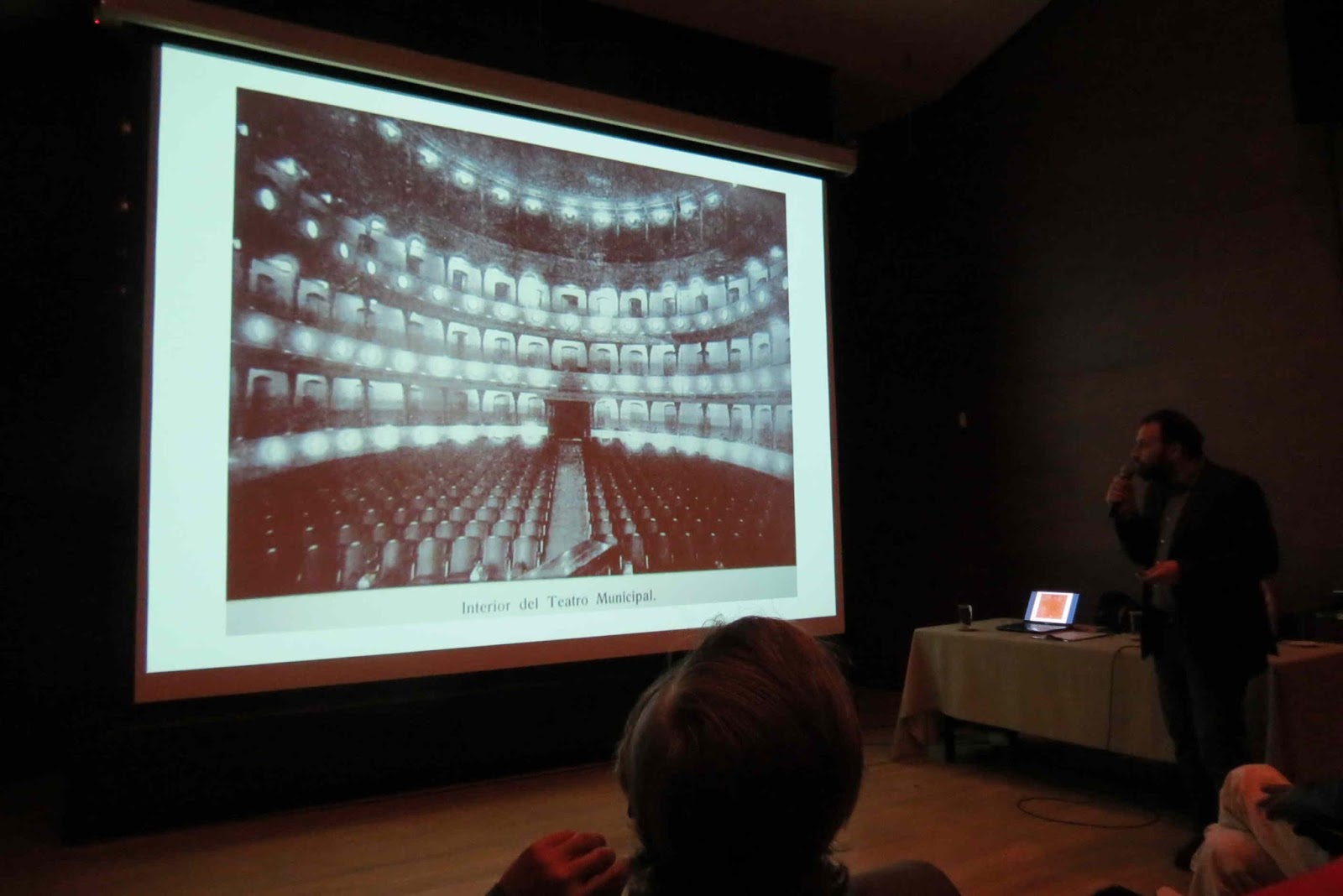
Perhaps the greatest loss for Bogotá was the demolition of the old Teatro Municipal, which was located beside the observatory behind the Presidential Palace. The theatre survived the Bogotazo riots triggered by the April 1948 assassination of politician Jorge Eliecer Gaitan - who had made many memorable and fiery speaches in the theatre - only to be demolished by the city. 

"They did it to bury Gaitan's memory," Becerra said. 

Ironically, today, Bogotá's municipal theatre, located on Calle Septima and 23st St., is named after Gaitan. 

A few of the movie theatres in central Bogotá. 


Central Bogotá, land of movie theatres.

The Teatro Ecci on Calle 17, which no longer shows films, but holds events such as graduations.

The Teatro Municipal, marked by the red dot, was located near the presidential palace, beside the astronomical observatory. Politician Jorge Eliecer Gaitan made many speeches there, and it survived the 1948 bogotazo riots only to be demolished by the city.

The classic Teatro Faenza, modeled after one in Italy, is being restored (slowly) by the Universidad Central. A grand art nouveau building built in 1924, it was Bogotá's first movie theatre. But it sank to showing porno films before finally closing in 2002.
The Teatro Mexico, across the street from the Faenza, also belongs to the Universidad Central and shows arts films.


The Teatro Jorge Eliecer Gaitan on Ave. Septima. But they don't show movies here.


The Teatro Pussycat on Ave. Septima, a holdover from the era when these blocks were part of the red light district. 

This handsome building on Carrera Septima across from the Avianca building looks like it was once a theatre. 

The disappeared Teatro Variedades on Carrera 7.

The Teatro Olympia. 

A porn theatre, on Calle 12, maintains downtown's film tradition. 


By Mike Ceaser, of Bogotá Bike Tours

Thursday, March 21, 2013

120 Years of the Pasaje Rivas


Audelino Gutiérrez, whose sold in Pasaje Rivas for 60 years, and his son Fernando. 
The historic Pasaje Rivas, repository of lots of Colombianismo, celebrated its 120th anniversary this week.
Luz Marina has had her stand at the Pasaje's
south entrance for 17 years. 

Today, Bogotá is full of 'centro comerciales,' many of them lacking any character or personality. But all of them owe a historical debt to the Pasaje Rivas, the pioneer in their industry.

The Pasaje Rivas, together with two adjoining pasajes added later, forms an 'L', connecting the chaotic and polluted Carrera Decima to the pedestrian-only Calle 10, on the edge of La Candelaria. Its 17 independent businesses, in dark, narrow corridors, sell a mixture of touristy and practical things, including souvenirs, handicrafts, clothing, house decorations and furniture.

And, of course, it has lots of great people, and the sort of human attention you won't find in one of those prefab glass-and-stainless steel malls.
The pasaje's crowded interior. 
When Pasaje Rivas opened in 1893 the area was on the edge of Bogotá. Over the century since, it's seen huge changes, including the growth of the city's largest popular market, La Concepción, on its western side, and the market's later elimination to make way for widening Carrera Decima.

Pasaje Rivas was one of the few institutions in central Bogotá to survive unscathed the disastrous 1948 Bogotazo riots.

In the mid-1900s, the Santa Ines neighborhood to the market's southwest evolved into the notorious El Cartucho district, known for robbery, prostitution and drug sales and use. After FARC guerrillas launched bombs from El Cartucho at the presidential palace during Pres. Alvaro Uribe's 2002 inauguration, the city bulldozed El Cartucho and replaced it with the existing Tercer Milenio Park.

Audelino Gutiérrez displays some ruanas. 
Directly west of el Pasaje Rivas, San Victorino has grown into one of the largest popular market areas in South America. Meanwhile, to the market's east, the La Candelaria neighborhood sank almost to the level of a slum and is now reviving.

Pasaje Rivas, with its colorful mixture of offerings, seems to have changed much less.

Audelino's son Fernando, 40, says that despite all of the changes around it, the Pasaje Rivas has held its place.

"What we sell here is unique," he said.

Audelino Gutiérrez, aged 80, has sold furniture, fabrics, hammocks, traditional kitchen equipment and furniture in Pasaje Rivas for 60 years. The market's survival has always been a struggle to survive, he says - but it has survived.

"Here, we survive on basic sales," he said. "But we survive."

He showed me a guillotine for cutting panela, a bandeja for preparing patacones and dishes for
The view from the second floor. 
serving beans and seafood. He also pulled out traditional hats used in rural Colombia, including the famous Vueltiao (these are made in Colombia, not China) and another named the sombrero Uribista after ex-Pres. Uribe, whose family owns ranches.

Gutiérrez also showed me ruanas, simple wool ponchose which have come to symbolize the Colombian of modest means - just the sort of local people who shop in the Pasaje Rivas.


Audelino Gutiérrez offers hats. 

A plaque placed by the city this week. 

One of the pasaje's larger stores. 


The Pasaje Rivas's south entrance, on Calle Diez. 

The Pasaje's western entrance, on Carrera Decima. 


Cane baskets for sale. 

...and fake fruits. 


Views of the chaotic, noisy and polluted Carrera Decima, which should improve when TransMilenio finally starts operating here. 


Audelino demonstrates a guillotine for cutting panela. 
and a patacones-maker.


Windows of the pasaje's deteriorting second floor. 


By Mike Ceaser, of Bogotá Bike Tours