Showing posts with label Panama. Show all posts

Wednesday, May 17, 2017

The Gunadules' Art from the Universe

A  mola with modern influences.

One of Colombia's least-known indigenous peoples, the Gunadules, also known as the Kunas, Cunas o Tules, lived in pre-Columbian times in northern parts of Colombia and the Darien peninsula, but were driven into what is now Panama by conflicts with the Spanish and other indigenous groups. Only a few thousand still live in present-day Colombia.

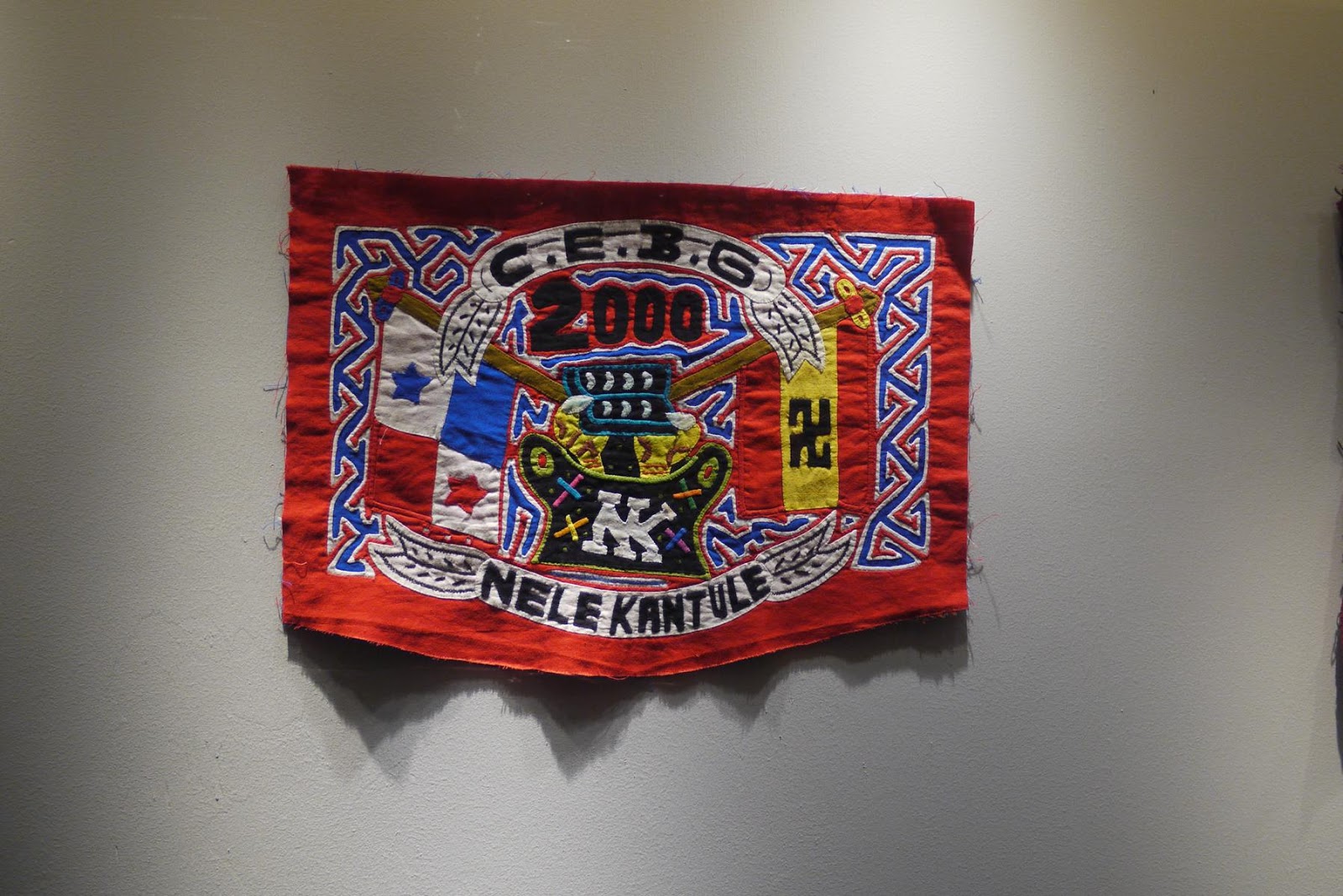
In 1925, the Kunas rebelled against the Panamanian government and achieved a measure of cultural autonomy - and also adopted a flag with a swastika, which they still use.
Most Gunadules now live in Panama.

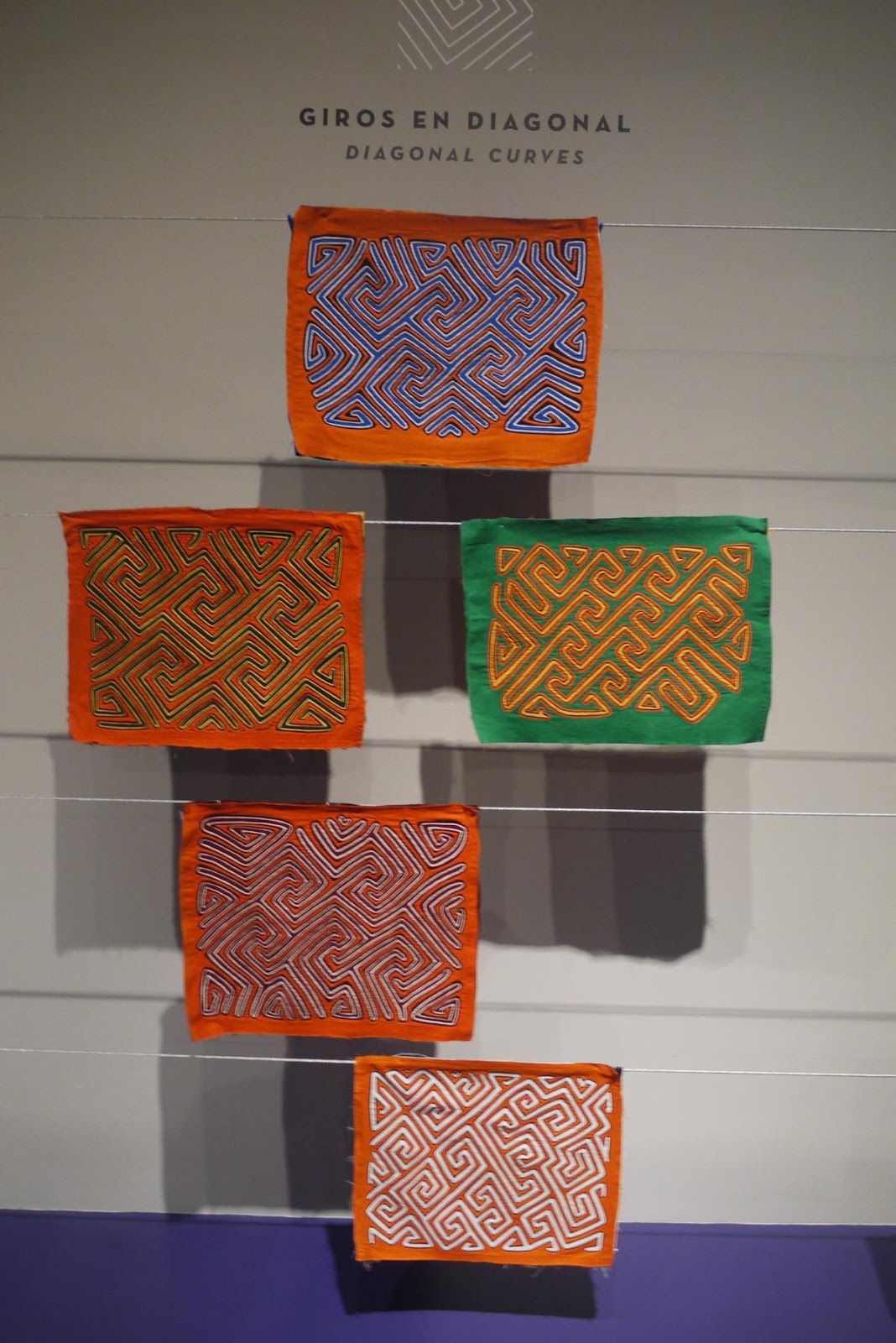
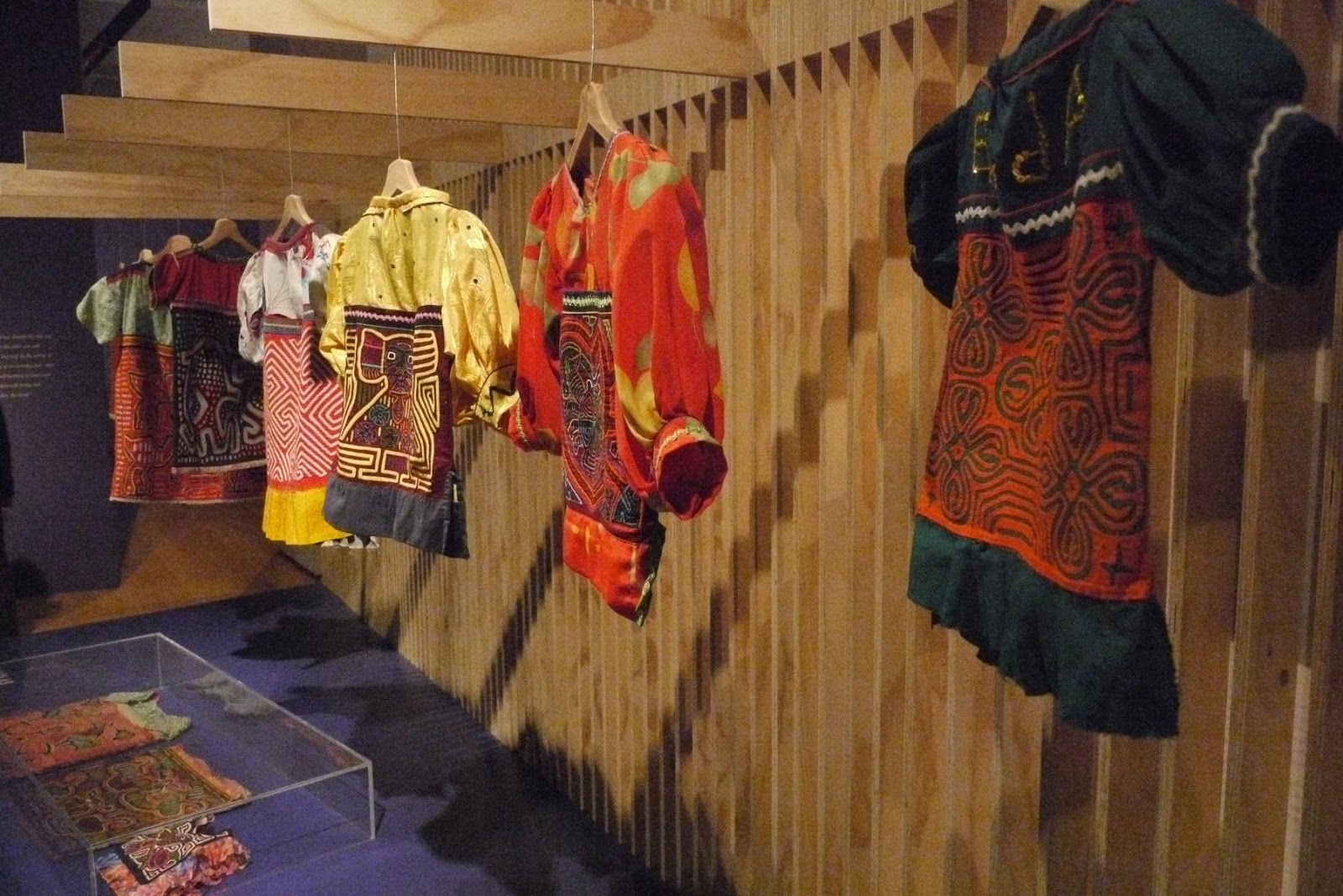
The Gunadule women are famous for sewing molas, which have a spiritual and artistic significance. According to Gunadule mythology, a woman traveled through the universe, which is divided into layers or capas, to bring back the secret of the molas.

An exhibition of molas, and other Gunadule artwork, is on now in the Museo de Oro in Bogotá.


When a figure cracks, it loses its spiritual value.


A bird.


Molas come in all colors.

Gunadule indigenous people.

Their flag includes a swastika.


Cultural influences: Old Milwaukee.


By Mike Ceaser, of Bogotá Bike Tours

Sunday, September 28, 2014

Doom for the Darien?

Luxurian vegetation in the Darien Gap. (Photo: Naked Man in the Tree)
The Darien Gap (Photo: Wikipedia)
The Darien Gap is one of those archetypal wild places.

A corridor of jungle between Panama and Colombia roamed by guerrillas and narcotraffickers and home to great natural biodiversity, the Darien is the one untamed segment left between Alaska and Tierra del Fuego. Bicyclists making the epic tour from one end of the Americas to the other have to get off for this one stretch and take a ferry between the Panamanian and Colombian coasts.

But that may soon change, because of a thirst for money and electricity. Colombia and Panama are planning to build a power line to carry electricity from Colombia, which abounds with hydroelectric power, to Panama and eventually as far north as Mexico.

The economic incentives are clear and immediate, but the environmental and social impacts will come only later.

A native Embera girl in
Panama's Darien Province.
(Photo; Wikipedia)
Chopping a 100-kilometer long corridor thru this legendary jungle will inevitably destroy it. The electrical corridor will not only become a barrier to animal migration, but also an invasion route for illegal farmers, miners and hunters. Deforestation and fires, already taking place, will accelerate and spread out from the power line, driving many native species to extinction. The invasion of construction workers, miners and loggers will bring alcohol, prostitution and fatal diseases to the native Embera-Wounaan and Kuna peoples, who will be decimated.

Plans for the $450 million project are supposed to be finalized next year, and it's projected to start operating in 2018, generating some $250 million in annual income for Colombia.

Deforestation is already going on in the
Darien region.
(Photo: VillalonSantaMaria)
I haven't found specific plans for the cable's route. But, while an undersea route would be much more environmentally sound, an overland route would be much cheaper.

Guess which path the Colombian and Panamanian governments are likely to choose?

By Mike Ceaser, of Bogotá Bike Tours

Wednesday, September 17, 2014

How Panama Created the United Kingdom

Colombia has not played much of a role in the campaign for tomorrow's Scottish independence vote.

However, if not for territory which was for a time part of Colombia, Scotland might never have united with England in the first place.
The Gulf of Darien, with New Edinburgh
on the right.

During the 1600s Scotland was a small struggling nation on the edge of Europe - but with dreams of greatness. Why shouldn't Scotland become, like England, the center of a great empire?

Scottish leaders set up a business scheme, which finally settled on establishing a colony on the Gulf of Darien on the Isthmus of Panama. Panama was strategic, the Scots believed, because it would be the pathway to trade between the Atlantic and Pacific oceans.

But English business interests, fearful of competition and of antagonizing the Spanish empire, prevented the Scots from raising money in London and on the European continent. As a result, the Scots had to raise their money at home, from patriotic Scotsmen and women. Ultimately, between one fourth and one half of all the money circulating in Scotland was invested in the Darien Scheme.

The first five ships, with 1,200 colonists, sailed in 1698 and established New Edinburgh in present-day Panama. But the expedition quickly turned disastrous from disease, internal quarrels, hostility from the Spanish and lack of aid from the English, who didn't want to antagonize the Spanish empire, which also claimed Panama. Only 300 people survived to return to Scotland.
Panama, the country which created the United Kingdom.

But before the survivors returned to tell their tale, another set of ships full of eager colonists had set off for Panama. This group also met disaster, including a Spanish military siege. Only a few hundred survived to return to Scotland. They left behind few traces, but today a town on the would-be settlement site is sometimes called Puerto Escocés.

In the wake of the disaster, the Scottish company invested its remaining money in two ships which bought slaves on the coast of Africa. However, on Madagascar those ships were seized by a pirate, who ultimately burned and abandoned them.

Thus ended Scotland's colonial adventure, which nearly bankrupted the nation. Scots seemed to conclude that they'd have better luck by uniting themselves with their larger, wealthier southern neighbor. The parliaments of Scotland and England passed acts of union, creating the United Kingdom in May, 1707.

The Spanish Empire eventually consolidated its control over the Isthmus of Panama. When South America became independent, Panama became part of La Gran Colombia, which also included what today are Colombia, Peru, Ecuador and Venezuela. When La Gran Colombia broke up in 1831, Panama remained part of Nueva Granada, which became the Republic of Colombia. U.S. Pres. Theodore Roosevelt wanted to dig a canal across the Isthmus, but Colombia's Congress was reluctant.

Not to be stopped, Roosevelt encouraged the Panamanians to rebel, which they did in 1903, and the U.S. recognized Panama's independence. The U.S. dug the Panama Canal, which was completed in 1914. In a way, the Americans fulfilled the Scots' centuries-old plan of connecting the oceans.

Scotland, meanwhile, seemed to flourish in its union with England. Edinburgh became a center of culture and philosophy, while Glasgow evolved into an industrial center. Many Scots played prominent roles in the British empire.

When Scots go to the polls, will they keep Colombia's role in their history in mind? Probably not.

And if Scotland votes 'Yes' and becomes independent again, will they take up once again the old dream of having their own empire? Panama had better watch out!

By Mike Ceaser, of Bogotá Bike Tours

Saturday, June 8, 2013

More Canal Trouble for Colombia?


A threat to Colombia? Old plans for a canal across Nicaragua are coming back. (Photo: Wikipedia)
In 1903, Colombia had just finished the bloody Thousand-days civil war. In Colombia's presidency was José Manuel Marroquín, a philosophy professor who reportedly was more passionate about writing books on grammar than governing. And the country was still smarting from the dismemberment it suffered when Ecuador and Venezuela broke away from La Gran Colombia.

It could have been Colombia: Construction of the Panama Canal (Photo: Wikipedia)
Enter the United States, led by Pres. Theodore Roosevelt, a military man, believer in Manifest Destiny and wielder of the 'big stick,' who was bent on expanding the U.S.'s power across the hemisphere.

A ship crosses the Panama Canal.
Roosevelt wanted to dig a canal across Central America to connect the Pacific and Atlantic oceans and save ships the long and dangerous passage around around the southern tip of South America. And the Colombian province of Panama was the logical place to dig it, since the French had already done years of excavation there. (The alternative was digging across Nicaragua.)

No warrior: Colombian Pres. Jose
Manuel Marroquin.
Bogotá's relationship with Panama was already tenuous. The province was isolated from the rest of Colombia - today, there's still no land connection between the two nations - and many Panamanians had long aspired for independence - even rebelling several times. The Panamanians also resented their sufferings during the Thousand Days War, which they felt was fought over issues foreign to them.

So, when Washington approached Bogotá proposing digging a canal across Panama, Colombian leaders worried. Bogotá had less than a century before already lost much of its territory, and now this big power from the north was proposing digging a trench across the country and then assuming long-term control of the corridor.

Colombia's Congress gave the Yanquis the cold shoulder and made big demands for the canal concession.

Theodore Roosevelt:
A rough rider.
The strategy backfired disastrously for Colombia. Roosevelt encouraged the Panamanians to stage yet another revolt and immediately recognized Panama's independence. Roosevelt even sent down U.S. warships to prevent Bogotá from putting down the rebellion.

Instead of losing temporary control of a corridor of land, Colombia lost a whole province.

It's interesting to think about how things would be different if Colombia had cooperated with the Roosevelt administration. Today, Panama would likely still be a Colombian province, giving Colombian much more economic and geopolitical importance.

But there's no changing history.

And today, Colombia's unfortunate relationship with Central American canals may be heading for a repeat.

The recent Hague International Justice Court's ruling expanding Nicaragua's Caribbean waters breathed new
Nicaragua still claims Colombia's San Andres archipelago,
located off of Nicaragua's coast. A nearby canal would
 impact them economically, geopolitically and
environmentally. 
life into that nation's hopes to build its own canal between the oceans. A canal across Nicaragua would be longer than Panama's, but have huge advantages. It would be a sea-level canal, meaning that ships would not have to be lifted and lowered in locks as the Panama Canal does, and it would be wider and deeper than Panama's. The world's biggest ships, mostly oil tankers, already can't fit thru the Panama Canal and still won't even be able to after that canal's current expansion is completed.

The Nicaraguan government is moving ahead with a concession to a Chinese company to dig a canal across the country. (There had also been talk of the Chinese building a 'dry canal' in the form of a railroad line between Colombia's Pacific and Atlantic coasts.) After the Hague ruling, some Colombian officials even suggested that the Chinese interest in building such a canal could have influenced the Chinese judge on the panel, but there's no evidence for that.

The Seaflower Marine reserve around the San Andres
archipelago would be hit with pollution and exotic species,
as well as huge sea traffic, if an inter-ocean canal is
dug across Nicaragua. (Photo: Unesco)
But a canal across Nicaragua could mean trouble for Colombia. It would inevitably increase Nicaragua's influence in the Caribbean, increasing pressure on Colombia's sovereignety over the San Andres Archipelago off of Nicaragua's coast. Nicaragua has long claimed the islands.

Adding a major shipping channel will also produce huge environmental impacts from ship movement, ship wastes and the introduction of exotic species. That's particularly worrying for Colombia's Seaflower Marine Sanctuary around the San Andres Islands. (Colombia is using the sanctuary to challenge the recent Hague court ruling, but its chances for success look slim.)

By Mike Ceaser, of Bogotá Bike Tours

Thursday, November 17, 2011

Bogotá's 'Subway' Mystery

Isn't that a subway entrance on Jimenez and Seventh Ave?
They look like subway entrances.... They're located like subway entrances...But Bogotá never had a subway (altho they keep talking about building one.)

Trading emeralds beside one of the structures.
Pass by Ave. Jimenez just west of Carrera 7 and you'll see two metal cages which look a lot like antiquated subway entrances - except that only rarely does anybody enter or leave them. Alongside them, TransMilenio buses roll up and down Jimenez.

In fact, the two mysterious structures have nothing to do with subways, but they are openings to a chapter of Colombian history.

What's the message in this flower?
Panama once belonged to Colombia. But U.S. Pres. Theodore Roosevelt wanted to dig a canal across the isthmus, and Colombia's government wasn't very cooperative. A man of action - and also imperialism - Roosevelt encouraged the Panamanians to rebel and sent U.S. Navy warships to prevent Colombia from putting down the rebellion. Panama became independent, the U.S. dug the canal, world trade changed and the rest is history.


Hanging around. Performance art. 
What's that got to do with those metallic structures on Jimenez Ave? Years later, the U.S. paid Colombia about $25 million for having stolen Panama - certainly one of history's best land deals. Colombia used the money for urban projects, including demolishing buildings along Jimenez to broaden the avenue. Those metallic structures are the entrances to the basement of a demolished building.

Ironically, there is a Subway nearby.
For years, I understand, the basement space sat vacant. Now, however, it's being used to teach theatre and for staging plays. Meanwhile, the theatre people use the space in the eastern entrance cage for quirky, random still lifes. One day it's flowers, then a couch, fast-food packaging...Once a week, they stage performances. The other structure a block west makes a convenient display area for street vendors' art.


A fun place to climb. 
The gringos took Panama, but they gave Colombia McDonald's.

A tribute to Ronald McDonald, America's gift.


A poster advertises theatre. 

On the western end of the block, art for sale. 


By Mike Ceaser, of Bogotá Bike Tours

Wednesday, August 18, 2010

No more 'bases gringas'?

After the U.S. handed over the Panama Canal , the Panamanians also kicked out the U.S. military base there. Washington looked around, and finally rented a space on the Ecuadorian air force base at Manta to use for what it said were solely anti-drug flights. But then Ecuador elected leftist Pres. Rafael Correa, and he ended the U.S.'s rights to use the Manta air base. So, Washington looked east and found Colombia, with which it signed an agreement giving the US's military landing rights on seven Colombian military bases.


The US-Colombia agreement generated lots of
controversy, especially among leftists, who denounced the arrangement as 'US bases' and an example of US imperialism. Venezuelan Pres. Hugo Chavez suggested that the US and Colombia would spy on his country and were even preparing to invade Venezuela.

Yesterday, Colombia's high court ruled that the agreement was invalid because it had not been approved by Colombia's Congress. That appears unlikely to happen, unless Colombian Pres. Juan Manuel Santos is willing to rile up the Venezuelan government.

What's the lesson in this? First of all, the US doesn't look like much of an imperialistic power - not when tiny nations like Panama and Ecuador have evicted US soldiers without firing a shot.

And the decision shows once again that Colombia is a democracy with an independent court system - with a backbone.

At the same time, the US should find a lesson in this: Its war on drugs is unpopular in Latin America, where it is widely seen as an imposition. What's more, despite billions of dollars spent and many thousands of deaths, the war has produced little progress against the drug trade.

Perhaps a change of strategy is in order.

This blog written by Mike Ceaser, of Bogotá Bike Tours.