Showing posts with label football. Show all posts

Tuesday, October 11, 2016

What's REALLY Important Here!

Men watch today's football along Jimenez Avenue in central Bogota.
Colombians - particularly male ones - turned out in droves today to watch the World Cup qualifying match. Colombian tied Uruguay 2 - 2.

If only people had shown half of this passion for the referendum on the peace agreement with the FARC, which happened to be the most important event in Colombia's recent history. Then, abstention wouldn't have been so high, and perhaps SI would have won.

A friend was just telling us about his trip to the Pacific Coast region, one of the areas hit hardest by Colombia's violence. In some places, he said, the threat of violence has lifted, and the people, most of them indigenous, turned to constructive projects. He described a fundamental change, which hopefully will last, despite the agreement's narrow loss at the polls. The politicians are still talking.


By Mike Ceaser, of Bogotá Bike Tours

Wednesday, June 10, 2015

Surprise! Suprise! Football is Sexist

Still all about James Rodriguez in El Espectador.
The sports industry is sexist. Everybody knows that. Football, basketball, American football, boxing...usually, we don't even consider the female versions of these - if they even exist.

The Womens' World Cup gets just a mention in El Tiempo.
That's particularly clear right now. The run-up to the Copa America, to be played in Chile, is receiving non-stop coverage in Colombian media: Who are the contenders? How's training going? How will Messi do? Who's twisted his ankle? And, for good measure, a feature on James Rodriguez's childhood. It's endless.

And Copa America hasn't even started yet.

Meanwhile, pushed into the corner of El Tiempo's sports page, is a small article about the women's side: Colombia managed to tie Mexico today, in the Women's World Cup tournament taking place in Canada.

Of course, a few women are featured by the sports journalists: A Colombian sports broadcast today dwelled endlessly, with generous videos, about a supposed plan by Venezuelan women to remove their clothing if their country's team does well in the Copa.

As for the Women's World Cup, which has has only existed since 1991, if Colombia wins, will anybody notice? Who knows, for example, who the reigning champion is? It's Japan, of all countries.

Also, in the women's cup's favor is the fact that, as far as I know, the FIFA corruption scandal hasn't touched the women's side. There's an easy explanation for that, of course - there's lots less money in it. Check out the FIFA women's sports page, which shows teams playing in fields resembling those of a mid.aized American high school.


By Mike Ceaser, of Bogotá Bike Tours

Wednesday, May 13, 2015

The Most Important Thing in Bogotá...


This afternoon, the most important thing in Bogotá was a bunch of multimillionares, only one of whom is Colombian, kicking an inflated bag around a field in Europe.

With crisis in crime, pollution, transport, violence...you name it, just go figger.


By Mike Ceaser, of Bogotá Bike Tours

Wednesday, October 1, 2014

Colombia Qualifies for the 'Other' World Cup

Colombia's Women's Team: On their way to the Olympics and the World Cup, in case you didn't notice. (Photo: El Tiempo)
Even as Colombia continues to feel the glow from its run in the football World Cup, and the country's self-esteem seems to be pegged to James Rodriguez's performance for Real Madrid, Colombia's qualifying for the Women's World Cup, to be held next year in Canada, received scant attention.

The women qualified by finishing second, after Brazil, in the Copa America, played in Ecuador. At the same time, they also qualified for the Olympics and Panamerican Games.

This is the second time the Colombia women have qualified, and in at least one sense it's a greater achievement than the men's qualifying, since there are places for far fewer teams (but fewer nations field women's teams). Colombia may stand a better chance at winning the women's cup, since the field appears more open than on the men's side, where a few elite teams dominate. In women's international soccer Brazil and Germany also do well, but Norway, Japan and the United States have all won women's cups, and even China and Canada have placed high.

A big boost for Colombian and Latin American women's soccer would be the creation of professional leagues. Women's leagues do exist in Europe, and one is struggling to survive in the U.S., but they receive minimal attention.

While a few Colombian women athletes have become heroines, it's perhaps a sad commentary that the greatest attention women athletes have received recently was for the supposedly suggestive colors of the women's cycling team's uniform.

By Mike Ceaser, of Bogotá Bike Tours

Thursday, July 24, 2014

The Dark Side of Jamesmania

A vendor in Paloquemao Market celebrates the success of millionaire athlete James Rodriguez.
Of all the things which might obsess a nation, one of the last I'd have expected would by the hiring of a Colombian football player by a team in Spain.

While we were obsessing with James Rodriguez...
drought-killed cattle in northern Colombia.
James' shirts fly off the hangars in Spain.
James Rodriguez is undoubtedly a talented football player and seems to be a nice guy. He's also become fabulously wealthy by playing a sport which many others play for fun. Banker Luis Carlos Sarmiento and beer brewer Alejandro Santo Domingo, Colombia's richest men, made their money by decades of getting up early, negotiating deals, hiring employees and analyzing budgets (and, sure, probably exploiting more than a few people along the way) - but they probably receive more resentment and jealousy than admiration from other Colombians.

Rodriguez undoubtedly worked hard, too. But he became rich and famous doing something fun, thanks to lots of inborn ability. And he gets showered with admiration, rather than jealousy.

Colombian footballer Juan Guillermo Cuadrado signing
t-shirts for Colombian children he has helped.
And, while the media and public have been obsessing over Rodriguez's ball-kicking ability, other things have happened in Colombia: There's a terrible drought in parts of the country; El Chocó has been wracked by poverty and violence; A new study found high levels of malnutrition in impoverished Colombian kids; Guerrilla bombings are spilling oil; a mine disaster in El Cauca killed seven people...and on and on.

But that's been eclipsed by Rodriguez. Is Rodriguez's ball-kicking ability really more important than any of that?

A football jersey from James Rodriguez's
foundation Colombia Somos Todos.
Spanish newspapers have questioned whether Rodriguez is really worth 80 million euros, just because he played well in a few World Cup games. They should also ask whether it's ethical for a Spanish company to spend a fortune on a single athlete while millions of Spaniards are unemployed, homeless and hungry.

Colombians should ask whether Rodriguez, a young man who hardly needs millions to survive, will send part of his fortune home to help the needy. I found this ugly list of five ways Rodriguez might spend his money, including buying luxury cars and big mansions. Helping others was last on the list. The Colombian business publication Portfolio has an equally ugly article suggesting that Rodriguez buy a luxury car or a mansion, and pointing out that he'll earn 2 million pesos per hour, more than triple Colombia's monthly minimum wage. Rodriguez's annual salary is greater than Bogotá's planned investment to clean up the Rio Bogotá. How many displaced or sick people could Rodriguez help? Or, will he instead follow in the footsteps of team mate Cristian Ronaldo and spent his fortune collecting luxury automobiles?

Hopefully not. In 2011, Rodriguez created the 'Colombia Somos Todos' foundation. That's a good start. Now that he's earning close to $1 million a month and will surely rake in much more by endorsing things like athletic shoes and deodorant, let's hope he does good with his fortune.

By Mike Ceaser, of Bogotá Bike Tours

Saturday, June 28, 2014

The Match in Egipto

celebrar!
I happened to be in the hardscrabble Egipto neighborhood above La Candelaria this afternoon when Colombia won its match against Uruguay. The celebration was loud and predictable. 

Sport is fun, but I'm getting a bit tired of this obsession over which set of millionaires can kick a ball more times between some goalposts. After all, there just might be some more important things going on in the world...

The Egipto neighborhood, for example, high rates of violence, poverty and malnutrition. But that's all forgotten today.
In Egipto's traditional fruit and vegetable market, the vendors are glued to a TV set.
In an informal restaurant set up on a sidewalk, patrons celebrate Colombia's victory.
Young men wave flags on an Egipto street by La Circunvular.
This park off of La Circunvular was pretty desolate, except for a few kids skateboarding.

Waving the flag.
By Mike Ceaser, of Bogotá Bike Tours

Friday, June 27, 2014

A Bite of Luck for Colombia

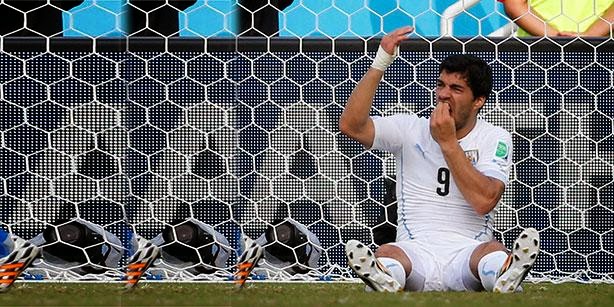
Italian player Giorgio Chiellini shows his shoulder, bitten by Uruguayan striker Luis Suarez.
When Uruguay's star striker Luis Suarez bit an Italian opponent, he did Colombia a big favor. When the teams play tomorrow in the World Cup's first elimination round, Uruguay will be missing the man who scored its two goals against England.

Suarez holds his teeth after attempting live cannibalism.
The loss is a boost for Colombia, but only evens things out, since Colombia's own star striker, Falcao, is off the team because of a knee injury.

Suarez, meanwhile, has been welcomed back home as a hero. Uruguay's coach called FIFA's nine-game, two-month suspension of Suarez an unfair persecution pushed by the 'English-speaking media.' Perhaps that English-speaking media has a special prejudice against cannibals. A bit ironically, Suarez plays for Liverpool, in England.
A muzzle for Suarez? (Image: The Independent)

Some have suggested that Suarez needs therapy to control his aggression. But that aggression and lack
of inhibition is probably fundamental to his soccer prowess.

So far, Colombia has done great - but had a pretty easy run. Assuming a victory tomorrow, Colombia will next run up against the winner of the Brazil-Chile match, in other words, Brazil.

By Mike Ceaser, of Bogotá Bike Tours

Monday, June 23, 2014

The Perils of Being a Colombian Athlete

Football star
Andres Escobar.
Almost 20 years ago Colombia was projected to do well in the World Cup, and was favored to beat the United States in their group stage match.

But then, in what sadly remains the best-known episode in Colombian sports, 27-year-old defender Andres Escobar scored an own-goal - apparently by accident - and Colombia lost 1-2 to the U.S. and made an early departure from the World Cup.

But that was only the first act of Escobar's tragedy. A popular and talented player, Escobar became the whipping boy for Colombia's disappointing performance. He returned to Medellin and hid in his house. Finally, on July 1, Escobar and a buddy went out with their girlfriends. There, the Gallón brothers, who were allegedly connected to paramilitaries and drug-traffickers, ridiculed Escobar from a nearby table.

"Autogol, Andrés, autogol" they yelled at him.

Escobar held his temper. But after leaving the restaurant at 4 a.m. he followed the brothers' car into a
Escobar's funeral procession.
parking lot. There,  Humberto Muñoz, the brothers' driver/bodyguard, fired six bullets into Escobar's head.

Afterwards, the driver would defend his employers, claiming they hadn't ordered him to kill Escobar "yet."

Colombian President Cesar Gaviria attended Escobar's funeral. The young football star had turned from hero to goat to martyr.

Gunman Muñoz did 12 years in prison. The Gallón brothers, who had influential friends, did short prison sentences for attempting to cover up the crime. Later, however, one of them was convicted of financing paramilitary groups. (El Espectador has an in-depth article here.)

Escobar, however, was far from the only Colombian athlete to fall victim to the country's violence.

A Cyclist's Father Murdered

Cyclist Rigoberto Duran.
Colombian cyclist Rigoberto Urán's second-place finish in the Giro d'Italia this month would have made headlines - if not for the fact that another Colombian, Nairo Quintana, finished first.

But Urán had to climb over more than hills to achieve cycling greatness. He also had to overcome illness, poverty and the tragedy of Colombia's armed conflict.

Born in 1987 in the municipality of Urrao, Antioquia, Urán grew up poor, helping his father collect farmers' milk and sell lottery tickets. The young Urán suffered from asthma, so to cure this his father took him cycling thru the region's hills. The boy soon improved.

However, like much of Colombia, the Urrao region was roamed by violent bands of leftist guerrillas and right-wing paramilitaries. One day, the elder Urán - also named Rigoberto - went out on a training ride and encountered an illegal paramilitary checkpoint. Altho what happened next is uncertain, the younger Urán says that the paramilitaries forced his father and others to steal cattle for them - and then killed the men.

Fatherless, the 14-year-old Urán was forced to support his family by selling lottery tickets. Nevertheless, he continued training, and soon after was signed by the Orgullo Paisa racing team. Now, he supported his family with his cycling income.

By age 18 Urán was in Colombia's national team, and a year later Team Tenax had signed him and moved him to Spain.

Kidnapping - a Professional Risk for Cycle Racers

Cyclist Luis 'Lucho' Herrera.
Other Colombian cyclists' scrapes with their nation's armed conflict have fortunately not been so tragic. Luis 'Lucho' Herrera was a legendary climber who achieved immortality in 1987 by winning the Vuelta a España. He retired in 1992 to spend time with his family.

However, in 2000 Herrera guerrillas kidnapped Herera. According to one report I read, only after grabbing Herrera did the guerrillas discover who they were holding. They then asked their captive to recount his racing glories, and freed him after only 24 hours, apparently embarrassed about having kidnapped a national hero.

Oliverio Rincón, kidnapped
twice in one year.
Also in 2000, fellow cyclist Oliverio Rincón was kidnapped twice,
once together with his family, the first time by the ELN and afterward by the FARC guerrillas. The ELN held Rincón for a week, and the second kidnapping lasted for only one day. After his second kidnapping, Rincón said that the guerrillas had apologized to him.

The kidnappers "told me that I wasn't the person they were looking for, that it was a mistake and that they were very sorry about it," Rincon said.


By Mike Ceaser, of Bogotá Bike Tours

Sunday, June 15, 2014

Santos's Campaign Secret: La Selección?

Pres. Santos and supporters celebrate his reelection victory. (Photo: El Tiempo)
Pres. Santos, it seems to me, ran a remarkably ineffective reelection campaign, despite impressive achievements to run on: The economy is growing at an almost 5% annually, unemployment is dropping, inflation is low, Santos has killed several important guerrilla leaders and the government-FARC peace negotiations are progressing.

Colombia beat Greece 3-0 on Saturday.
Nevertheless, just ten days ago some polls had Santos trailing right-wing candidate Oscár Iván Zuluaga - who until recently was almost unknown to Colombians - by as much as 10% in voters' intentions.

And then, today, Santos won reelection with a comfortable 6% margin.

What changed things? It wasn't the debates, in which Santos seemed to flail and Zuluaga made his arguments with confidence.

Members of Colombia's selección celebrating yesterday.
Pres. Santos had good reason to celebrate, too.
Perhaps continued progress in the peace negotiations helped, as did vigorous support from left-wing political leaders.

But a significant factor may have been Colombia's previous day's victory in the World Cup.

Before you shake your head, read this 2010 study 'Irrelevant events affect voters' evaluations of government performance,' which found that in United States elections, a victory by the local college (American) football team gave an incumbent politician an average 1.61% vote increase. The connection isn't rational, of course. But when a voter feels that things are going well generally, he or she can subconsciously transfer that sentiment to the local incumbent.
'Polls predict a Zuluaga victory in Colombia.'

'Big poll: Zuluaga 49% Santos 41%.'

'Santos 38%, Zuluaga 37%. 'The competition is head-to-head.'
Take that 1.6% number, add in the facts that this was Colombia's first World Cup appearance since 1998 and that the national team seems to represent Colombian patriotism, and it seems to me Santos' World Cup boost might have been 2 or 3%. In addition, a more enthusiastic public would tend to turn out to vote in higher numbers, which generally favors the more leftist candidate.

Arguing against a large football influence is the match's closeness to election date - by the day before the vote, most people have already made up their minds.

Still, it's hard to imagine that Colombia's resounding victory over Greece didn't make a difference of at least a point or two. Such a shift of votes from Zuluaga to Santos would at least have changed the election results from a tiny Santos victory to the minor mandate which he received.

Santos voters? Workers in Paloquemao market celebrate Colombia's World Cup victory.
By Mike Ceaser, of Bogotá Bike Tours

Saturday, June 14, 2014

What's a Victory Good For?

Workers go crazy in Paloquemao market as Colombia scores its second goal. I'm afraid I suffered permanent hearing loss.
A few scenes of celebration - and futbol paraphernalia - in central Bogotá today during and after the Colombia-Greece football game, which Colombia one overwhelmingly.

Today, they're celebrating. Tomorrow, they'll wake up to a country that still has a civil war, lots of poverty, hunger and other troubles. Hopefully, the presidential election will get as much attention as this match did.

Dancing away outside the Universidad Nacional.
Employees of Paloquemao Market.

They're not subtle.


Celebrators from a nearby 'Canadian' language academy cross an overpass above Carrera 45 near the Universidad Nacional.
The academy celebrators near the Universidad Nacional cheer Colombia's victory. However, the sign they're carrying is about emigration to Canada. 
The mural on the Universidad Nacional campus says 'Rebel Football, dignified and popular.'

The girls and the puppy are all dressed in the Colombian uniform.

Selling pirated jerseys on San Victorino Plaza.

Workers in Paloquemao Market watch the big screen. If not for that screen, would they have come to work?


By Mike Ceaser, of Bogotá Bike Tours

Friday, October 11, 2013

Colombia Returns to the World Cup in Heroic Fashion


Colombian futbol fans poured into Ave. Jimenez - and surely many other parts of the city - after Colombia qualified for the 2014 World Cup in heroic style by coming back from a 0-3 deficit in the first half to tie Chile. Colombia had expected to earn three points by winning this home game. But the comeback displayed a psychological and physical fortitude worth more than a victory.

Shortly before I started taking pictures a group of football fans had climbed atop a TransMilenio bus and danced on its roof, which brought out the riot police.

Next year's World Cup in Brazil will be Colombia's first since 1998.

Tragically, the post-classification celebrations caused five deaths. Colombian football has been notably deadly during recent weeks, with several murders committed in fights between fans of professional teams.


By Mike Ceaser, of Bogotá Bike Tours