Showing posts with label revolution. Show all posts

Tuesday, November 7, 2017

'Land, Peace, Bread' - and Tragedy

'Land, peace and bread.' Sounds great, doesn't it?
Every day, countless people pass by this mural on 26th St. not far from the Universidad Nacional, but I bet few recognize the catastrophic significance of what the dove is advertising.

'Land, peace and bread,' such beautiful sentiments, was the slogan of the 1917 Russian Revolution, which introduced the world to communism and its famines, totalitarianism and mass-murder. Because the Nazis gave right-wing fascism such a bad name, communism's sins are less well known. But The Volokh Conspiracy, a libertarian blog, uses the commonly cited figure of 100 million communist murders, including the Ukranian famines, Mao's Great Leap Forward and Cambodia's Killing Fields.

Nevertheless, the dream lives on, to a greater or lesser extent, in places like the nearby Universidad
The communist 'Voz' magazine celebrates
the Russian Revolution.
Nacional, whose marchers often carry images of Cuban revolutionary Che Guevara. But one doesn't have to look any further than Venezuela to see the impacts of a sort of socialism and a planned economy: People there are hungry, medicines are unavailable, crime has skyrocketed and Venezuela just entered hyperinflation. Meanwhile, its incompetent government is turning more and more authoritarian. Many thousands of Venezuelans have fled to Spain, Florida and Colombia - depriving the country of its most talented and educated young people. (Which why communist nations had a habit of building walls around themselves to keep their people in.)

It also provides a hint of what might have happened here in Colombia if the FARC had somehow obtained power. The mural was commissioned, incidentally, by the government of Bogotá Mayor Gustavo Petro, a one-time leader of the M-19 guerrilla movement.)

The paradoxical thing, of course, is that communism is based on wonderful ideals: equality, cooperation, from each according to his ability, to each according to his need. And on and on. Unfortunately, the tools those governments used to reach those goals - such as totalitarianism and forced collectivization of farms - clashed terribly with human nature.

If only communism were possible, then this would be a much better world. But it isn't, unfortunately.

By Mike Ceaser, of Bogotá Bike Tours

Saturday, June 27, 2015

A Half-Remembered Hero


Antonio Nariño, by Acevedo Bernal.
Antonio Nariño was one of the heroes of Colombia's revolution, but lives on mostly as a surname, immortalized primarily in the Colombian department named after him and the presidential palace, La Casa de Nariño.

But Nariño (1765 - 1823), who is being memorialized these days in an exhibition in the Archivo de Bogotá, deserves to be remembered as much more than another heroic portrait. In conflict after conflict, with both pen and sword, he battled for freedom - and paid with his own liberty.

A child of a wealthy Bogotá family, Nariño suffered lifelong health problems for which he moved to the warmer climate of Cartagena, where he became a successful exporter. He also imported the first privately-owned printing press in La Nueva Granada, ending the royal government's monopoly on the press.

In 1794, Nariño used that printing press to publish La Nueva Granada's first copies of 'The Rights of Man and the Citizen,' the fundamental document of the French Revolution and a furious challenge to the absolutist Spanish monarchy. After distributing only a few copies, Nariño got cold feet and burned the rest. But the virrey had already discovered the publication, and Nariño was arrested and condemned to ten years' exile in a Spanish colony in Africa.

Nariño, however, managed to escape and return to Colombia, where he was again arrested and imprisoned until 1803. In 1808, with the winds of revolution blowing, the royal government rounded up dissidents, including Nariño, who was imprisoned until freed by the rebels in 1810.

Back in Bogotá, Nariño founded what was probably Colombia's first opposition newspaper, La Bagatela, with which he helped drive out of office Jorge Tadeo Lozano, the first president of the then-independent Estado de Cundinamarca. Nariño then became Cundinamarca's second president.

The La Bagatela newspaper, in the Archivo de Bogotá.
Nariño also led troops in the independence wars, but was captured once again by the royal forces and carried to prison in Spain, and managed to return only in 1821, after independence had been won. Back in La Gran Colombia, Nariño returned to politics, but was accused of corruption and treason. In his final battle, he was absolved in court.

Suffering health problems, Nariño moved from Bogotá to a warmer climate, where he died two years later.

How might Colombia's history have been different if it had had such a fighter during each generation?

As for La Casa de Nariño, the presidential palace, it is located on the site of Nariño's birthplace.

By Mike Ceaser, of Bogotá Bike Tours

Tuesday, August 5, 2014

A Cannon in Parque Tercer Milenio


A cannon in Parque Tercer Milenio.
This afternoon these soldiers had set up this revolutionary-era cannon in Parque Tercer Milenio.

BOOM!
They were rehearsing for the celebration of the revolutionary victory in 1819 at the Puente de Boyacá.

BOOM!
The firing recalled, inevitably, the three pipe bombs which were fired from this same area during Pres. Alvaro Uribe's inauguration in 2002. Back then, this was the notorious El Cartucho neighborhood. According to the government, the bombs were fired by the FARC guerrillas. All three missed, and two landed in poor neighborhoods, killing and injuring residents.
BOOM!

Meanwhile, this rainbow appeared above Bogotá's Eastern Hills.


Near the Casa de Nariño, the presidential band was marching.


By Mike Ceaser, of Bogotá Bike Tours

Saturday, March 15, 2014

Simón Bolívar - The Flawed Man


Bolívar - a great man,
and a flawed one.
I recently read the Bolívar, the biography of Simón Bolívar, by Marie Arana. The book is pretty long, at just over 600 pages, but interesting and readable. And it provides a rounded, warts-and-all portrait of a man who has been transformed into a demigod by certain, mostly leftist, Latin American leaders.

Bolívar was by any measure a 'great man.' Overcoming huge challenges, he led (and drove) the armies which freed a half dozen nations in northern South America. Bolívar is often compared to George Washington, but Bolívar's accomplishments were, in many ways, much greater. Washington had only to drive out the British, but Bolívar had to deal with rival rebels, rebellions amongst other Americans, disease and even an earthquake.

While Washington's forces were overwhelmingly white and protestant, Bolivar managed to hold together a fighting force with huge racial and cultural differences.

Did Bolívar suffer remorse
for his massacres?
In contrast to the U.S. revolution, South America's was messy and fractured, with rival leaders, loyalist regions (which the British never enjoyed. In North America, the loyalists simply departed to Canada) and shifting loyalties, as whole regions switched allegiances.

And there was Bolívar's weakness for the ladies, which stole time from warmaking.

But Bolívar was clearly a much better general than Washington. Washington, according to some historians, lost more battles than he won, and won the war by managing to continue fighting until the British got exhausted and went home. Bolívar, in contrast, was a daring and ingenious tactician, who carried out almost superhuman feats, such as driving his army over high mountain passes to fall upon the unsuspecting Spanish.

Revolutionary pioneer Francisco de Miranda died in a Spanish
prison after Bolívar and others betrayed him to
the Spanish army.
George Washington and one of his
black slaves. The rebellion Washington led
protected slavery, while Bolívar's
started it toward its end.
The revolution Bolívar led also brought a much more fundamental change to South America than the North American 'revolution' did. Great Britain was, after all, something of a democracy in the 1700s, while Spain in the early 1800s was still an absolutist monarchy. (That's why I even wonder whether the North American colonies' rebellion should even be called a 'revolution.') And Bolívar's revolution was willing to make some fundamental changes which Washington's revolution was not - namely ending slavery and the slave trade, albeit not immediately. (Altho some would that Bolivar's motivation was partly pragmatic, to get the people of color, slave and free, onto the rebels' side.) In contrast, the U.S.'s Founding Fathers, terrible hypocrites many of them, wrote eloquently about the rights of man and human liberty and equality, but did nothing to end slavery and even protected the slave trade.

Deceased Venezuelan strongman
Hugo Chavez worshipped Bolívar.
But what is refreshing about Arana's book is that it includes Bolivár's mistakes and misdeeds - some of them
horrific ones. Take, for example, Bolívar's betrayal of revolutionary pioneer Francisco de Miranda to Spanish forces. Miranda died four years later in a Spanish prison.

South America's revolution was scarred by huge, wholesale savagery on both sides, including massacres of civilians and prisoners - which I haven't heard of in North America's revolution, which sounds gentlemanly in comparison. Bolívar massacred at various times Spanish prisoners of war, Spanish citizens for the crime of being Spaniards, and even a group of priests.

But at the revolutions' ends, Bolívar's comparison to Washington is less flattering. Bolívar seems to prove the old saying about power corrupting. In the end, Bolívar wanted to be made dictator of La Gran Colombia. Washington famously rejected being made king, served as president for two terms and then retired to his plantation (freeing his slaves in his will).

History may contain a sort of justice. Washington died a revered figure. Bolívar died almost a fugitive on the Colombian coast waiting for a ship to carry him to Europe for tuberculosis treatment.

By Mike Ceaser, of Bogotá Bike Tours

Saturday, July 20, 2013

How Important Really Was That Flowerpot?

Nicolás Pernett and a historian friend in the Casa de la Historia.
The Casa de la Historia,
in Teusaquillo.
What triggered Colombia's revolution against Spain? According to the common story, on July 20, 1810 a Spanish-born seller refused to lend a flowerpot to a group of criollos, who proceeded to smash the pot and run into the street screaming in protest. Thus, the 'Grito', or Cry of Liberty. (It sounds silly, but then so does a tea party in Boston.)

The incident, which the criollos had staged in order to trigger a rebellion, is usually credited with generating the anger which started the revolution against Spain.

A few of the CD's history produced by Diana Uribe.
But that's not the real story, says historian Nicolas Pernett, who gave a talk today in the Casa de la Historia in Teusaquillo. The Casa was founded three years ago by famed historian Diana Uribe, an author and popular radio personality whose historical talks range across continents and centuries.

Tucked away on a side street in Teusaquillo, the Casa houses a bookstore, holds talks and shows films. On July 20, the Casa and some of the neighborhood's many other theatres, cafes and bookstores held events related to the Grito de Libertad.

But historian Pernett doesn't swallow the idea that the Grito was really such a seminal event. Instead, he argues that Colombia has experienced various protests and rebellions against both the Spanish empire and later against the Colombian republic's power structure. The first major revolt was the 1780 Rebelion de los Comuneros, in which much of present-day Colombia and part of Venezuela took up arms against sudden tax increases. The Spanish rulers betrayed and then viciously supressed the rebels, sowing hatred and suspicions which probably contributed to the revolution of 1810.

But the Comuneros demanded lower taxes, not independence from Spain. And, in fact, the
Where it all began? La Casa del Florero,
or House of the Flowerpot, on Plaza Bolivar.
Colombians who rebelled in 1810 initially did not want independence, either - but just the opposite. At that time, Spain was occupied by neighbor France, and the American rebels claimed they only meant to govern the country until Spain's legitimate rulers were restored.

Interestingly, both the 1780 Comuneros rebellion and the 1810 rebellion were driven by middle class economic conerns rather than yearning for liberty - as is the case for many of today's protests, rebellions and 'revolutions' - whether in Brazil, Turkey, Myanmar or the Arab World. In 1810, the criollos - Spanish descendants born in the New World - felt constrained by the economic and social privileges enjoyed by the Spanish born. Liberty and civil rights received, as usual, less importance than did bread and butter.

Has Colombians post-revolutionary history also contained a series of would-be revolutions? Historian
The famous fight over the flowerpot. (Wikipedia.org)
Pernett doesn't think so. I suppose it's debatable - and impossible to say - since therebels, whether the Liberals in the wars of the 1800s and 1950s, the Gaitanistas of the 1948 Bogotázo and Colombia's many guerrilla groups have all been defeated by conservative state forces.

Perhaps the sole, partial exception were the M-19 guerrillas, who lost the violent battle, but achieved many of their progressive goals by helping to rewrite Colombia's Constitution in 1991. Today, the FARC guerrillas, who on the battlefield have accomplished little but cause suffering, are negotiating peace with the government in Havana, Cuba. Perhaps they too will accomplish more revolution through talk than force of arms.


By Mike Ceaser, of Bogotá Bike Tours

Sunday, October 28, 2012

The Cuban Missile Crisis and Colombia


Fidel Castro and Nikita Khruschev buddy up.
(Photo: Boston University)
A half-century ago, humanity came to the verge of armageddon when the United States discovered Soviet nuclear missiles in Cuba. After several tense weeks, John F. Kennedy and Nikita Khruschev reached an agreement and backed away from the abyss.

But, during those tense weeks Cuban dictator Fidel Castro asked the Soviets to shoot at U.S. spyplanes, which could likely have triggered nuclear war, as recounted in this story in the New York Times.


Castro, a revolutionary accustomed to dramatic acts and gestures, favored military action against the U.S. Castro, who was still angry about the attempted U.S. invasion of Cuba, also resented not being consulted by Moscow. Castro was motivated by anger and desire for vengeance. Cuba was an important country, he believed, and would not accept being treated as a non-factor. If proving Cuba's importance meant burning millions of people, including Cubans, to ashes, so be it. In contrast, both the U.S. and Soviet leaders were much more rational actors: they wanted to further their interests, but knew that nuclear war would be bad for everybody.

“This is insane; Fidel wants to drag us into the grave with him!” Khruschev reportedly told his advisors.


Fortunately for the world - and particularly for the millions of Cubans and Americans who would have surely been blown to bits or fried by nuclear storms - the Soviets removed their missiles, and in exchange the U.S. removed its own nuclear missiles from Turkey and also promised never again to invade the communist island.

(Reportedly, Colombia had offered its support for a U.S. invasion of the island to remove the missiles.)

Fidel Castro and bearded comrades celebrate the 
revolution's victory.
The world gave a sigh of relief. But the Soviets' support and the U.S. assurance that it would never again invade Cuba, as it had disastrously in 1961 at the Bay of Pigs, gave Castro cover to try to foment Communism across the hemisphere. In 1968, Che Guevara died in Bolivia trying to ignite a Cuban-style revolution there. Castro also financed and trained armed insurgencies across Central and South America, including Colombia's ELN guerrillas. In recent years, however, Cuba has assisted with as-yet-unsuccesful peace negotations between the Colombian government and the ELN and FARC guerrillas.

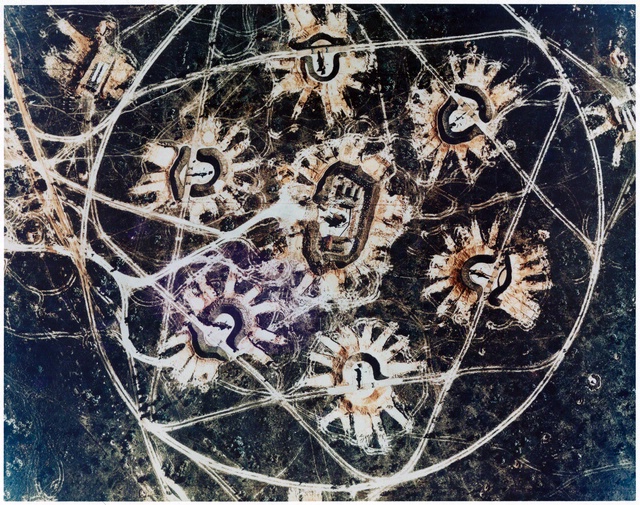
A U-2 spy plane photo shows Soviet missile silos in Cuba.
(Photo: Smithsonian Museum)
Meanwhile, the United States and now-geriatric revolutionary Cuba, only 90 miles apart, still maintain one of the world's last remaining Cold War hostilities.

Today, Latin America's only situation even distantly resembling the 1962 Cuba is Venezuela, a leftist nation hostile to the U.S. which has during recent years purchased billions of dollars of mostly Russian military weapons. But those are conventional weapons, and Venezuela presents no military threat to the U.S., altho its armamanets are potentially worrisome to its neighbors, Colombia and Guyana.

A bit like Cuba a half century ago, Venezuela is a source of tensions between Moscow and Washington, still vying for influence.

The Soviet missiles have ended up achieving their original goal: preserving the Communist revolution on the U.S.'s doorstep. But in the meantime their builders, the Soviet empire, has crumbled, leaving Cuba as a sort of museum piece for a failed system. However, in the guerrillas which still afflict Colombia, Colombia continues to feel the the missile crisis' consequences.

So, for Colombia, the missile Crisis leaves mixed messages. By preserving revolutionary Cuba, the missiles contributed to Colombia's ongoing troubles. However, the communist island could now contribute to peace in Colombia.

And, the crisis' greatest lesson for Colombia is that determined and cautious leaders can resolve the most difficult crisis without firing a shot.

But are Colombia's guerrillas rational actors? For that matter, is the government?


By Mike Ceaser, of Bogotá Bike Tours

Thursday, August 16, 2012

How Britain Created Colombia

Daniel O'Leary, a soldier from Ireland
who also preserved Simon Bolivar's personal
documents for history. 

Of course, that's probably an exaggeration. But I thought about it while looking at some English miniatures now on display in the National Museum in Bogotá.

The technique of creating miniatures probably came to Colombia with the Royal Botanical Expedition of 1783 to 2016, led by Celestino Mutis, which created miniatures to record plants encountered during the travels. After the expedition's end, artists sought other ways to earn money, such as making portraits of the wealthy.

One of the tiny portraits on display shows Irishman Daniel Florence O'Leary. He was an aide-de-camp under Simon Bolivar and perhaps the most famous member of the British Legion, a volunteer force which fought alongside Bolivar against the Spanish empire. The British effort was not altruistic, of course: they wanted to weaken a rival empire and rule the world - which they eventually accomplished.
England's King George IV: A dissolute,
unprincipled man, but nevertheless
admired by Colombians.

Even after the colonies had broken away from Spain's rule, their real independence wasn't assured. France, which practically controlled Spain, considered trying to reconquer the colonies. And a coalition of Europe's conservative monarchies talked of sending members of European royal families across the ocean to rule the New World. (The only place where this was actually tried was Mexico, where the French installed the Austrian Maximilian I. Maximilian lasted only three years, however, before being overthrown and executed by Benito Juarez.)

An unidentified member of the British Legion. 
Latin America's independence was tentative and uncertain until the British Empire, pushed by Foreign Secretary George Canning, recognized Colombia, Argentina and Mexico. Canning, naturally, did not act out of altruism. He wanted to weaken France, which controlled Spain, and open the Latin American markets for the British Empire's trade. Canning made no bones about this:

British Foreign Secretary George Canning,
whose recogintion of the nations of
Latin America made their independence certain.
"Spanish America is free," he said, "and if we do not mismanage our affairs she is English ... the New World established and if we do not throw it away, ours."

"I resolved that if France had Spain it should not be Spain with the Indies," Canning explained the next year. "I called the New World into existence to redress the balance of the Old."

The British Cemetery in Bogotá,
created for the British Legion veterans.
But if Canning acted out of Britain's interests, he evidently did have liberal, progressive sentiments. He had also opposed tyrranical governments in Naples and the Netherlands, advocated expanded rights for Britain's Catholics and opposed slavery.
A plaque on Plaza Bolivar in Bogotá
comemorating the British Legion.

Previously, the United States had recognized Colombia in 1822 and the next year U.S. Pres. James Monroe issued his famous doctrine opposing further European colonization or interference in the Americas. But the U.S. was a weak nation: It was Britain that mattered.


A tomb in Bogotá's Central Cemetery carries the surname O'Leary - possibly a descendent of revolutionary hero Daniel O'Leary, who is buried in Caracas, Venezuela?


A plaque in the British Cemetery says that a fence was built from the British Legion's muskets. 


By Mike Ceaser, of Bogotá Bike Tours