Showing posts with label mayoral election. Show all posts

Sunday, January 1, 2012

Petro's Political Pedigree


New Mayor Gustavo Petro is the
product of a complex political history.
Today, Gustavo Petro was inaugurated as mayor of Bogotá. He'll now preside in the just-expanded City Hall on the west side of Plaza Bolivar.

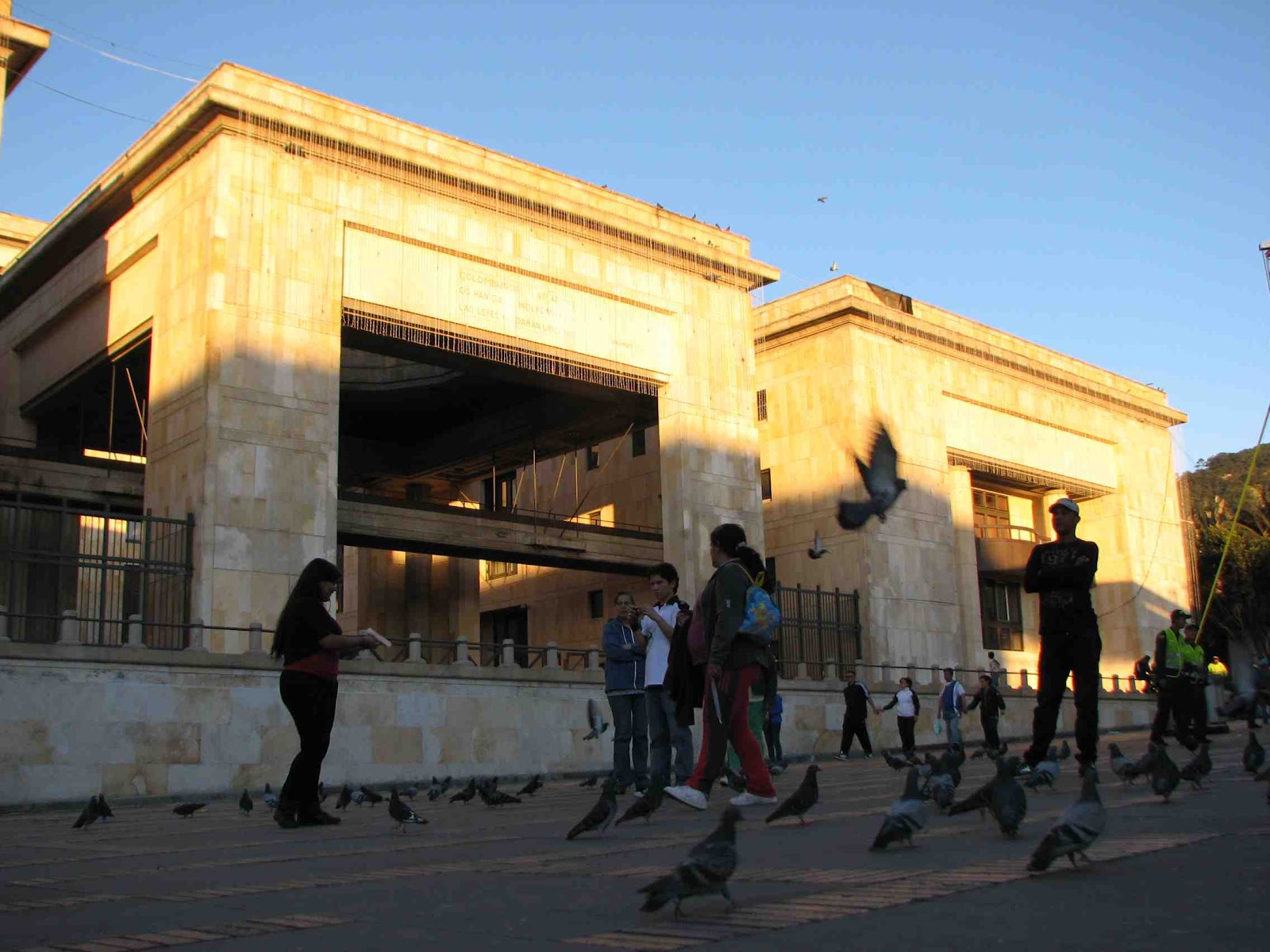
Petro was a leader of the M-19 guerrillas, who in 1985 attacked the Justice Palace building, on the right. He's now mayor of Bogota, presiding in City Hall, on the left. In front of the buildings are the tents from today's inauguration. 
But Petro's political past has also involved the Justice Palace on the plaza's north side, and Congress on its south side. His unlikely and remarkable story illustrates both the contradictions and interconnectedness of Colombian politics.

Petro was born in 1960, the son of a schoolteacher, and grew up in the town of Zipaquira, north of Bogotá. Petro early became a leftist, thru the reading of Gabriel Garcia Marquez and friendships with union members.

Tomb of military dictator Gustavo Rojas Pinilla,
whose losing candidacy inspired the  M-19
guerrilla movement.
When Petro was ten, one-time military dictator Gustavo Rojas Pinilla, now recycled as a populist, nationalist candidate, ran for president and lost by a sliver to a conservative. Petro had been overthrown in 1957 for good reason - he had massacred protesters and shut down the nespapers, amongst other crimes. Nevertheless, Rojas Pinilla became the darling of the left, his supporters cried fraud and founded the Movimiento 19 de Abril, or M-19 guerrilla movement.

Almost as soon as he graduated from high school at age 16, Petro joined the M-19 guerrillas and eventually become one of its leaders.

The M-19 started out with dramatic gestures, such as the theft of revolutionary leader Simon Bolívar's sword from one of his statues. "Bolivar's sword returns to battle," the M-19 announced.

The tomb of assassinated M-19
presidential candidate Carlos Pizarro,
perhaps Petro's political inspiration.
Note Bolivar's sword on the tomb.
But the M-19's acts were not always so idealistic. In 1976 they kidnapped and murdered union leader Jose Mercado and discarded his corpse in the street. They also took over the Embassy of the Dominican Republic during a diplomatic party. That attack ended bloodlessly, with the guerrillas carrying out something of a victory parade to the airport, from where they left for Cuba. In 1985, the group invaded the Justice Palace on Plaza Bolivar, took the Supreme Court justices hostage and demanded that Pres. Belisario Betancur submit to a guerrilla trial. Instead, the government counter-attacked, the building was destroyed and 11 of the 12 supreme court justices died, amongst some 100 deaths in total.


Jose Mercado,
union leader kidnapped
and murdered by the M-19 guerrillas.
Close to three decades later, the wounds remain open from what is known as 'The Holocaust of the Justice Palace.' Families still search for relatives who disappeared during the attack and counterattack and the general who commanded the counterattack is in prison for human rights violations.

1985: The Justice Palace in flames
after the M-19 attack. 
The rebuilt Justice Palace today. 
A few years after the attack the M-19 demobilized and turned into a political party. Today, several ex-M-19 leaders are in Congress, one is a governor, and Petro is mayor of the nation's capital city. Petro, of course, claims that he knew nothing about the Justice Palace attack.

After their demobilization, M-19 chose Carlos Pizarro as its presidential candidate. In 1990, Pizarro was assassinated - one of four candidates assassinated during that campaign. Surprisingly, the M-19 did not return to violence and participated in the 1991 convention which rewrote Colombia's constitution.

A plaque on City Hall memorializing the 1985 attack. 
Petro served in Zipaquira's City Council and later in Congress. As a congressman, Petro has been seen as idealistic, independent and non-corrupt. He has, for example, strongly criticized the FARC guerrillas and Venezuelan Pres. Hugo Chavez, despite the leftist revolutionary pretenses of both.

Petro won the election to a great degree because Bogotanos saw him as clean and independent. That made a sharp contrast to his predecessor Samuel Moreno Rojes, who is now in prison on corruption charges. Which brings up yet another irony: Moreno Rojas happens to be the grandson of dictator Rojas Pinilla, whose failed candidacy started Petro on the road to where he is today.

Perhaps the greatest significance of Petro's victory is its signal to the armed guerrilla groups which continue battling to overthrow the Colombian government. Mayor Petro is proof positive that the ballot can be a much more effective changemaker than the bullet. Are you listening, FARC?

A plaque near Plaza Bolivar paying tribute to the people who disappeared during the Justice Palace tragedy. 


An image full of contradictions: the grey plaque on Seventh Ave. memorializes protesting students massacred by dictator Rojas Pinilla in 1954. Beside it is a campaign poster for Petro, whose political career has its roots in Rojas Pinilla's failed presidential campaign. The building is covered with graffiti left by recent student protesters.

Scrawled on a wall along Seventh Ave., apparently by student
protesters: 'Against the Santos dictatorship, the M-19 gets ready.'
But Santos is no dictator,
and the M-19s leaders are in government. 
Petro's first statements as mayor sound positive: he repeated his intention to charge car drivers a congestion fee, which will subsidize public transportation. He also promised to tax the rich - a necessary move try to reduce the city's huge wealth gap. And he also plans to create new public universities. That's good, not only because it'll the city's youth more hope and opportuity, but also because it could reduce the crime rate by putting young people on a constructive track.

He also intends to give the poor a monthly stipend of water for free. The intention is good, but the method is mistaken: giving things away for free just promotes waste. A much better policy would be to provide subsidized water-saving devices like low-flow shower heads and toilets. That would save people money as well as conserving water.

By Mike Ceaser, of Bogotá Bike Tours

Sunday, October 30, 2011

It's Petro!

Petro and fans. 
Leftist congressman and one-time M-19 guerrilla Gustavo Petro won the Bogotá mayoral race today, overwhelming all the other candidates.

It's a remarkable political saga for Petro, who first became a public figure as a leader of the M-19 guerrillas, most notorious for their 1985 attack on the Justice Palace building on Plaza Bolivar, which ended with the building in flames and about 100 people dead. Petro claims that he had no previous knowledge of the attack.

The M-19 soon after demobilized and turned into a political party, which eventually integrated into the leftist Polo Democratico. Petro became a respected congressman, willing to criticize the left, including Colombia's Marxist insurgents.

Petro's victory shows once again that Bogotá is the leftist capital of a conservative nation. That is why Petro, the only leftist candidate with strong name recognition, won even tho the left is in disarray, with titular Mayor Samuel Moreno, of the Polo Democratico Party, in prison on corruption chargees. Remarkably, the fact that Petro only recently left the Polo Democratico and was long associated with Moreno didn't seem to hurt him.

Bogotanos, some on bicycles, line up to vote today on
Plaza Bolívar. Behind them is the rebuilt Justice Palace.  
But, even tho the mayoralty of Bogotá is considered the nation's second-most important political office, because Colombia is still a conservative nation, Petro has few prospects of ever becoming president.

As a candidate, Petro made some unpopular (but necessary) proposals, such as addressing Bogotá's traffic jams by charging drivers a congestion tax. But he also made populist gestures, such as promising free water for the poor.

Let's hope that as mayor his pragmatic side wins out over his ideological one. As a politician who speaks his mind and whose prospects for higher office are in any case limited, perhaps Petro will be willing to make courageous, unpopular decisions in the mold of London Mayor 'Red' Ken Livingstone. 

Police watch over a polling place in Teusaquillo.
Voting in Bogota was mostly peaceful. 
As for the losing candidates, David Luna, Carlos Galan and Aurelio Suarez polled poorly but likely have good prospects as fresh faces. Gina Parody finished third and but created a positive impression and will surely run again for mayor or even higher office. The big loser was ex-Mayor Enrique Peñalosa, who showed once again that, while he may be an excellent administrator and city planner, he's a lousy candidate. Peñalosa will now resume his career as public speaker and consultant on urban issues.

As for the significance of Petro's victory, it's yet another condemnation of the FARC guerrillas' futile, murderous, drug-financed war to overthrow the Colombian state. Setting aside all the suffering the guerrillas' have caused and the futility of their battle, Petro's victory shows that Colombia's democratic system provides a path for people of all political stripes to achieve power.

By Mike Ceaser, of Bogotá Bike Tours

Thursday, October 27, 2011

Following the Money to City Hall

Ask where the candidates' pesos came from and you will know to whom they belong.
If one thing is clear in the campaign for mayor of Bogotá, it's that whoever wins will have some debts to repay.

The National Electoral Council has done an admiral job of posting candidates' accounts of their campaign donations online. And the numbers are just as depressing as those of United States politicians, with its legal, institutionalized pay-to-play system.

The excellent investigative website La Silla Vacia published this summary of the sources of Bogotá mayoral candidates' money. The three leading candidates, Gustavo Petro, a leftist who leads in most polls, and the (apparently) center-right candidates Enrique Peñalosa and Gina Parody, are all near the 1.646 billion peso limit for mayoral campaign spending.

Wasted money: Petro campaign
cards scattered on a sidewalk near
the Central Cemetery. 
Perhaps Petro's finances have received the most attention. He's a leftist and one-time M-19 guerrilla, but some big businesses nevertheless evidently consider him a good investment. Petro has received money from a leader of farmers, which seem like an unlikely group to be supporting a candidate for big-city mayor, the owner of a transportation company, a construction company, a bank and someone who La Silla Vacia couldn't even identify. Most worryingly, El Espectador columnist Cecilia Orozco Tascón writes that two of Petro's deep-pocketed business donors were created recently, apparently just to donate to Petro. One company, strangely, actually donated more than the financial capital it was created with.

Peñalosa received lots of money from a plumbing fixtures company and the well-known businesses Comcel, Exito and Seguros Bolívar.

For her part, Parody spent family money (her father has maritime and port interests) and received donations from banks and an insurance company.

Interestingly, several big businesses have covered their bases by supporting more than one of the leading candidates. Grupo Bolivar, for example, donated to all three leading candidates, assuring itself an open door no matter who wins.

Some of these contributors might just be friends who happen to believe in the candidates, which is justifiable. But it also seems likely that most people shoveling in millions of pesos will want a payback if their man or woman wins.

Of course, all these finance reports assume that the candidates are actually being honest. And political money is notorious for being duplicitous. How many businessmen and mafiosos have funneled money to politicians thru girlfriends and second cousins' wives?

And money isn't everything. Peñalosa, for example, has received support from evangelical churches - which rightly worries civil liberties advocates.

El Espectador also summarized the finances of mayoral candidates from Colombia's secondary cities, and some of their funding sources are very suggestive. For example, a candidate from Barranquilla accepted lots of money from a construction company, and one from Cartagena from hotel interests. if those candidates win, those businesses will likely be lining up for payback in municipal contracts.

In contrast, many local candidates from smaller parties haven't declared the sources of their money. That's likely in part because those small-town, small-party candidates lack the resources and sophistication to crunch these numbers. But the situation certainly opens the door to dirty business, since many rural areas are notorious for corruption. Suggesting that something fishy's up, in some small towns actually have more voters listed than residents.


By Mike Ceaser, of Bogotá Bike Tours

Sunday, October 23, 2011

Bogotá's Next Mayor

Who will Bogotanos choose to lead their metropolus?

One week from today, Bogotanos will go to the polls to elect a new mayor - and it's high time. After all, residents' image of their city has slumped, the current mayor is in prison and the city seems to be sinking on basic quality-of-life factors like crime, transit and corruption.

Enrique Peñalosa
This is a big, and unfortunate, shift. Just a few years ago, Bogotá was admired worldwide for its innovative policies, including its pioneering TransMilenio express bus system, its bike lane network and policies to reclaim public space and create a spirit of civic pride.

Not many Bogotanos feel that spirit today. And, with more and more cars flooding the city, road construction everywhere and persistent poverty and violence, traffic congestion and crime look likely to just get worse.

Gustavo Petro
So, this mayoral election is a key one. Will Bogotá retake its innovative path? Or will it fall victim to the miseries of so many of the developing world's mega-cities and lose its quality of life in a mess of pollution, crime, traffic jams and social distrust?

So, the city's reached a key juncture. And, fittingly, Bogotá's voters face a dramatic choice for mayor: should they turn left or write?

The two candidates who are leading according to recent polls are ex-Mayor Enrique Peñalosa, generally considered a conservative, and leftist one-time M-19 guerrilla Gustavo Petro. Ex-Senator Gina Parody, who is allied with ex-Mayor Antanas Mockus, might have an outside shot.

The good news is that all the leading candidates appear to be serious, principled leaders and not to be corrupt. And, neither Petro nor Peñalosa has campaigned using facile promises, as did current imprisoned Mayor Samuel Moreno, who rode to City Hall on a smile and a promise to build a metro. That's a pie-in-the-sky project which will take many years, if Bogotá can afford it at all. Instead, Moreno instead apparently filled his and his friends' pockets with public money from the TransMilenio expansion contracts - which are still far from finished.

Petro promises free water for the poor. 
Petro's only populist stance has been his promise of several cubic meters of free water - which is an invitation to waste. If he wants to help the poor and help the city and conserve resources, he should instead offer subsidized water-conservation devices, such as low-flow toilets and shower-heads.

Some of the minor mayoral candidates - who, thankfully, have no chance of victory - are once again promising to build Bogotá out of its traffic tangles with a subway and urban freeways. Those are unrealistic fantasies for a mostly poor city with an exploding number of private vehicles. Bogotá should spend its limited funds on parks, schools, job training, law enforcement and improving public spaces, rather than expanding a road system to benefit primarily the minority who own private cars. And, the sad experiences of cities the world over which have bankrupted themselves paving themselves over to give cars room have shown that more road space only promotes more driving, quickly filling up the new space and producing even more monumental traffic jams.

Fortunately, both Petro and Peñalosa seem to favor demand-control policies such as a congestion charge, which would discourage unnecessary driving and would finance public transit. And both Petro and Peñalosa have demonstrated a willingness to pursue unpopular policies.

Bogotá and Colombia have the misfortune to suffer from some of the most unequal wealth distribution  rates in the world, and lots of recent research has shown that this situation has a corrosive effect on a society. When citizens see an unbridgeable impasse between themselves and others, the poor feel justified in stealing what they believe society will never provide them, and the rich feel no obligation to make sacrifices for the less fortunate.

TransMilenio buses: Peñalosa started the express-bus system. 
On this point, both Petro and Peñalosa appear promising. As mayor, the long-time leftist Petro would surely seek ways to redistribute income from the wealthiest Bogotanos to the poorest, perhaps thru taxes, user fees and other charges which would finance services for the poor. Peñalosa, I suspect, would also expand services and provide more quality-of-life opportunities for the poor, by improving schools, transit and public space for the poor.

So, I think that both Petro and Peñalosa would, hopefully, probably, pursue positive policies for the mass of Bogotanos. I repeat: hopefully.


But the great difference between the two is their experience. Peñalosa has been a successful mayor, who has become an international authority on urban development issues. Petro, in contrast, doesn't have any executive experience except from back in his guerrilla days.

Voters should ask: With Bogotá at a crucial juncture, will its citizens choose a mayor with proven experience or select an unknown to lead them?
A Peñalosa campaign banner. 'Peñalosa loves Bogotá, knows what to do and can change the city.' Perhaps significantly, the banner is on an evangelical church, and a blogger (see below) writes that Peñalosa is seeking support from conservative evangelicals - a worrisome relationship if true.  
To me, the choice is obvious. Petro will have another opportunity.


By Mike Ceaser, of Bogotá Bike Tours, which (full disclosure) has rented bikes to Peñalosa's campaigns.

Friday, October 7, 2011

Everbody Against Peñalosa?

Enrique Peñalosa
Petro,
Mockus
and Parody -
all for one
& one for all?
With the alliance of candidates Antanas Mockus and Gina Parody into a single campaign headed by Parody, the campaign for mayor consolidated into a three-person race, led by Gustavo Petro and Enrique Peñalosa, with Parody close behind.

The Mockus-Parody union struck me as a bit strange. Mockus is a leftist who used public spirit to improve Bogotanos' behavior, while Parody's advisors include New York's law-and-order Mayor Rudolph Giuliani. Perhaps not surprisingly, the alliance didn't produce the hoped for results. Mockus's supporters went to all three leading candidates, leaving Parody in third place with 14% support in one poll. The biggest beneficiaries may have been Petro, who now has about 20% support, and the 'I don't knows' with 14%.

Now, El Tiempo reports that Conservative candidate Dionisio Araujo is also jumping onto Parody's campaign and that Petro and Parody may even team up. That would likely make their combined ticket unstoppable.

Peñalosa's solitude is surprising for a man whose mayoral term is generally seen as successful: he reclaimed public spaces, expanded the bike lanes system and started the express bus network, which successive mayors have expanded. But Peñalosa has a reputation as haughty and aloof, so it may be a personality issue as much as anything. But if he wins, perhaps that'll mean that he won't be beholden to anybody.

It's refreshing, at least, that all the leading players are seen as uncorrupt and well-intended. The campaign so far has been generally positive and carried out on a high level, focusing on real issues, such as crime, transit and quality of life.

With Bogotá sunk into chaos, congested traffic and lots of concerns about crime, the city needs a leader who can put it back on a positive track. Is that person Parody, who is young and unproven? Is it Petro, the one-time M-19 guerrilla? Or is it Peñalosa, whose previous administration earned him high approval ratings and put the city in order?

You can guess my opinion, and it's not just because Peñalosa (as well as Mockus) has rented bicycles from Bogotá Bike Tours.

By Mike Ceaser, of Bogotá Bike Tours

Monday, September 26, 2011

Peñalosa Shakes Things Up

Alvaro Uribe campaigns with Enrique Peñalosa. (Photo: Radio Santa Fe)
Mayoral candidate Enrique Peñalosa tried to shake things up this weekend by campaigning with ex-President Alvaro Uribe.

Despite the fact that Peñalosa had a succesful term as mayor, remembered for improving public space, expanding the city's bike lane system and creating the Transmilenio express bus system. Peñalosa should have the red carpet laid out for him. After all, the political left has muddied its image with the scandal surrounding jailed mayor Samuel Moreno, of the far-left Polo Democratico party.

But...as a campaigner, Peñalosa can't seem to convince. And, paradoxically, he's stuck in second place in the polls behind ex-M-19 guerrilla Gustavo Petro, who only recently left the beleagured Polo Democratico party.

By campaigning with the conservative Uribe, who is popular but also polarizing - several of high officials from his administration are now in prison or in exile - Peñalosa is giving up any chance for the vote of young progressives, altho few supported him as it is. Peñalosa also recently took controversial strategist J.J. Rendon, whom I see called 'Latin America's Karl Rove' onto his campaign, causing several of his advisors to resign. But Rendon, like Rove, knows how to win - he advised Pres. Juan Manuel Santos in his tromping of Antanas Mockus last year.

Bogotá's mayoral campaign is reaching its final stretch, and only three candidates: Petro, Peñalosa and Mockus, also an ex-mayor, have a real chance. In the end, it will likely be decided by the suppporters of the eight other candidates who have little chance. Will they stick with their man or woman, who will almost certainly lose, or throw their support behind one of the men with potential?

This scenario, unfortunately, bodes ill for Peñalosa: he's got the highest negative rating of any of the candidates, and the Uribe alliance will only increase that negative block.

By Mike Ceaser, of Bogotá Bike Tours

Thursday, August 11, 2011

Miracle Workers for Mayor?

The final candidates for Bogotá mayor have filed their candidacies - and made promises that only their mothers could believe.

Dionisio Araujo, conservative candidate,
promises to get things moving. 
Dionisio Araujo, the ex-president of the National Federation of Retailers, looks like the champion of promises. To eliminate traffic congestion, he promises to build urban freeways, eliminate intersections and traffic lights by building overpasses, and suspend the 'pico y placa' driving restrictions. Meanwhile, Araujo also intends to build a metro system.

To see how likely all those achievements are, just look at the success of current (suspended) Mayor Samuel Moreno, who got elected using similar wonderous promises. Instead, the only major project he's launched, building two new Transmilenio lines, is way over budget and behind schedule and has mayor's brother in prison and the mayor suspended from office and headed toward trial on corruption charges.

But Araujo will somehow whip the contractors into hyper-efficiency, eliminate corruption and manage to contract based on ability, rather than buddiness - despite the fact that he comes from the business world. Most fundamentally, Araujo will eliminate the law of traffic supply, demonstrated all over the world, according to which expanding road space only lures more cars onto the roads - quickly making traffic congestion as bad as ever.

At the same time, Araujo says he'll make the unpopular 'pico y placa' law 'history.' Pico y Placa has clearly failed, as the city's terrible traffic jams prove. Bogotá's car-owning middle and upper classes will love that promise - until they see the results: terrible traffic jams replaced by horrific ones. Unfortunately, the truly effective alternative to Pico y Placa, a London-style congestion charge, is even more unpopular politically.

For his part, Antanas Mockus, who's already been mayor twice, promises that education will reduce crime, traffic jams and corruption. Mockus may very well win, as he's remembered positively for his campaigns to improve city spirit. But I really doubt whether street mimes and TV commercials, which he used in his previous terms, will make Bogotanos clean up their bad habits. If sitting in traffic jams can't teach people that cars cause congestion, then I'm not sure that Mockus can either.
Bogotá traffic jam: Educated away?

On specific, gritty issues such as the proposed subway system and what to do about Seventh Ave., Mockus won't tell us, but promises to study them. It's always reassuring to know a leader's got a plan.

Ex-Mayor Jaime Castro
And Jaime Castro, another ex-mayor who just filed his candidacy (for the Indigenous Authorities of Colombia party, despite looking very white himself), promises to "save the city from the grave and profound crisis it's in" by, among other things, building not just an urban metro system, but a regional one. Perhaps Castro could look at Medellin, which in three decades has built only two urban subway lines.

By Mike Ceaser, of Bogotá Bike Tours


Polo Democratico candidate Aurelio Suárez evokes populist icon Jorge Eliecer Gaitan. 

A pair of campaigners for Gustavo Petro. 

Monday, August 8, 2011

Mockus Leaps in!

Antanas Mockus wants to be mayor again. 
Antanas Mockus will join the campaign for mayor of Bogotá, El Tiempo reports.

Mockus has already been mayor of Bogotá twice before, from 1995-8 and 2001-3, and previously rector of the National University, Colombia's largest public university.

Mockus will be a strong candidate, because he's very well known here and has a positive, clean image. In his previous mayorships he did lots to expand public services and improve public spirit, for instance hiring hundreds of mimes to encourage drivers to respect traffic laws.

Mockus has run for president three times, the last in 2010, when he was the Green Party candidate and got plastered by conservative Juan Manuel Santos. Colombians supported Santos, who had been defense minister, in great part because they sought a strong hand to battle leftist guerrillas. Mockus, in contrast, was seen as a sort of eccentric intellectual. That's understandable: the man got married on an elephant in a circus and first caught the public eye by mooning an audience while university rector. Many Bogotanos may also question Mockus's dedication to the city  - he left both mayorships early, the first time to run for president and the second to take a year's speaking sabbatical.

As presidential candidate, Mockus was also vague about his goals, promising mostly 'change.' Hopefully, as mayoral candidate, he'll tell us his positions on specifics such as the city's transit mess, crime and other issues.

But Bogotanos might just go for a man they hope will raise the spirit of a city in something of a malaise due to high crime rates, a corruption scandal involving the current mayor, and seemingly interminable public works projects.

Enrique Peñalosa,
leading the race. 
On the other hand, voters may still look for a strong hand, such as Enrique Peñalosa, who was mayor from 1998 to 2001 and is known for creating the city's express bus system, called Transmilenio.

Because Mockus helped found the Partido Verde (the Green Party), he's likely to take votes from  Peñalosa, the Partido Verde's candidate, as well as from Polo Democratico candidate Gustavo Petro, since Mockus, like Petro, appeals to young idealists.

An August 1 poll by CM& Television put Peñalosa in the lead with 29% and Petro second with 20%. But a Mockus candidacy would garner 13% support, according to the poll, taking 4% percentage points from each of the leaders. Mockus' candidacy probably ends any possibility for a victory by Petro, who depended on cornering the leftist vote, while center voters splintered their support. The other three candidates are young and less well known, likely making this a two-man race between Mockus and Peñalosa.

Mockus' candidacy, incidentally, also shows the arbitrariness of Colombia's political party labels. Mockus is going to run as candidate of the Independent Social Alliance party, which until recently was called the Indigenous Social Alliance. Mockus is the son of immigrants from Lithuania. For his part, Peñalosa's Green Party doesn't have many environmental planks in its platform and is allied with conservative Pres. Juan Manuel Santos and ex-Pres. Alvaro Uribe.

I hope Peñalosa wins, to put the city in order on issues like transit, public space and rational growth policies. But my money's on Mockus, because of his charisma and positive image.

Mockus may also get the sympathy vote: he's been diagnosed with Parkinson's Disease, altho doctors say it won't affect his intellectual ability for years yet. Still, his political career is limited.

By Mike Ceaser, of Bogotá Bike Tours

Friday, March 4, 2011

Bogotá's Mayoral Campaign

Bogotá's mayoral election isn't until October, but candidates are already lining up. 

Enrique Peñalosa
The early leader has to be Enrique Peñalosa, who was mayor from 1998 to 2001 but lost a run in 2007 for another term to current mayor Samuel Moreno.

The only other declared candidate is Congressman David Luna, a one-time Peñalosa disciple.

Peñalosa, who is now with the Green Party, is generally remembered as an accomplished mayor who created the city's famous Transmilenio rapid bus system, expanded the city's parks and bike path network. But Peñalosa has a reputation as a lousy campaigner, which he fulfilled by losing to the smiling but unaccomplished Moreno. His political orientation is unusual - most of his ideas are progressive, yet he campaigns on a law-and-order platform and is allied with conservative ex-President Alvaro Uribe.

In fact, Uribe's backing has troubled Antanas Mockus, another leader of the Green Party, which was created last year but has no clear ideology - not even an environmentalist one.

David Luna
Luna, who switched from Peñalosa's Por el País que Soñamos political party to the Liberal Party, isn't such a big name. But his past association with Peñalosa could make him a spoiler candidate. Ironically, Luna's support for urban freeways and a metro line on the city's west side would promote urban sprawl, which is antithetical to Peñalosa's philosophy of promoting urban density with quality services.

Peñalosa is evidently honest, dedicated and has far-sighted ideas about transportation and city planning. But he's likely to disappoint as a campaigner. In his favor is the public's disgust with incumbent Mayor Samuel Moreno, who is deeply unpopular because of corruption allegations and slow-moving transit expansion work. (Ironically, perhaps, Peñalosa would have made the same expansion if he had won the election.)

There are lots of other potential candidates out there - but Peñalosa won't have to worry about the Polo Democratico, which has been politically crippled by infighting and corruption allegations.

Galan, son of assassinated presidential
candidate Luis Carlos Galan
Bogotá city councilman Carlos Fernando Galan threw his hat into the ring on March 3. He has one of the most famous last names in Colombian politics, but, at 33, is very young and his experience consists of only one term on the city council. In this interview, Galan sounds like a Peñalosista, advocating compact growth and mass transit.

In 2007, Peñalosa suffered from over confidence - a mistake he's not likely to repeat - and a perception that he's elitist. Maybe during this campaign he'll play tejo, get drunk at football games and vomit on the people in the next row. That should give him a 'man of the people' image. This time, too, Peñalosa has the backing of a political party - altho that party has already been strained by Uribe's support.

Yet, looming over the race is the possibility that ex-President Uribe himself will join the campaign. If he does, then all bets are off.

Wait and see. The campaign still has a long way to go.


By Mike Ceaser, of Bogota Bike Tours