|
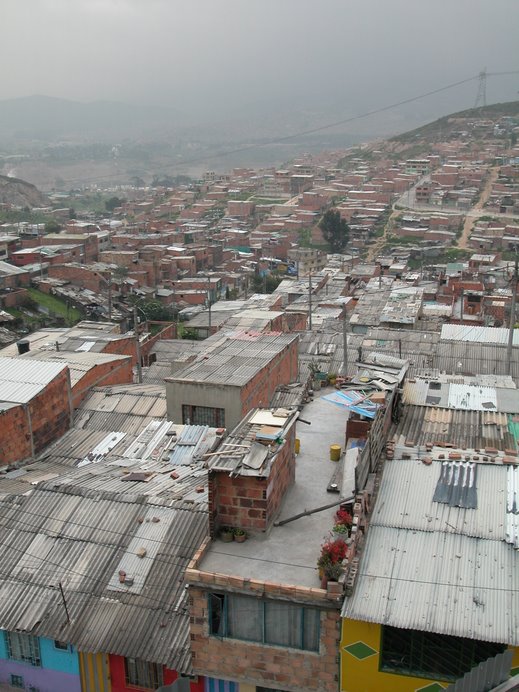
| Bogotá-area residents evacuate their home, while protesters at the South Africa climate talks demand action. |
While negotiators in Durban, South Africa haggle over another climate change treaty which will be weak, and probably ignored, anyway (despite all we know, last year saw the largest increase ever in world CO2 production). Meanwhile, Colombia has suffered a second year of horrendous flooding, which may very well be caused by climate change.
But, while Colombia has generated little of the world's global warming gas, it is no innocent bystander in either its domestic tragedy or the growing global climate tragedy.
 |
| Deforestation, cause of climate change and climate victims. |
Domestically, Colombia's terrible deforestation rate of
238,000 hectares per year - or even double that, according to
National University Prof. Jesus Rangel - caused by agricultural expansion, illegal drug crops, deforestation and cattle ranching, worsens flooding and erosion and desertification because forests normally soak up water like sponges and their roots keep soil from sliding into rivers.
Deforestation also contributes to global warming by
taking carbon out of trees and pumping it into the atmosphere, where it causes the greenhouse effect.
Pres. Juan Manuel Santos also vowed that Colombia would
"demand concrete actions" from the "big countries."
"I've given very concrete instructions," Santos said, while visiting a town whose flooding the government blames on global warming. Our representative to the climate talks "has to demand that the big countries which today don't want to make their contribution, don't want to make committments, commit themselves.
This (flooding) is affecting too many people."
 |
Out of the ground and into the
atmosphere: Coal mining in Colombia. |
But
Colombia doesn't want to make sacrifices either - for the same reasons that those 'big countries' don't. While denouncing climate change and its impacts, Colombia very happily sells those countries
more and more fossil fuels to combust into global warming carbon dioxide. Colombia's coal production, for example, is
supposed to double in the next decade.
Colombians are also burning more and more fossil fuels domestically, driven by record automobile sales - which will only accelerate when new free trade agreements with the U.S. and Korea take effect.
 |
| Up, up, and away: Colombian coal production. (Source: Simco.gov.co) |
By Mike Ceaser, of
Bogotá Bike Tours


 Posts
Posts