|
| A Wayuu girl covers her face. |
 |
| Nereo López, still cheery after all these years. |
After hearing photographer
Nereo López speak this evening in the BLAA library in La Candelaria, I left reflecting on how much younger he acted than his 70-odd years. Then I reread the
El Tiempo article about him and realized that he's 92.
 |
AfroColombians admire a
poster for an American movie. |
I didn't learn a lot about photography from López's talk, except his wise words that "the image isn't in the camera, but right here," indicating his head. Despite his many years, he continues innovating and has eagerly embraced digital technology. But he told lots of lively and humorous anecdotes about himself and Colombian history, and didn't shy away from myth-busting.
López, born in Cartagena in 1920, worked in movie theatres as a young man, until during World War II a friend gave him a used camera. López studied a Kodak 'How to Shoot Photos' book, and was on his way.

López then opened a photography school - only to be driven to bankruptcy by his own graduates, who set up lower-priced competing schools. Depressed, he even considered suicide.
 |
| Contrasting styles of transport. |
Thru luck and adventurousness, he saw some of the most famous events and personalities of Colombia's last half-century, including the overthrow in 1957 of dictator Gustavo Rojas Pinilla, and Gabriel Garcia's famous circle of intellectuals called 'La Cueva' - which López says wasn't intellectual at all, but mostly about partying, hunting and fishing. The outdoor sports didn't seem to appeal to López, who spent a lot of time hungry and once thot he'd caught a big fish, only to discover that he'd entangled his line with another fisherman.
Today, López continues photographing - so much so, that his doctor has warned him to stop staying up all night experimenting with digital techniques.
 |
| Enjoying a beer by a temporary shack. |
"I can't jump in and out of canoes anymore," he told a standing-room-only audience in the library, "but I'm not ready to sit in a wheelchair and watch television, either."
He's hard of hearing, but hasn't lot his eye for other subjects, either. He recounted an incident in the subway of New York, where he lives. He was hanging from a strap during rush hour and noticed a young woman looking at him intensely.
"I ignored her," he said. "After all, I'm very aware that I'm no adolescent anymore."
But she kept looking at him.

"She insisted and insisted," he said, "so I gave in and approached her, my heart beating wildly."
But it was all for naught. 'Sir,' she asked him, 'would you like my seat?'
 |
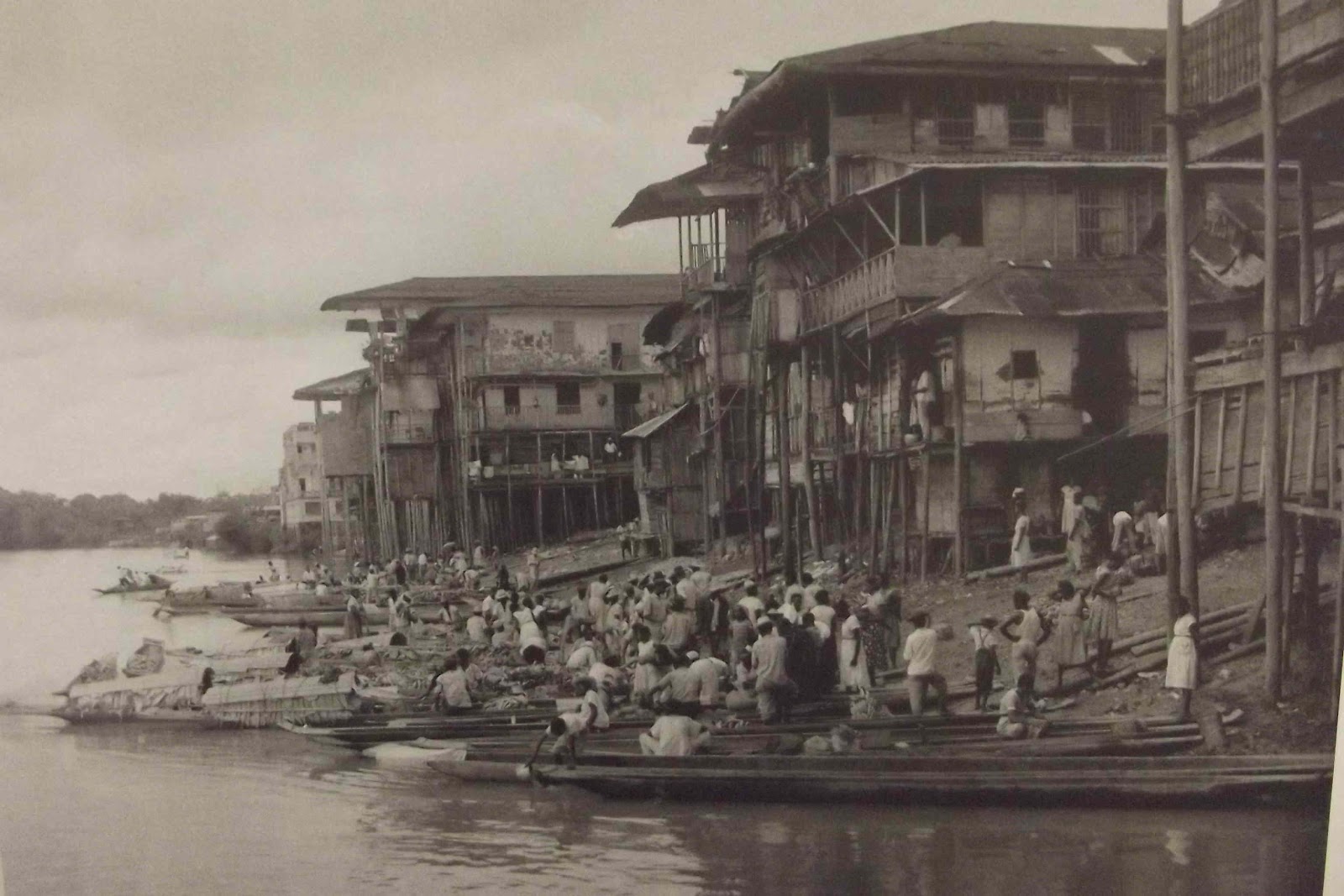
| Stilt houses in El Choco. |
If López's stories are humorous and self-deprecating, his photographs on desplay in the BLAA thru at least the end of this month are stark, beautiful and sometimes a bit haunting. Wayuu women appear ready to sail away as their dresses billow in the Guajira's desert winds; the stilt houses of impoverished Chocoanos seem about to collapse onto their fishing boats and sink into the river; in my favorite, an evidently very poor Afro woman and boy admire a movie poster of Errol Flynn's 'Adventures in Burma'. Can the pair ever dream of even leaving the Choco?
López has been profiled in the
New York Times.
 |
| Wayuu women in billowing dresses. |
 |
| Playing the harp. |
 |
| Miners at work. |
 |
| 'The Photographer of the Street.' |
 |
| López's book for sale. |
 |
| Prison labor. |
By Mike Ceaser, of
Bogotá Bike Tours

 El Parqueadero, an underground section of the Museo de Arte complex in La Candelaria, held a bunch of exhibitions this evening about what you should think, more or less.




 Posts
Posts