Showing posts with label public bicycles. Show all posts

Tuesday, March 31, 2015

The Wrong Route on Public Bikes?

A rider during a public bikes trial in Bogotá a few years ago.
Washington D.C. has a per-capita income of about U.S. $75,000. 

Bogotá, D.C.'s per-capita income is less than U.S. $20,000.

The conclusion? Washington is a much, much, richer city and Washingtonians have lots more spending power.

Washington also receives many more tourists than does Colombia's capital and has better streets and less crime.

So, now guess which of these two capital cities is subsidizing its public bikes program, and which one expects those bikes to pay a profit to the city?

If the answer made any sense, then I of course wouldn't be writing this commentary.

Last week, Bogotá finally chose a company to operate Bogotá's planned public bicycles program. Cycling advocates should be celebrating, and would be, if the scheme didn't have all the signs of disaster.

The Colombo-Chinese consortium, Bicibogotá, consists of a garbage collecting company and a home appliance company, neither with any experience in bicycles. And it's Colombian owner has a history of corruption and other scandals.

But those difficulties are minor compared to the fatal flaw in the city city's approach to creating a long-awaited public bikes program. Other cities see their public bike systems as public services which improve health and reduce air pollution and traffic congestion and subsidize them. But Bogotá expects its public bikes to pay the city profits.

Washington D.C. subsidizes its Capital Bikeshare program, as does Vancouver, Canada; Melbourne, Australia; and the U.S. cities of New York; Chicago; Minneapolis; and Chattanooga, Tenn. Toronto, Canada, Toronto, Canada decided not to subsidize its own bikesharing program. But, despite being a much wealthier city than Bogotá, its program was struggling as of 2013. Even mega-wealthy New York's Citi Bike program will be in crisis if sponsor Citibank pulls out.

And the numbers get even worse from there, as this graphic from the Washington Post shows.


In Washington, as the first circle shows, only about one fifth of users are locals who buy annual memberships. The rest pay by the ride, and are presumably mostly tourists. The second circle shows that the annual members do the great majority of the riding. However, the third circle shows that casual riders pay almost two-thirds of the program's revenues.

Bogotá, besides being a much poorer city than Washington D.C., also receives far fewer tourists, meaning that its revenues will be far lower. 

Is this contract only Mayor Petro's desperate effort to create a legacy, at whatever cost? Does anybody believe that public bikes can work in Bogotá without a subsidy? Why launch a program doomed to failure, which will only leave a black mark on cycling here? 

Instead, Bogotá should take the route of almost every other city and see bicycling as a public benefit, which cleans the air, reduces traffic jams and improves people's health, and subsidize cycling. 

This is particularly true, after all, since dirty transport receives, albeit often invisible, subsidies.

By Mike Ceaser, of Bogotá Bike Tours

Sunday, January 25, 2015

Bogotá's Public Bikes - Stuck in Park

A delivery cyclist rides beside traffic in the Santa Fe neighborhood. Is Bogotá ready for public bikes?
On Friday, Bogotá suspended for at least the third time bidding for a public bicycles program.

Bicyclist fill the street during the Sunday Ciclovia.
Cycling isn't so popular the rest of the week.
The program's non-start is not only a failure of the public bikes program, but another decline in Bogotá's status as a cycling leader.

Creating a public bikes program has been a long-time dream for sustainable transport advocates here. A few years ago, they even tried out a pilot programs, which revealed interest in the service. Since then, there have been repeated plans and predictions.

However, despite repeated promises, no public bikes have hit the streets. (The District Institute for Sports and Recreation, the IDRD, does lend bikes in a few spots in the city, but their program is limited and not designed for transport. Go figger.)

Public bikes on Jimenez Ave. They are to be used only on specific
streets and are not intended for transport. (Go figger.)
Over the past few weeks, Bogotá put a planned public bicycles system, consisting of some 1,500
bikes, out for bid. However, only two consortia made offers: One of them has little apparent experience in anything; the second's experience is principally in garbage collection, and its owner has a history of corruption problems and recently supplied defective garbage trucks to Bogotá.

To City Hall's credit, it did not sign a contract with either company. But why can't Bogotá, a big city with a growing economy, manage to set up an economically-sustainable public bikes program? After all, metropolises including Buenos Aires, Argentina; Santiago, Chile; Mexico City and even archrival Medellin all have public bicycles.

A cyclist wearing a pollution mask. Dirty air makes
cycling unpleasant - and even bad for you.
Is it because Mayor Petro, a one-time leftist guerrilla leader, suffers particular challenges in working with private businesses? Or do potential bidders, particularly operators of public bike programs in other cities, feel that Bogotá's crime, weather or vehicular chaos doom such a program to failure here?

Once upon a time, more than a decade ago, Bogotá was seen as a leader in the developing world in the promotion of bicycling. But in the last dozen years cities, Bogotá's bike lane network has been neglected, public bikes have not materialized and other cities around the region have made strides in cycling.

Sadly, the Colombian capital's inability to get its act together and make public bikes a reality may be symptomatic of a loss of drive and ingenuity from the days when Bogotá was celebrated as a leader in urban renewal.

'Latin America's best cycle paths network.' But other cities are building.
By Mike Ceaser, of Bogotá Bike Tours

Friday, September 28, 2012

Is Bogotá Ready for Public Bikes?


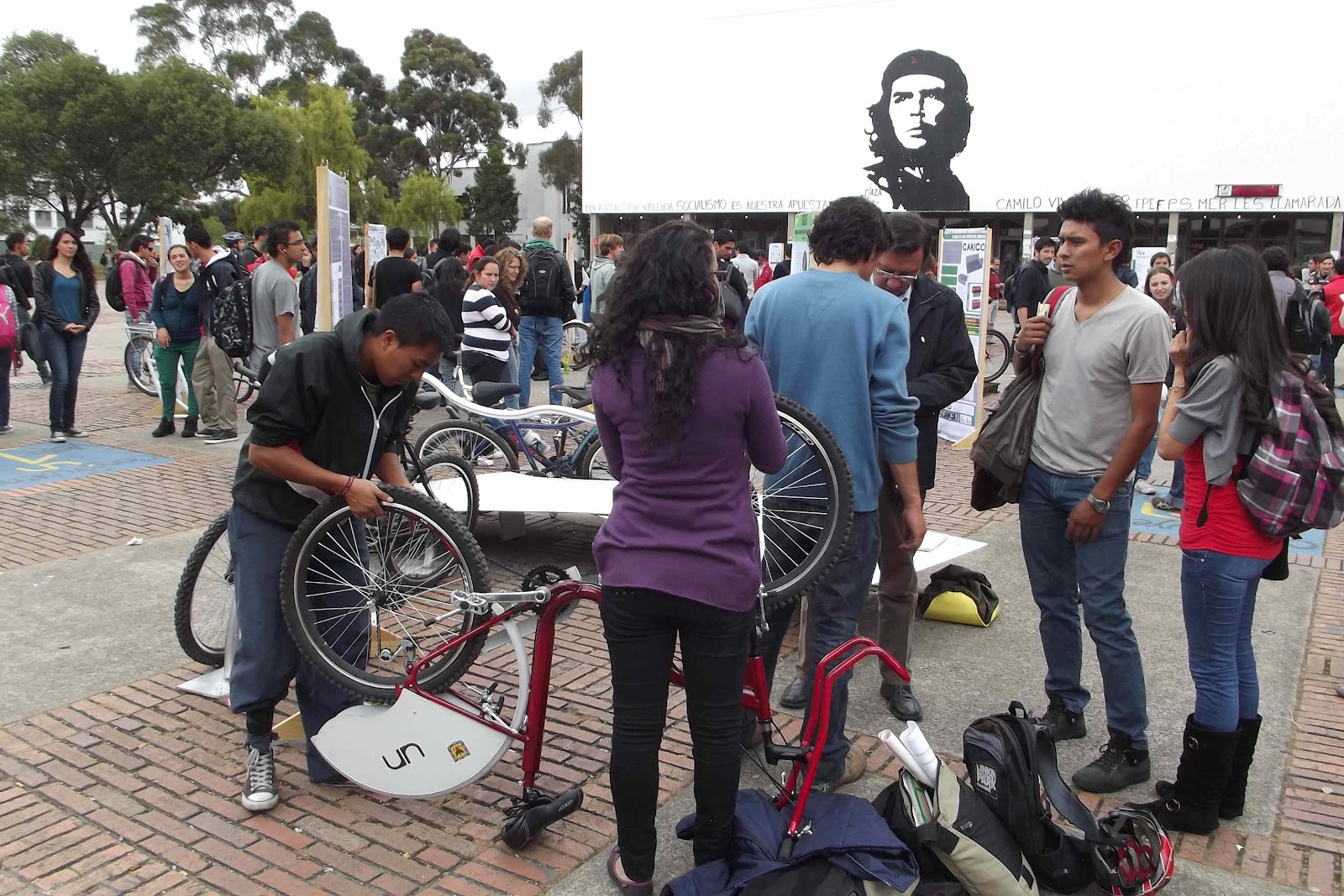
National University students exhibited proposed models for public bikes for Bogotá on the Plaza del Che today, under the watchful eyes of the Cuban-Argentine revolutionary and the guerrilla priest Camilo Torres. 
Some of the designs didn't seem practical, since shared public bikes need to be solid, sturdy, inexpensive and easy to use for bike novices. Also, they shouldn't be desireable to bike thieves. 

Cycling on the car-free Ave. Septima.  
In any case, if students at the National University, where you hear lots of talk about the communist revolution which never comes, can help make public bikes a success, they may deserve credit for a another kind of revolution, in sustainable transit. 

Bogotá officials have talked about bringing a public bicycle scheme to Bogotá for years, while doing nothing. Just a few months ago, they promised to have public bikes on the street next year. Bogotá's only public experiments have been mixed. A pilot public bikes program got a positive reception, but was unceremoniously ended. The National University, known as La Nacho, tried offering shared bikes, but the experiment was ended after many bikes got damaged or stolen - even tho the campus is a closed area with guards at the gates. For the past few weeks, the city has lent bikes for free on the 20 pedestrian-only blocks of Ave. Septima. But, since the bikes are free and the street closed to cars, the program could hardly not succeed.
Unfortunately, biking conditions in most of the rest of Bogotá aren't as nice as the car-free Septima and the National University. 

A homeless person set up camp in this bike lane....

....and this SUV driver thot that his vehicle had priority on both the bike lane and sidewalk .

Trying out a prototype public bike at the National University. 


By Mike Ceaser, of Bogotá Bike Tours

Monday, November 14, 2011

Victory of the Bicycle!

Everybody loses this race: Cars block each other, TM buses and even a cyclist. 
For the second year in a row, bicycle commuters won an overwhelming victory in the University of the Andes commuters race, which pits cyclists against private car drivers, Transmilenio riders and riders of regular private buses.

The commuters started off from three different spots around Bogota and traveled to Los Andes' campus in La Candelaria. The cyclists finished first on all three routes, averaging 21.5 kilometers per hour - leaving them time to sip coffee and read the newspaper before the car drivers arrived, having averaged only 15.5 KPH, barely ahead of the TransMilenios at 15.3 KPH. The regular bus averaged only 13.4 KPH.

Going nowhere: Cars sit still by a TM line
which is supposed to open in early 2012. 
The results, of course, don't figure in cycling's other benefits, including decreased pollution, more exercise and reduced traffic congestion - benefits shared in lesser degrees by forms of mass transit. The private car, which clogs streets and fills the air with fumes, is of course the villain of this story.

The results, are of course, a huge condemnation of Bogotá's terrible traffic jams and a commentary on the insanity of crowding the city's streets with big polluting machines which often carry only one or two people. The situation will only get worse as more cars flood into the city.

Trying on BiciBog for size. (Photo: El Tiempo)
The bicycles' victory comes at a time when both Bogotá and Medellin are carrying out pilot public bicycle projects. Bogota's project, named BiciBog, has been criticized by some transit experts. They say the bikes could be better designed and more durable, and that the stations could be better located. unfortunately, too, it's not clear where some of the planning money went.

Yet, the fact is, that commuters are using the bikes and appear to like them. Hopefully, Bogota and Medellin will both set up public bicycle programs. But for them to really succeed, they'll need to work on several fundamental problems, including reducing Bogotá's pollution and reducing its traffic chaos, both of which frighten non-cyclists from venturing out on two wheels.

Cycling central bogota at night. 
By Mike Ceaser, of Bogotá Bike Tours