Showing posts with label wealth. Show all posts

Monday, May 29, 2017

Does Being Pilo Pay Off For Colombia?

Scholarship students from the Ser Pilo Paga.
Ser Pilo Paga, the government program which gives scholarships to Colombia's best universities to top students from poor families, is paying off for the country.

That's according to Los Andes University economics professor Fabio Sánchez, whose study was financed by the National Planning Department. Sánchez reported that before the Pilo Paga program, only 28% of students who scored in the top 10% in the Saber 11 test went on to get a university education, and only 7% got into the top, or 'accredited', universities.

Those are mind boggling numbers. Looked at in reverse, they mean that 72% of top-scoring students didn't go on to university at all, and 93% of top-scoring students don't make it into top universities.

You can bet that the underlying dynamic there is economic. The talented students who don't get into
But who does it pay most?
universities lack either the money or connections to do so, while many low-scoring but wealthy students undoubtedly do go on to study in good universities.

That means a huge amount of wasted talent, and is probably a big reason why poverty here is so stubborn and innovation rates low.

In fact, another recent study, by the Organisation for Economic Co-operation and Development (OECD), criticized Colombia's huge gap between poor and wealthy, and said that the nation's economic growth has benefited the poor little.

Better education for students from poor families could help change that, and Sánchez's study found that Pilo Paga helped increase access to higher education for those 10% of top-scoring students from 28% to 60%, and that the percentage entering those top 'accredited' universities skyrocketed from 7% to 53%.

The program has thus increased the social variety of universities like Los Andes, whose students previously came overwhelmingly from wealthy families.

Los Andes universit:
Muy Pilo!
All of which are impressive numbers, if they're accurate.

However, there's a reason someone should double check Sánchez's results. Sánchez's employer, Los Andes university, happens to be a major beneficiary of the Pilos Paga program. According to a column by Pablo Correa & Tatiana Pardo Ibarra, an editor and a reporter for the El Espectador newspaper, respectively, Los Andes has been by far the biggest beneficiary of the Pilo Paga program - so much so that in 2015 its rector called it "the most public university in the country."

Today, an impressive 35% of Los Andes' incoming students are part of Pilo Paga. Yet,the university raised its tuition by 5.3%, 6.9% and 9.6% over the last three years. As a result, Los Andes receives far more Pilos Paga money, even tho other universities such as La Javeriana and La Salle enroll more students from the program.

Others question whether the government should be using public funds to subsidize some of the country's most elite institutions while public universities suffer severe deficiencies. (Los Andes does differ from other private universities in that it has no owners, and its profits are all supposed to be reinvested in the university.)

Pilo Paga has provided scholarships for 31,000 students at a cost of a half trillion pesos. Might it have been better to have instead invested that money in the struggling public universities, which enroll primarily students from poorer families?

By Mike Ceaser, of Bogotá Bike Tours

Wednesday, October 14, 2015

To Those Who Have Much, More

Julio Santo Domingo (seated), with his son and heir Alejandro.
In a nation which still has one of the world's most unequal distributions of property and income, it hasn't seemed to make waves that one of its two richest families, the Santo Domingos, has suddenly become billions of dollars richer - without breaking a sweat.

The family patriarch, Julio Mario Santo Domingo, who died in 2011, possessed a fortune of $8 billion dollars, with a business empire including the El Espectador newspaper, Caracol TV and radio and 14% of the SABMiller beer company.

It was the SABMiller interest which contributed the new billions this week, when the world's largest beer maker, InBev, bought the company for $104.2 billion dollars. According to El Tiempo, the interest which cost the Santo Domingos $7.8 billion in 2005 is now worth $14.8 billion.

The new company, AB InBev, will control 30% of the world's beer sales, including Bavaria's 98%
chokehold on the Colombian market. The combined companies control 61% of Latin America's beer sales.

Don't be surprised if the decrease in competition means paying more for your pola. The Wall Street Journal, no critic of capitalism, says the fusion "prepares the ground for an increase in beer prices all over the the world."

Call it the fulfillment of the Bible's Parable of the TalentsFor to everyone who has will more be given, and he will have an abundance. But from the one who has not, even what he has will be taken away.

By Mike Ceaser, of Bogotá Bike Tours

Tuesday, April 7, 2015

The Evolution of La Candelaria


Residents walk along a cobblestone street in La Candelaria.
 La Candelaria, Bogotá's oldest neighborhood and still the city's heart, has undergone multiple evolutions.

Poor people walk uphill toward the
Egipto neighborhood.
For centuries after the city's founding in 1538, La Candelaria was the home of the city's elite, its power brokers. The wealthy began moving out of the historic center during the 1920s, according to a report by the Universidad Nacional, and the 1948 Bogotazo devastated the city's center, pushign the wealthy north to newer neighborhoods such as Teusaquillo, Chapinero and Usaquen. Meanwhile, amid Colombia's chronic violence, the city's historic center became known for crime, poverty and decay.

However, since the early 2000s, thanks to Colombia's increased stability, lower crime rates and growing economy, La Candelaria has experienced something of a renaissance, with tourism, growing universities and rising property prices.

And now a study by Universidad Nacional students makes it official: La Candelaria is gentrifying.

Dying breed? A neighborhood shop.
According to the university report, monthly apartment rentals in the neighborhood are around a million pesos - a hefty sum in a city which defines an income of more than 200,000 pesos per month as being 'not poor' - and houses can be worth several billion pesos.

As a result, says the study, "the traditional low-income residents are beginning to migrate to other parts of Bogotá, such as the south, which can be noticed by the replacement of shoemakers and bakeries with expensive restaurants."

Today, La Candelaria still feels like a neighborhood. But, as rising rents force out traditional residents, it may lose that and turn into a district of old buildings, quaint cafes and museums.


Universities, such as the Catholic La Salle, have expanded, bringing more students and money to La Candelaria.
Increased police presence has made tourists and residents feel safer, altho crime remains a problem.
However, will La Candelaria ruin itself thru success?

Traffic jams have become chronic in the historical center. But instead of discouraging private car use, officials are allowing the Externado University to build a huge parking garage on the hillside.
A few years ago, someone built this faux-old house on Calle 9.
Whether because of corruption, lack of laws or lack of enforcement, the city keeps permitting constructions which conflict with the neighborhood's historic ambience.
Are those mushrooms behind these houses?
This multi-story apartment building going up on a cobblestone block of Carrera 3 doesn't look very colonial.
Some scenes of La Candelaria?

The Abadia Colonial Hotel was renovated by its Italian owner.
A beggar woman hawks flowers on a La Candelaria doorstep.
A delivery bike in front of a quaint store.
A view down Calle 10.
A theatre and the recently-renovated Muisca Hotel.

Tourists walk near La Plaza del Chorro.
Locals play their daily board game.

A used book store's doorway.

By Mike Ceaser, of Bogotá Bike Tours

Tuesday, March 17, 2015

Flying Above Problems

The Torre Colfondos, on Calle 67 and Carrera 8 in Chapinero, will not have a commuters heliport - for now.
(Photo: Panoramio)
Imagine the convenience of flying quickly and smoothly high above the noise and congestion of central Bogotá between Bogotá's business center and El Dorado Airport.

Such a service would come, naturally, at a high price for the commuter - but perhaps a much higher one for the city.

High above Bogotá, a commuter helicopter takes off.
(Photo: Aviatur)
Aviatur has been proposing using the commercial heliport on top of the Torre Colfondos, on Calle 67 and Carrera 8, for commuter flights from the surrounding business district to the airport. In the face of neighbors' protests about noise pollution, the company announced today the suspension of the plan, but that they would seek another location.

Helicopter commuting is already established in many big, traffic-choked cities. Liberty Helicopter, of New York, for example, offers eight-minute flights between New Jersey and Manhattan for $200.00 per day, replacing a one-hour ferry boat commute.

For elite bankers, stockbrokers, politicians and others, an hour may be worth $100.00. By the same token, the wealthy live in isolated, protected communities, send their kids to private schools and vacation on private tropical islands, far away from the problems which afflict the rest of us.

Congested streets? Why, we just fly over them!

Crime in the streets? That's why we live behind walls in a private community!

Pollution? Poverty? Dirt and hunger? We don't even have to see those things!

All of this might be well and good (besides the tremendous environmental impact), except that it insulates the wealthy and powerful - often society's decision makers - from society's real problems.

Once Bogotá's elite fly over the city's noise, pollution and traffic jams, they'll care less about working to solve those problems.

As a result, those problems become less likely to be solved.

By Mike Ceaser, of Bogotá Bike Tours

Monday, October 22, 2012

Drunk Driver Who Killed Three "Is not a Criminal."


Motorcycles lined up outside Bogotá's Central Cemetery
during the motorcyclists' funeral.
In another in Colombia's long series of cases of fatal drunk driving being considered a forgiveable act, the wealthy Caleño businessman who mowed down three motorcyclists and injured one more with his Mercedes Benzoutside of Bogotá while apparently drunk, will now get out of jail.

The driver "was transferred from La Modelo Prison to a site of special detention," attorney Iván Cancino told reporters the other day. 'Special detention' apparently means 'home sweet home'.

A motorcycle club was returning from an outing in La Calera the night of July 7, when Juan Carlos Varela Bellini smashed into them. Immediately after the accident, some witnesses said, Varela Bellini offered witnesses bribes and tried to pretend that he hadn't been driving. Varela Bellini also attempted to flee the scene of the accident and evade the drunkeness test, a judge said. Now, Varela Bellini has agreed to pay the survivors 1,400 million pesos, or a little over one million dollars, in return for dropping charges. That seems like mighty little for three lives, and makes you wonder if anything else was behind it. (The agreement was approved by prosecutors and a judge, Varela Bellini's lawyer said.)

"The important thing is for the world to know that Juan Carlos Varela Bellini is not a delincuent," the accused's lawyer said.

Motorcycle club members at their companion's funeral.
Varela Bellini, 25, belongs to one of the wealthiest and most elite families of the city of Cali, as you can read in this sympathetic story about his misfortunes in Jet Set magazine. How sad it would be for this young man's future to be ruined just because he killed three people. But, it may not be. By paying what is a small fortune for the victims' families, but not much for Varela Bellini's clan, he likely will go on in comfort.

Sure, the survivors will be better off with their pockets full. But those of us on the road in front of drunk drivers feeling confident that they'll get off lightly for any accident, are worse off. That's why drunk driving is a crime against both the individual victims and society in general. By letting drunks off easy the legal system sends a loud and clear message that driving drunk is no big deal, so go ahead and risk it.

And that drunk driver just might be Varela Bellini again. I haven't heard that they've taken away his driver's license or his Mercedes.

If I carry a gun or a knife or a hammer, get drunk and injure someone with those things, aren't I a criminal? Is a car, which is much bigger and potentially more deadly, any different? As I understand it, in other nations' legal systems, when you get drunk and lose control of your behavior, the law makes you responsible for your actions.

But, that's apparently not true in Colombia - at least not when you're rich and behind the wheel.

Related:


The Motorcyclists' Tragedy


Motorcyclists Rev Up Against Drunk Driving


By Mike Ceaser, of Bogotá Bike Tours

Monday, June 18, 2012

What Makes Colombia So violent?


Anti-bullfighting protesters outside the plaza de toros yesterday hold up a sign saying 'Bullfighting: Reinforcer of a Culture of Violence.' 

I've been thinking about that because of the confluence of several recent events, which at first glance might not appear related.

Tribal militancy? A Millonarios fan today celebrates
the team's birthday today by waving a
banner with a skull and crossbones. 
Yesterday, El Tiempo reported that Bogotá's homicide rate has dropped markedly and, perhaps surprisingly, far below those of Cali and Medellin. Also yesterday, I saw a protest in front of the bullfighting stadium calling La Fiesta Brava "A promoter of violence in society." And, today, we rode our bikes thru massive rallies of thousands of screaming Millonarios football team fans.

Despite the welcome drop in homicide, Colombia still has an unjustifiably high homicide rate: 33 per 100,000, which is six times higher than that of countries such as the Argentina and United States, more than triple the homicide rate in Bolivia and a mind-boggling 24 times higher than that of France and other European nations.

Colombia's homicide rate soared in
the '80s and '90s during the drug cartel wars.
(Source: Havana University)
Why is Colombia so violent? Poverty is part, but certainly not the whole explanation, judging by the lower homicide rates in much poorer nations such as Bolivia (8.9 homicides per 100,000 people), Cambodia (3.4 per 100,000) and Guyana (18.4 per 100,000). Colombia's homicide rate is almost double that of Mexico, which has been ravaged by drug cartel violence.

Aspiring bullfighters practice in Bogotá's Plaza de Toros. 
A second factor must be Colombia's very unequal distribution of wealth, or GINI coefficient, which is one of the worst in the world. This World Bank study from the 1990s, for example, graphs wealth inequality against robbery rates and finds an upward line - with the Latin American nations bunched together in the violent and unequal upper right-hand corner. (Interestingly, the World Bank study also says that median poverty and education rates do not correlate with crime rates.)

Inequality probably produces violence because it erodes social trust and the poor's confidence in being able to succeed thru legal pathways.

The War on Drugs and associated criminal and guerrilla violence also have a huge impact, as a glance at national homicide rates shows. The countries with sky-high homicide rates make a path from Colombia across much of the Caribbean and Central America across Mexico to the U.S. border. Inoffensive little Honduras, for example, suffers a homicide rate of 82.1 per 100,000, while Mexico, at 18.1 per 100,000 is just a bit above half of Colombia's, but still terribly high by world standards.

Internatioal robbery rates correspond
to greater wealth inequality.
(Source: United Nations)
Harvard psychologist Steven Pinker wrote a book a few years ago called 'The Better Angels Of Our Nature' which argued that violence has declined through history. Pinker ties this alleged decline to many broad changes in culture, including the decline of institutionalized and state-sponsored forms of violence and injustice. Not so long ago, witch burning, public executions by torture and cat burnings for entertainment were all accepted practices. More recently, slavery and wife beating were perfectly accepted in the west. Today, execution of criminals still goes on in some countries, as do violent spectacles for entertainment like bullfights and cockfights. If I understand Pinker's ideas correctly, this public violence generates more violence in Colombian streets and homes.

Pinker believes that these sorts of violent cultural practices influence all of society, contributing to higher homicide rates. On this measure, Colombia falls in the middle - it has no death penalty, but does allow cockfighting and bullfighting.


And do Millonarios' rabid fans fit into this analysis? Those young guys look to me like armies, just carrying banners instead of guns. God forbid they collide with a group of Santa Fe fans.

By Mike Ceaser, of Bogotá Bike Tours

Tuesday, March 20, 2012

Money Mates With Media - Once Again


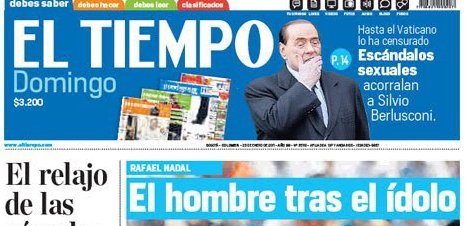
An El Tiempo headline reports about Italian media mogul Silvio Berlusconi. 

Colombia's richest man has purchased Colombia's most important newspaper.

That's good news for those of us who want newspapers to survive in the digital age, but potentially worrisome for those who want them to be independent critics of the powers that be.

Five years ago, some observers worried about how the conservative Spanish-based Planeta media group would change El Tiempo when it purchased the paper in 2007 from the Santos family, its historic owners. But El Tiempo, founded in 1911, has continued covering government scandals and editorializing in favor of drug decriminalization.

Luis Carlos Sarmiento
Now Planeta has sold Colombia's leading paper - perhaps to shore up its books amidst Spain's ongoing economic crisis - to Luis Carlos Sarmiento, Colombia's richest man. El Tiempo did not turn out to be a bad investment for Planeta - El Colombiano reports that Planeta sold its majority share in the paper for $100 million more than it paid. Now, how will El Tiempo cover industries in which Sarmiento holds interests, such as real estate, banking and agriculture, infrastructure, hotels, mining and innumerable other areas?

For a business magnate, a newspaper is much more than a simple investment. It's also a political and economic tool for influencing public opinion and furthering his interests. It's also a sort of a trophy, demonstrating the man's importance. Perhaps Sarmiento, the world's 64th-richest person with a fortune of more than $12 billion, according to Forbes, didn't want to be overshadowed by the Santo Domingo family, which owns El Espectador, Bogotá's other major daily. So, personal honor will hopefully motivate Sarmiento to maintain the paper's reputation in order to protect his own reputation. At age 79, Sarmiento is no youngster and has to be thinking about his own legacy.

El Tiempo amidst Bogotá's colorful press. 
In her El Tiempo opinion column Maria Isabel Rueda argues that the billionare Santo Domingo family, owners of the Bavaria beer company and other industries, has maintained El Espectador's journalistic tradition. I have seen good recent journalism in El Espectador, but also lots of fluff, like headline stories about the IPhone's arrival in Colombia. And, has El Espectador ever investigated, for example, the beer industry?

El Tiempo, of course, has never been free from potential conflicts of interests. Its historic owners, the Santos family, have produced several vice presidents and presidents, including Juan Manuel Santos (and family members continue owning a minority stake in the paper). And some El Tiempo critics have pointed to drug lord Pablo Escobar's bombing of El Espectador's building and his assassination of its editor Guillermo Cano as evidence that El Tiempo was intimidated by the drug cartels' threats.

Sarmiento's intentions sound good. In an interview with El Colombiano, he emphasized newspapers' vital role in a democracy. "They come out every day, watching, criticizing problems, suggesting improvements, trying to fix problems," Sarmiento said.

El Tiempo's historic building on Jimenez Ave. and Carrera 7.
The paper's new headquarters on 26th St. is on
valuable real estate. 
The newspaper industry has suffered severely in recent years, hit particularly hard by the Internet, which has sucked away much of papers' advertising. Some major U.S. newspapers have folded, while others are near bankruptcy. Acquaintances at El Tiempo have told me of lay-offs there, too. But despite all of this, most reporting is still done by newspapers.

By buying El Tiempo, Sarmiento also gets a prime piece of real estate in west Bogotá, television stations and a leading spot in the competition for rights to a third national television network to compete with RCN and Caracol.

Whatever the dangers and advantages of magnates owning media, we'd better get used to it. In the Internet age, with traditional media wobbling, only deep pockets may enable them to survive at all.


By Mike Ceaser, of Bogotá Bike Tours

Friday, June 3, 2011

Cartier in Colombia, and What it Means

The Cartier Woman - Coming to Colombia?
Cartier, the luxury French jewelry store chain, is expanding its Bogotá store, making it its biggest in South America (at least until a new Brazil store beats it out).

Of course that's great news, and not only for those of us who trade in our diamond-studded watches every month: it'll also mean a few more jobs and more taxes paid, which hopefully will finance schools, parks and hospitals for those who don't shop at Cartier.

Not yet in the Cartier club: sock vendors on San Agustin Plaza. One told me that she earns about $6 on a good day.
But this symbol of luxury and pretention also says something about the chronic troubles of Colombia, which has a poverty rate close to 50% and an extreme poverty rate of 20-something percent. Those numbers are much worse in the countryside, where the poverty is between 60 and 70% and among the indigenous and Afro-Colombian minorities.

The violent and impoverished San Agustin
neighborhood in central Bogotá.
Colombia has one of the most unequal income distributions not only in South America, but the world, according to the GINI coefficient, which measures such things. The lower a country's GINI number, the more equal its society. Sweden, where things work well, scored a GINI of 25 for the years between 2000 and 2007. The United States, amidst the Bush tax cuts for the rich, scored 41. Uruguay scored 46, Brazil 55 and Colombia 58.5.

I couldn't find more specific data for Colombia, but here's a yardstick: in Sweden the 20% wealthiest people control 36% of the wealth. In the U.S., the richest 20% control about 84%. In Colombia, that number must be above 90%, leaving less than 10% of the wealth for the other 80% of Colombians. And for the poorest 20%, the numbers must be even more appalling: In the U.S., the poorest 20% control only 0.1% of wealth. It's hard to imagine an even more unjust wealth distribution, but Colombia has it.

Opulence among poverty is ugly and unjust. But, according to recent research, economic inequality degrades societies in many ways, including ones you'd never suspect. As inequality grows, social problems including drug abuse, obesity, mental health, imprisonment, social mobility, violence and teenage pregnancies all get worse, according to the 2009 book The Spirit Level.

Worlds Apart: A slum climbs up he hill beside Los Andes University's newest building, left, named after billionare  Julio Mario Santo Domingo. 

With lots of inequality and poor social mobility, those at the bottom feel they have no chance to take part in the country's riches and their frustration grows. That's true in Colombia, where the same families have dominated business and politics - and appear likely to continue doing so. I read that the lion's share of Colombia's business leaders come from Los Andes University. I don't think that's because Los Andes is so much better than other universities, or its students any smarter. But the children of elite families who study there network and then get each other onto the boards of directors.

The Santos watch. Satin and sapphire
crystals for not much over $4,000.
Luxury is now within everyone's  reach!
Of course, we can feel better knowing that Cartier jewelry is actually in every person's reach. A Cartier executive pointed out in an interview that their watches and jewelry start at an affordable $800 - just several times the Colombian minimum wage.

"People start there and then move to the high-price items," he said.

Start saving up!

On the other hand, what use is a $4,000 watch, especially in Colombia, where taking out a cellphone in public can be dangerous? Certainly not for wearing on the street, where it won't last long, or for wearing at home in the mansion, which is full of clocks and where everybody knows you're rich, anyway.

A $4,000 watch is for showing off and glancing at conspicuously and repeatedly at ritzy events with other important people.

Things like this only perpetuate and intensify the isolation of the wealthy from the rest of Colombians by giving them another reason to hide from the masses who get by without such basic necessities as Cartier watches and jewels.

What can Colombia do to address this social chasm? One thing is tax the hell out of luxuries, and use them to create quality common spaces and resources for all Colombians, such as parks, hospitals and schools.

By Mike Ceaser, of Bogotá Bike Tours