|
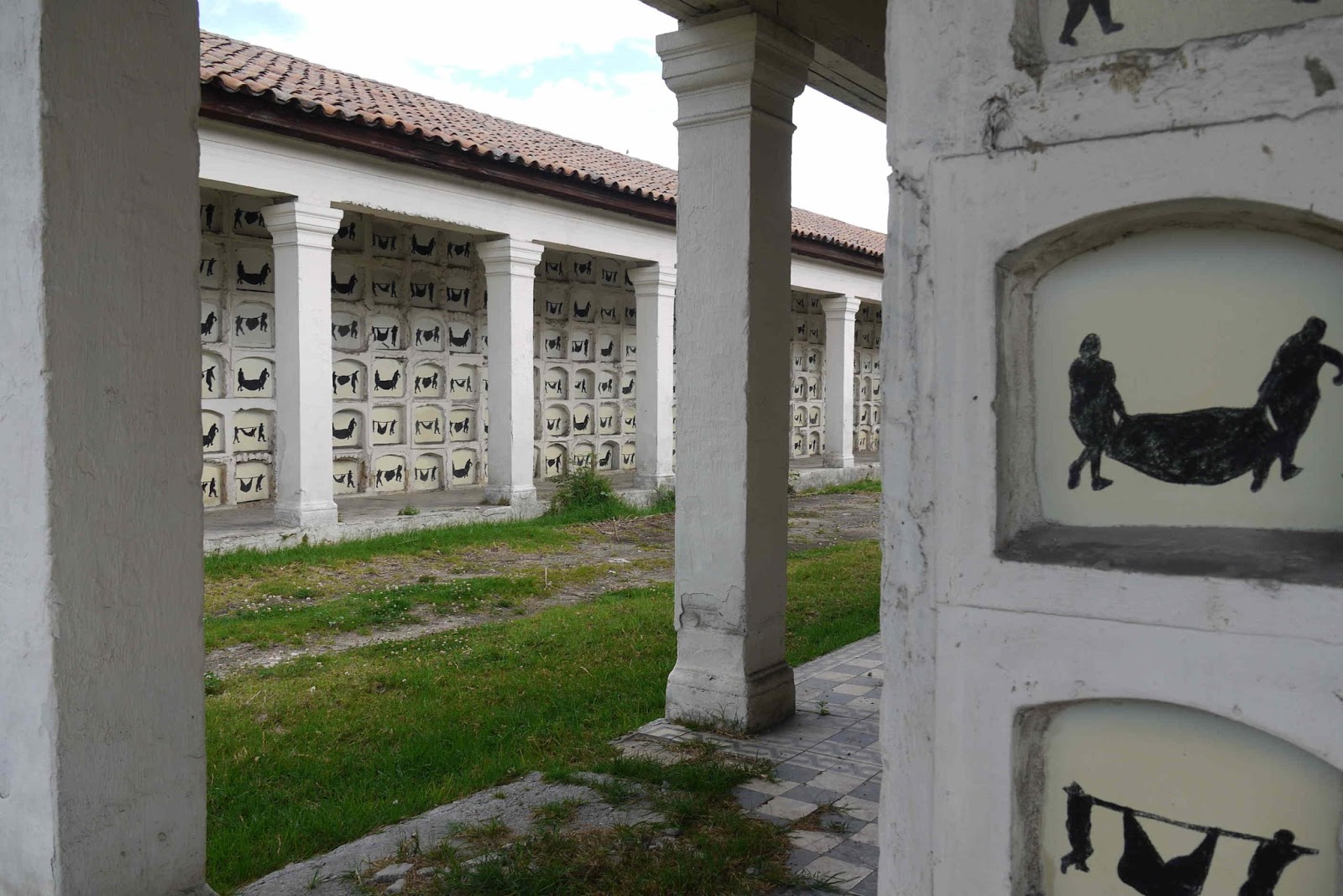
| The new Centro Memoria, with its reflecting pool. In the background are now-empty mausoleums, once part of the Central Cemetery. |

The recently opened
Centro Memoria, just off of 26th St. near the Central Cemetery, is heavy with symbolism of Colombia's long, tragic domestic conflicts: the somber building, whose design suggests a headstone; the building's walls, embedded with vials of earth representing tens of thousands of victims of the conflict; and the very location of the Centro, in Bogotá's Central Cemetery.
A visitor to the center can obtain a general understanding of Colombia's long, tragic and often senseless internal conflicts (as long as that visitor knows Spanish). But the displays - texts, photos and a video - don't rise much above high school level and do nothing to bring the conflict's tragedy home to visitors, much less bringing it to life.
 |
An exhibit about the history of Colombia's
guerrilla groups looks like it could have come from a
high school textbook...and perhaps did. |
The Centro's very limited exhibitions consist of panels with texts and photos and a short film providing a summary of Colombia's violent history and the actors involved. It's interesting - I learned things - but this is what kids are supposed to learn in high school and tourists could find on Wikipedia. The Centro Memoria should provide something additional and different. (On the positive side, an employee told me that the exhibitions will be expanded and change every few months.)
The Centro Memoria could fill in a gap in Bogotá's cultural and educational offerings. But I found myself wishing that its exhibits were more dynamic, more interactive.
How about victims' testimonies about their experience, both written and on video?
 |
An exhibit about the paramilitary demobilization points
out that only a tiny number of paramilitary fighters have
been prosecuted judicially, despite their horrific crimes. |
How about asking visitors what they would do if confronted by some of the horrific situations produced by Colombia's conflict.
What if guerrillas threaten to take away your children and turn them into child fighters? Do you abandon your town or farm for refuge in the city?
How about if paramilitaries threaten your family unless you denounce your neighbors as guerrilla sympathizers?
What if you're a soldier whose unit is expected to murder civilians to inflate guerrilla kill numbers? Do you cooperate or risk your own life and career by opposing your comrades?
 |
| The video: 'From Gaitan to La Havana.' |
If you live in a town where paramilitary death squads are performing 'social cleansing' by hunting down and killing prostitutes, drug addicts and small-time criminals, do you keep quiet?
What if you're a small farmer ordered by a cartel to plant drug crops? Those sorts of terrible decisions have contronted thousands or even millions of Colombians, and could bring home the drama of the nation's conflict.
 |
| Dictator Gustavo Rojas Pinilla in a scene from the video. |
And how about asking visitors to consider some of the big questions facing Colombia in its negotiating with the FARC guerrillas in Havana Cuba? How should guerrilla leaders be punished for their numerous crimes? Or, should Colombia give in to their demands for particularly the punishment - or lack of same - to be given to the guerrillas. Is political representation for the FARC too high a price to pay for representation in Congress, as a necessary price for ending a half-century of killing, kidnapping and forced displacement?
 |
The 1954 massacre of
university students by the
Rojas Pinilla regime. |
Neither did I see an examination of the roots of Colombia's violence: the drug trade and unequal distribution of land and wealth, which continues today. The illegal drug trade, which made 'Colombia' shorthand for violence during the 1980s and '90s and continues financing Colombia's outlawed organizations today. Would legalizing drugs, as Pres. Santos has suggested, deprive Colombia's violent groups of their fuel?
 |
Old radios on a wall. I don't know what
these were doing there. |
Colombia's current conflict involving leftist guerrillas, right-wing paramilitaries and drug cartels is only the most recent chapter in its domestic conflicts. Before that was the politically-driven La Violencia. Before that, other guerrillas and terrible civil wars.
 |
A display details the number of
people killed and displaced
by the conflict. |
Certainly, the Centro Memoria is primarily a research organization. It participated in a
recent report which documented hundreds of thousands of killed and millions displaced during recent decades of Colombia's conflict. But those studies will be read mostly by academics and NGO officials. The Centro Memoria provides an opportunity to tell the tragic story to a different audience, of students, tourists and casual visitors. But to do that well will require more dynanism and immediacy.
In fact, I was struck to find a bunch of colorful mobile exhibits about political activists assassinated in Bogotá left outdoors to be damaged by the wind and rain.
 |
Capsules of soil imbedded
in the walls represent victims
of the conflict. |
As a sideline, it'd also be nice to have an exhibition about the archeological research done during the building's construction. Students from the National Unniversity excavated human remains and found evidence of witchcraft and other occult burial practices, as well as Bogotanos' lives during decades past. They did not, however, find remains of victims of El Bogotazo, the huge riots triggered by the April 1948 assassination of populist leader Jorge Eliecer Gaitan in downtown Bogotá, when thousands were killed. Photos show bodies piled up in the Central Cemetery, and historians have long believed that victims were interred in mass graves on this block to the cemetery's west. Gaitan's assassination intensified a violent conflict between the Liberal and Conservative political parties known as La Violencia, which killed hundreds of thousands of people during the following decade.
The
Centro Memoria is located just off of Calle 26, just west of the Cementerio Central. It opens every day except Sunday and is just a
short walk from from the TransMilenio station of the same name.
 |
| An 'Act of thanksgiving' from the faithful. A candelabra in a wall from the land's time as part of the cemetery. |
 |
| The center's land includes this large, wooded field. What use will they give it? |
 |
| These mobile exhibits about political activists and leaders assasinated in Bogotá have been left outside to be damaged by the sun and wind. |
 |
| The Centro has two parking lots for cars, one of them underground, but no bicycle parking. |
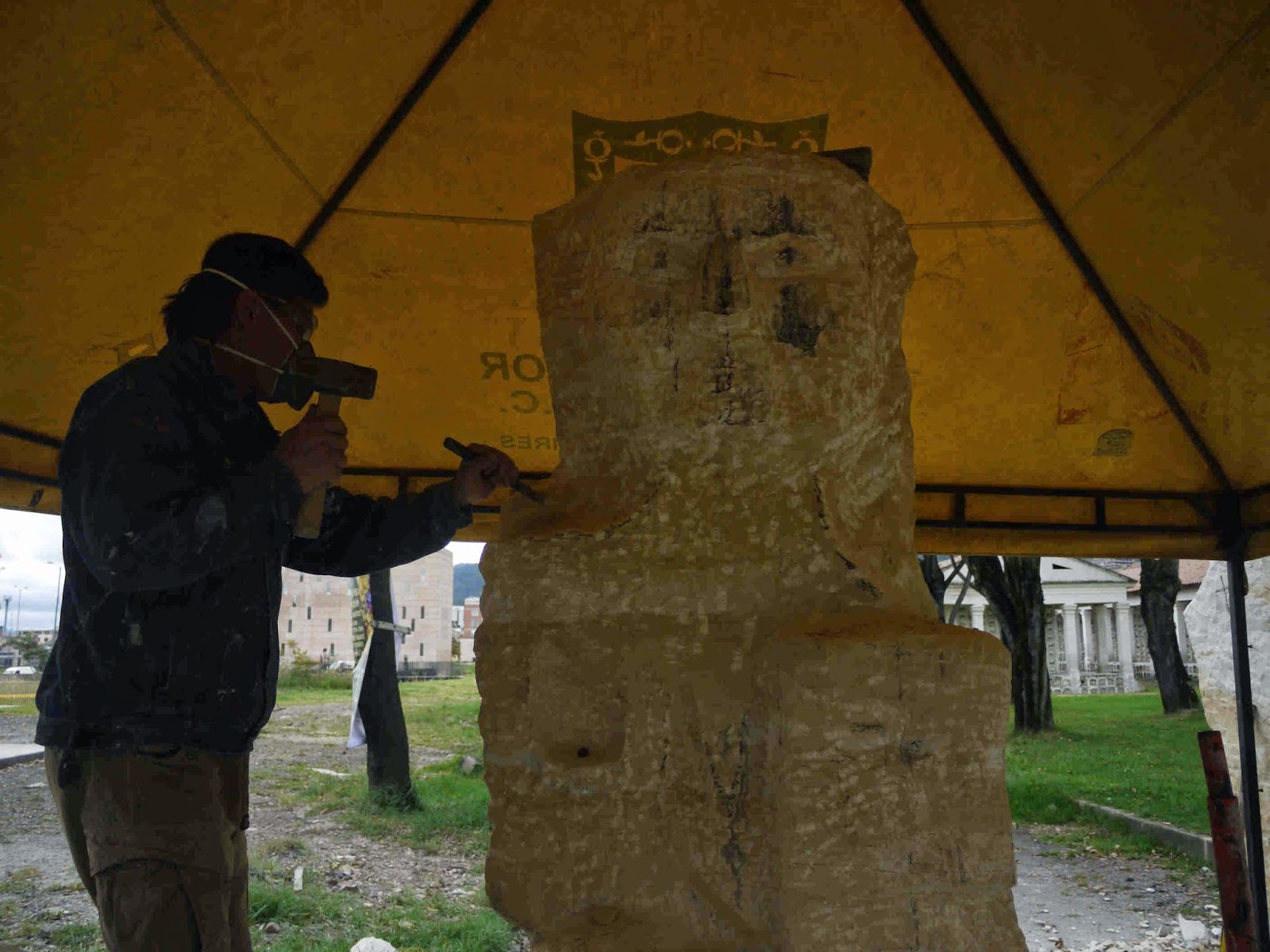
Images of the now-empty mausoleums, once part of the Central Cemetery. A pair of artists stenciled images of dead being carried on stretchers, representing victims of Colombia's conflict. It was a huge project - there are some 9,000 tombs.
 |
| Empty tombs. |
By Mike Ceaser, of
Bogotá Bike Tours

 Bogotá is vacant these days (except for tourists), its streets empty, schools and shops closed and many homes unoccupied. The wealthy and middle classes have mostly cleared out to the coast or their countryside fincas.






 Posts
Posts