Showing posts with label immigration. Show all posts

Thursday, April 12, 2018

Counting the Venezuelans

Venezuelans wait in La Candelaria to register with a government office.
By some estimates, more than a million Venezuelans have fled into Colombia over the past several
years, fleeing their own nation's hyperinflation, sinking economy, soaring crime rates and empty stores and pharmacies.

Colombia has been remarkably accepting, perhaps because in past decades Venezuela received innumerable Colombians fleeing the violence here, and because many of the Venezuelans crossing the border are children or grandchildren of Colombians who fled into Venezuela.

Now, Colombia wants the Venezuelan immigrants to formulize their status here by registering.

A money-transfer place in Bogotá's red light district

Waiting to transfer money to Venezuela.
Remarkably, there's been little public resentment against the Venezuelans, except for some concern about crime and grumbling by low-income workers and prostitutes that the Venezuelans are taking away jobs. But fortunately so far in the congressional and presidential campaigns, no populist candidate has seized on the Venezuelans to get votes.

By Mike Ceaser, of Bogotá Bike Tours

Thursday, October 12, 2017

The Venezuelans are Coming, and Coming

Two young men from Venezuela sell arepas on Plaza San Victorino recently.
The two employees in a stir fry place here in La Candelaria came recently from Venezuela, where one was an attorney and the other had some small businesses. A street musician whom I knew more than a dozen years ago in Caracas just showed up in La Candelaria. The other night, I was accosted by two young Venezuelan women selling arepas venezolanas. Apparently desperate, one of them placed her hand fondly on my shoulder just a few minutes after we'd met.

A Venezuelan man and boy ask for money - supposedly for
other Venezuelans - near Bogotá's Plaza Bolivar.
Colombia, which for decades sent millions of its people overseas, is now being inundated by immigrants from oil-rich Venezuela - which until not long ago was the economic envy of the rest of the continent.

The reasons are obvious: Venezuela's incompetent, increasingly authoritarian government, has caused the economy to contract nearly 20% and inflation of almost 800%, numbers usually seen only in wartime.

The Caracas Chronicles website calculates that more than 70,000 Venezuelans have come to Colombia - but nobody knows for sure, since many undoubtedly cross the border illegaly.

Venezuelans are a godsend for this year's bumper coffee crop, which is short of pickers. And I suspect that they're also helping collect Colombia's record crop of coca leaves.

According to this graph from the Caracas Chronicles blog,
the number of Venezuelans fleeing their nation far exceeds the
number of refugees crossing the Meditarrean to Europe.
The wave of foreigners has inevitably generated tensions. The two young arepa sellers talked about minor confrontations on the bus, and said that street merchants insulted and harrassed them. Undoubtedly, low income Colombians feel threatened by the wave of cheap labor. Even Colombian prostitutes have complained that Venezuelans are invading their industry, offering services at cut-rated prices.

What will happen? Venezuelan Pres. Nicolas Maduro seems determined to continue his disastrous economic policies, and shows no sign of sharing power with the oppisition. So, Venezuela will likely continue its economic tailspin, and possibly end up in some sort of civil war.

Expect the Venezuelans to keep coming.

Many thousands of Venezuelans pack Bogotá's Plaza Bolivar
during a recent vote arranged by that country's
opposition parties.
Update: A young Venezuelan woman waiting tables in a restaurant around the corner described to me a series of crimes in her country, including one when assailants threatened to shoot her dog unless she handed over valuables. She has two college degrees and back in Caracas worked in media production. Economically, she was getting by, but the crime epidemic terrified her. Via Whatsapp, she just learned that some 20 people in her community had been kidnapped in recent weeks. Those are 'express kidnappings,' in which the victim is taken to some poor neighborhood and held there until relatives deliver the ransom in euros, dollars or gold.

"The kidnappers won't accept bolivars," the fast-devaluing local currency, she added.

"The social decomposition has been terrible and really fast," she says, adding that "everybody's just out for money."
According to one poll published by the Caracas Chronicles
website, the great majority of Venezuelans
want to leave their country.

Yet, she actually seems to sympathise with the criminals. "When your salary is only enough to buy some bread and milk, how can you blame them," for being so desperate? she asks.

She's also sure that the government committed fraud to win majorities in most states in recent regional voting. After all, "who would vote for a government that's keeping you hungry?"

In fact, the Caracas Chronicles blog has published documents they say demonstrate pro-government fraud in the vote.


By Mike Ceaser, of Bogotá Bike Tours

Friday, September 29, 2017

Visa Blues

Sad and slow: Visa services row beside the U.S. Embassy.
Went to the U.S. Embassy the other week to get a new passport, and the folks there who offer support services for U.S. visa seekers are suffering.

Fewer than before: Visa seekers and their friends and
relatives wait outside the embassy.
The kid who took my passport photo pointed to the mostly empty space in front of his shop. Last year, that was full of visa applicants and their relatives, he said, sadly.

"That man has got us like this," he said, sticking his forefinger into his own neck.

Not difficult guessing who 'that man' is.

Coincidentally, I've read that U.S. tourism and applications by foreign students are down, too.

I'm in the San Francisco Bay Area right now, where the Internet economy is booming. Seems like every other shop and restaurant has a 'help wanted' sign: but Trump's stricter immigration laws are keeping out the immigrants who want to do those jobs, harming the economy.

By Mike Ceaser, of Bogotá Bike Tours

Thursday, January 30, 2014

The Legacy of Leopoldo Rother


The National University's Fine Arts building is characteristic of the simple, block-style arhictecture employed by Rother.

German-Colombian architect Leopoldo Rother would turn 120 this August, and likely be disappointed at the sad state of many of his Colombian works. 

Born in 1894 in Breslau, Germany, now part of Poland, Rother designed governmental and athletic buildings in Germany. But the ascent of Hitler forced Rother and his family to flee because of their Jewish heritage. 

In 1936, Rother immigrated to Colombia, where he quickly obtained work designing public buildings and teaching at the National University. He designed the Edificio Nacional in Barranquilla and the Eduardo Santos Stadium in Santa Marta.

But Rother's best-known work is likely the Universidad Nacional's Bogotá campus. Rother designed the 121-hectare campus as an oval, with ring roads circling its periphery. The campus is so large that it is formally known as the University City. (The 'Nacho' was founded in 1867, but its buildings were scattered throughout Bogotá. The Ciudad Universitaria became Colombia's first university campus.) The buildings are block-shaped and unadorned, a style which he apparently adopted from a 1932 modern arquitecture exposition in New York's Museum of Modern Art. Today, the buildings can seem a bit boring and monotonous. And the government has allowed many to decay, a situation which has triggerred student protests. 

In his later years, Rother taught architecture at the Universidad Nacional and did designs for Colombia's public works department. In 1977, he was awarded the Cruz de Boyaca and died the following year in Bogotá.

On the National Univesity's campus, the architecture department's museum is named after Rother. The museum recently held an exhibition about his life and works.
A 1930s map of the National University's campus, showing its oval design. 
The National University's engineering building, designed by Rother and now under repair. 
A crumbling building on the National University campus.
The National University's Bogotá campus's newest building, which breaks the campus's block pattern, and has won recognition for its design. 
The Edificio Nacional in Barranquilla, designed by Rother. (Image: Wikipedia)

Eduardo Santos Stadium, in Santa Marta, designed by Leopoldo Rother (Image: Hoy Diario de Magdalena)

By Mike Ceaser, of Bogotá Bike Tours

Tuesday, January 21, 2014

The Helvetic Expedition and the Swiss in Colombia

Otto Fuhrmann and Eugene Mayor on expedition. 
In 1910, two Swiss scientists set off into what must to them have seemed one of the wildest and remote corners of the globe: the hinterland of Colombia.

From the expedition, sketches of a
Colombian fungus. 
The expedition lasted only five months, and the organisms the men studied - primarily fungus and other parasites - weren't particularly glamorous. But the expedition helped map out Colombia's tremendous biological diversity and created links between two very distand and different nations.

The Biblioteca Luis Angel Arango (BLAA) has an exhibition about the expedition as well as the Swiss presence in Colombia until the end of January.

'Voyage of Scientific Exploration in Colombia' by Fuhrmann and Mayor, published in 1914. Their trip also produced more than 30 scientific papers.
The two scientists, Otto Fuhrmann and Eugene Mayor, who hailed from the same university in the city of Neuchâtel, might have aborted their expedition before
they started when they discovered the ship they had boarded from Europe also carried 900 boxes of dynamite for Colombian gold mines. Fortunately, it was too late to abandon the ship, and the pair continued on to Colombia, where they landed at Barranquilla and proceeded up the Magdalen River and then proceeded on horse and mule back and by foot. Their work identified 1,279 species of plants and 647 animal species, more than 300 of which were new to science.
Scientist and expeditionist Eugene Mayor at work. 

Other prominent Swiss-Colombians include Ernst Röthlisberger, a history and philosophy professor who worked for the National University from 1881 to 1885 and would later write letters of recommendation for the expeditioners. If I understand correctly, Röthlisberger was the first person to climb one of the peaks of the Cocuy range.

But the first recorded Swiss citizen in what's now Colombia was the priest Jean Magnia, who came here in the 1720s on an evangelical mission.

The Colegio Helvetia, designed by
Swiss-Colombian architect
Viktor Schmid.
Probably the most famous Swiss-born person to play a role in Colombian history was the Swiss born architect Le Corbusier, altho he is more associated with France, where he lived and worked most of his life. Le Corbusier visited Bogotá in 1947 and drew up grand plans which would have meant flattening much of central Bogotá and replacing it with districts for residences, industry, recreation and others, but which fortunately were never carried out. Le Corbusier's ideas were incorporated into Ave. Caracas, which he envisioned as a shady, tree-lined avenue for families to stroll along. It hasn't turned out that way, altho the trees are still there. Rogelio Salmona, who emigrated from France to Colombia, where he became Colombia's most famous architect, studied with Le Corbusier after World War II.
Ernst Röthlisberger in old age. 

Another Swiss-Colombian architect was Viktor Schmid, who emigrated to Colombia in 1939 and settled in Bogotá, where he designed more than 100 buildings, including the Colegio Helvetia. Schmid is apparently the same Victor Smith, described in this El Tiempo article, who studied in Germany and fled the Nazis. Today, his son Urs is trying to preserve his father's works, many of which are falling into ruin.

Today, the 'Swiss community' in Colombia consists of more than 2,400 people, most of whom live in Bogotá. The Colegio Helvetia, which teaches in Spanish, French and German, is the world's largest Swiss high school outside of Switzerland, according to the BLAA's exhibition.

The La Candelaria building on Calle 11 in the
neighborhood of the same name, designed by Viktor Schmid.
"How small and montonous our own forests appear in relation to these immense, virgin jungles which cover the whole Magdalena Valley and which die at the river's edge!" Mayor and Fuhrman.

The Expedition might be almost forgotten today, but for the work of Alberto Gómez Gutiérrez, a graduate of the Colegio Helvetia, and Michel Schlup, a one-time teacher there, who located the Swiss expeditionaries' Memoires in a library in Neuchâtel and translated and published the work.

Inauguration of the clock in the Parque Nacional
donated by Bogotá's Swiss community in 1938.
The Swiss-donated clock in the Parque Nacional today.
Despite a restoration and repair in 1908, it doesn't work. 

In 1922, the Swiss helped Colombia and Venezuela resolve a border dispute. 
Ave. Caracas's design was inspired by Le Corbusier. But is isn't the pedestrian way which the Swiss-French architect envisioned.

The Swiss-Colombia Friendship Treaty, signed in 1908. In 2011, the two nations signed a free trade agreement. 
'The Golden On.' On the right, a long-ago view of the Plaza del Chorro de Quevedo.
Preserved fern leaves. 
A Swiss engineer designed both the funicular and
the cable car to Monserrate. 
A cable car climbs up toward Monserrate church.
Joseph Eberhard (which one is he?), who visited Colombia's indigenous people and collected plant samples and indigenous remedies for study back home. 
The route of Otto Fuhrmann and Eugene Mayor thru Colombia. 
On the road between Medellin and Igaguí.

In Antioquia. 
By Mike Ceaser, of Bogotá Bike Tours

Saturday, December 22, 2012

Immigrant Art in La Candelaria


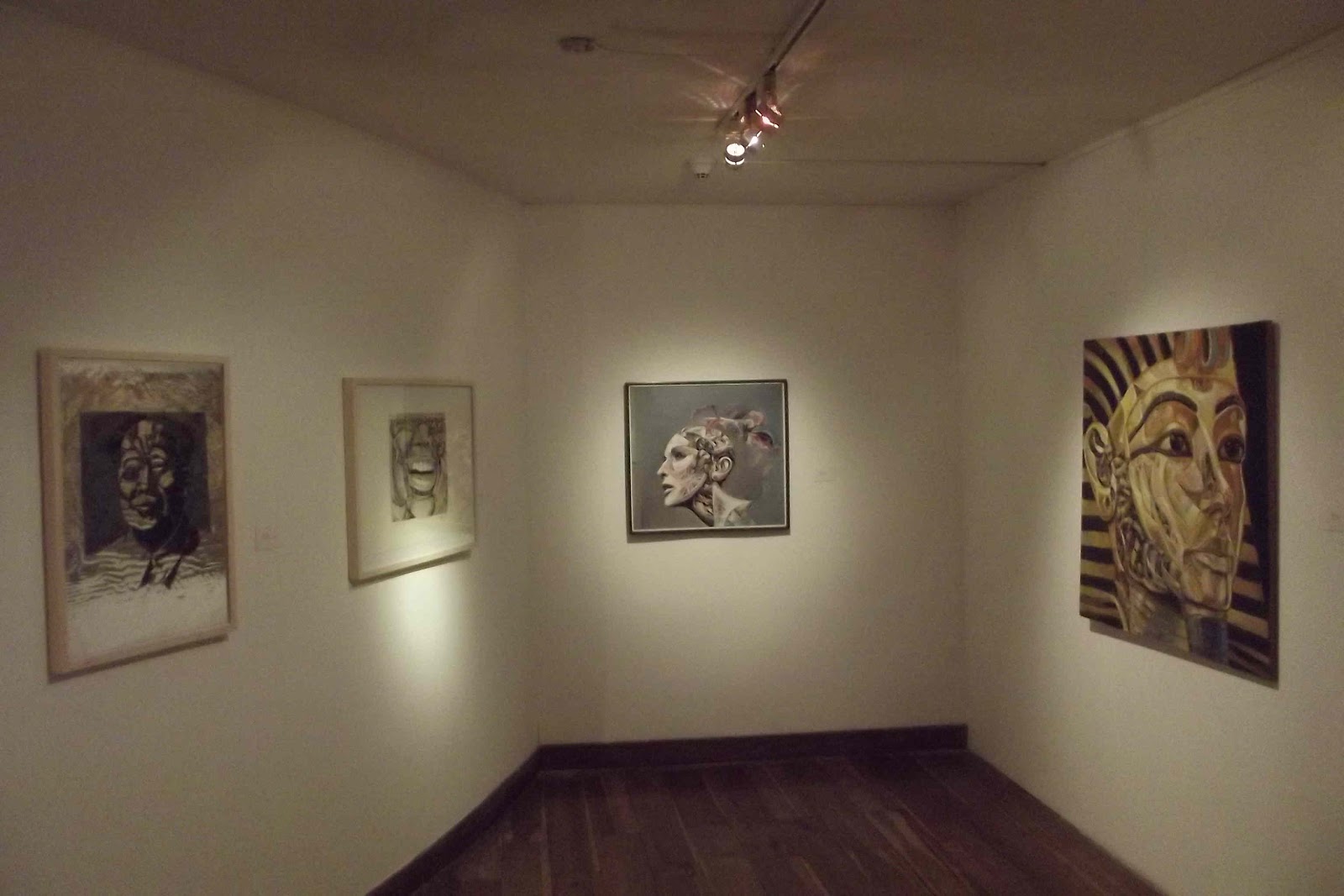
The Fundacion Gilberto Alzate Avendaño has this exhibit of works by immigrant artists in Colombia. I'm no great fan of modern art, but I found many of these works interesting. They made me think a bit. Others are just entertaining.


A double doll by Jan Bartelsman,
born in Holland in 1916.

Why don't today's modern artists make art the way they used to?


The artists in the exhibition include:

Nijole Sivickas, born in 1930 in Lithuania.
Jim Amaral, born in 1933 in the United States.
Arthur Tashko, born in 1901 in Albania.
Maria Thereza Negreiros, born in Brazil in 1930.
Jan Bartelsman, born in Holland in 1916.
Umberto Giangrandi, born in Italy in 1943.
Ned Truss, born in the United States in 1939.
Juan Antonio Roda, born in Spain in 1921.

A nice colorful painting by Arthur Tashko of Albania.

Armando Villegas, born in Peru in 1928.
Freda Sargent, born in England in 1928.
Ramon Barba, born in Spain in 1892.


Hand and breast merge in a work by Jim Amaral of the United States.


A dark and stormy night at sea, perhaps by Jan Bartelsman, from Holland.

A female doll in space Umberto Giangrandi, born in Italy in 1943.
By Italian Umberto Giangrandi.


'Homage to the Fallen Student,' by Umberto Giangrandi, born in Italy in 1943.


By Mike Ceaser, of Bogotá Bike Tours