Showing posts with label parque nacional. Show all posts

Monday, May 14, 2018

A Makeover for Rita

Cyclists observe Rita in the Parque Nacional.
The long-suffering Rita's
graffitied torso.
Rita, 5:30 p.m., the sculpture by Enrique Grau on Carrera Septina in Bogotá's Parque Nacional has become something of an unlikely urban landmark. Standing at the entrance to one of the city's most popular parks, right beside its largest Catholic university, Rita is a prostitute.

Installed in the park in 2002, over the years, Rita has suffered for reasons more related to her location than her profession. Offering large iron plates on one of the city's primary thoroughfares, this Rita tempts not sexually frustrated males, but passersby in search of self expression, often without the redeeming qualities of artistic ability. Poor Rita has become defaced by graffiti and tagging. Soon, Bogotá plans to clean and renovate Rita.

Besides urban neglect and adolescent misbehavior, Rita's condition could also
A poster on a wall in the Santa Fe neighborhood's
red light district says 'Rejection.'
be interpreted as a representation of abuse against women, always a timely issue in Bogotá. And news of her repairs comes at a time when policies about sex work, which is legal in designated 'tolerance zones,' are once again under discussion in the wake of the sexual abuse of a 3-year-old girl taken from an informal day care center located in Bogotá's Santa Fe tolerance zone.

Whether she is honoring prostitution or warning against it, Rita's renovation won't come cheap: 27 million pesos, or about US $1,000 dollars, according to El Tiempo.

Still, it might be worthwhile, if not for the fact that Rita will get graffitied again soon after.

By Mike Ceaser, of Bogotá Bike Tours

Sunday, May 31, 2015

Remembering Rosa Elvira Cely

Participants in today's ceremony carry a sign about another victim of gender violence. 
Almost exactly three years ago, Rosa Elvira Cely, a 35-year-old cafeteria employee was savagely raped and left to die in the upper part of Bogotá's Parque Nacional. Discovered unconscious by police the next morning, Cely died while awaiting treatment after being shuttled from one hospital to another.

The viciousness of the crime and senselessness of Cely's death has made the crime an emblematic one for activists against violence against women, who staged a commemorative ceremony today on the site of the crime.

Despite publicity campaigns and stricter punishments - Cely's attacker, who was mentally ill, was sentenced to almost 50 years in prison - violence against women continues to be an epidemic in Colombia. A recent report by the Defensoria del Pueblo said there were 38 cases of such violence per day in Colombia - and those are only the cases reported and recorded publicly. Congress has two laws pending on the issue, one of which would make femicide a specific crime, and another increasing penalties for acid attacks.


By Mike Ceaser, of Bogotá Bike Tours

Sunday, May 17, 2015

Cosplay in the Parque Nacional

Who are these guys?
Today, these folks were showing off their costumes, of Star Wars, Dr. Who, Sailor Moon and other stuff which I either couldn't identify or understand, probably because of generational issues and my lack of a television.


Straight out of Dr. Who.
Dragon Ball???


Gladiators!

No lack of photographers. 


We are Sailor Moon. 
Star Wars is back!
Who is this guy?
By Mike Ceaser, of Bogotá Bike Tours

Sunday, November 16, 2014

The Banana Massacre on Stage in the Parque Nacional


The 1928 banana workers massacre became a landmark event in Colombian history after Gabriel Garcia Marquez made it a key episode in his Nobel prize-winning novel 'One Hundred Years of Solitude'. 

This theater troupe, performing around mid-day in the Parque Nacional, didn't employ much subtlety in portraying the hardships of the banana workers, employed by the United Fruit Company (now Chiquita). Banana prices had declined, causing a drop in pay and benefits. Workers went on strike and the military arrived to back the U.S. company. With union leaders gathered in the plaza of the town of Ciénaga, near Santa Marta, in Magdalena Department, the soldiers started firing machine guns placed on roofs of buildings on all four corners of the plaza. Estimates of the number killed range from a few hundred to thousands of unionists. Afterwards, the corpses were loaded onto the trains used to ship fruit to the coast and dumped into the ocean. 

Some believe that the Colombian military acted because they feared that if they did not, then U.S. Navy ships waiting off the coast would invade. The U.S. Embassy at the time knew about the massacre, and reported it to Washington, but kept quiet publicly.  

The massacre brought fame to then-Senator Jorge Eliecer Gaitán, who made fiery speeches in Congress demanding punishment for the killers. But that didn't happen.

Today's performance portrayed the hungry workers with empty milk cans and starving infants. Death, with a skull head, pursued the workers and even chased Gaitán. Actors waved black and red flags, suggesting anarchism. Workers and Gaitán waved flags and yelled in protest. But a businessman denounced the workers as troublemakers who deserved repression.

For liberty! - if Death does not catch Gaitán.
Our poor starving babies!
The businessman, in grey on left, denounces the protesting workers as troublemakers who deserved what happened to them. 

Death victorious!


Shining shoes.
Forward!


Who will fill our empty milk cans?


On a different note, a homage to the disappeared.
By Mike Ceaser, of Bogotá Bike Tours

Monday, October 13, 2014

Theatre in the National Park


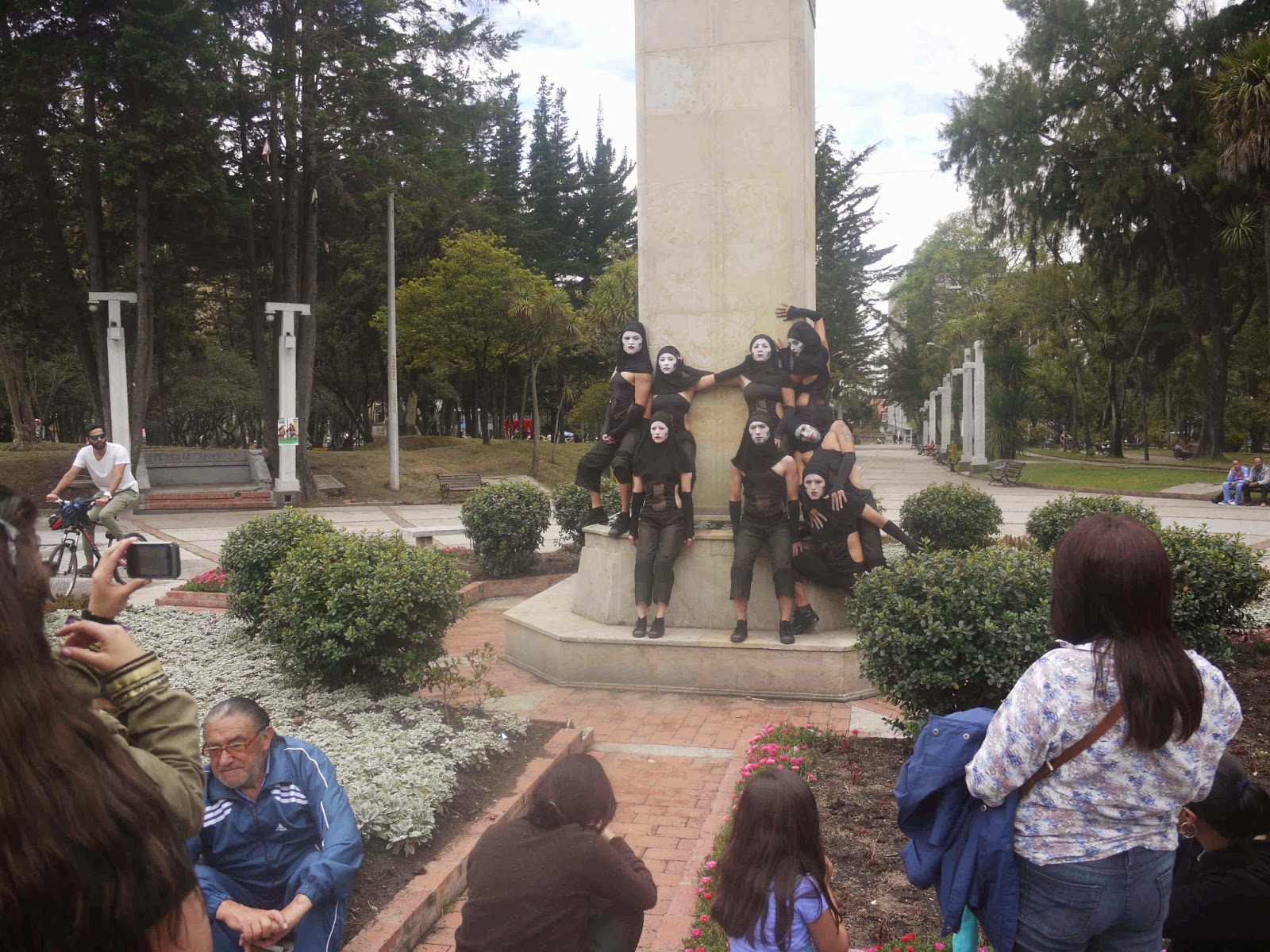
A theatre troupe - whose name I never learned - carried out this piece of performance art - whose name I never learned - today in the Parque Nacional. The sort of stark, haunting costumes and acting (completely silent) suggested to me that the performance was about violence and human rights violations - common themes in Colombian alternative art.


By Mike Ceaser, of Bogotá Bike Tours